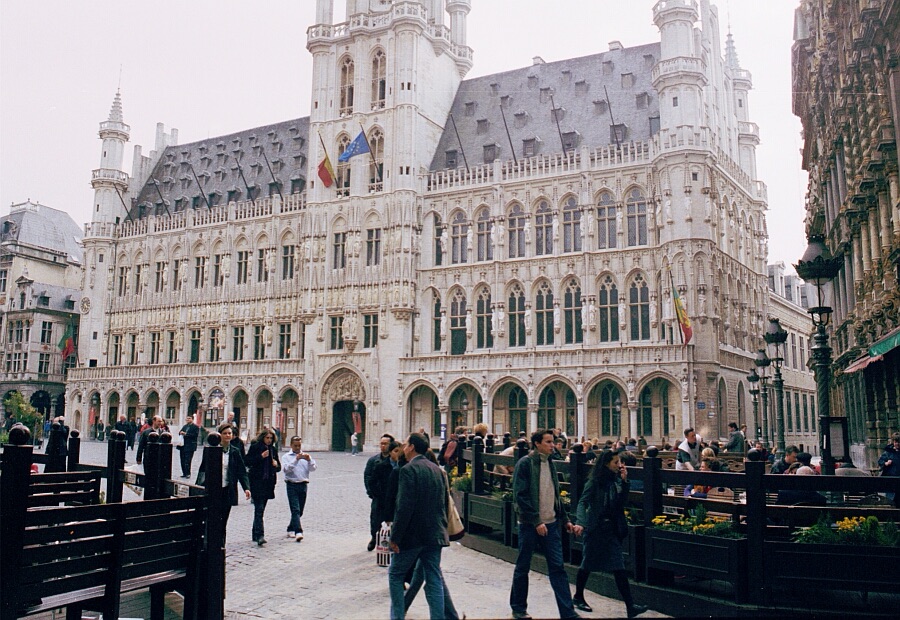
Hiya! Yup, I’m back from my weekend in Brussels – I had a great time.
Friday
We set off very early – the train we were talking was a 6am train out of York. The journey down was okay – since it was still early it wasn’t busy, though once we got to King’s Cross it was a bit of a hustle getting onto the Tube since it was rush hour. Handily there was a sign that gave a suggested route to London Waterloo – we would have taken the Victoria to Euston and then the Northern to Waterloo, but actually it recommended the Victoria to Oxford Circus and then the Bakerloo, since there were no stairs or escalators to climb to change platforms. And when you’re carrying heavy cases, it sure is useful.
We arrived at Waterloo much earlier than anticipated – we actually had to wait for check-in to open at 9am. We then passed through the airport-style security checks without problems (as we wouldn’t :)) and then had an hour and a half to wait for the train to arrive – I spent most of the time drinking Tango and reading the Guardian. Because there were trains to Brussels and Paris leading at roughly the same time, there was quite a rush for the platforms, but we got on in good time. The train was about 40 minutes late on arrival – we were delayed slightly in Kent, which then meant we missed our slot for the Channel Tunnel, and then in Lille, one of the passengers had to be treated after falling ill. And then we were stuck again in Belgium. But once we got to Brussels-Midi station, it was just a case of going through Passport control, finding the taxi rank and jumping into a taxi. Because mum had to drop a report off at the European Commission (the reason for our visit) this was our first priority. Although our driver drove like a Formula 1 driver (I did have to cover my eyes on a couple of occasions), he was able to get us to where we wanted to be, and even waited for us at the EC before taking us to the hotel. That said, I think most of the drivers there were driving equally as recklessly, so it was a good thing someone else was behind the wheel.
The hotel was very posh, arguably the poshest I’ve ever stayed in. It was a five star place – all the rooms were ensuite, and the TVs had 40 channels with a PlayStation and internet access, as well as a minibar, safe and kettle. After dropping our luggage there (which was kindly brought up by one of the porters) we did a little sightseeing and window shopping in the centre, before encountering the Lop Lop Café. This was a pub that served 150 different beers, most of which were Belgian. They even had a list of all of the beers available, which was promptly handed to my father when he used his “Pigeon French” to ask for ‘un biere’. Most of the people there seemed to be British or Canadian, and the TV was showing BBC One, which gives you an idea of the clientele. Another, to use the American term, ‘quaint’ aspect of the pub was that many of the beers came with their own glasses, so for example if you ordered Leffe you got it in a Leffe glass. That may have not been such a big deal if it weren’t for the fact that each glass was profoundly different from the others, including the interesting-looking Kwak glass (for Kwak beer) which looked like some kind of test-tube and came with its own wooden stand. Me? I just had a Pepsi. Call me unoriginal, but I needed a drink and having spent the equivalent of 6 hours on trains I wasn’t in the mood to be adventurous.
I also got the chance to buy a new CD – a record shop that looks like a former Virgin Megastore was selling the Belgian release of ‘Underwater (Rank 1 Remixes)’ by Delerium for €2.50, or £1.79. I wouldn’t have been able to get it at that price back home.
We then set about finding dinner. Like in Paris, many of the restaurants are congregated around a small area, so finding one was no problem. We only spent about 10 minutes in the first – there were some rather grim sounding noises coming from the kitchen, and then the owner told us to leave before the police arrived. Ho hum…
Anyway, every cloud has a silver lining, and so the restaurant we actually ate in was actually better than the first – I had a fillet of Scottish smoked salmon for starters, followed by moules marinière (one of my all-time favourite dishes) and then chocolate mousse for desert (hey, I couldn’t come to Belgium without having some of the chocolate, now could I?). The mussels were a little rubbery, but the salmon was nice, and the chocolate mousse was sublime.
Although it was only getting on for 9pm, we then headed back to the hotel (you would do too, if you’d been up as early at 4:45am).
Saturday
Breakfast isn’t one of my favourite meals of the day, mainly because I hate the traditional English breakfast that most hotels over here serve. But, remember, we’re at a five star hotel here, so the choice was immense. I could have had my bacon, eggs, sausage, mushrooms, baked beans and tomato if I wanted to, but instead I could have had cold meat, pineapple, grapefruit, peaches, yoghurt, cereal, croissants… The hot chocolate was also nice – I’m not a tea or coffee drinker (I sleep instead), and there was plenty of fruit juice available too.
That morning we went to see an exhibition of paintings by Breughel at the Belgian Museum of Fine Arts. Normally I’m not really one for art, but this was interesting because it showed the originals among copies made by members of the Breughel family, and how the copies differed – for example, in one a man had a red coat, then he’d have a grey one, then a blue one, and so on.
After descending on an Italian restaurant for lunch, where I had a very nice pizza with Parma ham as the topping, we did a spot of shopping. My mum bought my uncle a T-shirt – about drinking beer, no less (it’s one of his favourite pastimes) – and I went into Fnac, where I bought another Delerium album (“Odyssey” – a double CD of remixes) and a new mouse – I’ll come onto that later.
We then returned to the Lop Lop Café, where my dad was able to watch the rugby game on the BBC while drinking Kwak – he later bought a bottle of the stuff to take home, but fell short of buying the presentation pack with the weird glass in it, mainly because it weighed a tonne. By then it had started raining, so we made a beeline for the hotel and put our feet up for a couple of hours, before heading out for dinner.
My mum walked out of the first restaurant we went to, since it was too warm and stuffy – we’d been put upstairs since there was no room on the ground floor. Like in Paris, the restaurant owners are very keen to get you in, so it was perhaps ironic that we went to one where there was no-one outside trying to push us in. Although I had the same starter as before, I went for steak and chips for my main course, which came in a green pepper sauce, and was very nice. For desert we all got crème caramel, which was also very tasty.
We then had a brief walk around the centre of the city, taking night photos of some of the buildings – I was the only one with a camera, so my dad borrowed it for taking photos – his is somewhat larger and heavier (though much better).
Sunday
After breakfast, we took a taxi from the hotel to the station, where we put our luggage into the Left Luggage section, then took a metro back into the town. I have to say that the metro system wasn’t as good as the systems in Paris or London – there are only two lines, though Brussels does have street trams that serve much of the city, so that is perhaps why. The escalators actually require a button press to work them – though I think this is for saving energy and not because they are old.
We actually took the wrong line and ended up in a different part of the city than expected, though we still got chance to take photos and see things. We then headed back to the station, where we picked up our luggage and bought some lunch, as well as an English paper to read, plus a French computer magazine (Windows News – I buy a copy every time I’m in France/Belgium) and a French newspaper, as requested by my French teacher.
We didn’t have quite so long to wait around this time – only about half an hour, and we arrived in Waterloo on time at about 2pm. We then took the tube back to London King’s Cross, where we met the 3:30pm train back to York.
All in all, it was a very enjoyable holiday – Brussels was a city that I haven’t visited before, and it has been almost 10 years since I last visited Belgium properly – I can’t really call changing at Brussels airport a visit to the country. I found it interesting how the two official languages (French and Flemish – like Dutch but with more similarities to German) co-exist – all signs are in the two languages, and even some of the streets have different names – ‘Rue d’Argent’ (Silver Street) was also called ‘Zilverstraat’. Although this exists in Wales, where English and Welsh are both official languages and therefore both appear on signs, only a handful of the population speaks Welsh as their first language and almost everyone understands English. While I think most people in Belgium speak both languages, it was interesting how in one shop I was served in Flemish and others I was served in French – these were all high street stores in the same city.
English is also a third language – many shops had English names and a lot of the people spoke English when one of us struggled with vocabulary. I guess that is simply the dominance of the language – I think if someone where to choose a ‘global language’ it would probably be English (even though the largest proportion of the world’s population speaks Chinese).
I was also surprised how Europhillic the country is. I obviously live in the UK, where there is a lot of silly opposition to European matters such as the Euro. Yet in Brussels (which does happen to the main home of the European Parliament), I counted at least 4 ‘Euroshops’ which sold gifts and souvenirs with the 12 stars and the € symbol on them. Statistically, the country is the most Europhillic behind Luxembourg, and has one of the largest proportions of people who are happy with using the Euro as their currency, instead of the Belgian Franc. If only the UK was similar…
I also noticed a lot of beggars around on the street. While no major town is without them, they seemed to stand out more there – they open doors for you at churches for example. Although I am in support of helping homeless people (the postcoded park bench in Bristol was a very good idea, for example), I don’t give money to beggars since you can’t be sure they’re for real – having a mother as a magistrate means I’m aware of the cases where beggars travel in from other towns, get changed in the toilets of the station, beg on the streets and then go home to their families while claiming job seekers allowances…
I also found a little difficult to take the city seriously after seeing one of its popular attractions – the ‘Manequin Pis’. Well, you would have a doubts about somewhere that had a urinating cherub as its emblem, wouldn’t you?