
The Vagina Museum

A photo of the outside of the Vagina Museum in Bethnal Green.

This is one of those blog posts where I’m glad I don’t take advertising on this blog anymore, as I imagine this post would get demonetised. This is the fifth of my blog posts about last month’s trip to London; I’m aware that we’ve been back for a month now, and there’s still a sixth and final post to go live this week. Today’s post is all about The Vagina Museum.

A Vagina Museum‽

Yes, a museum all about vaginas. Well, and the wider reproductive organs of women and others with vaginas – the museum tries very hard to be inclusive of trans and non-binary people as well.

It’s not a very big museum, and occupies two railway arches under the Weaver Line of the London Overground. It’s made up of three small named exhibitions spaces, called Betsey, Lucy and Anarcha, named after three enslaved Black American women who were all experimented on, and from whom our modern understanding of gynaecology is derived. Betsey’s gallery, upstairs, is home to the permanent exhibition, where you can see a complete preserved uterus (Christine commented that it was smaller than expected, considering how much it hurts when she’s on her period) and many photos of different types of vulvas.

Also upstairs is Anarcha’s gallery, which has written pieces from migrant women about their first period, and the challenges that their status as refugees has caused.

Downstairs, as well as the excellent gift shop, is Lucy’s gallery, and the current temporary exhibition about menopause, including its history and how our understanding of it has changed over time.

In all, we spent about an hour in the museum. It’s quite text heavy, and I don’t think our ten-year-old would have got much out of it, but we both found it enlightening. I’d definitely recommend visiting if you have a vagina, or live with someone who does.

Accessibility

Accessibility is good – there is a lift to the upstairs galleries, and no steps. There’s a single, gender-neutral, accessible toilet available. If you need a Changing Places toilet, then there is one nearby at the Young V&A (which we visited in 2024).

Entry to the museum is free, but a £5 donation is strongly encouraged. And did I mention that the gift shop is excellent? Note that museum is closed on Mondays and Tuesdays.

The museum is very close to Cambridge Heath station on the London Overground, and a little further from Bethnal Green tube station on the Central Line. We got there on the 254 bus from outside Aldgate tube station, which is probably your best option for step-free transport; the nearest step-free station is Hoxton on the Windrush Line, which is a 20-25 minute walk.

I haven’t been noting about car parking or electric car charging in these London reviews, as we didn’t drive and I think you would be mad to drive in London, but there is a rapid Shell Recharge station around the corner.
Young V&A

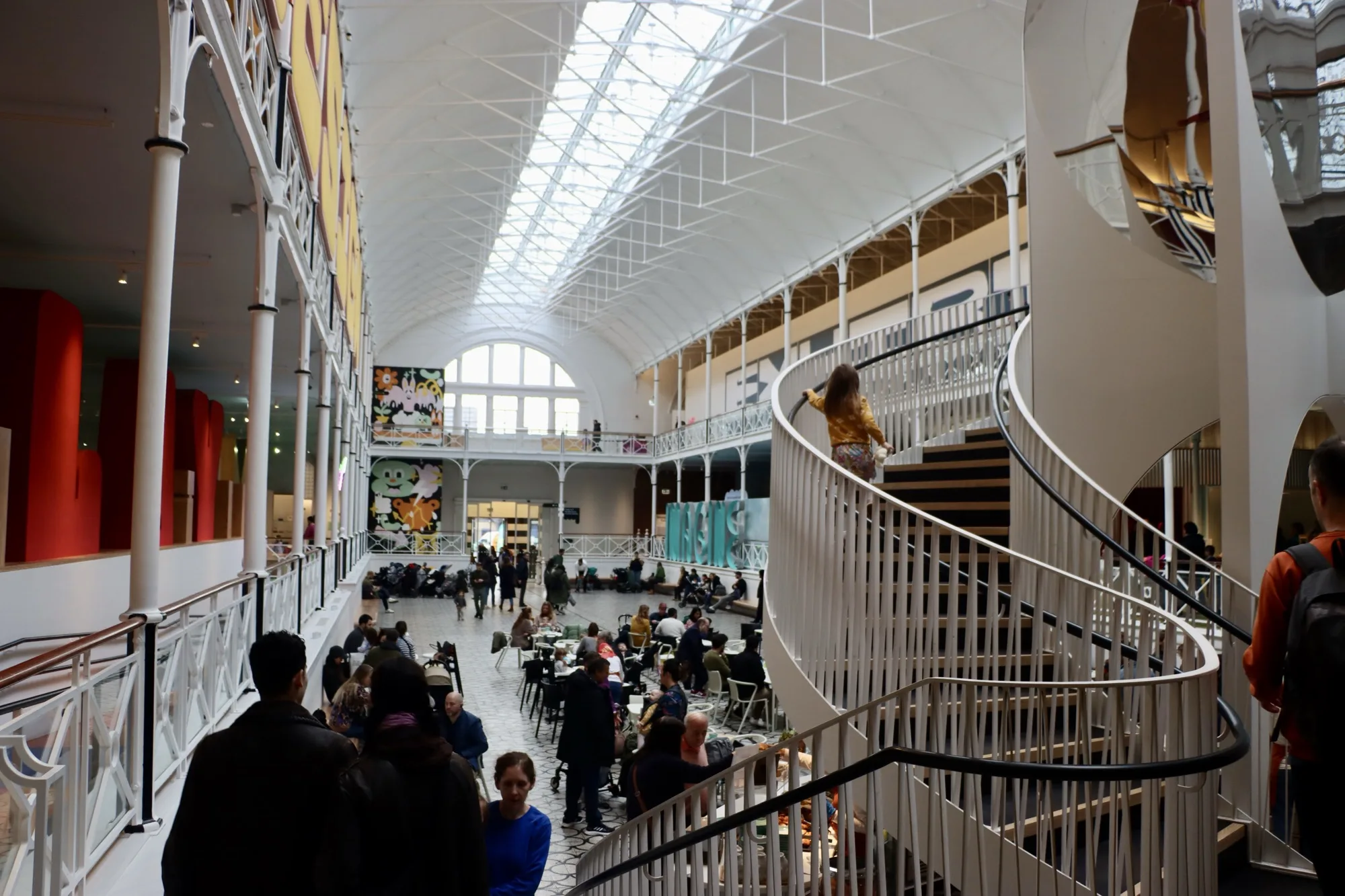
A photo of the interior of the Young V&A.

This is the third in the series of blog posts about places we went to in London – you can also read about the Bank of England Museum and the Cute exhibition at Somerset House.

The Young V&A is the new name for the V&A Museum of Childhood. It’s still in the same place, outside central London in Bethnal Green, but the new name reflects a complete refurbishment. We last went in 2017, and it’s changed massively since then. Before, it was very much a museum, with lots of objects in big glass cases and not much to interact with. Now, whilst there are still some objects to look at, it’s a much more interactive space, and somewhere to bring young children to play. Indeed, our eight-year-old was probably one of the older kids there. Dropping the ‘museum’ from the title therefore makes sense.

The gallery spaces have been split into themes – Play, Imagine and Design. Play arguably caters for the youngest children, although there’s a big screen with a playable Minecraft version of the museum (thankfully it resets regularly to discourage hogging). Imagine includes the dollhouse collection from before, and design looks at how products are designed. There’s a particular focus on recycling waste into useful furniture.

Japan: Myths to Manga

Japan: Myths and Manga

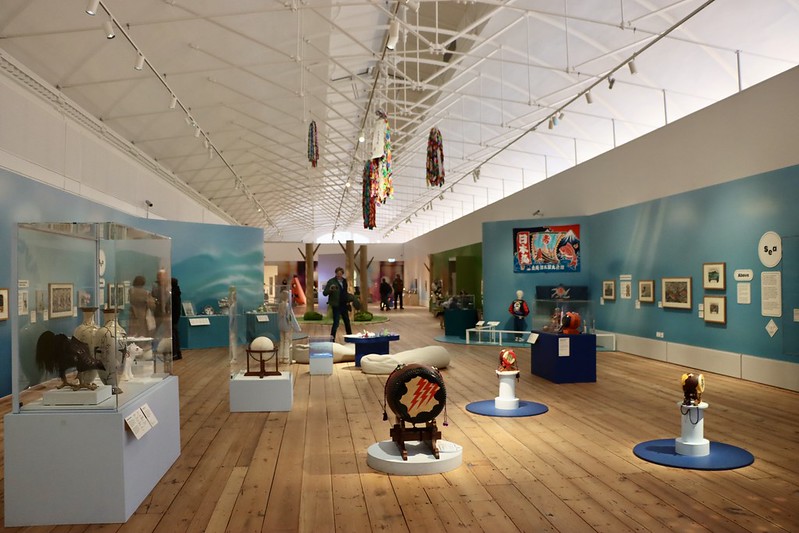
Then there’s an exhibition space, and the opening exhibition is called Japan: Myths to Manga. Whilst the main museum is free to enter, you have to pay to access the exhibition space, and tickets are limited. We made the mistake of not booking in advance, so when we were ready to visit the exhibition on a Saturday afternoon, no more tickets were left. So, we ended up booking tickets for the Sunday and came back the following day.

Personally, I concur with Ianvisits and found the exhibition a little under-whelming, but my wife and child seemed much more engaged. The exhibition is rather sparse, and I would have expected to see more objects there. However, I’m not in the target market for this and we did spend over an hour in the exhibition. There’s several clips from Studio Ghibli films to watch and plenty of Pokemon; but it was also good to read about the traditional Japanese stories and myths which inspired these works.

Accessibility

Because our hotel was located between Aldgate and Whitechapel, we caught the bus to the Young V&A, but it’s also a short walk from Bethnal Green tube station which is on the Central Line. It’s also not too far from Cambridge Heath station on the London Overground, on what will soon be known as the Weaver Line. Around the corner is the new permanent home of the Vagina Museum, although we didn’t have chance to visit this time around.

As you would expect from a recently-renovated museum, there is step free access everywhere, and there’s a dedicated quiet space in the Reading Room. Which we found quite welcome; although the renovation has been extensive, it’s a listed building and so there are limits. Any building popular with children is bound to be noisy, and the open space in the middle is quite echo-y.

Creative Commons License
Except where otherwise noted, the content on this site is licensed under a Creative Commons Attribution-ShareAlike 4.0 International License.