National Centre for Birds of Prey

A photo of a hawk with its keeper at the National Centre for Birds of Prey in Helmsley, North Yorkshire

On Easter Sunday, we went to the National Centre for Birds of Prey, in Helmsley, North Yorkshire. This was our third visit, and happened to be exactly six years to the day since our first.

The National Centre for Birds of Prey, as you would expect, has one of the UK’s largest collections of birds of prey, including many species owls, eagles, hawks, condors and vultures. Originally, there was a sister site in Gloucestershire, but this closed in 2022. Whilst there are plenty of birds of prey centres across the UK, there are far more on display here than I’ve seen anywhere else.

Birds of Prey shows

It’s all well and good looking at birds on their perches, or in their aviaries, but it’s always better to see them actually flying. There are three flying demonstrations each day (two in winter), each with five birds, and with a different set of birds in each show. Therefore, if you stay all day, you can see fifteen different birds flying. The staff who present the birds are all very knowledgable, not just about the species as a whole, but about the individual birds that they fly. Many of the birds have GPS trackers attached to them, so you can see how high they can fly, and it helps the staff retrieve them should they decide to fly off. Indeed, the last of the five birds in the morning session that we attended decided to have a little explore and didn’t come back until about half an hour after the show ended.

There are also wild red kites in the area, and one rudely interrupted a great horned owl’s flying time until it was offered some food to go away. Considering that as recently as 1990s, red kites were almost extinct in the UK, their reintroduction has been a success story. At the centre, you can see their close relatives, the black kite.

Experiences and events

It’s possible to spend a full day at the centre and see all three shows, but like most zoos, there are also experiences that you can pay extra for. These include hawk and owl walks for 1-2 hours.

In 2019, we went on one of their winter owl evenings, which was great. They also offer monthly photography days in the summer and autumn.

Accessibility

The National Centre for Birds of Prey is located at Duncombe Park on the edge of Helmsley. Car parking is available on site, and it’s a 10-15 minute walk from the town centre. Buses from Scarborough and York call at Helmsley.

It’s open every day from early February until Christmas Eve. A Max Card discount is available.

Whilst there are no steps, there is some uneven ground and slopes around the centre. Disabled toilets are available, although I couldn’t find a Changing Places toilet anywhere nearby (the nearest being several miles away in Thirsk and Pickering).

Other things to see and do in Helmsley

Helmsley is a lovely little town, and it’s possible to make a weekend of it:

  • Duncombe Park has some gardens and shares a car park with the centre.
  • Helmsley Castle is an English Heritage property. Although mainly a ruin, thanks to the English Civil War, much of it still survives. We went in 2011.
  • Rievaulx Abbey is another ruined monastery (continuing a theme of Henry VIII having a lot to answer for) just outside the town.
  • Rievaulx Terrace, next door, is a National Trust property and home to some gardens.

The town itself is full of independent shops and is worth a visit on its own.

RSPB Bempton Cliffs nature reserve

RSPB Bempton Cliffs

A couple of weeks ago, at the height of the recent heatwave that hit Britain, we decided to head for the East Coast, and specifically the RSPB nature reserve at Bempton Cliffs.

Bempton is to the north of Flamborough Head, and the tall chalk cliffs are full of nooks and crannies that provide plenty of nesting opportunities for seabirds. Consequently, over 200,000 birds make Bempton their home during nesting season, including puffins, gannets, herring gulls, shags and kittiwakes.

I’ve been to Bempton a few times before, as my paternal grandparents used to live nearby. But this was my first visit in many years, and Christine had never been before. We expected the usual seaside locations like Scarborough to be incredibly busy, and so this would be a quieter alternative. Plus, June is peak season for spotting puffins, which are one of my favourite bird species.

The visitor centre at Bempton has expanded a little since my last visit. There’s now a small café with outdoor seating, toilets and a bigger gift shop. Entry is just £4 for adults and £2 for children aged 5-17, with family tickets also available, and parking is free.

RSPB Bempton Cliffs

Bird spotting at Bempton

Once you’re out of the visitor centre, a network of footpaths takes you to various viewing platforms along the clifftops. On weekends, volunteers will have some telescopes set up trained on key points of interest, including the ever popular puffins. Whilst the platforms over-hang the clifftops, you’ll need to bring a decent pair of binoculars to be able to see anything up close. If you’ve not brought any with you, there’s a good range back at the gift shop to buy or rent.

The platforms nearest the visitor centre are all accessible, with lower barriers for those in wheelchairs (or pushchairs in our case). There are also various information boards for kids to introduce them to the various bird species that can be seen on the cliffs, and how to tell them apart.

Puffin

I was delighted to be able to take this photo of a puffin. It has been cropped somewhat; my longest lens has a 80-250mm range, which is better than nothing but still not really up to taking photos of individual birds. There were plenty of people there with huge zoom lenses and high-end cameras.

Although there was a café, we brought a picnic and there are several picnic areas across the site.

We had a really good time at Bempton. Seeing puffins was a real highlight, but there’s a wide variety of other seabirds there too. If you’re planning a visit, I would recommend doing so sooner rather than later, as some of the birds (the puffins especially) will depart soon.

Lotherton Hall

A photo of flamingoes at Lotherton Hall Bird Garden

On Saturday, we went to Lotherton Hall, which, like Temple Newsam, is a stately home with parkland near Leeds. Whereas Temple Newsam has a farm, Lotherton Hall has a ‘bird garden’ – effectively a zoo specialising in birds.

I’ve been quite a few times before, as it’s on the York side of Leeds and therefore very easy to get to from York. I have vague memories of going on a school trip when I was in primary school, and one of the birds doing its business on the head of one of the teachers.

The majority of the birds are not native to Britain, so there are plenty of flamingoes, cranes, ibises and emus. Some attempt has been made to theme the areas, so most of the ducks are in one place, and the parrots and cockatoos are grouped together. There’s also a walk-through area with African birds. Highlights for us were the kookaburras, the owls and an agouti – one of the few non-feathered animals there.

The estate also provides a large playground, café, gardens, and the house itself. We had a stroll through the gardens but didn’t go into the house – bad weather was expected in the afternoon and so we wanted to be able to head off home.

As we’re staying at my parents’ house, I haven’t had chance to edit the photos and upload them to Flickr, so the photo above is as it came off the camera (albeit resized). We’re in York until Tuesday, and so hopefully I’ll have chance to work on the photos later this week.

The Sowerby Bridge Geese

Geese

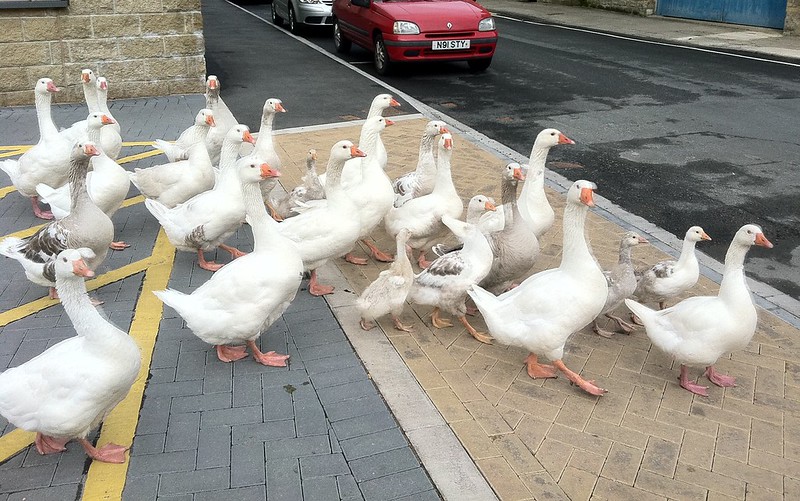
Pictured above are some of the geese that make up a gaggle in my home town of Sowerby Bridge. They nominally live on the River Ryburn, the smaller of Sowerby Bridge’s two rivers which joins the River Calder in the town. Usually they are found on the river outside the swimming pool, but occasionally they waddle a little further afield.

They never stray very far. I’ve never seen any of them fly – they will occasionally flap their wings but they don’t seem to be capable of using them. They just waddle or swim, and the furthest they get is a couple of streets away.

There are probably around 20 of them, and they tend to move together as one big gaggle. This helps when trying to cross the busy A58 road that runs through the town, which they often do, as this video shows. And frequently it’s at rush hour.

Their presence in the town is, unsurprisingly, controversial. Letters from concerned nearby residents have been sent to the local paper and local councillors. The local council have asked that the public do not feed them, and a sign stating this has appeared at one of their regular haunts. However it’s fair to say this sign is regularly ignored as I’ve often seen people throwing bread into the river for them.

I have to admit I’m mostly on the side of the geese (even if their honking occasionally wakes me up on weekend mornings). Whilst they can be a bit threatening to small children and have a habit of defecating a lot, I don’t think there are many humane ways of getting rid of them. And I think they add character to the town, especially in the spring when the newborn goslings hatch. There’s even a Facebook fan page with over 800 ‘likes’. They’ve been here longer than anyone can remember, and I don’t think the town would be the same without them.