My best non-fiction books of 2024

Between now and Christmas Eve, I’ll be posting about the best books that I’ve read (or the best audiobooks that I have listened to), just in case you need any last minute present ideas. Today, I’m focussing on the non-fiction books that I’ve read or listened to this year. All of these are books that I have awarded five stars on Goodreads.

The links below to buy the books are all sponsored links to Amazon, but you’re welcome to borrow these from your local library, or buy them from an independent book shop.

‘Period. It’s About Bloody Time’ by Emma Barnett

The cover of the book 'Period. It's About Bloody Time' by Emma Barnett.

I don’t get periods, being a cisgender man, but my wife Christine does. Whilst this isn’t the first period book I’ve read (that would be Maisie Hill’s Period Power), I really enjoyed Period. It’s About Bloody Time by Emma Barnett. It’s funny, but also a very important book about how periods are perceived, and what society can do to better accommodate those who menstruate.

I like how it goes through lots of the euphemisms that people use instead of the word ‘period’ (it’s called ‘Shark Week‘ in our house).

The Book You Wish Your Parents Had Read by Philippa Perry

The cover to Philippa Perry's book 'The Book You Wish Your Parents Had Read (and Your Children Will Be Glad That You Did)'

Or to give it its full title, ‘The Book You Wish Your Parents Had Read (and Your Children Will Be Glad That You Did)’. If you only ever buy one parenting book, make it this one, as it was full of useful advice. It’s taught me to be more patient as a parent, and to focus on being present and nurturing with our child.

I also read Perry’s follow-up book, The Book You Want Everyone You Love To Read (and maybe a few you don’t) this year, which was still good but not as good as her first.

Barry Cryer: Same Time Tomorrow? by Bob Cryer

The cover of the book 'Barry Cryer: Same Time Tomorrow?' by Bob Cryer.

I’ve been to a couple of recordings of I’m Sorry I Haven’t A Clue, which is now into its 82nd series, and Barry Cryer was a regular contestant for over 50 years before his death in 2022, aged 86. Barry Cryer: Same Time Tomorrow? is a biography of him written by his son, Bob, along with many anecdotes contributed by Barry’s friends and colleagues. It’s a lovely tribute to someone who carried on working in comedy well into his senior years, and was loved and respected by comedians both new and old. As with Rob Wilkins’ biography of Terry Pratchett, it’s written with warmth and admiration.

A Girlhood: A Letter to My Transgender Daughter by Carolyn Hays

The cover to the book 'A Letter to my Transgender Daughter' by Carolyn Hays

Right now, the issue of care for young transgender people is very much in the news, and I would urge anyone wanting to have an informed opinion on the topic to read A Girlhood: A Letter to My Transgender Daughter by Carolyn Hays.

Published under a pseudonym, it’s written as a letter over several chapters, about a family who is doing their best to provide gender-affirming care for their child. There’s a lot of bravery on show, especially as the book starts in an American state which isn’t particularly trans-friendly.

Fix the System, Not the Women by Laura Bates

The cover of the book 'Fix the System, Not the Women' by Laura Bates

Laura Bates was the founder of the Everyday Sexism project, and wrote a 2014 book of the same name. This follow-up, Fix the System, Not the Women, is about how society’s systems and structures work against women and other marginalised people. But it also has positive recommendations for how society can change to be more equal.

It’s an important book for anyone committed to gender equality and inclusion.

“No Offence, But…” by Gina Martin

The cover to the book 'No Offence, But' by Gina Martin

Gina Martin is probably best known as a campaigner who pushed for the Voyeurism (Offences) Act 2019, which made upskirting a specific criminal offence. “No Offence, But” is a useful handbook for responding to claims such as ‘not all men’ and ‘playing devil’s advocate’. Whilst Gina herself has written around half the chapters, there are also contributions from other authors and activists who write in their area of expertise. Again, it’s a positive book that offers useful talking points to respond to lazy stereotypes.

Next time, I’ll be writing about the fiction books that I’ve most enjoyed this year.

Finding alternatives to Goodreads

Screenshot of my profile on thestorygraph.com which is a potential alternative to Goodreads

I’m a little late to the Goodreads review scandal. Late last year, an author whose debut book was due to be published, wrote several fake reviews of books by other authors that were due out at the same time, and posted positive fake reviews of her own book. Unfortunately for her, she was found out, and dropped from her book deal.

But, as the above-linked New York Times article states, Goodreads isn’t in a good place right now. It’s been around since 2007, although I joined in 2016 and first blogged about it in 2017. This was after Amazon’s purchase of Goodreads in 2013.

In the almost eight years that I’ve used Goodreads, it has barely changed. There have been annual Readers Choice Awards, and the annual reading challenges, but other than a change to book information pages in 2021, it feels like Amazon has basically abandoned it. The iOS app gets ‘bug fixes and performance improvements’ on a regular basis, but I suspect that these are updates to downstream code libraries and not a result of actual work by Goodreads developers.

Its recommendations of new books to try have always been terrible, and it’s reliant on volunteer librarians. Which wouldn’t be an issue if Goodreads was a non-profit, but it’s owned by one of the world’s most valuable conglomerates. Giving away labour for free to such enterprises doesn’t sit well with me, even if it’s something I’ve done a lot in the past.

So, Goodreads both has a problem with fake reviews, and a lack of interest from its owner. So what are the alternatives?

The Storygraph

I tried out The StoryGraph about a year ago. You can import your reading history from Goodreads during the onboarding process, and its recommendations are much better, as its design. There are mobile apps, reading challenges, and giveaways where authors can offer limited free copies of their books, presumably to generate some reviews.

The StoryGraph does have social features like Goodreads, but there doesn’t seem to be an easy way of importing contacts from elsewhere. Quite a lot of my friends use Goodreads and I’m sure some of them use The StoryGraph too, but I don’t know how many because I can’t seem to find them. If there’s an ‘import contacts’ option in the iOS app, then I haven’t found it.

Bookwyrm

Another site that I’ve heard about, but haven’t yet signed up to, is Bookwyrm. It uses ActivityPub and is therefore part of the Fediverse, so you can follow people using Mastodon clients, for example. You can use the bookwyrm.social instance, but you can also install and host it yourself. Importing from Goodreads (and other services) is supported.

I’m aware of some friends who use Bookwyrm, so it may avoid the issue I’m having with The StoryGraph where I can’t find my existing contacts.

And there are many other Goodreads alternatives

I found this list of Goodreads alternatives, which mentions 31 (!) sites that you could consider. Bookwyrm and The StoryGraph are both listed, as is LibraryThing which actually pre-dates Goodreads.

I suppose it will come down to what my existing friends use, and getting large numbers of people to change platforms happens rarely. We’ve seen many challengers to Twitter rise and fall over the years (Andy Baio posted an excellent eulogy of Ello this week) and it’s only because X/Twitter has become utterly terrible in the past 15 months that a significant number of people have moved to the likes of Bluesky and Mastodon. And some are still left behind.

If we follow that model, then Goodreads would have to become significantly worse, before people start looking for alternatives en masse. Right now, it’s just stagnant; clearly not a priority for Amazon, but not so badly broken as to require much of an intervention. I certainly can’t see it joining Bookwyrm in the Fediverse.

My favourite things of 2023

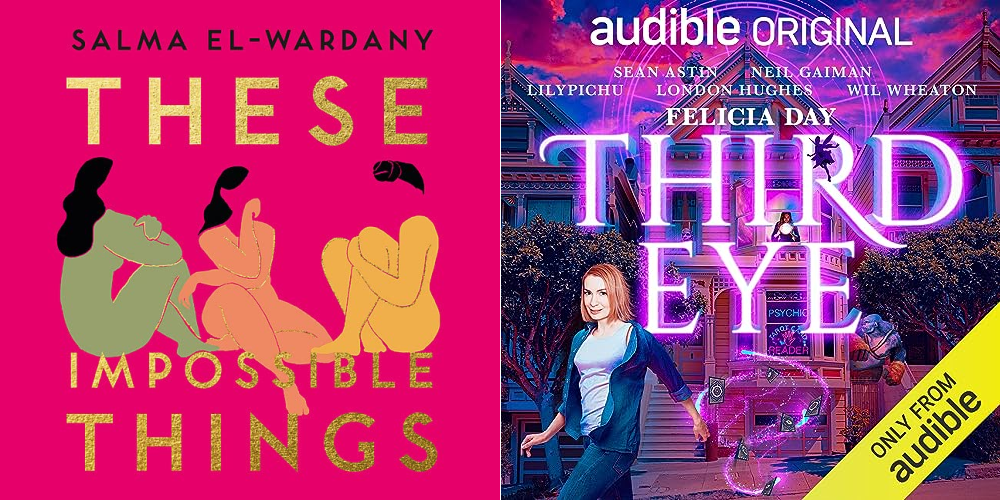
Covers for books I read in 2023, including These Impossible Things by Salma El-Wardany and Third Eye by Felicia Day

There’s only 32 hours of 2023 remaining in my timezone, so it’s time to review the things I’ve consumed this year and pick out my favourite content.

Note: all links below marked with a * are Amazon referral links, and so I receive a small amount of commission from any purchases. But please feel free to buy these from a local, independent tax-paying shop, or borrow them from your local library, as I did with several of these recommendations.

Favourite book of 2023

So far I’ve read 95 books this year, although to be fair, quite a few of these were bedtime stories for our eight-year-old. Those aside, my favourite book was ‘These Impossible Things’ by Salma El-Wardany*. It tells the story of three young British Asian women, who are navigating the divide between family and cultural expectations, and life as a young person in the UK in the 21st century. It’s very well-written, with very relatable characters. This is El-Wardany’s debut novel and so I’m interested to see what comes next.

Honourable mentions: There were a few books that I awarded five stars to on Goodreads this year:

Favourite film of 2023

We haven’t been able to watch many films this year, and those that we have seen at the cinema have tended to be child-friendly films. We’re also behind on Marvel films and haven’t seen any in a couple of years. Of those that we have seen, probably my favourite was the Barbie movie, which was just hilarious all the way through. We saw it a few weeks after it came out and there were several of us laughing out loud in the cinema.

Honourable mentions: Dungeons and Dragons: Honour Amongst Thieves* was fun, and it was good to see Hugh Grant playing an antagonist for once. And it was nice to finally see a sequel to Chicken Run – I had the first film on VHS, which gives you an idea of how long ago since that came out, and meant I’ve had to explain to our eight-year-old what a ‘VHS’ is.

It’s also worth noting that we are planning to see Wonka tomorrow.

Favourite TV show of the year

Again, we’ve not had much time to watch TV this year. When you work full-time in a different city to where you live, and have a child who has school and homework and weekend activities, there’s not a lot of time to keep up with TV. Of the shows that I have seen bits of, The Repair Shop has filled that niche of being interesting, comforting and educational.

Favourite audio series of the year

Okay, so I basically created this category so that I could tell you about Felicia Day’s ‘Third Eye’*. It’s an Audible exclusive, and is more akin to a radio play rather than an audiobook. But, it has a narrator in the form of Neil Gaiman and is split into chapters. Felicia Day wrote the script for TV several years ago, and although no TV channels picked it up, it’s become a very good audio series with Day playing the lead character. London Hughes, Alan Tudyk and Wil Wheaton provide some of the other voices.

So – these are the things that I have watched, read and listened to in 2023. Next year, I’m hoping to catch up with the Marvel films we’ve missed (especially now that the pace of release has slowed down) and continue to read more things. Maybe I’ll manage 100 books across the year this time?

Ultra Processed Food

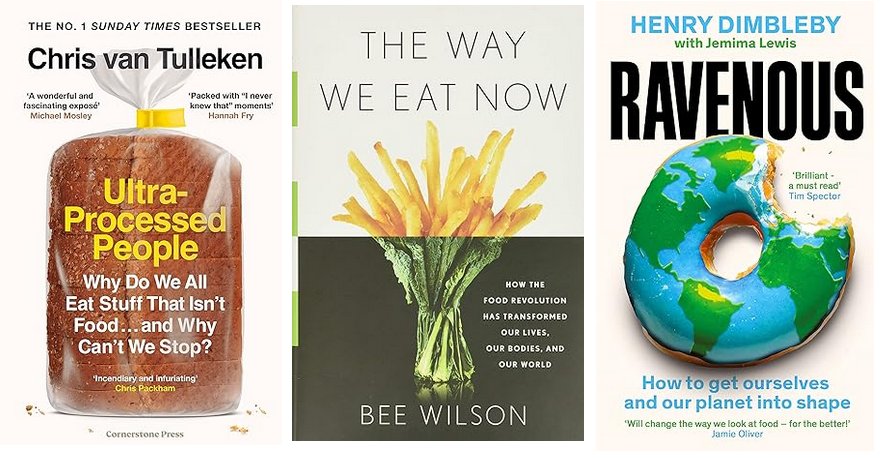
Cover images of the books about ultra-processed food mentioned in the article

Something that I’ve become more concerned about in our household is our consumption of so-called ‘ultra-processed food’. My wife has had a few health issues over the past 18 months, including an elevated risk of developing type two diabetes which has seen her cut her sugar intake. But this coincided with the publishing of several books related to ultra-processed food, and has seen us made some changes to reduce our exposure to them.

The books

Before I go into much detail, here are the books I’m talking about:

  1. Ultra-Processed People by Dr Chris van Tulleken
  2. The Way We Eat Now by Dr Bee Wilson
  3. Ravenous by Henry Dimbleby

Note: these are sponsored links, but feel free to purchase these books from your local independent tax-paying bookshop, or borrow them from a library.

If you only read one of these, read Chris van Tulleken’s Ultra-Processed People. Chris is probably better known as ‘Dr Chris’ from the CBBC show Operation Ouch, which he presents with his twin brother Dr Xand (and later Dr Ronx). He’s a triple-threat: a GP who is also a research scientist and a TV presenter, and it shows. He’s able to digest some academic research into an easily readable format, which isn’t surprising when you consider that this is what he does for his patients and his TV audience. But it also means that there’s academic rigour behind this book.

Dr Xand pops up quite a bit in this book; Chris and Xand are identical twins but have different physiques. Chris puts this down to Xand’s time in the USA, where he was exposed to higher amounts of so-called ‘ultra-processed food’, and so he’s ended up higher on the BMI scale than his brother (although Chris acknowledges that BMI is discredited). When they both contracted Covid-19 in 2020, Xand was more seriously ill than Chris.

Over the course of the book, we discover that there’s increasing evidence that ultra-processed food is linked to obesity, and how the food industry tries to downplay it.

How do we define ultra-processed food?

Chris acknowledges that it can be hard to define what ultra-processed food is. The best model that we have is the Nova classification, developed by Prof Carlos Augusto Monteiro at the University of Sao Paulo in Brazil. Essentially, this splits food into 4 groups:

  • Nova 1 – wholefoods, like fruit, vegetables, nuts etc that can be eaten with little to no processing
  • Nova 2 – culinaries, like vinegar, oils, butter and salt that require some processing
  • Nova 3 – processed food. This is basically anything that’s been cooked, so home-made bread would fall under here. Foods from the Nova 1 and 2 categories are combined to create the foods in the Nova 3 category.
  • Nova 4 – ultra-processed food, which is made from formulations of food additives that may not include any ingredients from the Nova 1 category.

Probably the easiest way to work out if something fits into the Nova 4 category is by looking at the list of ingredients. If there are one or more ingredients listed that you can’t expect to find at a typical large supermarket, then it’s probably ultra-processed food. Things like emulsifiers, artificial sweeteners, preservatives and ingredients identified only using those dreaded E numbers that my mum used to be wary of back in the 1980s.

And there’s a lot of food that fall into the Nova 4 category. Almost all breakfast cereals, and any bread that is made in a factory, are examples.

Why are ultra-processed foods so common?

Fundamentally it’s to do with cost and distribution. For example, a tin of tomatoes that contains some additional ultra-processed ingredients may be cheaper than a tin just containing tomatoes (and perhaps a small amount of acidity regulator). It’s a bit like how drug dealers cut drugs with, for example, flour, to make more money when selling their drugs on.

Distribution is also a factor. A loaf of bread that is baked in a factory may take a couple of days to reach supermarket shelves, where it also needs to be ‘fresh’ for a few days. So the manufacturers will add various preservatives and ingredients to ensure that bread remains soft.

You can bake your own bread using only yeast, flour, salt, olive oil and water. But Tesco will sell you a loaf of Hovis white bread that also contains ‘Soya Flour, Preservative: E282, Emulsifiers: E477e, E471, E481, Rapeseed Oil, and Flour Treatment Agent: Ascorbic Acid’. These are to keep the bread soft and extend its shelf life, as a homemade loaf may start going stale after 2-3 days. This means that a shop-bought loaf may go mouldy before it goes stale.

Other common examples

Breakfast cereals brand themselves as a healthy start to the day, but often contain worryingly-high amounts of sugar. And there’s evidence that their over-use of ultra-processed ingredients interferes with the body’s ability to regulate appetite, leading to over-eating.

Ice cream is also often ultra-processed, if you buy it in a supermarket. The extra additives ensure that it can survive being stored at varying temperatures whilst in transit. It’s notable that most UK ice cream is manufactured by just two companies – Froneri (Nestlé, Cadbury’s, Kelly’s, Häagen-Dasz and Mövenpick brands) and Unilever (Walls and Ben & Jerry’s). There are many small ice cream producers, but the challenge of transporting ice cream and keeping it at the right temperature means that they have limited reach.

I’m also worried about a lot of newer ‘plant-based’ foods that are designed to have the same taste and texture as meat and dairy products. You can eat a very healthy plant-based diet, but I would argue that some ultra-processed plant-based foods would be less healthy that the meat and dairy products that they’re mimicking.

What we’re doing to cut our intake of ultra-processed food

We now bake our own bread in a bread machine. Not only do you avoid ultra-processed ingredients, but freshly-baked bread tastes so much nicer than a loaf bought in a shop. It takes a little more planning, but most of the ingredients don’t need to be kept fresh.

We also buy more premium products where we can. Rather than refined vegetable oils, we buy cold-pressed oil for frying, and I’ve mentioned chopped tomatoes above. Of course, these products cost more, and it’s something that both Chris and Henry mention in their books. It should come as no surprise that there’s a link between obesity and poverty, if people on low incomes cannot afford good food.

And we’ve had to give up Pringles. Chris devotes practically a whole chapter to them, and how they trick the brain into wanting more.

You can download the Open Food Facts app to help decipher food labels. It includes a barcode scanner, and will warn you if what you’ve scanned is ultra-processed food. The good news is that there are still plenty of convenience foods which are not ultra-processed – there’s some suggestions in this Guardian article.

Whilst I haven’t yet given up on artificially-sweetened soft drinks, we reckon that we’ve cut our sugar intake and our exposure to artificial additives. In many cases, we don’t know the long-term health effects of these additives, although we do know that some people struggle to lose weight despite eating a supposedly ‘healthy’ diet and exercising regularly.

Managing e-books with Calibre-web

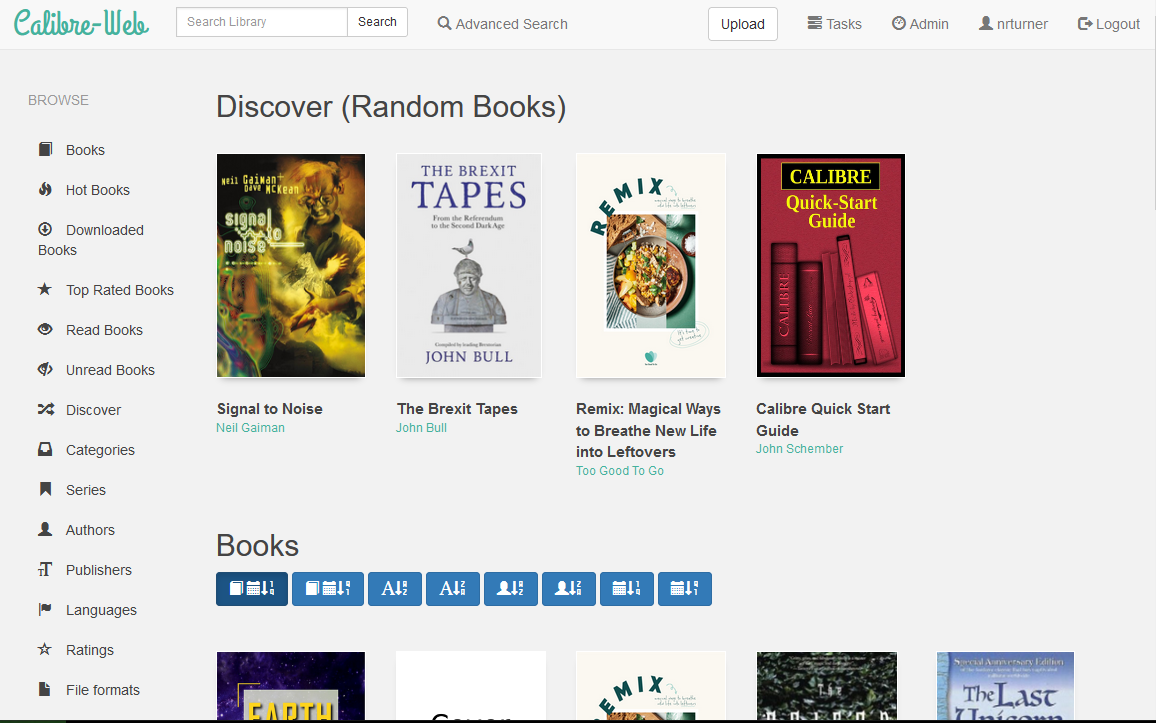
Screenshot of the calibre-web interface

If, like me, you’ve picked up a number of e-books over the years, you may use Calibre as your e-book manager. It’s a desktop application with an optional web interface, but it has its drawbacks. The user interface is clunky, and it tries to cram lots of advanced features in – even the latest version 7 is overwhelming for new users. So, if you can forego the desktop application, there’s an alternative called calibre-web that does the same thing in a web browser, and with a much nicer interface.

Once installed, you can migrate your existing metadata.db from Calibre and the e-book folders, and calibre-web will pick up where you left off. I particularly like the ability to download metadata from sources such as Google Books, to get more complete data about each book besides its author and title. There’s a built-in e-reader, or you can use an app that supports OPDS – I used Aldiko.

By far the easiest way to install it is using Docker. There’s a good image on DockerHub; it’s maintained by a third-party but recommended by calibre-web’s developers. Once installed, it doesn’t require much additional configuration.

By default, calibre-web doesn’t allow uploads, but you can amend this in the Admin settings. The settings toggle s rather buried away, and it took me some time to find. But once uploads are enabled, it allows you to completely replace the desktop Calibre app if you want to. You can also set up multiple user accounts, if you want to share your calibre-web server with others.

I have calibre-web installed on the same Raspberry Pi as my Plex and Home Assistant servers. Indeed, calibre-web essentially offers a kind-of Plex for e-books, seeing as Plex doesn’t offer this itself. Unfortunately, most of my e-books were purchased through Amazon, and so only accessible through their Kindle apps and devices. But for the handful of books that I’ve picked up through the likes of Unbound and Humble Bundle, it’s helpful to have them in one place.

What was your first Amazon purchase?

Inspired by @mikko I just looked at my first ever Amazon order and: yup, that’s 14-year-old me. pic.twitter.com/cAuNzAoKAj

— Alex Hern (@alexhern) July 4, 2017

I saw this tweet on Tuesday about your first Amazon purchase. Amazon, of course, remembers your order history going back to when you first registered an account.

My first purchase was in May 2003, a few days before my 19th birthday. I actually blogged about it at the time. I bought Just for Fun (sponsored link) by Linus Torvalds, the memoirs of the creator of the Linux operating system. Although I wasn’t, and still am not, a great reader of books, I did actually read this book – it kept me occupied whilst on holiday with my parents over the summer. I remember a few things from the book, but not much.

The rest of my purchases from 2003 were a couple of textbooks that I needed for my undergraduate degree course in Computer Science. One was about TCP/IP networking, and the other on software engineering. I’m sure they’re significantly out of date now. Oh, and I bought Shrek on DVD (sponsored link).

So what was your first Amazon purchase?

Goodreads

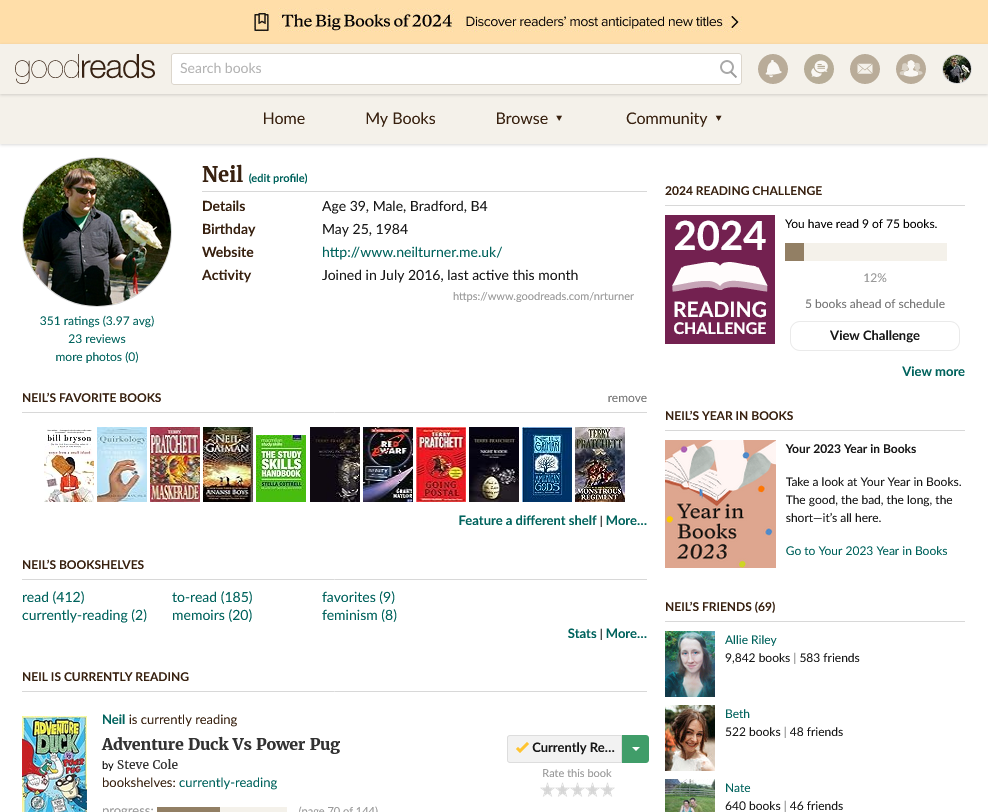
Screenshot of my profile on Goodreads

I probably don’t need to tell you about Goodreads, the social book recommending web site. After all, it’s used by millions of people, including over 50 of my own friends. But I am anyway.

I only recently joined Goodreads – recently being a year ago. For many years I didn’t read books; I didn’t have the time or the inclination to do so. But since restarting my Audible subscription last year, I’ve become more interested in books again. The advantage of an audiobook is that you can listen to it whilst doing something else, such as housework or commuting. This gets around the issue of not having time to sit down and read.

Goodreads became a good way to catalogue the books that I’ve read, and find new books to read. As you read and review books, Goodreads can recommend other titles similar to those that you’ve read. You can also see what your friends are reading, and what they thought of the books they’ve finished.

Goodreads integrates well with Facebook, and so you can see what your friends are reading without having to add them as friends separately. Friends can also be imported from Twitter.

Whilst originally independent, Amazon purchased Goodreads in 2013. Consequently, you can link up your Amazon account, and this allows you to import your previous Amazon book purchases. This is quite helpful if you’re new to the site, as it allows you to import your books in bulk.

As you’d expect, there’s also an app for iOS and Android devices. This includes a barcode scanner for adding books to your lists.

You can find my profile here. If you know me, feel free to add me as a friend if you haven’t done so already. I’ll continue to review books on here from time to time – right now, I’m listening to The Long Earth (sponsored link) by Terry Pratchett and Stephen Baxter.

Getting started with Terry Pratchett’s Discworld books

The Discworld Reading Order Guide 3.0 - a chart showing all of Terry Pratchett's Discworld books and what order to read them in

Last Monday, I posed the following question to my Facebook friends:

Let’s imagine that you have a friend who has read a few Terry Pratchett books, but none of the Discworld books, and would like to start somewhere – which book would you recommend?

This friend has also seen the Sky TV adaptions of Colour of Magic, Light Fantastic and Going Postal.

And this friend may also be me.

27 comments later, and I received a useful list of starter books:

  • Guards, Guards!
  • Wyrd Sisters
  • Pyramids
  • Equal Rites
  • Mort
  • Reaper Man
  • Going Postal
  • Soul Music

Of these, ‘Guards, Guards!’ was the most popular suggestion, and so that’s my next audiobook on Audible. I’m about 30% of the way through it already. It’s okay – it’s narrated by Nigel Planer (aka Neil from The Young Ones), who does a good job. However, the breaks between scenes could be handled better. I think I found Good Omens to be a funnier book.

Discworld is a bit like the Marvel Cinematic Universe; there are lots of books that follow different groups of characters. There are several books with which you can start with, and some of these coalesce into a larger story. There’s even a diagram, which I’ve included above.

You could, of course, read the Discworld books chronologically, starting with The Colour of Magic and The Light Fantastic, but I gather that these aren’t Pratchett’s best works. That, and I’ve already seen the TV adaptations so I know the plot.

I will probably read another of the starter books next, before delving into any particular pathway through the Discworld universe. However, I have a couple of other books to listen to first, thanks to some recent Audible daily deals. These include The Long Earth, another Pratchett book which was a collaboration with Steven Baxter, and is more science-fiction than fantasy.

Listening to books, part V (Fiction edition)

It’s time for another update on the audiobooks that I’ve been listening to. As mentioned last time, I’ve been listening to a few fiction books lately, rather than just yet more celebrity memoirs. As someone who hasn’t read (or indeed listened to) fiction in many years, this was a bit of a departure for me. Indeed, Mitch Benn’s book Terra was the first in a long time.

Here’s what I’ve listened to:

Battlemage by Stephen Aryan

The cover of Battlemage by Stephen Aryan

I’ll disclose a minor conflict of interest here: I used to work with Stephen’s partner. At the time, I remember hearing about how he was struggling to get a publisher. This was when self-publishing on Kindle and the like was becoming more popular. I’m pleased to see that Stephen’s persistence paid off, with this book being published by Orbit in September 2015. It’s available as an actual paperbook in real shops (or Amazon – sponsored link), and an audiobook on Audible.

Battlemage is among the longer books that I’ve listened to – roughly on a par with a typical Game of Thrones book. It tells the story of several battlemages, powerful and feared wizards, who are recruited to fight in a war against the ‘warlock’. It’s firmly in the ‘sword and sorcery’ subgenre of fantasy.

I really enjoyed this book; whilst I chose it principally to support someone I know, the story was good and the characters had depth. The narration by Mark Addis on the audiobook is good as well. It’s the first in a trilogy, and I’m looking forward to listening to Bloodmage, the next book in the series.

Dietland by Sarai Walker

I listened to this book on a recommendation from Sofie Hagen, formerly one half of The Guilty Feminist podcast. I didn’t really know what to expect, other than that it would likely criticise the diet industry.

Dietland (Amazon link – sponsored) tells the story of Plum, a fat girl who doesn’t want to be fat. She signs up for a weight loss scheme called ‘The Baptist Plan’, but is left looking for other options when the company is closed by its founder’s daughter. Considering bariatric surgery, she’s recruited into a secretive collective and finds out the truth about dieting.

The reviews of this book are mixed, perhaps due to its controversial second half where the story takes an interesting twist. For me, I found the second half much stronger than the first. Initially I almost wrote this book off as being typical cheap ‘chick lit’, but I stuck with it and was rewarded. Drawing parallels with real-life events, it’s hilarious and empowering.

Lauren Henderson narrates the book, and whilst she does so well, she wouldn’t be my favourite voice actor.

The Alchemist by Paulo Coelho

I listened to The Alchemist (Amazon link – sponsored) because it was available as a freebie on Audible back in November. I had run out of credits, didn’t fancy paying full price for another audiobook and saw that it was a relatively short 4 hour listen, which I completed in a week thanks to a few long car journeys.

It’s certainly not the sort of book that I would normally listen to, and it was okay, I guess. The story follows a young Spanish shepherd, as he travels to Africa to find treasure. The revelations he has on his journey end up changing the course of his life.

There’s a lot of religious imagery in the book, even if it isn’t overtly Christian. The narration was good, but you can tell that it has been translated into English. There’s not the level of nuance that I expect it would have if read in its original Portuguese.

Good Omens by Terry Pratchett and Neil Gaiman

The cover of Good Omens by Terry Pratchett and Neil Gaiman

As a child, I read a few Terry Pratchett books – namely the Johnny Maxwell trilogy, but as yet I haven’t dabbled my toe into any of Pratchett’s books for adults. Similarly, I’ve not really read any Neil Gaiman books apart from a couple of short stories. So I thought that Good Omens (Amazon link – sponsored), a collaboration between the two of them, would be a good introduction to both authors. It’s a standalone book that is not part of any wider series.

Good Omens follows Crowley and Aziraphale, a demon and an angel who live on Earth, and who aren’t very happy about its imminent destruction. As the four horsemen of the apocalypse gather, and the anti-christ goes missing, it’s up to them to save the world, with the help of a surprisingly accurate book of prophecies written by one Agnes Nutter.

There are some laugh-out-loud moments in Good Omens, especially in its comments about the M25, and how every cassette that spends more than a couple of weeks in a car becomes songs by Queen. Some of the pop culture references are a little dated – this book was first published in 1990 – but on the whole, it holds up well. Stephen Briggs offers an excellent narration in the audiobook.

Update (May 2025): This was written before the allegations about Neil Gaiman’s sexual abuse were made public. Also, the original Stephen Briggs audiobook has been replaced with a newer recording narrated by Martin Jarvis.

Up next

At present I’m back to celebrity memoirs, but will be listening to more fiction books in future. I’m considering making a start on Game of Thrones, and perhaps making inroads into Terry Pratchett’s Discworld universe.

Listening to books, part IV

It’s time for another update on the audiobooks that I’ve been listening to, this time since December.

Bossypants

Continuing my trend for listening to memoirs by female comedians, I spent December listening to Bossypants by Tina Fey (Amazon link – sponsored). Fey is a comedian and actress for whom I’m broadly familiar with – particularly her Sarah Palin impressions. Alas, having not watched 30 Rock, I missed some of the references in the book. This perhaps ruined my enjoyment of it slightly.

Fey’s advice on improvisation is something that has stuck with me – the ‘Yes, and…’ response when asked a question. It’s a key part of keeping improv sketches moving, but can be applied to many other situations too.

The book is now six years old and it sort-of shows. But it’s enjoyable and I recommend it.

Where am I now?

Growing up, I was a fan of Roald Dahl’s books, and enjoyed Danny DeVito’s film adaption of Matilda. The starring role in that film was Mara Wilson, and Where am I now? (Amazon link – sponsored) is her story.

Mara isn’t so well-known nowadays. As a child actor, she was in a string of well-known films, but she wasn’t able to continue this fame into adulthood. The book covers how she never quite fitted in, her battles with mental health and her sometimes difficult family life. It’s a charming book that will take you through many emotions, both happy and sad.

After listening, I bought this book as a Christmas present for Christine, as many of Wilson’s life experiences mirrored hers. That, and it’s a book that I really enjoyed.

Be Awesome: Modern Life for Modern Ladies

I’m not a lady, but this book by Guardian journalist Hadley Freeman was recommended to me. Be Awesome: Modern Life for Modern Ladies (Amazon link – sponsored) is part-memoir, part advice column, and partly an opportunity to rant about patriarchal oppression and the rubbish that modern women have to put up with.

Freeman’s wit livens up a book that I’d otherwise have stopped listening to partway through. Again, a lack of familiarity with the many TV series that Freeman references in the book made it hard to follow in places. And like her columns, this is a very light-hearted read that shouldn’t be taken too seriously.

As with Lindy West’s audiobook Shrill that I reviewed last time, Freeman isn’t the best person to speak her own work. This is especially noticeable at the beginning when her performance isn’t great. Again, I put this down to Freeman (and West) being journalists rather than actors and performers.

Update (May 2025): I wouldn’t now recommend this book due to Freeman’s transphobic views.

Algorithms to Live By: The Computer Science of Human Decisions

Making computer algorithms both interesting and relevant to the wider public is a hard task, but this book does it well Algorithms to Live By: The Computer Science of Human Decisions (Amazon link – sponsored) is by Brian Christian and Tom Griffiths, and Christian himself reads the audiobook. It takes the concepts of various common algorithms and shows how these can be applied to real life. The collision detection algorithms used in computer networking are a good example. We use the concept naturally when talking in a group, to ensure that we don’t speak over others.

Because computers follow every instruction explicitly, the book shows how actions that we humans take for granted have to be unpacked for a computer, and how we can learn from this process.

Some of the concepts can be a little hard to get your head around, and having a background in computer science definitely helped me. Whilst it’s not your typical self-improvement book, I picked up a few tips for dealing with real life situations based on this book’s concepts.

In addition to these books, I’ve been listening to some fiction books, which I’ll write about later. Next up, is Steve Coogan’s Easily Distracted.