Have you ever been to a Greggs Outlet?

A photo of the Gregg's Outlet on Great Horton Road, opposite the university in Bradford

Greggs, the UK bakery chain, is basically everywhere nowadays. What started out as one shop in the north east in the 1950s has grown to approximately 2500 stores across almost all of the UK. Most towns and cities have at least one; whilst Sowerby Bridge doesn’t have one, nearby Halifax has three. Even the New York Times wrote a gushing article about them earlier this year.

What’s less well known about are the smaller number of Greggs Outlets. These sell excess stock from other Greggs stores at a discount. And there’s one opposite the university where I work.

The Greggs Outlet in Bradford wasn’t always an outlet. Pre-pandemic, it was a regular Greggs, selling the full standard range including the vegan sausage rolls that seemed to boil Piers Morgan’s piss. But when shops could open again, it received new red branding and had the indoor seating area closed.

Inside, you can buy most of the things that you can normally buy in a regular Greggs, but not everything; it depends what has been left over elsewhere. Nor will it be quite so fresh; the sandwiches will have been made the previous day, for example. You also can’t get things like bacon sandwiches, although usually coffee is available to take away.

But it is much cheaper – typically everything is half price. Baguette sandwiches are around £1.60 each, and sweet treats are almost always under £1. Great for students on tight budgets at the university and nearby college, but also for those on low incomes.

Indeed, the reason why you may not have come across a Greggs Outlet is that they’re strategically located in areas of social deprivation. This includes some in its home territory around Newcastle, but also Bradford, Birmingham, Glasgow, Liverpool, Cardiff, Leicester, Leeds, Preston, Sheffield, Oldham, and some in London. Greggs is planning to have 50 outlets open by the end of next year, representing about 2% of its estate. Food that remains unsold then gets passed to charities, and Greggs claims to have distributed over 1000 tonnes of food in 2023.

Whilst I can afford to go to a regular Greggs, I appreciate having an outlet in easy reach. And it’s a good way of avoiding food waste. Schemes like Too Good To Go are great for smaller businesses to offload excess stock, but for larger chains like Greggs, making cheaper food available all day for those less likely to be able to afford it is welcome.

What ChatGPT thinks about Omar’s

On Monday, I wrote about Omar’s Balti House in Bradford. But before publishing it, I also asked ChatGPT the following:

Write a 300 word blog post about Omar’s Balti House in Bradford, West Yorkshire

So, here’s what it came up with:

Nestled in the heart of Bradford, West Yorkshire, Omar’s Balti House stands as a culinary gem, offering a delightful journey through the rich tapestry of flavors that define Balti cuisine. This renowned restaurant has earned its stripes as a go-to destination for locals and visitors alike, seeking an authentic taste of Pakistani and Kashmiri culinary traditions.

As you step into Omar’s Balti House, the warm ambiance immediately envelops you, setting the stage for a memorable dining experience. The restaurant’s commitment to authenticity is evident not only in its decor but, more importantly, in the carefully crafted menu. From aromatic biryanis to sizzling kebabs, each dish showcases the expertise of the chefs in delivering a true taste of the region.

One standout feature of Omar’s Balti House is its namesake dish—the Balti. Served in a distinctive, wok-like bowl, the Balti is a symphony of flavors, combining tender meats or vegetables with a medley of spices. The result is a harmonious blend that captures the essence of Pakistani and Kashmiri cuisine. Whether you’re a spice enthusiast or prefer milder flavors, Omar’s caters to all taste preferences, ensuring a culinary journey that suits every palate.

The commitment to quality extends beyond the kitchen, with Omar’s Balti House sourcing the finest local ingredients to create dishes that are not only delicious but also reflective of the restaurant’s dedication to supporting the community. The menu evolves with the seasons, ensuring that patrons can savor the freshest produce while enjoying a diverse range of dishes.

In addition to its culinary prowess, Omar’s Balti House prides itself on providing exceptional service. The attentive staff adds a personal touch to the dining experience, making guests feel not only welcome but also part of the extended Omar’s family.

For those seeking a taste of authenticity in Bradford, West Yorkshire, Omar’s Balti House emerges as a must-visit destination. With its rich tapestry of flavors, warm ambiance, and commitment to quality, this restaurant stands as a testament to the vibrant culinary heritage of Pakistan and Kashmir.

I have an interest in AI, and especially large language models like ChatGPT and their impact on my industry, higher education. We are seeing students using AI tools to write assessments, and even their personal statements for their university applications. And I think the above text is a good example of how AI is at the uncanny valley stage – it looks okay on first glance, but a more detailed critique highlights its flaws.

Firstly, I wouldn’t describe this as a ‘blog post’, even though this is what I asked ChatGPT to write. It reads more like a puff piece that you would read in some marketing to promote a town or city as a place to live or invest in.

It talks quite a bit about the balti dishes that the food is served on, although that could be because I mentioned ‘balti’ in the writing prompt. A major issue with AI is that they’re not always able to explain why they’ve done something. But it doesn’t mention the enormous naan breads anywhere – which, arguably, is what Omar’s is best known for.

And there are some things it has plain made up. The menu does not ‘evolve with the seasons’. Indeed, the menu doesn’t really evolve at all; whilst it has been reprinted a few times and the prices have gone up over the years, many of the dishes that are on there were ones that were available 20+ years ago. Also, I’m not sure about the ‘local ingredients’ either.

This all feeds into my concerns about the thousands of web pages currently filling up our search engines with AI-written content. How much of it has actually been proof-read, and is accurate?

In education, AI generated content is an issue for two reasons. One, it’s cheating, in the same way that plagiarism and essay mills are – it’s just that you’re using something written by a computer rather than another person. But there’s a quality issue too. I specialise in doctoral level admissions, and much of what current AI language models generate just isn’t at that level. You tend to get vague lists of things with few references (and sometimes these are made up), and if you ask it for a longer essay then it’ll probably start repeating itself. I’m sure if I’d asked for, say, 600 words on Omar’s balti house, it would have run out of unique things to say and just repeat the same statements in another way.

Most universities are now very much aware of both the opportunities and the threats that such AI models present; Turnitin, used by many universities, can now indicate whether an assignment has been written using AI as well as detecting plagiarism. There are simpler tools available online, such as AI Detector, where you can copy and paste a short piece of text. Indeed, when I put ChatGPT’s text above in there, it said that there was a ‘relatively high’ chance that it was written by AI.

I’m sure these language models will improve over time, and will overcome their current shortcomings. At which point, we may struggle to work out what has been written by a human and what was hallucinated by a computer. We’re certainly not there yet, and I don’t know how long it’ll take to get there, or whether it’ll be like driverless cars which seem to be perpetually ten years away. I hope this blog post serves as an explanation of why I won’t be farming out my blog post writing to AI any time soon.

Omar’s Balti House in Bradford

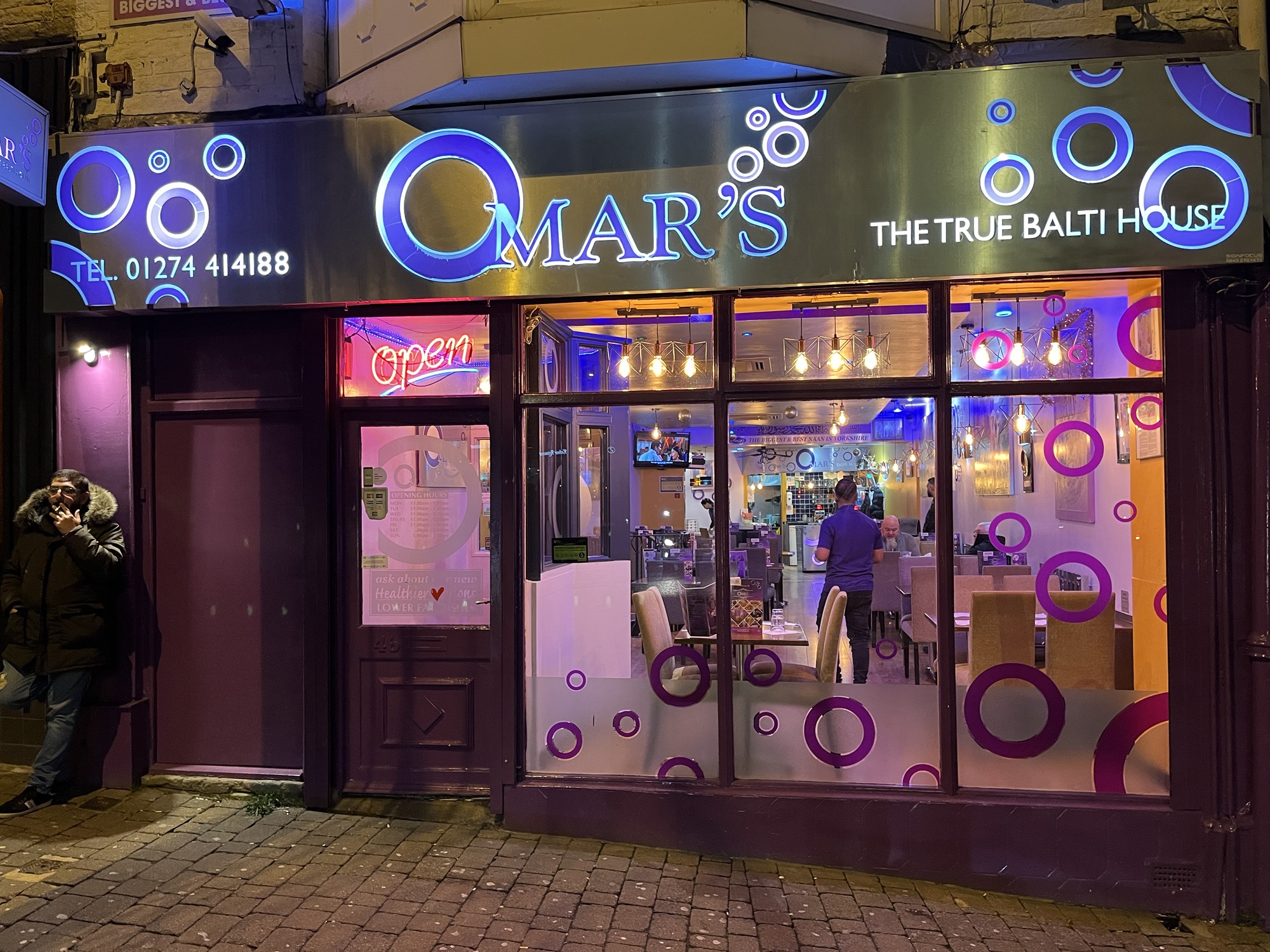
A photo the outside of Omar's Balti House in Bradford

I’m sure I must have written about Omar’s Balti House on Great Horton Road in Bradford at least once before, although I don’t think I’ve ever written a whole blog post about it. We went there last week with a group of friends, which is an excuse to write about it.

Bradford is not short of curry houses and has repeatedly won the title of ‘Curry Capital of Britain’ over the years. And whilst Omar’s may not have the renown of other curry houses like Mumtaz, or the likes of Aagrah and Akbars which have become chains, it’s one that is held with affection amongst people who have lived in Bradford. Indeed, I’d argue that it’s a rite of passage for students who study in Bradford. I first visited early on in my first year at university, and have been back many, many times since.

Omar’s is known for serving its meals in the same metal balti dishes that they’re cooked in, and for it’s enormous naan breads. No really, they’re claimed to be the largest in Yorkshire and typically measure almost a metre across. Indeed, eating one of these naans on your own, with a balti dish, is a food challenge – and the record is currently 35 minutes having been last set in 2019. Before that, the record had stood for over a decade.

Massive naans aside, the food at Omar’s is good, and despite being a small restaurant they do cater for large groups. They also serve some western food, which is good when you have an eight-year-old who hates even the mildest spicy food.

When Jeremy Corbyn came to Bradford

Yesterday, the Labour Party launched its General Election manifesto. And it chose to do so in the building where I work.

We were treated to Jeremy Corbyn and his shadow cabinet, who delivered a presentation and answered questions for around 90 minutes. All in front of the nation’s media, with live TV and internet broadcasts. Naturally, security was tight, and access was limited. Only university staff and students, Labour Party members, and invited members of the media where permitted. This included heavyweight political correspondents such as ITV’s Robert Peston, the BBC’s Laura Kuenssberg and Sky’s Adam Boulton.

I was unable to get a seat, so I had to watch from one of the balconies above with no view of the stage. Corbyn got a really warm reception, particularly as the majority of people there were university staff. The biggest cheers were in response to Labour’s policies regarding ending hospital car parking charges, renationalising the railways, and, predictably, ending university tuition fees.

From the university’s perspective, it was great to see a high profile event run so well. This was despite it having been planned at such short notice. But we have form here: seven years ago, then Labour Prime Minister Gordon Brown came to us to make a speech the day before the 2010 General Election. And the university’s first chancellor, back in 1966, was Labour prime minister Harold Wilson; this was something that Corbyn referenced in his speech.

I’m a Labour Party member, so I’ll be voting for Labour next month anyway. Brexit aside, I was very impressed with what Jeremy Corbyn promised us yesterday if elected. Sadly, that’s a big ‘if’; despite recent improvements, Labour are still trailing significantly in the polls. We’ll see what happens come June 9th, when the results will be clear.

All of the above is my own opinion, and not necessarily that of my employer.

Low Moor railway station

Low Moor Station

Last summer, Kirkstall Forge became Yorkshire’s newest railway station, and I went to have a look on a free afternoon. But it’s now lost the crown to another new Yorkshire station: Low Moor. And today I popped over to have a look.

Re-opening

Low Moor is technically a re-opening of a station that was closed in the 1960s, following the Beeching report. It used to be a junction station, with a branch line heading down the Spen Valley through Cleckheaton and Heckmondwyke. That branch line was closed, and is now the Spen Valley Greenway, a segregated footpath that I’ve walked a few times (but curiously never blogged about). Low Moor station has an exit onto the Greenway, improving access to it.

For a couple of years in the 1990s, the land once occupied by the old Low Moor station was used for Transperience, a public transport museum. I wrote about it a few years ago despite having never been; it closed due to a lack of visitors, and therefore money.

The new Low Moor station has been quite a long time coming; plans have existed for some time. Its construction has also taken far longer than planned. The local area was a major coalfield, and, during work to build a lift shaft, an uncapped mining shaft was found that didn’t exist on any plans. The station should have therefore opened in 2016, but, hey, better late than never.

The start of construction was also held up due to the need to get a standards derogation for the curved platforms. Modern stations have dead straight platforms, to minimise the gap between trains and the platform edge. Low Moor station is on a curve, and so there are a number of ‘Mind the Gap’ warnings around.

Low Moor Station

The new Low Moor station

So what did I find when I visited? Well, it’s very similar to most new stations that have opened of late. As you’d expect, it is (almost) fully wheelchair accessible; the only exception being the steps down to the Greenway. A ramp for cycles has been provided (but was fenced off) – this seems like a curious omission. Lifts provide access to the two platforms, which surprised me slightly. The station is unstaffed, so if the lifts break down, there’s no assistance for wheelchair users. I’m guessing large ramps would have added to the cost; the station already cost over £10million to build.

As mentioned, Low Moor station is unstaffed, so there’s no ticket office. There is a machine by the car park, however, which has around 100 spaces. When I visited today, there were around 20 cars parked up. Which isn’t a lot, but the station has been open less than a fortnight, and there are almost no road signs to it. I expect that, in time, it’ll be signposted from the nearby M62 as a park-and-ride facility for those travelling into Leeds and Bradford.

Low Moor Station

Services

Which brings me to the train services. There aren’t many of them.

After spending a lot of money on a new station, you might expect there to be a regular train service. But the majority of train services on the Calder Valley line whizz through Low Moor station without stopping. There’s a basic hourly service in each direction: one northbound to Bradford and thence onto Leeds, and one southbound to Halifax and Huddersfield. There’s no direct service to Manchester Victoria.

Grand Central, the open access operator which runs trains between Bradford and London King’s Cross, stop most of their trains at Low Moor, so there is a link to the capital. But these trains only run four times a day in each direction.

It’s a shame that Low Moor hasn’t got a great service, especially considering the money spent. Improvements should, however, come with time. The Calder Valley line is undergoing a multi-million pound upgrade this year, which should see more and faster trains. At present, only 4 trains per hour can use the line in each direction; the upgrade will add a fifth path and hopefully more. This should mean that more trains can stop at Low Moor without existing services having to slow down.

The poor service frequency was part of the reason why I made my visit to Low Moor by car, rather than by train. I’m hoping that getting there by train will be easier in the not too distant future.

There’s a few more photos on Flickr here, and I uploaded a 360° photo to Google Maps Street View here.

No, Bradford is not the worst place to live in the UK

Bradford Town Hall

Yesterday’s newspapers covered the results of a ‘quality of life’ survey that stated that Edinburgh is the best place to live in the UK, and Bradford is the worst. Whilst I’ll agree that Edinburgh is a wonderful (if expensive) city, there is no way that Bradford is the worst place in the UK. And I’m speaking as a former Bradford resident who still works there and travels to the city at least five days a week.

The survey came from a press release put out by uSwitch.com. uSwitch is not a thinktank, local authority or university, or indeed any kind of organisation involved in research. It’s actually a price comparison web site, designed to help you find cheaper deals on phone, internet and energy contracts. So clearly, this ‘survey’ is about getting publicity and press coverage, rather than a serious piece of research.

Bradford is apparently “let down by low disposable income, low employment, high rent and crowded schools”, according to the press release. There are issues with schools in Bradford – as someone who works in education, I’m very much aware of this. But I dispute the high rent claims. uSwitch claims that average rents are £92.60 per week, but a few minutes on Rightmove showed a wide range of properties for less than half of this.

Whilst disposable incomes may be low, so is the cost of living – food is cheap, as is public transport.

Next month sees the long-awaited opening of Westfield’s Broadway shopping centre, which will bring hundreds of new jobs to the city. So hopefully the unemployment rate in the area will continue to fall as it has been doing recently.

In 2007, Bradford was named Britain’s greenest city and is home to several large public parks, including the award-winning Lister Park, Horton Park, Peel Park and the new City Park in the city centre. You can get out into the countryside quite quickly, unlike in many other cities. And my employer, the University of Bradford, recently won a Green Flag award for its campus.

Just this week, Bradford was named Curry Capital of Britain for a record fifth year in a row.

Hull also did poorly in the ‘survey’, coming second from bottom. This is despite it being named City of Culture 2017.

In essence though, is there really anything to be gained from highlighting the ‘worst’ cities in the UK? Sure, it gets a bit of publicity for the company releasing the survey. But it then leaves those cities and its employers and representatives with the job of mopping up the damage to their reputation. It’s rather mean of companies like uSwitch to publish these ‘surveys’, especially when they don’t seem to understand the implications for the cities named.

In any case, the ‘best’ or ‘worst’ city to live in depends on a lot of factors, some of which will be unique to each person. Given the choice between Bradford, and, say Bracknell in Berkshire, I’d happily choose Bradford. But there are also places like Sowerby Bridge, where I now live, that now meet my needs better than Bradford does. A survey based on a few generalised measurements isn’t actually all that helpful.

The Rossendale Taxi problem

Valley Tailor Tailors - Repairs & Alterations 5, Manchester Road, Haslingden, Rossendale, Lancashire BB4 5SL
Photo by Robert Wade, licensed under a CC BY-NC-SA license.

If you’re a northerner like me, then, the next time you get a taxi, have a look at which local authority the car is registered with. You may find that, rather than being registered with the authority for the area that you are in, it’s been registered with Rossendale Borough Council.

I’ve noticed this both in Bradford, where I work, and in Calderdale where I live. Whilst the majority of cars are registered with Bradford and Calderdale councils respectively, some are registered in Rossendale, even though they carry operator logos for local companies. In other words, there are taxis working in Bradford, with a Bradford operator, but registered with a completely different local authority.

It’s a strange situation, but one that is entirely legal. It’s perhaps worth delving into a bit of history first though.

In Britain, we have two types of taxis:

  • Hackney carriages, also known as ‘black cabs’, which can be hailed from the street without pre-booking. These are well-regulated, especially in London where drivers are required to pass a series of exams called ‘The Knowledge‘. Hackney carriages will always have a meter on display and most modern vehicles can accommodate a wheelchair.
  • Private hire, which in London are known as ‘minicabs’. These have to be booked in advance via an office – you can’t hail a passing private hire vehicle nor can a private hire driver tout for business. Drivers for upstart services like Uber and Lyft come under this type. Private hire vehicles were completely unregulated until 2001 when councils were able to introduce registration. In some areas, the fare has to be agreed in advance, but others permit the use of meters.

For more, see the Wikipedia article on taxis in the United Kingdom.

To drive a taxi and be able to pick up customers, you have to be registered with a local authority – but there’s no requirement for it be the authority in the area that you choose to work in. I assume that this is mostly because some journeys will inevitably result in crossing local authority borders. In particular, I’ve taken taxis from Bradford to Sowerby Bridge and it would be a bit silly if the Bradford taxi driver was required to end the journey at the border between the Bradford and Calderdale districts.

Because registration is handled by individual local authorities, and each local authority handles registration differently, it’s therefore possible to ‘cherry-pick’ a local authority that is less stringent. This seems to be the allegation that has been laid at Rossendale Borough Council – it’s seen as being lighter on regulation than other authorities. This has a knock-on effect in areas outside Rossendale where drivers who are registered there operate. In Bradford, it means that Bradford council can’t carry out safety checks on these drivers as they have no jurisdiction – even though the drivers are working in the Bradford area for Bradford taxi operators.

It’s also meant that the borough of Rossendale, which is a largely rural part of Lancashire with only three towns and a total population of under 70,000 people, has over 1200 licensed taxis registered there. That compares with a little over 200 in Bradford, which is home to almost ten times as many people and is a major city.

It would appear that Rossendale Council are aware of the problems and are proposing changes, which has resulted in the threat of strike action. One of the changes that the council is proposing is that it can refuse or revoke a license on the ‘presumption’ that a licensee is operating primarily outside of the area. If these changes go through, then those drivers registered in Rossendale but primarily working elsewhere will need to register with a different authority. And whilst I’d hope that this would be the authority for the area that they work in, I can’t help but feel that some will just move on to whichever other authority is seen as being soft on regulation.

Moby Dick! The Musical at the Bradford Playhouse

The poster for Moby Dick the Musical at the Bradford Playhouse. It's on a purple background, with a chalk drawing of a happy whale on a green chalkboard.

Next week, Christine and I will be part of a production of Moby Dick! The Musical at the Bradford Playhouse, along with the rest of BUSOM – The Bradford University Society of Operettas and Musicals. Christine is the producer and has a minor acting role, and I will be a part of the technical team.

If you’re like me, then this may be the first time you’ve heard of a musical theatre adaptation of Herman Melville’s famous book. The musical version dates from the early 1990s – it had a brief run in London’s West End at the Piccadilly Theatre, but closed after a four month run due to poor reviews. Don’t let that put you off though.

Moby Dick! The Musical is essentially a meta-play – a play within a play. It follows the girls of St Godley’s School – faced with closure, they put on a performance of Moby Dick to raise money to save the school. Whilst the cast is predominantly female, the role of the headmistress/Captain Ahab is usually played by a male actor in drag.

Christine has been working on the show for months now and it’s been great to see it come together. There’s just a few more rehearsals before it opens on Thursday night, with further showings on Friday and Saturday.

You can buy tickets online – they’re £10 each, or £8 for concessions. If you’re local to Bradford, it would be great if you can come along and support the students who have worked so hard to put on this show. I hope I’ll see you there!

The Bradford Brewery

The Bradford Brewery

Last night, I went along to the opening night of the new Bradford Brewery. Once it’s fully up-and-running, it’ll be the first brewery in Bradford city centre since the last one closed in the 1950s.

Whilst the brewing equipment is still being assembled, the Bradford Brewery’s brewpub, The Brewfactory, opened yesterday. As well as various beers and ales from other local (and not so local) breweries, there is the first of the Bradford Brewery’s own beers available to purchase, called The Origin. It’s an IPA – smooth with a slightly spicy after-taste, although overall I found it a little bland. It’s being brewed at the Baildon Brewery for now until the on-site equipment is up and running, which should be within a couple of weeks.

The Bradford Brewery

The brewery is located in a small former factory building on the corner of Westgate and Rawson Road, behind the Oastler Centre, with the pub occupying most of the ground floor. As a factory, moisture meters were built there to measure moisture in wool (to discourage dampening the wool to increase its weight), and its industrial past is reflected in the decor. It’s a bit sparse at the moment, but then the place has only just opened after all.

North Parade

The Bradford Brewery is just around the corner from North Parade, home to Bradford’s independent quarter and an increasing number of bars. I wrote about the Record Café last year, which joined The Sparrow and Al’s Dime Bar on the same street. The Brewhouse is another bar due to open there shortly.

Good quality new bars are always welcome in Bradford and hopefully a sign that the trend for pub closures might be easing, at least in certain areas. The Brewfactory certainly has a great selection, with eight handpulls for cask beer, several more keg pumps and a variety of canned beers. It’s aiming towards the top end of the market – the only mainstream beer available on tap was Amstel with most of the rest coming from independent microbreweries.

Whilst The Brewfactory will be the home of the Bradford Brewery’s beers, the brewery has ambitious plans for production once its equipment is commissioned – with the aim to produce over 10,000 pints per week. So hopefully their beers will be widely available across the region, and maybe even further beyond. And conveniently, they’ve been able to start production (albeit offsite) just in time for next week’s Bradford Beer Festival in Saltaire.

I wish the team behind the Bradford Brewery the best of luck – their plans have been in the pipeline for a long time, and it’s great to see them finally coming to fruition. It was busy when we visited last night and I hope that it remains so.

The Record Café, Bradford

The Record Café

Last night I went to a preview night at Bradford’s newest bar, The Record Café, on North Parade. Officially it opens tonight, and it will be a great new addition to Bradford’s new independent quarter.

The Record Café is three things. First and foremost it’s a bar, with four hand-pulled cask beers and six keg beers, along with a fridge full of bottled beer. Most of the beers are either British (Saltaire, Great Heck, Brewdog and Camden Town were present when I visited) or American, including the Anchor Steam Brewery’s Porter available in a keg – this is the first time I’ve seen their beers in anything other than a bottle in this country. There were also a small number of bottled continental beers, and an eclectic selection of gin that eschews the more common brands. No mass-produced mainstream lager here.

It’s also a delicatessen, offering platters of ham and cured meats – there were plenty of samples available at the preview, and it was good quality stuff. In this sense, by offering beer and charcuterie it’s a bit like Friends of Ham in Leeds, but less hipster-y.

The Record Café

Where it differs is the third thing, and the clue is in the name – as well as being a bar, it’s also a record shop. There’s an upstairs mezzanine where you can browse and buy records on vinyl. This wasn’t quite ready with limited stock and some decorating to do, but the emphasis will be on new music, rather than it being an exchange for old records.

It’s located just opposite The Sparrow, which was Bradford’s first ‘bier café’ – that opened in 2011, just as craft beer started becoming popular in the UK. That’s still going strong, and joins Al’s Dime Bar further along North Parade, in an area becoming known for bars serving good beer. Next year, the Bradford Brewery opens around the corner, along with another new bar called The Beerhouse and an independent cinema which will have a bar as well.

The Record Café

For once, it’s becoming an exciting time to be in Bradford, and I hope these bars will do something to improve Bradford’s nightlife. In recent years people have travelled from Bradford to Leeds, Halifax and Huddersfield for nights out and I hope some of those will choose to stay in the city in future.

I took a number of photos last night and these are available to view on Flickr.

With thanks to Keith Wildman and his colleagues at The Record Café for inviting myself and the Bradford University Real Ale & Cider Society along.

Creative Commons License
Except where otherwise noted, the content on this site is licensed under a Creative Commons Attribution-ShareAlike 4.0 International License.