Happy Valley

Rainbow

Last week we belatedly started watching the BBC One drama series Happy Valley. It stars Sarah Lancashire as Sergeant Catherine Cawood, a policewoman still coming to terms with the suicide of her daughter, when the boy she blames her death on is released from prison. A parallel story thread sees a businessman dabble with the criminal underworld to get enough money to send his daughter to a private school.

All six hour-long episodes of Happy Valley have now aired, but they are available on BBC iPlayer for a couple more days (and you can download the episodes to keep for 30 days). I also expect that it’ll be available on DVD and other digital download services before too long. Happy Valley has been a very well-received series and is tipped for a BAFTA, and there’s talk of a second series.

Happy Valley is shot, and indeed set, in the Calder Valley where Christine and I live. Indeed, the police station where the lead character is based is our local station in Sowerby Bridge, which I pass on the way to work every day. Earlier in the year there were frequently film crews outside, and the signs on the front had been changed from ‘West Yorkshire Police’ to simply ‘Yorkshire Police’, a fictional police force. Unlike its portrayal in the series, the police station is no longer open to the public – an issue that our local MP took up in parliament several years ago. Other scenes are filmed elsewhere in Sowerby Bridge, and also further up the valley in Hebden Bridge, Heptonstall, Todmorden and in the shadow of Stoodley Pike.

Despite the title of ‘Happy Valley’, the series is quite gritty and, though it’s fictional, focuses on some of the area’s social problems. As an example, whilst Hebden Bridge has a reputation for being a tourist-friendly hippie lesbian preservation area, it also has high rates of drug abuse and suicide. The steep sides of the valley, and gentrification, are frequently blamed for the area’s ills.

We’ve only watched episode one so far, so no spoilers please.

A bank holiday visit to Hebden Bridge

Hebden Old Bridge

As it was such a nice day on Good Friday, and we were both off work with it being a bank holiday, Christine and I paid a visit to Hebden Bridge. We’ve been there many times over the years, however, this was actually the first time we’d been in almost two years.

In June and July of 2012, the upper Calder Valley was badly affected by floods. Whilst it didn’t cause too many problems here in Sowerby Bridge, Hebden Bridge was hit hard, with large parts of the town underwater. This included the main road through the town and the main shopping streets.

It’s taken the town quite a long time to get itself back together again, so we were pleased to see it looking rather resplendent when we visited last week. There were almost no empty shops; though some hadn’t re-opened following the floods, others had taken their place. And the town was bustling with people taking advantage of a day off work and some nice sunshine.

Hebden Bridge features on this year’s Tour de France route. The Tour de France has its ‘Grand Départ’ in different places across Europe each year, and Yorkshire won the bid for 2014, so the first two days of the course are in Yorkshire. Riders will pass through Hebden Bridge before tackling a long, sustained incline further down the Calder Valley at Cragg Vale. Hopefully the weather will be equally nice as it was when we visited, and the local economy will get a nice boost.

Speaking of which, there is large amount of disquiet in the town about a proposed Sainsbury’s supermarket opening nearby. What makes Hebden Bridge so special is that the vast majority of shops are independently run, including a number of clothing boutiques, delicatessens and craft shops. The worry is that a big supermarket like Sainsbury’s would adversely affect business in these small shops. Many shops had posters in their windows about it and there’s a web site encouraging people to object to the planning application.

Hebden Bridge Duck Race

Finally, as today is Easter Monday, there is the annual duck race, where hundreds of rubber ducks are dropped into the river. Each duck is sponsored, and there are prizes for the first ducks to cross the finish line. Again, the local community are strongly behind this with many shops having duck-themed displays in their windows.

Hebden Bridge is always a lovely place to visit and it’s a shame that we haven’t had chance to drop by recently. Apart from the looming potential of a new supermarket, I’m glad the town is doing well.

Calderdale Industrial Museum

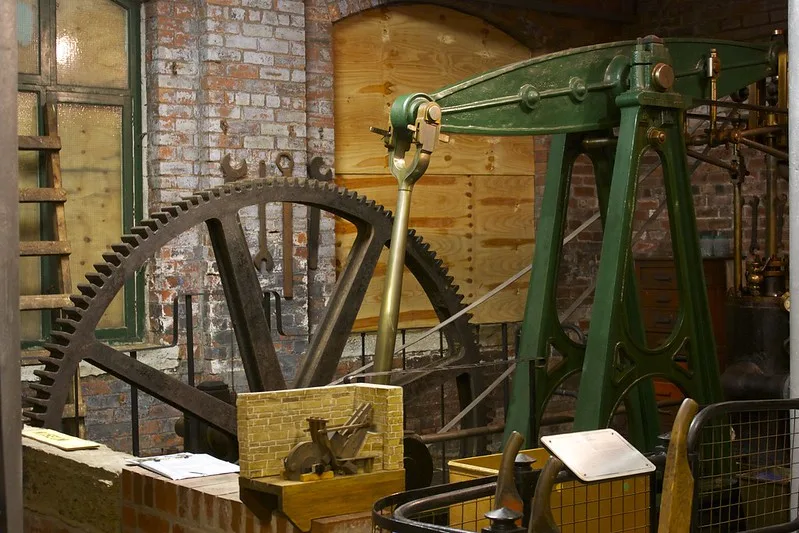
Calderdale Industrial Museum

A few weeks ago Christine and I went to the Calderdale Industrial Museum in Halifax. The museum opened in 1985, but sadly closed only a few years later and has been mothballed ever since. A group of volunteers called CIMA are working to get the museum open again, and the 10th August was one of their regular open days where visitors could have a look around. I’ve uploaded the photos of my visit to Flickr.

Not all of the museum is accessible; the volunteers have been working for a couple of years but some parts are still out of bounds. However, there are three floors of exhibits, which include stationary engines like the one pictured, weaving machines and histories of some of the major companies that were founded in Halifax. These include Percy Shaw’s catseyes company, Mackintosh – maker of Quality Street and now a part of Nestlé, and the Halifax Bank.

A lot of the windows are still boarded up and not all of the light bulbs had been replaced, so the museum is quite dark. The paintwork on the walls needs some attention as well, as shown in some of my photos.

It was my first visit, but Christine had been as a child, back when the museum was open properly in the 1980s. I think she was disappointed at how the museum had been left to rot for so long. The volunteers have done well but will have their work cut out to get the museum back to where it was when it was closed, never mind taking it forward. I also got the feeling that the local council, which still owns the museum, isn’t being 100% co-operative.

There are also question marks hanging over the museum’s future. It backs on to The Piece Hall, which in January will under-go a 15-month modernisation, and it is next to the proposed site for Halifax’s new central library. The plans may see the museum building being cut down somewhat, although the artists’ impressions do at least show it so hopefully it’ll still be around in future.

There are two more open days planned for 2013, on the 14th and 15th September as part of the national Heritage Open Days events. If you’re in the area I would definitely recommend a visit – it’s easy to get to as it’s just around the corner from Halifax station. Entry is free, but I’m sure CIMA would be delighted if you were able to donate some money to help them get the museum open again more often.

The Calder Valley Line

A Grand Central and a Northern train side-by-side at Bradford Interchange, on the Calder Valley line

This is an entry about the Calder Valley Line (also known as the Caldervale Line), which takes trains from my home town of York, through to Bradford where I currently reside, and onto Manchester and Blackpool, where Christine lives. As you can imagine, I use this railway line a lot.

Technically speaking it’s a ‘route’ rather than a ‘line’, as the sections of track were built at different times by different companies and it shares tracks with other services for a number of sections, but it’s known as the Calder Valley Line. This is because it passes through the upper Calder Valley.

Bradford and Blackpool are on roughly the same latitude, so in an ideal world there would be almost a straight line between them. Alas, the Pennine Hills are in the way, and so the railways tend to follow the valleys and serve the communities in them. Indeed, on leaving Bradford the trains head almost due south, before then curving around to face south-west to reach Halifax.

The line certainly isn’t the most modern in the country. It saw quite a bit of attention in the 1980s, when a number of stations closed in the 1960s were re-opened, and new trains were introduced for some services in the early 1990s. But apart from a new junction outside Bradford there hasn’t been much significant investment in the line of late. Some sections, such as the 9 miles between Burnley and Todmorden, have very slow line speeds of around 45 mph, compared with the usual minimum of 60 mph elsewhere. Consequently, the train from Bradford to Blackpool takes 1 hour and 50 minutes, which is slower than it would be to drive (around 1 hour 35 minutes) despite the driving route taking you via Manchester and being much further in distance.

But some changes are afoot. South of Bradford, a new railway station at Low Moor should be open by the end of 2012, again to replace one closed in the 1960s. Blackpool trains, which skip many intermediate stops elsewhere, won’t stop there but it will be served by a number of local services, and its location close to the M606 on the site previously occupied by Transperience means it will be suited for park-and-ride facilities. Manchester Victoria station is due for a major refurbishment and by 2017 there should be more frequent services to Bradford, as well as new direct services to Manchester Airport and Liverpool from Bradford. A new section of track will allow trains from Burnley to reach Manchester via Todmorden, although this plan is presently unfunded, And the line connecting Blackpool to Preston is due to be electrified later this decade, although that will largely benefit local services and not trains from Yorkshire.

A faster service to Blackpool from Bradford would be most welcome – obviously it would be nice for me but if it becomes faster than travelling by car then it will be more likely to pull in extra passengers. New or refurbished trains would be nice; while the Express Sprinter trains that usually run on the line aren’t too bad, they’re in need of a refit as many carry most of their original fixtures and fittings which have become well-worn over the past 20 years.

The Calder Valley Line is a useful route, covering a long distance and linking many northern towns together, but it could really do with some more TLC. Hopefully in 10 years time I won’t have to use it so much, but I can hope that if I do it’ll be a quicker and more comfortable experience.