Our 2018 summer holiday in the Loire

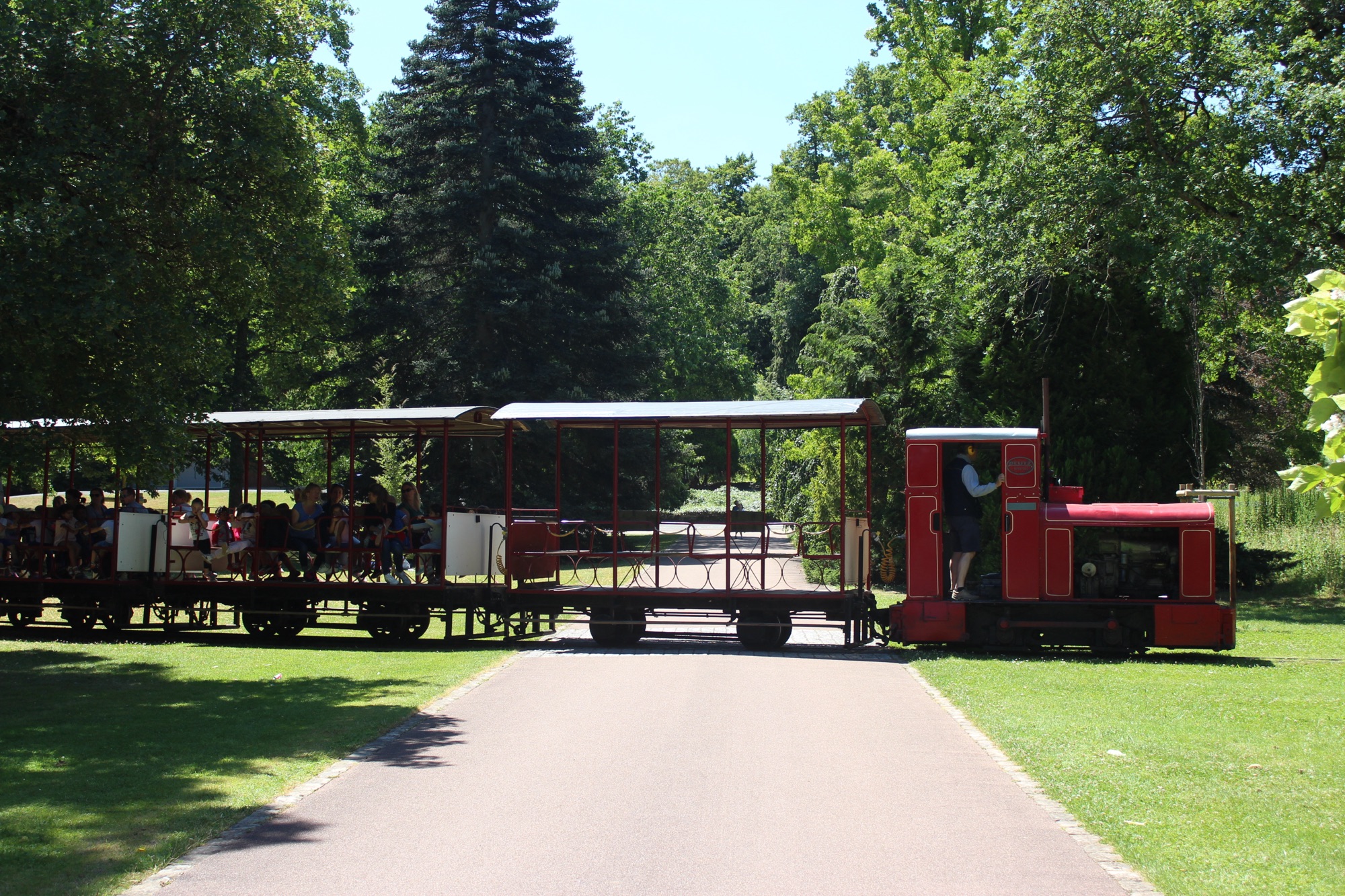
A small train plodding around the Parc Floral de la Source

Last summer, I blogged about previous un-blogged holidays in 2019, 2021, 2022 and 2023. As I’m away on this year’s holiday at present, I’m going to write about our 2018 holiday. Although our holiday fell before my blogging hiatus, it only got a brief mention at the time.

This particular holiday was our nine-year-old’s first trip outside England, although as it was seven years ago they were two at the time, as that’s how maths works. Nominally, our holiday was in the Loire valley in France – yes, the same place as 2023 – but we fitted some other places in too.

A photo of the outside of the Cadbury's Factory in Bourneville, West Midlands

Cadbury World

I suppose our holiday ‘started’ in the West Midlands, at Cadbury World. This was one of several places that we called at on our journey down. I’d been before with Hari – her family is from Worcestershire – but this was the first time we’d been as a family.

Cadbury World is adjacent to the Cadbury’s factory in Bourneville, a model village built by Cadbury’s for its workers that now forms a suburb of Birmingham. It tells the story about Cadbury’s – the history of the company and how chocolate is made. So whilst it’s a museum, it’s also very much a tourist attraction, with indoor rides and a chance to watch professionals make chocolate. During my earlier visit in the 2000s, you were able to see some of the actual Cadbury production lines in the factory, but I don’t remember seeing them on this visit.

It’s not quite a full day out, which suited us as we’d arrived there having set off from home – it was over two hours’ drive, and we had further to go afterwards. The attraction is run by Merlin (the Alton Towers and Sealife Centre people) so whilst it can be quite pricey, there are various discounts available if you can book in advance.

We stayed overnight near Oxford, where we met up with my parents and had a meal for Father’s Day.

A photo of a tall sailing ship called HMS Warrior at Portsmouth Historic Dockyard

Portsmouth Historic Dockyard

As per usual, we entered France by ferry from Portsmouth. Having driven down from Oxford in plenty of time, we spent the afternoon visit the Portsmouth Historic Dockyard, home to a museum and various boats such as HMS Warrior (pictured) and HMS Victory. The museum is huge, and is actually split across three sites with a shuttle boat between them. We were only there for the afternoon, and so we only saw about half of the museum. It’s also home to the wreck of the Mary Rose – again, we didn’t have time to see it.

We did, however, have a late evening stroll around Gunwharf Quays in Portsmouth.

Our ferry was the overnight Portsmouth to Ouistreham (for Caen) service. In subsequent years, we’ve taken the longer Portsmouth to St Malo service, which leaves earlier and arrives later, giving you a better night’s sleep. The Caen ferry leaves Portsmouth at 11pm UK time, and arrives at 7:30am French time (6:30am UK time). I wouldn’t recommend it, especially if you then have to drive once you’ve arrived.

Photo of the Chateau de Blois

Blois

We called briefly in Blois on the way to our campsite to have some lunch. It’s a city with a large, well-preserved château in the centre – bits of the château date as early as the 13th Century, but it was substantially complete by the 17th Century. We had a quick look around, but didn’t go in.

A photo of Chateau de Chambord, a massive French castle.

Château de Chambord

One thing the Loire is not short of is châteaux, and Chambord is the chonkiest. It’s an absolute unit.

It was built in the 16th Century as a hunting lodge, and so as you would expect, the surrounding parkland is huge. Following the French Revolution in the 18th Century, it was abandoned with its furnishings removed. During the Second World War, it was used to store works of art normally displayed in the Louvre in Paris, and later on the 20th Century it was restored and opened to the public.

Inside, many of the rooms remain unfurnished. Most notable is a double spiral staircase.

Zoo Parc de Beauval

As mentioned, we stayed in the same area in 2023 and made a return visit to this zoo, so I won’t go into much detail here. It’s a fantastic zoo and arguably one of the best in the world.

A photo of Château de Chenonceau which spans the River Cher in France

Château de Chenonceau

Chenonceau is the château that is also a bridge, spanning the River Cher (which then flows into the Loire further downstream). You can indeed hire a rowing boat to go under the château, should you wish – we didn’t. And whilst it spans both sides of the river, you can’t exit on the other side.

Most of the château dates from the 16th Century. In the 20th Century, the château had roles in both World Wars – in the first, it was used a hospital, and for a time during the second, it was a way to smuggle people out of occupied France. It was then occupied by the Nazis, leading to the Allies bombing it in 1944. Thankfully, it was restored in the 1950s and remains one of the most popular Loire châteaux for visitors.

A photo of the Parc Floral de la Source near Orleans

Parc Floral de la Source

This was somewhere that we hadn’t originally planned to visit ahead of time, but decided to visit on a whim. And it was lovely.

It’s a huge garden, with several different themed areas. Indeed, it’s big enough for there to be a little train that runs around the park – we saw it running (and it’s the header image of this post) but it was only open to a pre-booked school group. As well as a wide variety of plants and trees, there are animals too – some birds, a butterfly house, and some farm animals. I think we spent most of the day here, before we hit Auchan in nearby Orleans – Christine’s first time in giant a French hypermarket.

A photo of Le Mont-Saint-Michel, an island accessed by a causeway

Le Mont-Saint-Michel

On the way back now, and we called off at Le Mont-Saint-Michel. It’s a small island, accessed via a causeway from the mainland, and it’s very photogenic. I’ve been before, and on a previous visit you could park your car on the causeway and then walk up. Nowadays, you park on the mainland, and a double-ended shuttle bus takes you across the causeway.

As well as the abbey at the top, there are lots of little windy streets selling everything a tourist could want. Indeed, it’s a UNESCO World Heritage Site, and the most-visited bit of France outside of Paris.

The bandstand at Matlock

Matlock

Back across the channel now, and we called in at Matlock in Derbyshire for a couple of hours on the way home. It’s a picturesque inland spa town on the edge of the Peak District, and we had a wander around the town and the park. Nearby is the Heights of Abraham – we didn’t go, but it’s on my long list of places to visit in future.

Our 2023 summer holiday in the Loire

A photo of a model of Chateau de Chambord, one of the Loire castles

I’m away on holiday at the moment, so this week’s posts are about previous un-blogged holidays from 2019, 2021, 2022 and 2023. Yesterday was our 2022 holiday to Brittany, and today it’s our 2023 holiday to the Loire Valley in France.

Though I did go into some detail about our 2023 holiday in my 2023 review, here’s a bit more about what we did and where we went. Our holiday followed its usual format – an overnight ferry from Portsmouth to St Malo, and then we drove down to stay in a static caravan at a campsite. This year we stayed near St Catherine de Fierbois, to the south of the Loire valley and between Tours and Poitiers.

Here’s what we got up to:

A miniature model of Chateau de Chambord at the Parc des Mini-Chateaux

Parc des Mini-Châteaux

One thing the Loire Valley is known for are its many castles, or ‘châteaux’ in French. We limited ourselves to three this year, but we got to see miniature models of almost all of them at the Parc des Mini Châteaux. Here, there are models of Chambord, Chenonceau and many others that we had previously been to in person. It’s a fun way of seeing lots of places without having to travel to them all in person, and probably better for kids too.

A photo of Château du Clos Lucé

Château du Clos Lucé

The first real château that we visited was Château du Clos Lucé, in which Leonardo da Vinci spent some time. Consequently it’s a museum containing recreations of some of his inventions, and a print of that painting. What we enjoyed more were the gardens, which also contained several of da Vinci’s inventions, but on a much larger scale. Some, like an Archimedes screw, were interactive, and exploring the gardens was fun.

Three giant pandas at Zooparc de Beauval

Zooparc de Beauval

Zooparc Beauval is probably my favourite zoo that I’ve ever been to. We went there for the first time in 2018, and made a return visit last year. Since then, it’s expanded, and as was already too much to see in one day before, we focussed on the new bits and then our favourite bits from last time.

Its star attraction is probably the giant pandas, and we were lucky enough to see them. Unlike those that went to Edinburgh Zoo, those at Beauval have had more success at breeding and so there were four pandas there when we went. There had been a cub that we saw in 2018, but I believe it’s moved elsewhere to carry on the breeding programme.

The other thing that you should make time to see is Les Maitres des Airs, which is a fantastic daily bird flying show. Though there were fewer birds taking part compared to 2018, it’s still a great spectacle. Get there early to get a good view.

Other animals that I haven’t seen much elsewhere include hippos, dugongs and white tigers.

A spiny fish in the Aquarium de Touraine

Grand Aquarium de Touraine

We bought a joint ticket for both the Grand Aquarium de Touraine and the Parc des Mini-Châteaux, so when a wet day rolled around we had something to do. It’s interesting enough to spend half a day at; a particular highlight for our (then) seven-year-old was being able to draw a fish and have it scanned by a camera, to then appear in a virtual aquarium on a projector screen with others creations.

A photo of Château d’Ussé

Château d’Ussé

The second Loire château that we visited was Château d’Ussé, which allegedly was the inspiration for the story of Sleeping Beauty. This is something that the owners have capitalised on, and so as well as being able to go inside some of the interior of the château, there’s also a walk around the top floor where the rooms have been decorated to tell the story. There’s also some nice gardens to walk around, but part of the building is off limits as its owners still live there.

A photo of Château du Riveau

Château du Riveau

One château that wasn’t at the Parc des Mini-Châteaux was Château du Riveau, as it hasn’t been open to the public for very long. Again, its owners live here and so only a few rooms inside are open.

The gardens are really good – and we got a discount for being RHS members. There’s lots of sculptures, and a few pet birds around, and it’s very whimsically French. The whimsy continues inside – there’s lots of taxidermy on the walls wearing glasses or mounted backwards. We really enjoyed our visit here and it stands out compared to the other châteaux of the Loire. You can see the rest of my photos on Flickr.

Futuroscope

Futuroscope

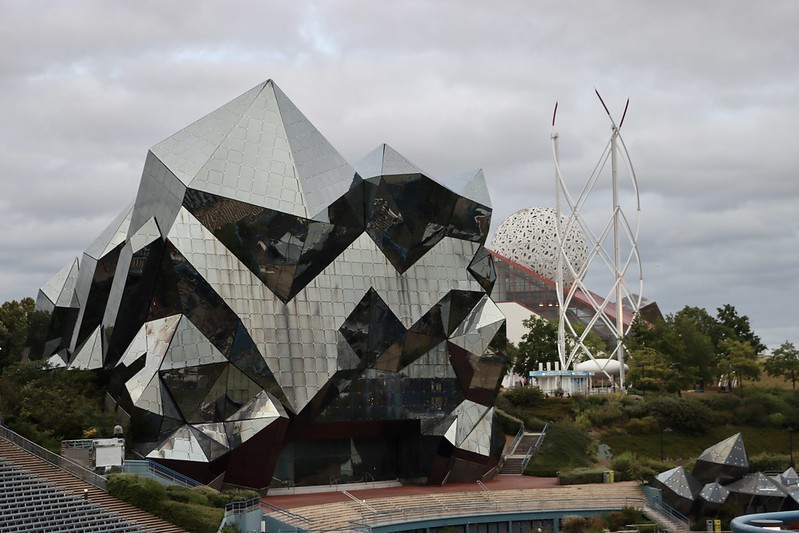
Futuroscope is a theme park based around film. It opened in the 1980s, and I went twice with my parents in the 1990s. This time I introduced it to my wife and our (then) seven-year-old, and it was a lot of fun.

Each of the pavilions is a different kind of cinema. Some have massive Imax screens, others are in 3D or the seats move with the film. In some, you may find yourself sprayed with water or blasted with air. The architecture is also futuristic, in a way that (for the most part) still feels modern even after over 30 years.

And yes, it’s very French. The food is much better than your average British theme park, and there’s some really whimsical evening entertainment. We would have liked to have stayed around for the evening sound and light show, but being July it was quite late at night. Again, there’s more photos on Flickr since I actually got around to uploading them.

Our 2019 summer holiday in the Dordogne

A photo of a ferry leaving Ouistraham port on our way home from our Dordogne holiday

I’m away on holiday at the moment, so this week’s posts are about previous un-blogged holidays from 2019, 2021, 2022 and 2023. Today, it’s our 2019 holiday to the Dordogne in France.

For our 2019 summer holiday in France, we went quite a bit further south, to the Dordogne region (named after the river that runs through it). As well as the overnight ferry from Portsmouth to St Malo, we stopped off at a hotel in Poitiers and so it took the equivalent of three full days of driving to reach our campsite near Bergerac. We took our own car, but we had to abandon it after (what I presume) was a failed wheel bearing saw me skid off the road into a ditch, so the second half of the holiday was in an a hire car.

As this holiday was five years ago, in June 2019, my memories are not the best, which is why there’s not a lot of detail here. It’s thanks to checkins on Swarm and my own photos that I can recall what we did.

Here’s where we visited:

A photo of Beynac in the Dordogne

Beynac-et-Cazenac

Benyac overlooks the Dordogne river where it cuts through a deep gorge, and the village is built into the side of the steep valley. It’s a pretty little place with narrow, twisting streets and craft shops.

A photo of Château de Castelnaud. It is a castle on top of a hill in the Dordogne in France

Château de Castelnaud

Castelnaud is quite a good castle. It sits high up, in a commanding position over the surrounding valleys, and the courtyard is full of catapults, trebuchets and over siege engines that might have been used during the various wars that it has experienced over the centuries. I remember that we treated our (then) three-year-old to a wooden sword and shield from the gift shop.

Gouffre de Proumeyssac, and underground cave complex

Gouffre de Proumeyssac

Known as the ‘crystal cathedral’, Gouffre de Proumeyssac is a huge underground cave full of stalagmites and stalactites. Clever use of lighting makes it a fascinating experience. Whilst nowadays there’s a wheelchair-accessible main entrance, you can also opt to be lowered into the cave in a basket, as the original explorers would have done at the beginning of the last century.

A photo of a fountain ans some traditional French buildings at Le Bournat

Le Bournat

Le Bournat is an open-air living museum – a bit like Beamish or the Black Country Living Museum. The aim is to recreate how people lived in the Dordogne region in the past, with farms and small industry to look at. Whilst I would argue that it’s not as realistic as its British counterparts, it’s very pretty and makes for a nice day out. Like many of the places we went to in 2019, I seem to remember visiting when I was much younger and it seems to have expanded significantly since then.

A view of the village square in Eymet

Eymet

Eymet (pronounced ‘ay-may’) is an example of a Bastide, or fortified town. This means that there are walls around the town centre, and buildings such as the church are fortified. There’s also quite a large British diaspora here, with British ex-pats making up around a quarter of the population. Like many small French towns, its communal wash house has been preserved.

A photo of Château des Milandes in the Dordogne

Château des Milandes

Our second château of the holiday was the Château des Milandes. It was home to the American singer Josephine Baker, and so it has a number of her more famous (and infamous) outfits and tells her story. There are some nice gardens outside, along with an aviary which is home to a number of birds of prey. If you time your visit right, then you can watch a bird of prey show. I visited here with my parents when I was younger and had the interesting experience of having a harris hawk land on my head, which my dad took a photo of.

A photo of a Coypu at Aquarium du Perigord Noir

Aquarium du Perigord Noir

We usually end up at an aquarium whilst on holiday, as it’s a way to spend a wet day, and so we went to the Aquarium du Perigord Noir. Besides the many fish – mostly freshwater, as it’s a long way inland – they are a breeding centre for caimans, and have some coypu (also known as Nutria or Chilean beavers).

On the way back, we stopped off at a hotel in Le Mans, and also at Warwick Castle once back in England.