
How we dry laundry

A photo of our tumble dryer that we use for drying our laundry.

One of the benefits of our kitchen renovation in 2022 was that it gave us space to install a tumble dryer in our cellar. Previously the cellar was inaccessible, and so our washing machine was in the kitchen; now both are in the cellar and out of the way.

Tumble dryer

We bought this Grundig heat pump tumble dryer at the end of 2022. Being a heat pump model, it’s very energy efficient; if you want to know how heat pumps work, this interactive guide from The Guardian is worth watching. Consequently, it’s cheap to run; whilst it cost more upfront than a regular condensing tumble dryer, over time, it works out cheaper. It’s not a ‘smart’ model but it’s simple enough to use, and at some point I may connect it to a smart plug with energy monitoring, so I get notified when it’s finished.

However, we can’t dry all of our laundry in a tumble dryer. About a third of our clothes aren’t suitable, due to either being handmade or having care labels advising against tumble drying.

Drying laundry outside

Ideally, we would dry as much laundry as possible outside. We have a small garden with washing lines, and there’s no cost involved when you let the sun and wind dry your clothes for you.

But we also live in the Pennines, which is one of the wetter areas of England, so we get fewer dry days than elsewhere. Indeed, it’s rare that we can dry our laundry outside at all in winter. When it is sunny and there’s a gentle breeze, drying laundry outside can be the quickest way, beating even the tumble dryer. But on a dull day with no wind, even after a full day outside, our laundry can still be damp.

Heated drying rack
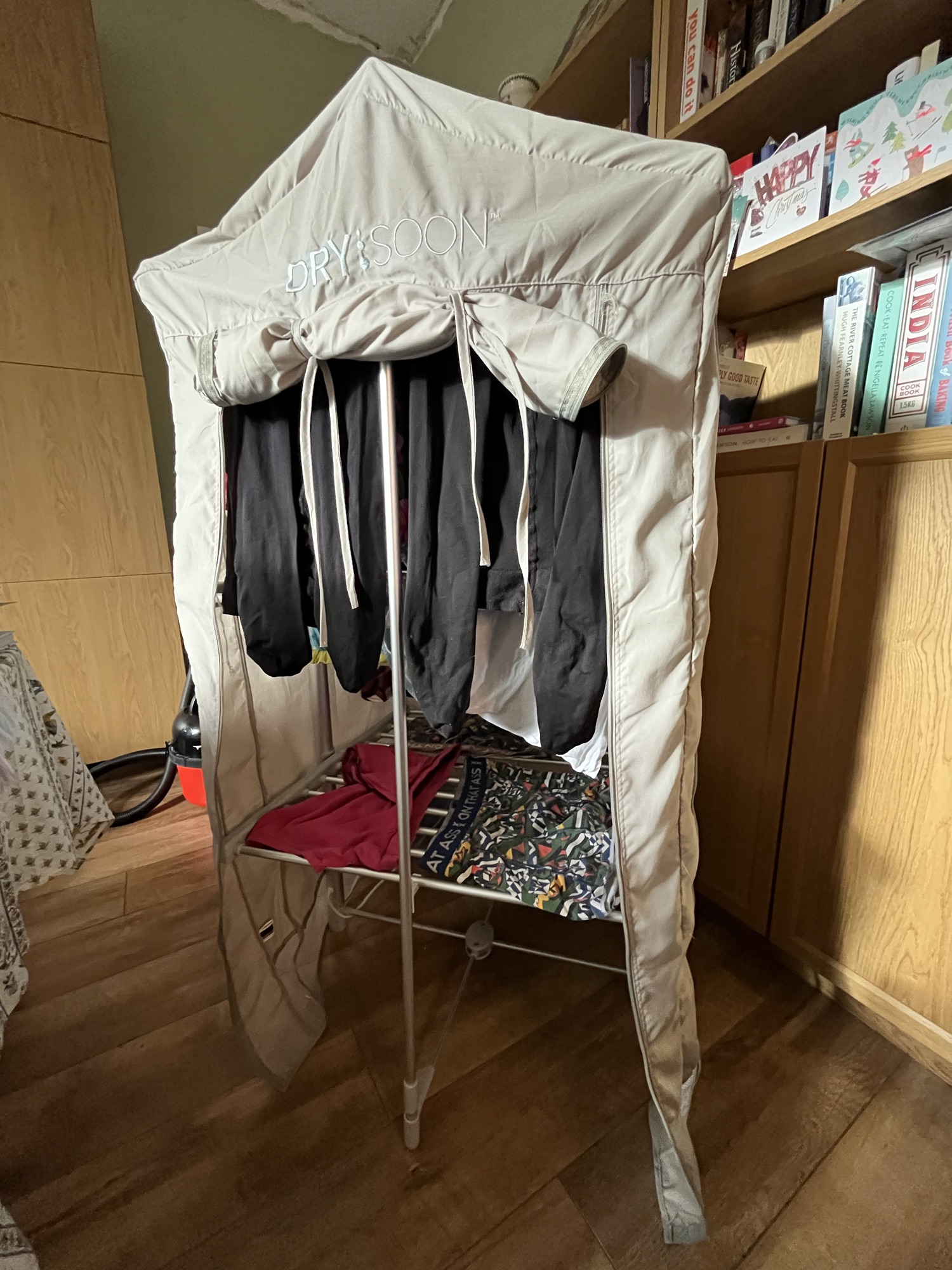
A Dry:soon heated airing rack, for drying laundy

So we needed a way of drying our laundry indoors that doesn’t use the tumble dryer. For this, we bought a Dry:Soon heated airing rack from Lakeland. The rack gently heats your clothes to dry them, and there’s an optional cover to go over the rack to keep the heat in.

These became popular in 2022 when electricity prices started to rise, as a cheaper alternative to tumble dryers. Indeed, they are cheaper to run than older condenser dryers. However, they don’t save much energy compared with our heat pump dryer, and so we just use it for clothes that can’t go in the tumble dryer.

How long clothes take to dry depends on how full the rack is and what material they’re made of, but I typically found 18 hours is enough to get all clothes completely dry. Our model doesn’t have a timer or a moisture sensor – just a rocker switch to turn it on and off. So I have it connected to a smart plug, and an automation in Home Assistant that turns it off automatically after 18 hours.

Bicester Village

Bicester Village

Today we went to Bicester Village, an outlet shopping centre in Bicester, Oxfordshire, whilst visiting relatives. It’s one of a number of outlet shopping centres, where shops sell off old, excess or seconds stock at discount prices. However, Bicester Village is somewhat posher than others.

By this, I mean it has shops from the likes of Gucci, Alexander McQueen, D&G, various Saville Row tailors, and other luxury brands that are normally the preserve of the ’1%’ who can actually afford these. If you’re happy with buying something that isn’t quite perfect, or from last season, then you can bag a significant discount.

Of course, despite these discounts, pretty much everything was still well out of our price range. Hooded jumpers for over £300 for example – and that’s a reduced price. In the end, we just bought some cheese and pasta from Carluccio’s and retreated to Starbucks for a coffee to warm up.

Visiting on a Sunday in the run up to Christmas meant it was very, very busy, although we got there before 11am so there were still a few parking spaces (top tip – use the car park next to Bicester Town railway station as it’s quieter). Sunday trading laws meant that some of the larger shops couldn’t open until 12pm, and when we went past just before then there was a queue of at least 100 people waiting to get into the Polo Ralph Lauren shop. This is despite it being one of three shops in the centre, and not the only brand to have multiple outlets – there were a couple of Calvin Klein shops as well, amongst others.

Also notable was that many of the signs were both in English and Chinese, and that UnionPay, a major card system in China akin to Visa and MasterCard, was accepted by many of the shops there. Hence there were many Chinese tourists shopping when we visited, although we heard a number of other foreign languages being spoken, and there was a wide variety of left hand drive luxury cars in the car park.

As a Northerner who doesn’t have a huge disposable income, coming to a place like this was profoundly weird, and from a social anthropology perspective it shows just how wide the gulf between the ‘haves’ and ‘have nots’ is in this country. Many shops did not have anything for sale under £100 per item, and yet neither me nor most people I know would pay those sorts of prices, even though they’re already discounted. Whilst this sort of place isn’t quite for the ’1%’, it’s certainly aimed at those in the 99th percentile. I’ll stick with my Marks & Spencers clothes.