
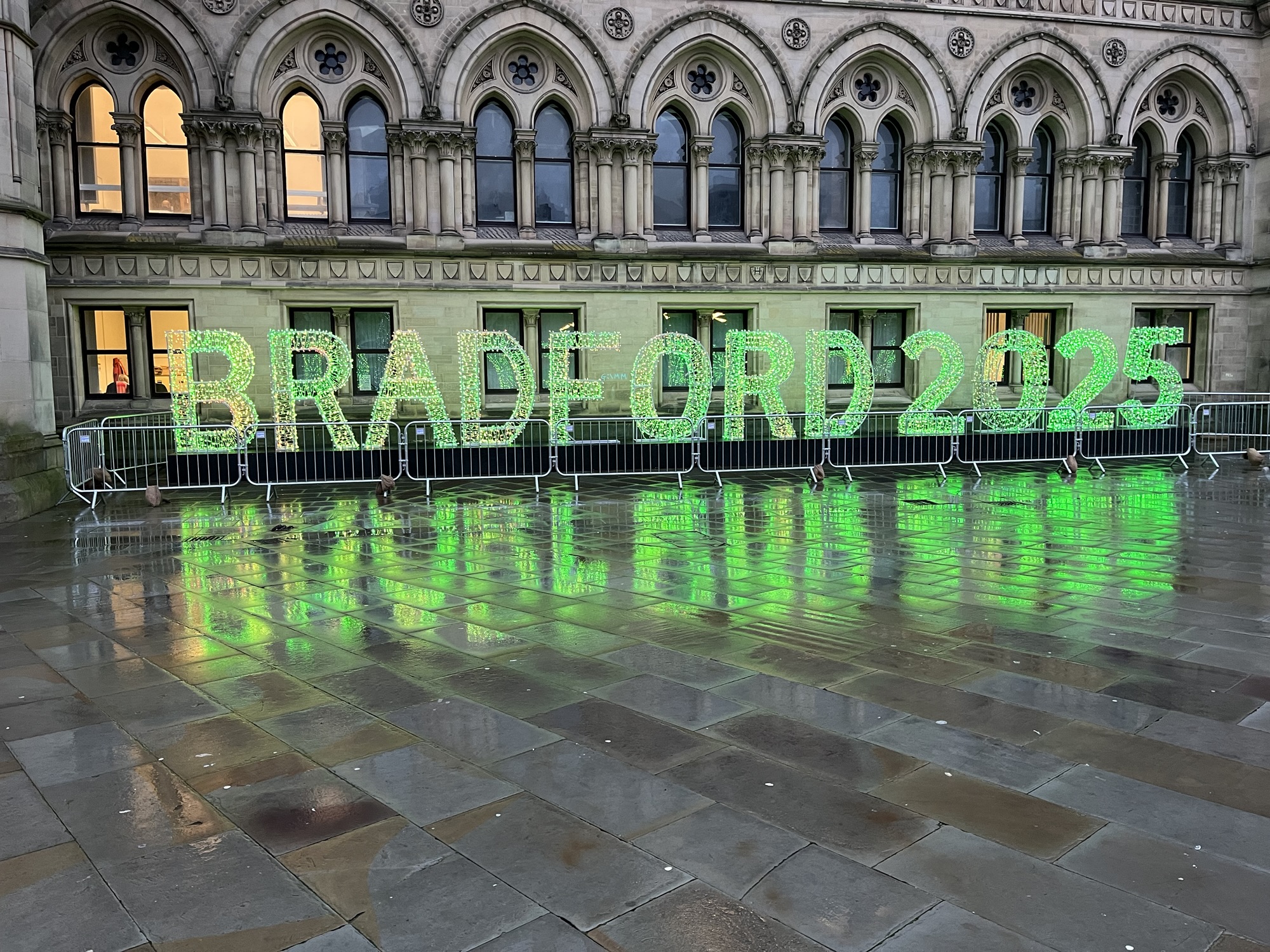
Bradford 2025 – UK City of Culture

A photo of some large illuminated letters spelling out 'Bradford 2025' in green, outside Bradford City Hall

Every four years, a different UK city is designated a City of Culture for the year. And this year, it’s Bradford, the city where I work and used to live.

This isn’t Bradford’s first rodeo. Back when we were still an EU nation, it was decided that a British city would be the European Capital of Culture in 2008. Bradford put in a bid, but wasn’t shortlisted. Ultimately, Liverpool won the bid, but the success of Liverpool’s year as European Capital of Culture resulted in the creation of the UK City of Culture designation, to take place every four years. Derry/Londonderry, in Northern Ireland, won the first designation in 2013, followed by Hull in 2017, Coventry in 2021, and now Bradford in 2025.

Now, I’m biased; I spent eight years living in Bradford and still work there, and indeed my employer is a major Bradford 2025 partner. But I was genuinely delighted when it was announced that the Bradford bid had been successful. When the bid was being prepared, way back in 2019, it was claimed that Bradford has the youngest population of any city in Europe, with 29% of people aged 19 or under. Bradford is also well known for being very multi-cultural, with a large population of British Asians. And there are a number of interesting cultural places in Bradford, including the Theatre in the Mill, Kala Sangam, Impressions Gallery and Cartwright Hall. Bradford itself became the first UNESCO City of Film.

The Bradford 2025 bid includes the wider Bradford district as well, so there’s the Saltaire UNESCO World Heritage Site and Salts Mill, and Haworth, long-associated with the Brontë sisters.

There’s already a long list of events planned throughout 2025. These include the re-opening of the National Science & Media Museum, which has undergone a year-long refurbishment. Bradford 2025 kicked off with Rise, an outdoor event which attracted around 10,000 people on both nights, hosted by Bradford-born illusionist Steven Frayne (who previously went by the name Dynamo).

It’s not just the Media Museum that’s had a refit. If it’s your first time visiting Bradford city centre in a while, you’ll find that much of 2024 was spent pedestrianising many of the streets, making it a much more pleasant place to walk through. Whilst there is some work still to complete, it looks much nicer and the extra trees and shrubs are welcome.

When Hull was City of Culture in 2017, it resulted in the creation of almost 800 jobs in the city, and regeneration of some run down areas by the docks. I hope that Bradford 2025 will be similarly transformational.

Paris cultural observations

Eiffel Tower through the trees from Montmatre

We’re back from our Parisian honeymoon. We had a great time and I have over 200 photos to sort and upload to Flickr at some point.

Whilst I could write a detailed review of everything we did whilst in Paris, instead I’ll just cover the things that I found interesting and different. A mixture of advice and observations, if you will.

General observations about Paris and France

  • Unlike in the UK, where the green man means it’s usually safe to cross, in France it ‘may’ be safe to cross as traffic may still turn whilst you are crossing.
  • VE Day is a public holiday each year, on the 8th of May.
  • A service charge is included in all restaurant bills, so tipping isn’t strictly necessary. Rounding to the nearest €5 or €10 is considered polite for good service though.
  • Raisin swirl pastries are known as ‘Escargots aux raisins’, literally ‘snails of raisins’.
  • Around the Sacré-CÅ“ur in Montmatre (but elsewhere as well) you may see the ‘String Men’, who have pieces of string in their hands. It’s a scam and you should walk away and ignore them. They are very persistent though.
  • Unlicensed street vendors are very prevalent in the tourist areas of Paris, and like the string men can be very persistent. Don’t buy from them.
  • Wifi hotspots called ‘Free Wifi’ aren’t free. ‘Free’ is a French ISP – you need to look for ‘Wifi Gratuit’ for hotspots that do not cost money to use.
  • Chartier is well worth visiting – it’s a late 19th-century dining hall that serves very good and very cheap (by Paris standards) food. We walked straight in on a Tuesday night but the queues can be 100 people deep at other times.
  • You now have to pay to get onto the roundabout where the Arc de Triomphe is.
  • The Moulin Rouge is not as interesting as it’s depiction in the Baz Luhrmann film. It’s also surrounded by sex clubs, adult shops, and the actually quite interesting Musée de l’Érotisme.
  • The original model for the Statue of Liberty is in a corner of the Jardin de Luxembourg. It’s a lot smaller than the one in New York.

The Louvre

  • It’s closed on Tuesdays.
  • The audio guides use Nintendo DS handheld consoles.
  • But rather than hiring an audio guide, you can download a smartphone app and use your own phone instead, if you prefer. There’s no wifi on-site though, so best to do it before you set off.
  • If it’s raining, rather than queue outside to get in, you’re better off going into the Carousel de Louvre shopping centre which is under the Arc de Triomphe de Carousel. It’s also connected to the Palais Royale – Musée de Louvre Métro station, so you can get from the Métro to the Louvre without needing to go outside.
  • Good luck with getting a good photo of the Mona Lisa – it’s a small painting and we had at least 100 other people jostling to get a picture. It’s pretty much in its own room now.
  • The museum was recently closed for a day after staff went on strike over pickpockets. As such, be careful with your valuables. Also, the French don’t have a separate word for ‘pickpocket’ so they just use the English word.

The Musée d’Orsay

  • It used to be a railway station. There’s still an RER station underneath but the nearest Métro station is about 200 metres away.
  • Photography is prohibited everywhere inside. I did see quite a few people taking pictures regardless, and there are loads of pictures on Foursquare, but I did also see one person being told off for taking photos. Interesting related article on the subject.
  • Many of the audio guides are iPod Touch devices, albeit ones that have been inserted inside a cheap, tacky-looking plastic case which covers the home button.
  • The café on the top floor is good and is located behind one of the two huge clocks. It is pricey but the mille-feuile is to die for.
  • There are a small number of Vincent Van Gogh paintings on level 2. ‘Exploding TARDIS‘ sadly isn’t one of them.
Rennes Métro Station

Paris Metro

  • There are very few escalators and lifts at stations. You’ll be going up and down stairs most of the time.
  • The Navigo card is the Parisian equivalent of London’s Oyster Card, but it isn’t promoted to tourists. We decided to stick with buying a ‘carnet’ of 10 tickets at a time, which is slightly cheaper than buying them individually.
  • Mobile phone coverage is available at most stations and even on the trains, although frequently it’s only 2G and not 3G.
  • Some lines, like 1 and 14, have modern, fully-automated trains, and platform edge doors like on London’s Jubilee Line, but some lines have trains that date from the 1960s and require you to turn a handle to open the doors. And on many of the older trains, the doors unlock a couple of seconds before the train has come to a halt, so it’s possible to alight from a moving train.
  • Line 6 of the Metro runs on an elevated section down the middle of a wide street to the west of Paris, near the Eiffel Tower. I gather this happens on the New York Subway from time to time as well.
  • Generally the ticket barriers only scan your ticket to enter the Metro, not to leave.
  • The RER is a bit like Thameslink (and Crossrail when that opens in London), in that it’s actually a full rail service that happens to pass through the centre of Paris. Some of the trains are double-deckers. Ticketing is fully-integrated with the Metro.
  • Some Metro trains run on rubber tyres, rather than metal wheels. It gives a smoother ride.

Bradford Mela 2010

Avenue

Yesterday I visited the Bradford Mela, an annual festival celebrating Asian culture. It’s held in Peel Park, which is close to where I’m currently living, and having missed it in previous years I decided to pop along.

Peel Park is quite large and the Bradford Mela takes over most of it. As well as a stage, ‘village green’ area and a central avenue, there are several rows of stalls from local and national businesses. You would need at least an hour to just walk around everything.

Despite having an Asian focus, the Mela has become a truly multicultural event and this is reflected both in the organisations present at the event but also the people there – it gave an almost perfect cross-section of Bradford’s population. No one race or background was under or over-represented.

We spent a few hours there and really enjoyed it. It’s on again today until 8pm – otherwise you’ll have to wait until next year.