
What ChatGPT thinks about Omar’s

On Monday, I wrote about Omar’s Balti House in Bradford. But before publishing it, I also asked ChatGPT the following:

Write a 300 word blog post about Omar’s Balti House in Bradford, West Yorkshire

So, here’s what it came up with:

Nestled in the heart of Bradford, West Yorkshire, Omar’s Balti House stands as a culinary gem, offering a delightful journey through the rich tapestry of flavors that define Balti cuisine. This renowned restaurant has earned its stripes as a go-to destination for locals and visitors alike, seeking an authentic taste of Pakistani and Kashmiri culinary traditions.

As you step into Omar’s Balti House, the warm ambiance immediately envelops you, setting the stage for a memorable dining experience. The restaurant’s commitment to authenticity is evident not only in its decor but, more importantly, in the carefully crafted menu. From aromatic biryanis to sizzling kebabs, each dish showcases the expertise of the chefs in delivering a true taste of the region.

One standout feature of Omar’s Balti House is its namesake dish—the Balti. Served in a distinctive, wok-like bowl, the Balti is a symphony of flavors, combining tender meats or vegetables with a medley of spices. The result is a harmonious blend that captures the essence of Pakistani and Kashmiri cuisine. Whether you’re a spice enthusiast or prefer milder flavors, Omar’s caters to all taste preferences, ensuring a culinary journey that suits every palate.

The commitment to quality extends beyond the kitchen, with Omar’s Balti House sourcing the finest local ingredients to create dishes that are not only delicious but also reflective of the restaurant’s dedication to supporting the community. The menu evolves with the seasons, ensuring that patrons can savor the freshest produce while enjoying a diverse range of dishes.

In addition to its culinary prowess, Omar’s Balti House prides itself on providing exceptional service. The attentive staff adds a personal touch to the dining experience, making guests feel not only welcome but also part of the extended Omar’s family.

For those seeking a taste of authenticity in Bradford, West Yorkshire, Omar’s Balti House emerges as a must-visit destination. With its rich tapestry of flavors, warm ambiance, and commitment to quality, this restaurant stands as a testament to the vibrant culinary heritage of Pakistan and Kashmir.

I have an interest in AI, and especially large language models like ChatGPT and their impact on my industry, higher education. We are seeing students using AI tools to write assessments, and even their personal statements for their university applications. And I think the above text is a good example of how AI is at the uncanny valley stage – it looks okay on first glance, but a more detailed critique highlights its flaws.

Firstly, I wouldn’t describe this as a ‘blog post’, even though this is what I asked ChatGPT to write. It reads more like a puff piece that you would read in some marketing to promote a town or city as a place to live or invest in.

It talks quite a bit about the balti dishes that the food is served on, although that could be because I mentioned ‘balti’ in the writing prompt. A major issue with AI is that they’re not always able to explain why they’ve done something. But it doesn’t mention the enormous naan breads anywhere – which, arguably, is what Omar’s is best known for.

And there are some things it has plain made up. The menu does not ‘evolve with the seasons’. Indeed, the menu doesn’t really evolve at all; whilst it has been reprinted a few times and the prices have gone up over the years, many of the dishes that are on there were ones that were available 20+ years ago. Also, I’m not sure about the ‘local ingredients’ either.

This all feeds into my concerns about the thousands of web pages currently filling up our search engines with AI-written content. How much of it has actually been proof-read, and is accurate?

In education, AI generated content is an issue for two reasons. One, it’s cheating, in the same way that plagiarism and essay mills are – it’s just that you’re using something written by a computer rather than another person. But there’s a quality issue too. I specialise in doctoral level admissions, and much of what current AI language models generate just isn’t at that level. You tend to get vague lists of things with few references (and sometimes these are made up), and if you ask it for a longer essay then it’ll probably start repeating itself. I’m sure if I’d asked for, say, 600 words on Omar’s balti house, it would have run out of unique things to say and just repeat the same statements in another way.

Most universities are now very much aware of both the opportunities and the threats that such AI models present; Turnitin, used by many universities, can now indicate whether an assignment has been written using AI as well as detecting plagiarism. There are simpler tools available online, such as AI Detector, where you can copy and paste a short piece of text. Indeed, when I put ChatGPT’s text above in there, it said that there was a ‘relatively high’ chance that it was written by AI.

I’m sure these language models will improve over time, and will overcome their current shortcomings. At which point, we may struggle to work out what has been written by a human and what was hallucinated by a computer. We’re certainly not there yet, and I don’t know how long it’ll take to get there, or whether it’ll be like driverless cars which seem to be perpetually ten years away. I hope this blog post serves as an explanation of why I won’t be farming out my blog post writing to AI any time soon.
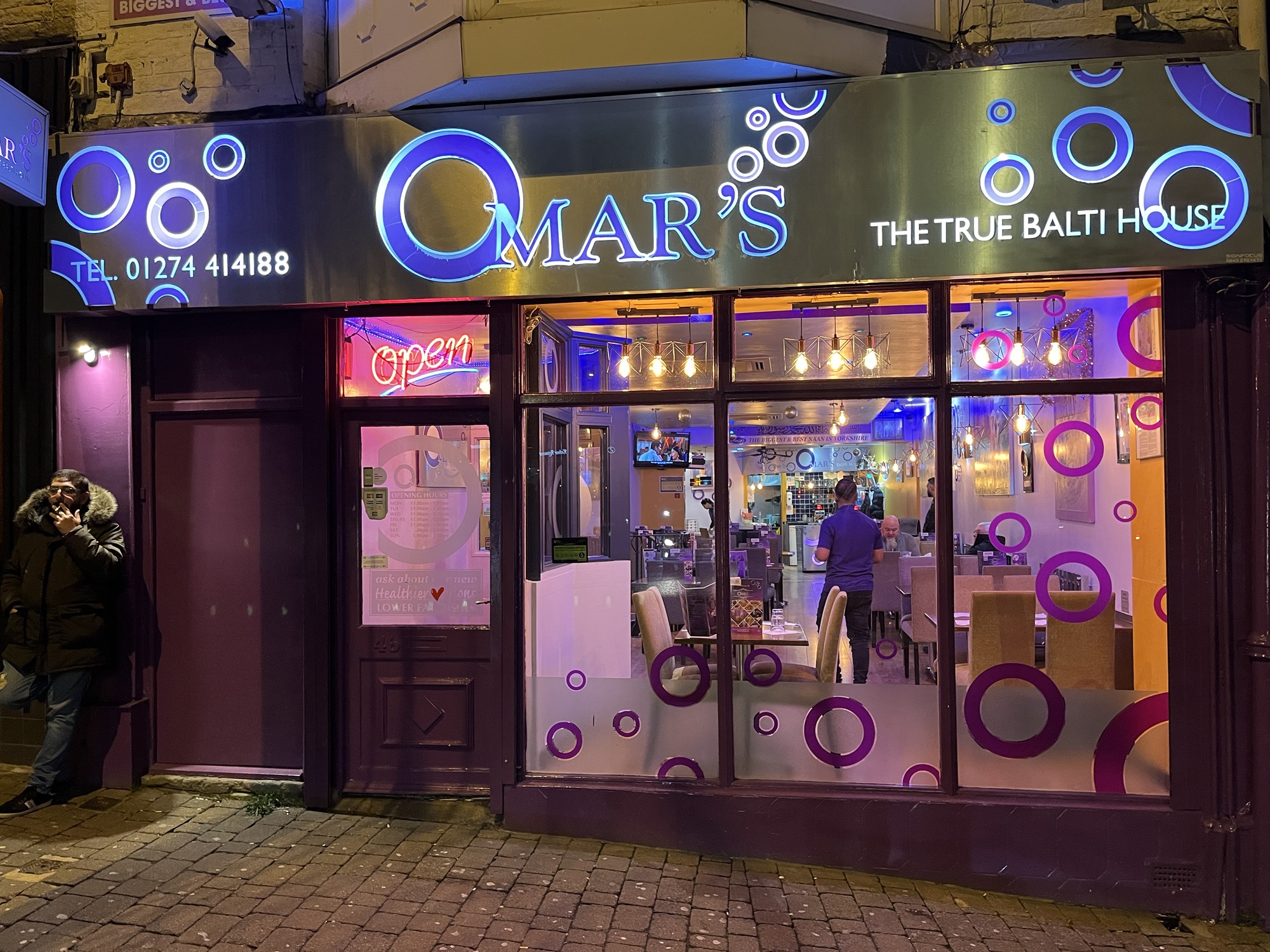
Omar’s Balti House in Bradford

A photo the outside of Omar's Balti House in Bradford

I’m sure I must have written about Omar’s Balti House on Great Horton Road in Bradford at least once before, although I don’t think I’ve ever written a whole blog post about it. We went there last week with a group of friends, which is an excuse to write about it.

Bradford is not short of curry houses and has repeatedly won the title of ‘Curry Capital of Britain’ over the years. And whilst Omar’s may not have the renown of other curry houses like Mumtaz, or the likes of Aagrah and Akbars which have become chains, it’s one that is held with affection amongst people who have lived in Bradford. Indeed, I’d argue that it’s a rite of passage for students who study in Bradford. I first visited early on in my first year at university, and have been back many, many times since.

Omar’s is known for serving its meals in the same metal balti dishes that they’re cooked in, and for it’s enormous naan breads. No really, they’re claimed to be the largest in Yorkshire and typically measure almost a metre across. Indeed, eating one of these naans on your own, with a balti dish, is a food challenge – and the record is currently 35 minutes having been last set in 2019. Before that, the record had stood for over a decade.

Massive naans aside, the food at Omar’s is good, and despite being a small restaurant they do cater for large groups. They also serve some western food, which is good when you have an eight-year-old who hates even the mildest spicy food.

Bradford – things to see and do as a tourist

This post is a retort to the news that Bradford has been named as Britain’s worst tourist city in a poll by Travelodge, whose ‘Bradford’ hotel is actually closer to New Pudsey.

Having lived in Bradford for over 7 years I wholeheartedly disagree that Bradford is ‘dangerous, ugly and boring’ as the survey suggests. It’s no less dangerous than any other major UK city and while Bradford has its fair share of 1960s monstrosities in architecture, there are some fine examples of stone-built Victorian buildings which have been faithfully restored and look rather splendid, all over the city.

As for boring, there are plenty of attractions for tourists to visit:

1. In the city centre:

  • National Media Museum – this is the UK’s most visited museum outside of London, and has a wide range of galleries focussing on film, photography, television, radio and new media such as the internet. Its latest addition is an arcade games gallery, where you can play a range of 1980s arcade machines. It’s also home to Yorkshire’s only Imax cinema. Best of all, it’s free to go in (bar the cinemas and some special exhibitions). It was influential in Bradford’s successful bid to become the world’s first UNESCO City of Film, which launches this weekend.
  • Peace Museum – one of Bradford’s lesser-known gems, this has a fantastic collection of items and records. It’s open on Wednesday and Fridays, and for pre-booked groups.
  • Bradford Sculpture Trail – around the turn of the millennium, a series of sculptures were commissioned across the city. This trial takes you around 27 different sculptures and statues, including those of JB Priestley, the famous Bradford-born author.
  • Curry houses – Bradford has a huge range of curry houses across the city and any visit isn’t complete without visiting at least one. There’s the world famous Mumtaz, the student favourite Omar’s, Markaz on Centenary Square and many more. What’s more is that they’re all very affordable.
  • Bradford Cathedral – being one of Britain’s newer cities (the Royal Charter was granted in 1897) the cathedral is quite small compared to the likes of York, Lancaster and Lincoln, however, it’s still an old building with parts dating from the 15th century. It holds regular events and sits in an area of Bradford known as ‘Little Germany’, full of well-preserved and renovated Victorian buildings.
  • Alhambra Theatre – one of several venues in Bradford (there’s also St George’s Hall, Bradford Playhouse and the Theatre in the Mill), the interior of this theatre has been thoroughly restored and looks magnificent. It hosts many major shows throughout the year.
  • The Wool Exchange – once the centre of Bradford’s wool trade, this fantastic piece of 19th century architecture has been restored and now hosts probably the nicest-looking branch of Waterstones in the country. There’s also a Starbucks on the mezzanine level.
  • Bradford 1 Gallery and the Impressions Gallery – these two new art galleries are in Centenary Square and host a number of exhibitions.

2: In the suburbs

  • Bradford Industrial Museum – located in late 19th century mill, this working museum has various examples of mill machinery, as well as a horse-drawn tram, worker’s houses and a transport exhibition. Entry is free and it’s open 7 days a week.
  • Lister Park – open to the public since 1870, this large park includes a boating lake, café, adventure playground, gardens and is also home to the Cartwright Hall art gallery which has recently been host to an exhibition of work by David Hockney, who originally came from the Bradford area. It was named Britain’s Best Park in 2006.
  • Peel Park – across the valley from Lister Park, this opened in 1850 and now plays host to the annual Bradford Mela which is one of the biggest festivals of British Asian culture in the UK.
  • Undercliffe Cemetery – Bradford was at the heart of the UK wool industry and many of the great and good from Bradford’s past have been buried here with some very elaborate and decorative memorials.
  • Bolling Hall – a mansion house which now houses exhibitions showing the life and times of Bradford families over the past few hundred years. Like many of Bradford’s other museums, entry is free.

3: Further afield:

  • Saltaire – a UNESCO world heritage site, and home to Salt’s Mill, which houses a permanent exhibition of art by David Hockney and a range of specialist shops and restaurants.
  • Keighley & Worth Valley Railway – a working steam railway that takes you through the pretty Worth Valley. Connects with the main line at Keighley station.
  • Haworth – a hillside village with a great range of independent shops and fine public houses.

While I think this list is pretty exhaustive I’m sure there’s bits I’ve missed. But there’s certainly no shortage of things to see and do as a tourist in Bradford and it’s well worth spending a day or two to look around. There’s also the City Park which is under construction and will be open by next summer.

(See also another take on the article and an article in our local newspaper)