Submitting dashcam footage to Op Snap

A screenshot of West Yorkshire Police's Op Snap portal

In last week’s review of our new Nextbase dashcam, I mentioned that, within 48 hours of having the dashcam fitted, we experienced a near miss which was recorded by the dashcam. So, we submitted this to our local police force’s Op Snap portal.

Most police forces have an ‘Op Snap’ (Operation Snap) portal; for example, where we live in West Yorkshire, there’s one on the West Yorkshire Police web site. If you have witnessed what you believe to be a motoring offence and have footage of it, then you need to submit this to the local police force for the area where the event took place, not necessarily your local force. So, if we saw something whilst driving in North Yorkshire, for example, we would submit to North Yorkshire Police’s Op Snap portal.

What happened

Because the footage has been submitted to the police and is, at the time of writing, being investigated, I’m going to keep the details vague and not share the video. We were stopped at a red light, and moved off when it turned green. Opposite us, a driver also moved off to turn right to cross our path, and almost hit us – honking their horn in doing so. Now, this is a junction we know well, and so we knew that this driver had gone through a red light to turn right. Indeed, this was one advantage of having both front and rear dashcams, as the rear dashcam clearly showed the red light.

I’m not qualified to give legal advice and I’m not a police officer, but I believe that the other driver failed to stop at a red light and did not drive with due care and attention. So, after discussing it with Christine who was driving, I submitted the footage to the police using their Op Snap portal.

How to do an Op Snap submission

If you witness something that you think could be a potential road traffic offence, then once you’ve found the portal for the local police force to where the offence took place, there’s usually a form to complete. Now, it’s important to understand what you are submitting. The form is a formal witness statement, and the video footage is evidence of potential criminal activity. You need to be aware of this because, as a result of the evidence you have provided, the police could charge someone with a criminal offence and this could go to court.

Whilst unlikely, you therefore need to be willing to attend court if this happens, and this may be a court near to where the offence took place. In other words, if you live in Yorkshire, but submit evidence to Surrey Police of an offence that took place on their patch, you could be called to attend court as a witness a long way away from where you live.

There is also a time limit on submissions. You need to submit the footage within 10 days of it being recorded, as the police have a 14 day limit to serve a notice of intended prosecution if they deem that an offence may have occurred.

The form that I filled out for West Yorkshire Police was straightforward, and structured so that the witness statement included the key details that they needed. At the end, I could then upload the video footage and submit.

What happens next

After submitting the footage, I got a confirmation email to say it had been received. Then, I got a follow-up email a couple of days later, telling me that the police would now attempt to identify the driver of the other vehicle. This presumably means that the police felt that the footage met their threshold for pursuing a notice of intended prosecution.

However, this was back in June and I’ve not heard anything since. As such, I don’t know what the outcome was. If this was their first motoring offence, then they may be required to attend a ‘driver education course’ which is similar to the speed awareness courses that drivers caught speeding the first time may be offered. They could also receive a fine, penalty points on their licence, and, rarely, be required to attend court. The latter is more likely if they already had penalty points on their licence and are therefore at risk of receiving a ban from driving.

I’m not sure if it’s standard practice to tell those that have submitted what the outcome was, but it would be nice to know I suppose.

Should you submit footage to Op Snap?

So far, I’ve covered the ‘how’, so here’s the ‘why’. If you spend any time on or near roads in this country, whether as a driver, passenger, cyclist or pedestrian, you will have undoubtedly seen examples of poor driving. Whilst speeding is hard to prove with dashcam footage, your dashcam could pick up people driving through red lights, ignoring traffic signs (like ‘no entry’ signs), dangerous overtaking manoeuvres or just a general lack of care when driving. These are all things that the police can deal with – if they’re aware of them happening. And that’s where Op Snap comes in.

Unfortunately, some people are just bad drivers, and they continue to be bad drivers because they do not face consequences for doing so. The police can’t be everywhere all at once, but dashcams and members of the public can help. Being convicted of one offence may be enough to encourage those people to drive more safely, if they know that their poor driving does have consequences after all. And if it’s not, then repeated convictions should hopefully see them banned from driving, and potentially having to complete unpaid work or a prison sentence if then found driving whilst disqualified.

People sometimes make innocent mistakes whilst driving, but by submitting footage, you may help the police find a pattern if the same cars and drivers keep coming up.

Plus, there are some people who become unfit to drive for medical reasons (unfortunately, this includes me, but I haven’t driven a car since my seizures started for the safety of myself and others). At present, it’s on individuals to report themselves to the DVLA as unfit, but some don’t – either because they don’t realise that their health has declined, or they’re told to be a healthcare professional but don’t as they see it as a loss of liberty. Being prosecuted for careless driving may be the wake-up call that some people need for them to realise their driving has fallen below the acceptable standard and to do something about it.

Incriminating yourself

There is one other factor to consider before you submit dashcam footage to Op Snap. The police officer who reviews your footage will be looking of evidence of a criminal offence, and your driving will be scrutinised as well. As such, you could put yourself at risk of prosecution, if your driving was also to a poor standard. This happened recently to a cyclist who was fined £1200 for his bad riding, whilst reporting bad driving.

I would strongly recommend reading this FAQ from West Yorkshire Police, from which a lot of the information here is derived, as it explains the process and what not to submit. For example, Op Snap portals shouldn’t be used for actual collisions, or other forms of non-motoring offences.

So whilst dashcams are primarily there for car insurance purposes, they can also help the police improve safety on our roads.

Nextbase 522GW Dashcam kit review

A photo of a front-facing Nextbase dashcam in our front windscreen

A couple of months ago, we got a Nextbase 522GW Dashcam (sponsored link) installed in our car. And today, I’m going to review it.

Why a dashcam?

By now, I think most people know what a dashcam is – the word is a portmanteau of ‘dashboard’ and ‘camera’, and is a camera that sits on your dashboard or front windscreen, and records video footage of the road ahead of you whilst driving. The key reason why people invest in a dashcam is usually because of car insurance claims; by having video footage of what happened during an incident, you can potentially protect yourself from being found liable for a claim if it is disputed by the other party.

As for why we specifically bought a dashcam, it comes down to some near misses that we’ve experienced, but also videos from Big Jobber on social media. For those unfamiliar with Big Jobber, he used to work as a claims handler for a car insurance firm, and has reviewed many hundreds of hours of dashcam footage when handling claims by the company’s customers and third parties. He now re-posts footage of car accidents and near misses, and explains how the claim would likely be settled.

More than once, there have been instances where the dashcam footage may have made a difference between a claim being settled on a split basis (e.g. 50/50) where both parties take a share of the liability, and one where the claim can be settled with the fault entirely on one driver. That should, in turn, result in lower car insurance premiums due to not having a fault claim in your driving history. And as our car insurance rocketed this year at renewal, getting a dashcam may well prove to be worth it.

The Nextbase Dashcam kit

Although I’ve linked to the Amazon listing in the opening paragraph, we instead bought ours as a kit from Halfords, including installation. Having the dashcam professionally installed offered a couple of key advantages:

  1. No trailing wires inside the car.
  2. It keeps your car’s 12 volt auxiliary power outlet socket (commonly known as a ‘cigarette lighter socket’) free for other things.

The kit comes with two cameras – a larger one to go in the front windscreen, and a smaller one that goes in the rear windscreen. That means you can record video looking both forwards and backwards. This underlines the first reason for having the dashcam kit installed professionally, as the wire leading to the rear dashcam is hidden away inside the car’s internal panels.

The kit also includes the windscreen mounts, cables, and a 32 GB micro-SD card, which goes in the front-facing camera.

Halfords stated that installation would take a couple of hours, but in our case it was done in just over an hour, and included a demonstration of how it works.

Using the Nextbase app

A dashcam is of limited use if you can’t get access to the footage. You can, of course, pop the micro-SD card out of the dashcam and use a card reader to access the files. Indeed, I’ve recently bought this multi-card reader (sponsored link) for that purpose. But there’s also a Nextbase app for iPhone and Android devices to allow you to connect to the dashcam directly.

The app works in the same way as my Canon SLR camera; it maintains a Bluetooth connection for basic communication, but when you need to download videos, it switches to Wi-Fi Direct. That does mean that, if your car has its own Wi-Fi network linked to a 4G/5G router (ours does but we don’t use it), you’ll need to disconnect from the car Wi-Fi temporarily to download the videos. These can then be saved to your phone’s camera roll.

The app is… okay. The design feels a bit dated and it can be a bit slow. But it works.

Unfortunately, you can’t connect the dashcam to your home Wi-Fi network (or the one in your car, if you have one). That means that it’s not possible to have the dashcam automatically transfer videos to a computer at home. Theoretically, you could rig something up with a Raspberry Pi that connects to your dashcam over Wi-Fi Direct, and then uses a separate Ethernet connection to save the videos somewhere, but I haven’t done this. Yet.

Video quality

So what’s the video quality like? Obviously, a dashcam with poor quality video isn’t as useful; you want it to be clear enough to identify car numberplates to identify other vehicles in the case of an incident – especially if they drive off without stopping.

The good news is that the video quality is pretty good. It records in High Definition, and seems to be okay even when driving into the sun. As it’s been the summer, we’ve not had the chance to test it at night yet. Within 48 hours of having the dashcam installed, we had a near miss, and the footage was clear enough to be able to read the other car’s numberplate.

Our Nextbase dashcam also burns in the date and time to the video footage, as well as the GPS co-ordinates and estimated speed that you are travelling.

However, it’s worth mentioning that you will likely fill up the included 32 GB micro-SD card quite quickly. We have to format ours every week; it’s easily done in the app, but if you’re often away from home, consider buying a bigger card.

Alexa built-in

The Nextbase 522GW model is one of those that has Alexa built-in. As it records audio from inside the car, it can listen out for the ‘Alexa’ wake word and then send commands to your phone by Bluetooth. At least, in theory; I found this to be temperamental and it wouldn’t always work. It’s a nice to have, but I wouldn’t buy this particular dashcam model just for the Alexa integration. Other voice assistants like Siri and Google Assistant aren’t supported.

Other dashcams to consider

Big Jobber has a list of dashcams he recommends on his web site, which doesn’t include our Nextbase model. The dashcam he currently uses, as I write this, is this Vantrue N4 Pro S 4K dashcam (sponsored link), which is rather more expensive but records video in 4K.

We went for this model because Nextbase dashcams seem to be well-reviewed, but mainly because it could be professionally installed at Halfords. Whilst we could have bought a better one from Amazon and fitted it ourselves, it wouldn’t be as neat as a fitted dashcam.

Privacy implications of dashcams

If you are an individual and you are using a dashcam in your personal vehicle, then you can just go ahead and install one. The rules are different for business vehicles; you need to let people know they’re being recorded and register with the Information Commissioner’s Office.

According to the pressure group Big Brother Watch, Britain has one of the highest concentrations of CCTV cameras of any country after China. In some respects, the increased use of dashcams is just an extension of this, but primarily by individuals rather than business or government.

Whilst person use of dashcams isn’t heavily regulated, you probably should be mindful of what you do with the footage. Delete any un-needed footage regularly, and don’t post videos online without good reason.

Hopefully we won’t need to use our dashcam footage in an insurance claim, but if we were involved in an accident, the footage should protect us from claims against if we weren’t at fault.

Surrendering my driving license to the DVLA

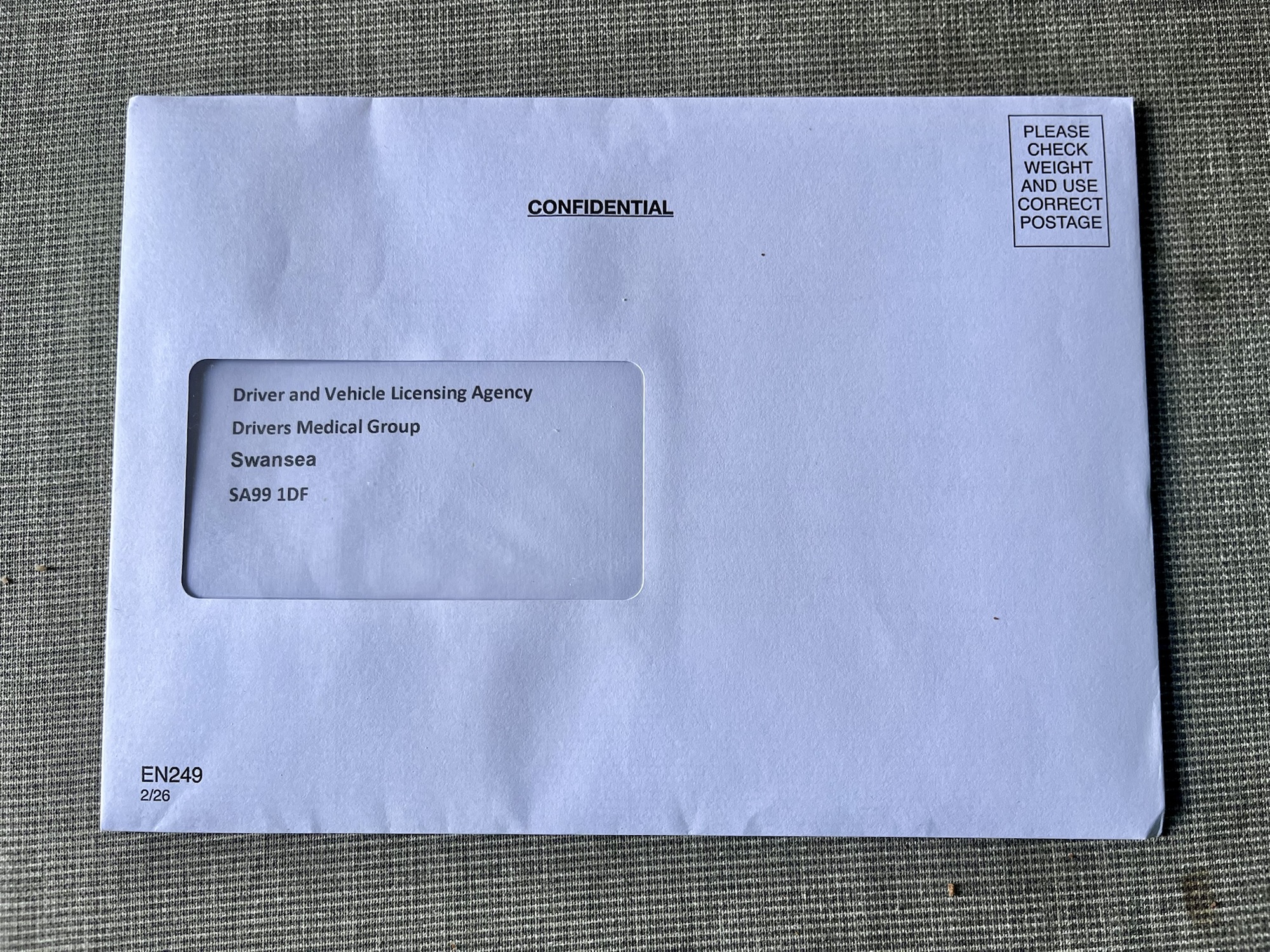
A photo of an envelope addressed to the medical team at the DVLA. My surrendered driving license is inside.

The good news is that I was discharged from hospital on Wednesday.

The bad news is that, as I’ve now had two seizures in six weeks, I’ve had to surrender my driving license to the DVLA. I can’t get it back until a doctor confirms that I haven’t had a seizure for 12 months, so it’ll be next summer at the earliest before I can drive again.

Reporting to the DVLA

The doctors who were treating me in hospital advised me to contact the DVLA to tell them I was no longer fit to drive. This is done online and is quite thorough, although you probably won’t get an immediate outcome. As it was, I received a letter through the post a couple of days later, confirming my unsuitability to drive and with a pre-addressed envelope to send my license back in.

As much as it will be a pain not being able to drive for at least the next 12 months, we’ll manage. Christine thankfully passed her test 18 months ago and so she can drive. Once I start going back to work in the office, I can take the train – we bought our house before I passed my driving test and so public transport remains an option for me.

Meanwhile, I’m taking anti-seizure medication twice a day and will have some further tests and scans to narrow down what’s caused the seizures. This may include surgery in future, but, fingers crossed, I won’t have another seizure in the next 12 months. Obviously, if I do, then the 12 month counter resets.

The need to self-report

Unlike most other European countries, it is an individual’s responsibility to tell the DVLA that they’re no longer fit to drive. And, unfortunately, some people carry on driving despite being told not to, sometimes with deadly consequences. It’s a particular problem with older drivers with failing eyesight, and who end up in prison for causing death by dangerous driving rather than enjoying their retirement. Nobody wins.

Hopefully, in future, there will be a system set up for healthcare professionals (doctors, but also optometrists and others) to report people unfit to drive to the DVLA directly, rather than relying on self-reporting. That way, people unfit to drive who are reluctant to give up driving can be forced to do so. It would need enforcement, and arguably resources to help people find alternative transport, but could save lives.

In any case, I understand why I can’t drive and have done what I’m legally required to do. I would never want to be responsible for injuring someone (or worse) because of a seizure whilst driving. And even if all I do is injure myself or damage the car, driving against medical advice will almost certainly invalidate my car insurance, leaving me out of pocket. It sucks, but driving right now just isn’t worth the risk to me or anyone else.

Changing EV charger speed terminology

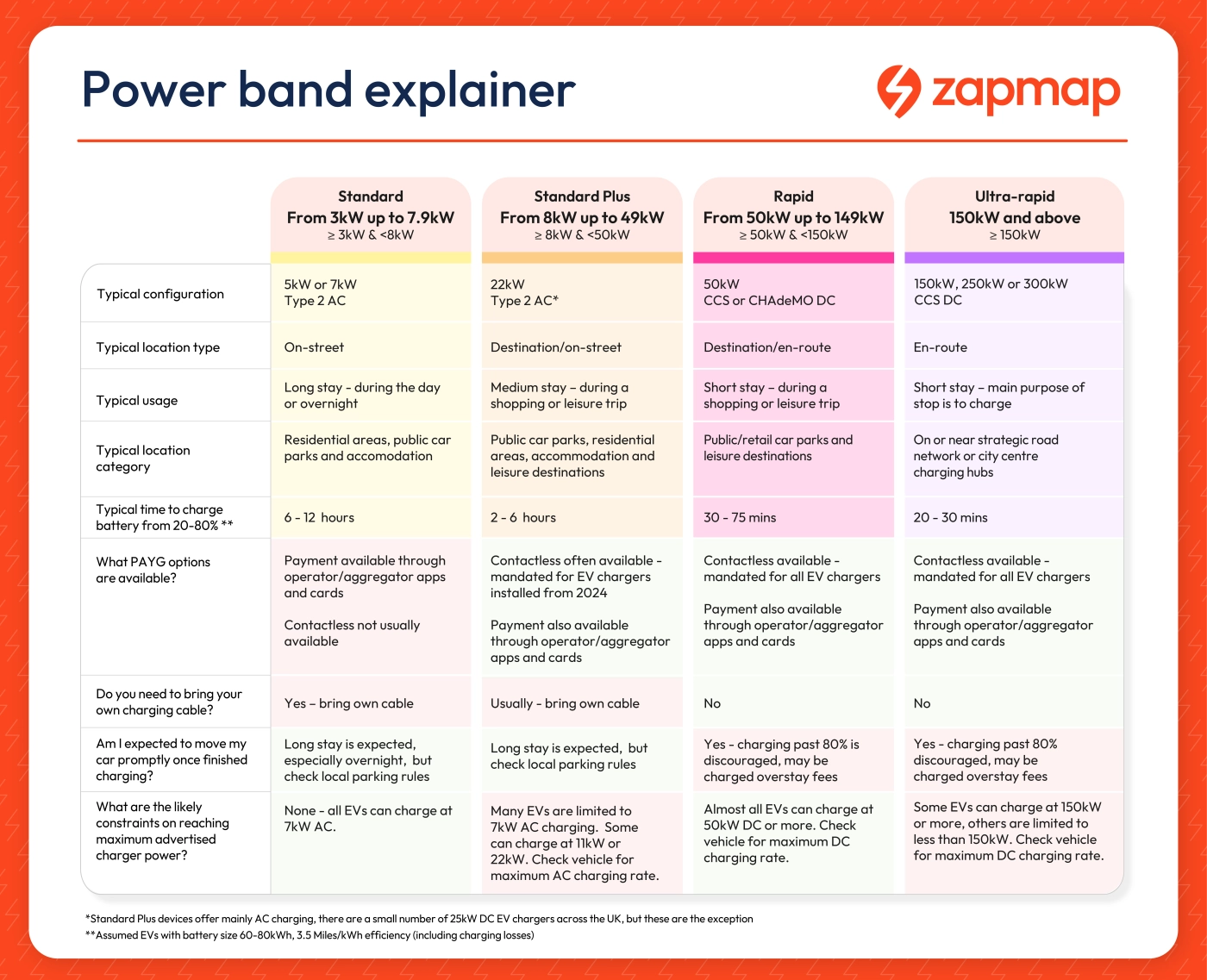
A Zapmap infographic explaining the different charging speeds for each type of charger

Zapmap recently published updated guidance about EV charger speeds, and the names that we give the different types of chargers. The same guidance has been supported by the Department for Transport, and now categorises electric vehicle chargers into these four categories:

  • Standard
  • Standard-Plus
  • Rapid
  • Ultra Rapid

I’ve put their infographic as the featured image above, and here’s how each category works in practice.

Standard charger

Standard chargers were often known as ‘slow’ chargers before, and cover speeds from 3 kW to 7 kW. These are the single-phase AC chargers that use a Type 2 cable (that you usually have to provide yourself). If you have a charger installed at home, then it will most likely be a Standard charger.

Renaming it from ‘slow’ to ‘standard’ is deliberate because ‘slow’ implies that these chargers are inferior. They’re not – I have one at home and so it’s the type of charger that I use the most. They’re also common as ‘destination chargers’, at places such as hotels or attractions where you would typically spend the whole day. As such, the slower speed is fine, and so ‘standard’ is a better term for these.

Standard-Plus charger

What are now known as ‘standard-plus’ chargers are those in the 8 kW to 49 kW speed bracket. Typically, these will also use Type 2 connectors, but will draw their power from a three-phase AC electricity supply. These were known as ‘fast’ before, but ‘standard-plus’ is a better name as they’re still slower than rapid chargers, and not all cars support the faster speeds.

For example, our Nissan Leaf can only charge at up to 6.6 kW. It’ll charge from a ‘standard plus’ charger, but at a ‘standard’ speed.

Both ‘standard’ and ‘standard plus’ chargers can be considered to be ‘level 2’ chargers, as per this guide I wrote in October. There exist a few older 25 kW DC chargers that would fit into this category based on speed, but these are in the minority and I haven’t personally come across them.

Rapid charger

Rapid chargers haven’t changed their name, and are still used to describe DC chargers that offer between 40 kW and 149 kW charging speeds. These will have a CCS-2 or CHAdeMO connector (or both), and are designed for fast charging. The charger units will include the cables, so you don’t need to bring your own.

Ultra Rapid charger

Increasingly, a new generation of charger can offer speeds of 150 kW or higher, and these are categorised as ‘ultra rapid’ – again, no change to the name. Like rapid chargers, these use a DC electric supply and will use CCS-2 or CHAdeMO connectors – although most that I’ve seen at this speed don’t offer CHAdeMO.

Our Nissan Leaf can only slurp down 46 kW using CHAdeMO, so whilst we can use an ultra rapid charger, we can’t take advantage of the faster speeds over a rapid charger.

Overall, I like the new categories, and I think they better manage the expectations for EV users needing to charge. Standard chargers are fine for even the biggest electric vehicles when staying overnight, for example, and so renaming them from ‘slow’ to ‘standard’ should mean that people aren’t discouraged from using them.

Hidden motorway services

Today I’m written about ‘hidden’ motorway service stations. These are places which offer most, if not all of the facilities of standard motorway services, but they’re typically not signposted from the road.

M1 – Markham Vale Services

There’s one that we’ve used a couple of times at Markham Vale on the M1 – most recently on our way back from Hardwick Hall earlier this month. Like the other hidden motorway services that I’ll mention here, this is built at an existing junction, in this case Junction 29A. As you may gather from the ‘A’ in the junction number, this isn’t one of the original M1 junctions. It was added in the 2000s to improve access to the Markham Vale Employment Growth Zone, and so the area is mostly offices and warehouses.

But a strip of land next to the motorway is now home to Markham Vale services. Unlike typical motorway service stations, there isn’t one single amenity building. Instead, it’s a cluster of separate buildings with their own car parks. There’s a fuel station, a small Asda, a Starbucks, a KFC, a McDonalds, a local fish and chip shop and a pub. Of these food outlets, all of them (except the pub) offer drive-through service as well. I’m not sure a drive-through pub would be a good idea. Most of these are operated by EG (formerly Eurogarages).

For electric vehicle owners, there are three separate sets of chargers, on the EV Point, Osprey and Instavolt networks, and they all happen to charge slightly different prices. When we were there, EV Point was cheaper, by 10p per kWh, than the others. Across the road, Gridserve are building one of their ‘electric forecourts’ which may open soon as well. That’ll offer 25 rapid chargers and its own amenities, as well as a children’s playground.

Because there’s not one central building, and because it’s not signposted, it’s a bit quieter than others. We were there on a Saturday afternoon and it was moderately peaceful. If you’re sensitive to noise and don’t like big echo-y spaces, then somewhere like this may be preferable.

There used to be a huge totem sign next to the fuel station that was viewable from the M1, but this seems to have been removed in recent years.

M62 – Plantation services at Gildersome

A little closer to home is at Gildersome interchange, or Junction 27 of the M62. It’s where the M621 splits off towards Leeds, and, to the south, is home to Birstall retail park and Ikea.

But to the north of the junction, just off the A650, is another EG site, which calls itself ‘Plantation Services’. Again, there’s a fuel station with a small supermarket – currently Spar, but EG is under the same ownership as Asda, so it could change. There’s also a Greggs, a Subway, a Starbucks and a Popeyes Chicken.

For electric vehicles, there are several chargers on the EV On The Move network.

It’s a compact site, but it’s easy to get back onto the M62 (or M621) after using it.

M62 – Chain Bar services

Going back a junction, to junction 26, there’s also a smaller hidden service station here as well. Junction 26 is where the M606 heads off towards Bradford, but there’s also a massive roundabout here too.

Just off this roundabout, on the A58, is a small site with a Starbucks, a Greggs and a Subway. There isn’t anywhere to get fuel here, but there are rapid chargers, again on the EV On The Move network. It therefore won’t surprise you to learn that this is also an EG site, who call it ‘Cleckheaton Services’.

Separately, but a little further down the road, is a pub with more rapid chargers (Osprey network), and across the road is a Premier Inn and another pub.

A1 (M) – Coneygarth services

This is a bit of a cheeky one. Coneygarth services is located at Junction 51, which is also the nearest junction to Leeming Bar Rest Area. However, whilst Leeming Bar is officially signposted from the motorway, Coneygarth is merely marked out as a ‘truck stop’. That doesn’t mean that it’s restricted to trucks though – cars can use it as well, and there’s fuel, car chargers, a Londis shop and a Subway available.

Here’s why it’s cheeky. The ‘rest area’ at Leeming Bar pre-dates this section of the A1 being converted to motorway in the 2010s. As motorway junctions are more spaced out, traffic heading to Leeming Bar rest area has to leave at junction 51 and then travel around a mile along an access road. Coneygarth services was then established at the junction, and so you could just call here, rather than take a longer detour to Leeming Bar.

Also, Leeming Bar is generally regarded as being the worst in the UK. The fact that it is considered a ‘rest area’ rather than a full services should be a clue; we had the misfortune of calling there on a baking hot afternoon in 2024. There’s literally just a Costa, a hidden-away McDonald’s, a fuel station and some car chargers. The main amenity building, which once hosted a hotel, is derelict, and has been for some time.

Advantages of ‘hidden’ motorway services

I’ve just listed three examples that I’m aware of, but there will undoubtedly be others. Indeed, as building a few electric vehicle chargers is much easier than a whole fuel station, I imagine we’ll see more of these pop up alongside motorway junctions where the land is available.

Because they’re not signposted from the motorways themselves, they tend to be quieter. This is especially true of those that you can’t see whilst driving, as you need to know that they’re there. That may also mean that the fuel is cheaper, and that you can charge your electric car more cheaply too.

You may also find a different range of food options available. If you’re planning a longer stop, you could have a nice pub lunch at Markham Vale. Very few ‘official’ motorway services have pubs – Beaconsfield services on the M40 had a Wetherspoons until 2022. Of course, you absolutely should never drink and drive.

I suppose the disadvantages are a narrower range of shops or food outlets, and that they’re more spread out. Not so good if it’s raining.

Difference between level 1, 2 and 3 chargers

A photo of my Nissan Leaf, with the car charging port open and a Type 2 cable plugged in.

This is one of those blog posts where I’d wondered something, looked it up, and am now sharing what I’ve found out. When it comes to charging your electric car, you may hear the terms ‘level 2’ or ‘level 3’ charger being used. They’re not common terms in the UK, but you may encounter them in other countries – especially the US.

Level 1 chargers

A level 1 charger is, essentially, just a standard 3 pin plug like you have at home. Your electric car will probably come with an adaptor cable, with a 3 pin plug on one end, and a Type 2 plug on the other end. There’s usually a chonky box on the cable, known as an EVSE (Electric Vehicle Supply Equipment), that regulates the power flow. Colloquially, these are known as granny chargers.

In the UK, our standard power supply is 240 volts and 13 amps. Going back to GCSE Science, we know that power is the product of voltage and current (amps), so the maximum output is 3.1 kW. An electrician may be able to fit a waterproof external plug socket for you which is rated at 16 amps, upping the maximum power output to 3.8 kW. One of our neighbours had this done for charging their plug-in hybrid as it was cheaper than a dedicated car charger (level 2, as we’ll encounter in a bit).

In the US, the voltage is lower (typically 120 volts) but the current can be as high as 20 amps, depending on how it’s been wired. However, even a 20 amp socket in the US can only output a maximum of 2.4 kW due to the lower voltage.

A level 1 charger is therefore going to charge your car quite slowly – especially if you have a big battery. I have also seen photos of plug sockets that have melted due to continual use for charging electric cars. And it’s (probably) the least efficient; some tests suggest that 25% of the electricity doesn’t make it into your car’s battery and is lost as heat.

Level 2 chargers

Level 2 chargers are the dedicated electric car chargers that you can get fitted at home. In our case, we have a Rolec EVO unit, and this will be fitted to the outside of your house. In the UK, it’ll have a Type 2 connector, and will be capable of much higher current – up to 32 amps. That equates to (almost) 7.7 kW, which is the maximum that you can get on a single-phase electrical supply that is standard in UK homes.

My Rolec charger lets me vary the current, so I can set it below 10 amps if I’m not in a hurry and want to make the most of my solar panels. Level 2 chargers also incorporate EVSE inside them, so the cables just tend to have a standard type 2 plug on each end.

Many public chargers are also level 2 – especially older ones. Some may be connected to a three-phase electrical supply, which triples the power output to 22 kW. You’ll generally find these at places where you can park your car all day.

I used to describe level 2 chargers as ‘medium’ speed, but a full charge at 7 kW will take a long time for larger vehicles (they’re now known as ‘standard’ chargers for 3-7 kW and ‘standard-plus’ for 8-22 kW). For our Nissan Leaf, a full charge (from 0 to 100%) would take 6 hours and 30 minutes, although that’s partly because it can only accept 6.6 kW from level 1 or 2 chargers.

Level 3 chargers

Level 3 chargers are the rapid and ultra-rapid chargers that can output 40 kW or more – some can do up to 150 kW. Unlike level 1 and 2, these chargers use DC (Direct Current) rather than the standard AC (Alternating Current) that you would get from a standard 3-pin plug. They also use different plugs – CCS2 is the most common, but some cars, like our Nissan Leaf, use a competing standard called CHAdeMO. You’ll also find that these are almost always ‘tethered’ chargers that include their own cable, so you won’t need to plug your own cable in.

I doubt you would be able to get a level 3 charger installed at home, as they’re expensive and would probably need planning permission and authorisation from the electricity distribution network operator (DNO). But increasing numbers of these rapid chargers are available when out and about, and especially at places like motorway service stations where you need to charge quickly whilst en-route somewhere.

How fast your car will charge will again depend on its maximum charging speed. Our Nissan Leaf, when using CHAdeMO, can only accept up to 46 kW. Still, that means a full charge in less than an hour.

DC chargers are also more efficient, in that you’re less likely to lose power as heat than AC chargers. As these chargers are generally the ones you pay a premium for, that’s a good thing as almost all the electricity you pay for will make it into your car’s battery. However, regular use of rapid chargers can degrade the battery more quickly.

Regenerative braking in electric cars

My Nissan Leaf dashboard showing that it has regenerated enough energy through regenerative braking to add three miles to the range

One of the benefits of most electric cars (and many hybrid cars) is regenerative braking – recovering the energy created from braking to charge the battery. It’s something that most petrol and diesel cars can’t do, and it allows electric cars to extend their range slightly.

Regenerative braking is something that electric trains have done for many years (indeed most electric passenger trains in the UK have regenerative braking), but it’s something that is probably new to car owners.

The first law of thermodynamics

If you’ve studied physics, you may be familiar with the first law of thermodynamics. This law dictates that energy can’t be destroyed and it can only be changed from one form to another. When you press the brake pedal to slow your car down, the energy from the brake force has to go somewhere.

On a internal combustion engine (ICE) car powered by petrol or diesel, your car will slow down by the friction created when your brake pads are pressed against your brake discs. The energy is therefore wasted as heat, and braking gradually wears your brake pads down over time.

Electric cars brake slightly differently. They still have brake discs and brake pads, but when you want to brake, the electric motor can work in reverse. The resultant kinetic energy can then be converted into electrical energy that is fed back into the battery, rather than being wasted as heat. From what I understand, this is done using magnets; if you think back to GCSE Science, you’ll remember that a magnet, combined with motion, produces electricity.

Additional range

That additional energy flowing back into the battery can therefore extend the range that your car can achieve on a full charge. We’ve actually noticed the charge level go up whilst driving downhill. An example is when we’re heading home from Manchester; to reach Sowerby Bridge, we exit the M62 at its summit point which is 372 metres above sea level, and descend around 300 metres. Typically, the charge goes up around 2% over the 8 miles from the M62 to Sowerby Bridge.

One thing to note is that your battery needs some capacity to accept the extra charge from regenerative braking. Therefore, if your car is 100% charged, there won’t be any regenerative charge. On our car, regenerative braking is limited above 80% charge.

Overall, depending on the types of roads, regenerative braking tends to add between 5 and 10% more range, which equates to between 7 and 14 miles. As well as allowing you to drive further on a full charge, it also saves a bit of money.

Reduced brake wear

Because you’re using the car’s electric motor to slow down, you should also find that your car’s brake pads and brake discs suffer less wear and tear. Again, this will save you money, as the discs and pads won’t need replacing as often as they would in an ICE car. It also reduces your car’s emissions; not only do electric cars not have any tailpipe emissions, but the particulate emissions from your brakes is also reduced compared to an equivalent ICE car.

How much regenerative braking your car will do, will depend on its mode. On our Nissan Leaf, in standard and eco driving modes, it will do a moderate amount of regenerative braking. But if we pop it into e-pedal mode, which is its one-pedal driving feature, the motor brakes more aggressively to regenerate more energy. We tend to keep it in e-pedal mode almost all of the time, although it’s of less use on motorways, for example.

Regenerative braking is a nice bonus feature of electric cars, and helps them be more efficient. It also adds to their lower maintenance costs, through lower brake wear. It’s certainly something to consider when weighing up whether to buy an electric or hybrid car.

Some thoughts on the state of public electric car charging in 2025

A photo of my Nissan Leaf, with the car charging port open and a Type 2 cable plugged in.

So we’re about a month into owning an electric car, and in that time we’ve taken it on two long distance trips – our holiday in Wales, and to the Midlands and Oxfordshire for a family birthday. As our Nissan Leaf only has a 150 mile range on a full charge, we were therefore reliant on public chargers to be able to continue our journeys. This post is therefore some collected thoughts on our experiences, in case you are thinking about switching to an electric car.

Availability of charging bays

Across the UK, there are almost 42,000 places you can charge an electric car, according to ZapMap, with each location offering an average of two chargers and three connectors. However, sometimes you would encounter a charger with two bays, for two cars – but the charging machine could only charge one car at a time. This was a particular problem with the faster ‘Rapid’ chargers. There were a couple of occasions where we arrived at a charger, and could plug in a cable, but would have to wait because another vehicle was already charging.

Other times, we would get there and all the chargers would have been taken. On the way back from Wales, we visited Chester Zoo, which I’ll blog about later in the summer. There are 26 charging bays available, but on a summer Saturday in August, all were taken by the time we arrived at 10:30am. Thankfully, I could check their availability on an app, and was able to move our car around when one had become free around lunchtime.

There is a degree of etiquette when it comes to charging a car. For example, if your car has finished charging, then, if you can, it’s best to go back to it and move it to a standard space to free it up for someone else to use. Also, don’t hog a rapid charger if there’s a slower charger available that you have the time to use.

So far, we’ve not encountered a charging bay being ‘iced’, as in occupied by a standard petrol or diesel car with an internal combustion engine (ICE).

Only slower chargers available

Many public chargers are 7 kW ‘medium’ speed chargers. A full charge on one of these would take about six hours for our Nissan Leaf, and likely much longer for those with much bigger batteries. These chargers are fine for ‘destination charging’ – for example, at Portmeirion, where we were intending to stay for the whole day anyway. But they’re no good for a quick charge to continue a journey.

This problem will get better in time as more rapid and ‘ultra-rapid’ DC chargers are installed.

CHAdeMO, or the lack thereof

Our Nissan Leaf can charge from three types of plug:

  • Standard 3 pin plugs at around 2 kW for a slow charge
  • Type 2 plugs at around 7 kW for a medium charge
  • CHAdeMO plugs, for a rapid charge of around 40 kW

CHAdeMO is a Japanese standard, and a number of Japanese cars of a similar age to our Nissan Leaf were built with these sockets and sold worldwide. But it’s not the European standard for fast charging, which is CCS2. CCS2 looks similar to the type 2 socket, but with an extra bit on, and it’s DC rather than AC. We can’t use CCS2 chargers without buying a converter, and they’re expensive – at least £600.

A lot of rapid chargers will just have one or two CHAdeMO plugs. A good example was Northampton services on the M1, where a bank of 12 rapid CCS2 chargers have been installed, but only one CHAdeMO charger. Which, predictably, was already occupied by another Nissan Leaf. Thankfully, we managed to find somewhere else to charge.

I get the point that barely any new electric vehicles are being built with CHAdeMO connectors, but for those of us with such cars, it can be a pain when they’re not available.

All the apps

Public car charging apps are a bit like car parking apps, in that you may well end up with several of them installed. Early on, many public chargers could only be used using an app – I remember talking to someone who was a very early electric vehicle adopter, who said that having all the apps was the worst thing about it. Thankfully, many public chargers offer contactless payments with a credit card, which is much easier. And some accept an RFID card, which you can order from several places that you then link to a payment method. We’ve got one from Octopus Energy, which works most of the time, but not always.

But some still require you to download an app, sign up for an account, link a payment method and then start charging. The worst of these, in my view, is Pod Point, where you also have to top-up a balance before you charge. That means estimating how much you’re going to need to pay before charging, and then having any money left over held in a Pod Point account. Unfortunately, Pod Point are one of the bigger operators, having partnered with Tesco.

The other issue with apps is phone reception. We managed in Wales, but had we not had a signal, there would have been some places where we wouldn’t have been able to use the chargers.

No chargers where you need them

I mentioned ‘destination charging’ above, giving good examples of Portmeirion and Chester Zoo that allow visitors to charge whilst they’re there. This is one of the key advantages of having an electric car, in that you can charge at somewhere you were planning to stop at anyway, rather than taking a detour to a petrol station.

But not all ‘destinations’ have charging. Whilst in the Midlands, we visited Cadbury World, which doesn’t yet allow its visitors to charge their cars. Which was a shame, although we did find a rapid public charger at an art-deco McDonald’s in King’s Norton.

Thankfully, it looks like more places are investing in charging infrastructure for their visitors. The National Trust, where possible, is installing chargers at many of its properties. And they’re potentially another income source for these attractions. Whilst some may offer free charging, as an incentive, most electric car drivers do expect to pay to charge. So whilst there is the upfront cost of installing electric car charging infrastructure, and then maintaining it, in the long run it could make a good return on investment.

Broken infrastructre

At home, our nearest rapid charger is a short walk away. But it’s been out of order for months, and we’ve seen a number of public chargers that were broken on our travels. This particular charger is in a local authority car park, and I understand that the council got funding to install it, but not maintain it. And last weekend, when we needed to use a rapid charger in Congleton in Cheshire, all of them across the whole town were faulty.

I wouldn’t say faulty chargers are a widespread problem, and most mapping tools for finding public chargers will indicate whether chargers are faulty if they have this data. That should reduce the risk of arriving at a charger with only a few watt-hours to spare, to find it’s out of order.

Charging at home is (almost) always cheaper

Electric cars make the most sense when you can charge them at home. Your home electric supply will (almost) always be cheaper than using a public charger. We’re on a fixed electricity tariff with Octopus, where we pay 20p per kWh. And that assumes that we’re charging overnight, without any contribution from our solar panels.

By contrast, even the cheapest public chargers are usually more than double that. Rapid chargers, especially those at motorway service stations, cost even more – typically 88p per kWh, so more than four times more expensive than charging at home. Part of the reason for this is that public chargers must charge you a higher rate of VAT. At home, your electicity bill has VAT at 5%, but public chargers have to charge 20% VAT.

If you need to use a public charger to top up your charge to get home, then it’s worth calculating how much you need to charge to get home. That way, you only need to charge your car by that much (plus maybe a bit extra) to get home, where the rest of the charge can be done more cheaply.

I say ‘almost’ always cheaper because you may get lucky, and find a free public charger. There aren’t many, but we came across two in Wales. Admittedly, one was a 3-pin plug, offering a very slow charge, and the other was a medium speed 7 kW charger. But still, it’s free electricity, and as we were away and reliant on public chargers, it was very welcome.

Farewell to our old car

A photo of a black Peugeot 3008.

By the time you read this, we’ll have got ridden of our previous car, a black Peugeot 3008, after six years. We’ll have picked up our new electric car and I’ll write about that in future blog posts.

The Peugeot 3008 was our second car, and we bought it in 2019. It was not a planned purchase, but was necessitated by our previous car being written off in France. That car was a Nissan Note, bought in 2015 shortly after I passed my driving test. We were therefore limited by what we could get locally, and at short notice.

Trim and spec

As it was, the Peugeot 3008 has served us well. When we bought it, it was six years old and had clocked up around 80,000 miles in that time, which probably meant that it was cheaper than it would’ve been with a lower mileage. We didn’t expect to be able to buy such a large car within our price range.

In terms of trim, it was an ‘Allure’ model, which meant that it had some additional features. These included a transparent head up display showing your current speed, cruise control with distance alerts and dual zone climate control. However, it also had the most basic stereo system, with just a CD player, 3.5mm auxiliary port, FM radio and a single USB port which could be used as an iPod Dock Connector. It didn’t support Bluetooth at all. A couple of years ago, we added a free-standing CarPlay and Android Auto screen which helped, but also meant having various wires trailing across the interior.

Dirty diesel

The other big disadvantage of the Peugeot 3008 was that it was a diesel. At the time we bought the car, dieselgate was thought to just apply to Volkswagen vehicles, but it may well be that our car was affected. We’ll see what happens when the case against Peugeot finally makes it to court.

Its emissions mean that we would have to pay to access certain clean air zones, such as London’s ULEZ and the clean air zone in Birmingham. As it is, we’ve not needed to enter those zones whilst we have the car, but will be taking our new electric car into Birmingham’s clean air zone next month. Ironically, our previous Nissan Note would’ve been fine in the ULEZ with its petrol engine, despite being an older car.

That being said, it did have a six speed (manual) gearbox, and that sixth gear was great for motorway driving.

Getting expensive

I wrote last year about how keeping our car roadworthy was getting expensive. It had been in the garage for repairs four times in as many months, and would be back in again within a month.

What proved to be the turning point was finding a patch of rust on one of the doors. Getting this fixed would have cost a lot of money, and with the car’s mileage continuing to increase, we decided it would be beyond economic repair. There’s also a laundry list of other issues:

  • The tyre pressure monitor on one of the wheels has never worked in the six years we’ve owned it, and so the car beeps loudly at you after around 10 minutes of driving to tell you this.
  • Various squeaks and knocking noises, suggesting bits of the car are working loose.
  • The air conditioning hasn’t really worked in well over a year, despite being recharged.
  • It seems to burn out headlight bulbs quicker than it should do.
  • It’s always leaked very small amounts of oil, but it’s never been clear where it’s leaking from.

I spent about an hour yesterday getting our personal effects out of the car, which included £3.04 in change that had ended up in various nooks and crannies.

Trading it in

We are doing a part-exchange, so the value of the old Peugeot 3008 will be used as a discount on the new car. However, with our car now having almost 130,000 miles on the clock, it’s worth less than £1000. Indeed, the part exchange quote we got was about 10% what we spent on it six years ago.

It’s probable that the car will be sold at auction. After which, who knows. I wouldn’t be surprised if it’s stripped for useful parts and scrapped. It would be a shame, as it’s been a good car for us. It got us through the pandemic, and we’ve taken it on three holidays, including two in France. But unless someone is able to repair it cheaply, I doubt it’s worth much to anyone.

Incidentally, our old Nissan Note is still on the road, as far as we can tell. After we left it behind in France, the insurance company arranged for it to be collected and sold it to a car breakers. However, it looks like they fixed it up and got it back on the road, and it passed an MOT as recently as this May. I can only assume the breakage firm had enough spare parts to patch it up and sell it on.

Our journey towards an electric car – part II

Time for a second post in this series about our journey towards an electric car – part one was last week. This time I’m going to focus on the ‘why’ and the ‘why now’.

Why an electric car?

In less than five years, unless something changes, it won’t be possible to buy a new car solely powered by an internal combustion engine in the UK. From 2030, sales of new petrol and diesel cars will be phased out; there will then be a five year period where new cars must be fully electric, or hybrids. Then, from 2035, sales of hybrid cars will end too – so in ten years time, if you want to buy a new car, it will need to be electric. Or some other form of zero emissions vehicle that isn’t yet on the market.

Last year, around 20% of new UK car registrations were for electric cars. And, more and more public chargers are becoming available for electric car owners to use.

That’s the wider context. For us personally, an electric car makes sense for the following reasons:

  1. We’ll be able to charge it at home. Being able to charge an electric car from your own electricity supply is pretty cheap – especially if you have a tariff that gives you cheaper overnight charging for example. Currently, I work at home 2-3 days per week, and so we can have our car plugged in for long periods to charge up if needed. And we generate our own electricity from our solar panels.
  2. Most of our usage is short distance. Whilst we occasionally drive longer distances, most of our usage is for short journeys, and so we don’t necessarily need a car with a massive fuel tank or battery.
  3. It’ll be better for the environment. Electric cars aren’t totally emissions free – you still get particulate matter from the brakes and tyres emitted into the air. But you’re not burning a fossil fuel, and the UK electricity grid is become more sustainable all the time.
  4. It’ll be better for air quality. Where we live, in Sowerby Bridge, is a hotspot for poor air quality due to being in a narrow valley. By driving an electric car, we’d be no longer contributing to this.
  5. It’ll be quieter. Traffic noise isn’t a major issue for us, but just imagine how much quieter the roads would be without noisy engines. Also, as I have issues with hearing loss, less noise inside the car should make it a nicer driving experience.
  6. It’ll cost less to service. Compared to cars with an international combustion engine (whether on its own or as a hybrid vehicle), electric cars have fewer moving parts and consequently require fewer repairs.
  7. We won’t have to pay the ULEZ. I’m not planning to drive in or near London any time soon, but our current car would incur a charge under the Ultra Low Emissions Zone. Whilst many petrol cars are exempt, an electric car is likely to remain so if the criteria change. It used to be that electric cars were also exempt from vehicle tax, but that’s no longer the case.
  8. No gear changes. Compared to other nations, especially the US, us Brits have a weird obsession with buying new cars with a manual transmission, rather than automatic, and that trickles down to the used car market. Meanwhile, almost all electric cars only have one gear – electric motors work differently and so don’t need to have gears. Therefore, no gear changes. I think Christine was a bit cheesed off when she found out that she could’ve learnt to drive in an automatic instead, but at least it means she can drive our current car until we change it.

Why now?

As for why now, the key reason is that we need a new car soon. Our current car has lots of minor niggles that are starting to get annoying, and are likely to be costly to repair.

But also, more electric cars are starting become available on the used car market. We can’t really afford to buy a new car, but there’s a reasonable number of electric cars available in our price range. Whilst the capacity of the batteries does go down over time, we’re still happy to consider a used electric car.

Creative Commons License
Except where otherwise noted, the content on this site is licensed under a Creative Commons Attribution-ShareAlike 4.0 International License.