Reviewing my 2024 predictions

So, back in January, I made seven predictions about events that would take place in 2024. So, seeing as there’s just a few days left in 2024, let’s see how I did:

Twitter/X won’t become an ‘everything app’

Remember when Elon Musk took over Twitter in 2022 that it would become X, the ‘everything app’? I predicted that this wouldn’t happen in 2024, and, so far, it hasn’t. I don’t use X anymore, although I keep my account live, and upon logging in to write this, the only new things I could see were some kind of job search, and Grok, its AI ChatGPT competitor. This is a far cry from apps like WeChat.

One of the few things that Elon Musk is actually good at is over-promising and under-delivering, so this isn’t surprising. But X was supposed to be able to offer all sorts of new functionality, including financial services, if Musk were to be believed.

Labour will win the 2024 General Election

Yes, they did. But any other result was unlikely, to be fair. It has been a rocky ride since then, with Labour front-loading their time in power with unpopular policies like the limits on the Winter Fuel Payments. However, with the next general election not due until 2029, there’s time to re-build.

What I didn’t expect was how well the Liberal Democrats ended up doing in the election. Their tactics of concentrating on seats mainly in the south west massively paid off, with one of their best ever results.

There will be a ceasefire in Palestine

Nope, sadly. We’re over a year in now, and fighting continues. The recent regime change in Syria is a potential bright spot though.

But the war in Ukraine will continue

Yes, sadly. But it’s notable that things are not going well for Russia, with forces being drafted in from North Korea. That’s because Russia is rapidly running out of people fit to fight on the front in Ukraine, as shown by its massive fall in unemployment.

Energy prices in the UK will start to fall again

They did, and then they started going back up again in October, by around 10%. Overall, Brits are still paying significantly more for energy than we were a few years ago, although there are at least a wider range of tariffs available now.

The UK will do okay at Eurovision this year

No, we didn’t really. We came 18th out of 25th, with all the points coming from professional juries and none from the voting public. I was hoping we would do better, with Olly Alexander representing us, but I don’t think it was the best song.

Trump won’t win the US Presidential Election

Oh dear, a big no. Honestly, in the run-up to the election I though Kamala Harris had it in the bag, so I was surprised and disappointed that she didn’t win.

So, overall, half of my predictions were (mostly) correct. Which isn’t bad, although clearly there were some that I wanted to be correct but weren’t. Oh well.

Oh, America, not again

I genuinely thought that Kamala Harris would be the next president of the USA. She was running a professional, positive campaign, and had showed that she was capable of doing the job.

So you can imagine it was a very unwelcome surprise to wake up on Wednesday to find that Trump had won the presidential election. I think much of what I wrote back in 2016 still stands, but with more weariness this time. Obviously, I live in the UK and am therefore somewhat removed from the situation. And thankfully we elected a centre-left government here back in July, although how that’ll be seen by the next world’s most powerful man remains to be seen.

Ultimately, I just feel like it’s really unfair. As I said, Harris ran a good campaign. Whereas Trump and the Republican party resorted to gerrymandering, purging voters from electoral rolls, lies, and outright vote-buying on behalf of Elon Musk in Pennsylvania. And the bad guys are supposed to lose. I was really looking forward to be able to point and laugh at Musk for ploughing millions or even billions of dollars into Trump’s re-election campaign for it not to work out.

Unlike last time, we know what the next four years will entail, and I’m not particularly looking forward to it. I suppose all I can do is live my life in a way that would annoy Trump and his cronies: be kind and welcoming, not be judgemental or prejudiced, be extremely queer, and work with and not against people from marginalised groups and different faiths.

Some 2029 election predictions

An AI-generated image of a fortune teller looking into a crystal ball which says 2029

Okay, so I appreciate that we’ve only just got the 2024 general election out of the way. It’s likely that the next general election will be in 2029, and so I’m going to make some predictions. Mainly because it’ll be interesting to look back on them in five years time, to see if I was right. So, here’s what I predict:

The Tories won’t win a majority

I suspect that the Conservative party will be out of power for at least the next two parliamentary terms, and so will lose the next election in 2029. We know that Rishi Sunak will step aside as leader, once a successor is found, and so there will be a leadership election soon. We also know that, to be eligible to stand, you have to be an elected MP – and there aren’t many left now. Penny Mordaunt, for example, was seen as a potential candidate, but she lost her seat. Jeremy Hunt has also ruled himself out, despite having narrowly retained his seat in the House of Commons. He has stood twice before for leader and lost both times.

The names that are being discussed are:

  • Suella Braverman
  • Priti Patel
  • Kemi Badenoch
  • James Cleverly
  • Robert Jenrick
  • Victoria Atkins

As we saw last time, the Conservative party membership, when faced with a choice between Rishi Sunak and Liz Truss, went for Truss and triggered the Truss-Kwarteng Budget Crisis. Rishi was then brought in as leader after the economy crashed and Truss was forced out. I mention this, because Rishi was arguably the better choice (though not much better) and yet the mostly white, mostly older party membership voted for Truss. This wouldn’t be good news for Patel, Braverman and Badenoch.

The 1922 Committee

There’s also the issue of the rules of the 1922 Committee of backbench Tory MPs. I don’t have a better source other than this thread on Bluesky, but to be a candidate in a Conservative Party leadership contest, you need the support of 100 MPs. This is regardless of how many Conservatives MPs there are – which is currently 121. Therefore, any potential candidates are going to have to get the support of more than 80% of sitting MPs, and MPs will be asked to back multiple candidates – assuming that’s even allowed. Oh, and once a leader is elected, if 15% of sitting MPs send a letter to the chair of the 1922 Committee, a vote of no confidence can be instigated. That’s only 19 MPs in the current Parliament, as opposed to over 60 before.

Of course, I wouldn’t be surprised if the 1922 Committee and/or the Conservative Party itself changes its constitution, to adapt to having a historically low number of MPs.

After the 2029 election, there will potentially be a new crop of MPs who have better leadership qualities, and who can’t as easily be blamed for the mess that the Tories have made until now.

Labour will win again in 2029, but with a smaller majority

Labour have a lot of work to do. Even though yesterday was a Saturday, the first cabinet meeting took place, as a sign that the new government wants to hit the ground running. Of course, it could have been mostly performative, but most government roles have already been filled.

Interestingly, there’s a couple of appointments to ministerial roles outside of the House of Commons:

  • James Timpson, boss of the Timpsons business, is Minister for Prisons, Parole and Probation. Timpsons employs many ex-prisoners to help their rehabilitation and reduce re-offending
  • Sir Patrick Vallance is the new Science Minister – you may remember him as Britain’s chief medical officer during the Covid pandemic and his regular appearances alongside Prof Sir Chris Whitty.

I’m guessing both will need to be appointed as members of the House of Lords, but it’s refreshing to see people with relevant knowledge and experience being appointed to suitable roles. It gives me hope that this will be a government that actually gets things done, and I hope that, by 2029, they’ll have done enough to warrant re-election.

Not all of Reform’s MPs will last

I suspect that Nigel Farage is the dog that caught the car. He’s succeeded at being elected as an MP on his eighth attempt, but when faced with the day-to-day reality of being an MP of a small party, I suspect he’ll get bored soon enough and quit, triggering a by-election. Depending on who wins the Tory leadership contest, they may end up joining the Conservative party, although that will prove controversial and may see others quit in protest.

The same may happen with the handful of independents who were elected; either they’ll quit, or join one of the major parties.

There may be another coalition government

If Labour doesn’t do so well next time and we end up with a hung parliament, then I can see Labour potentially going into coalition with the Liberal Democrats. The SNP and/or Green Party may join too, depending on how many MPs they have and how many are needed to get a majority. Turnout was low this time and Labour managed to get elected with a thumping majority despite winning fewer votes overall than in 2019. So, Labour will need to get more people out to vote for them next time, rather than rely on a combination of apathy and split votes among the opposition.

Before the election, Labour talked about automatic voter registration, which would ensure many more people are registered to vote. Whilst they haven’t committed themselves to completely abolishing voter ID (which stopped 14,000 people from voting in 2023’s local council elections), there are likely to be changes to what ID will be accepted. I’m against voter ID personally – it tries to fix a practically non-existent problem – but accepting a wider variety of ID would be an improvement. The Electoral Reform Society shows an example of two almost identical Oyster cards, one issued to a young person and one to someone over 60, but only the latter is accepted under the current rules.

I think that’ll do for predictions. They say that a week is a long time in politics, so five years is almost an epoch.

It’s polling day!

A photo of a sign saying 'Polling Station' on the side of a building

Today’s the day when you can vote in the UK’s General Election (assuming you haven’t already voted by post). The polling stations opened at 7am, and you have until 10pm to get out there and vote.

If you’re not sure where your polling station is, use WhereDoIVote.co.uk – just pop your postcode in. Similarly, WhoCanIVoteFor.co.uk will tell you who will be on your ballot paper, and (most likely) some more information about the candidates and what they stand for.

You don’t need to take your polling card with you, but you must bring some photo ID with you. The Electoral Commission has an extensive list of what forms of ID are accepted, but the main ones include your passport and driving licence.

I’ll be off to vote in person this morning. Tomorrow, I’ll try to find the time to write about the result, once we have a picture of which party (or coalition of parties) is likely to be in government. I may or may not stay up for the exit polls tonight.

The 7 election candidates in Halifax

A screenshot of the map of the Halifax parliamentary constituency

So, there’s a General Election coming up on the 4th July. Although I live in Sowerby Bridge, our local constituency is Halifax, as we’re lumped with the larger town just up the road.

Since the last general election at the end of 2019, there’s a couple of changes.

New constituency boundaries

The first change is the constituency boundary. Whilst there will still be 650 constituencies across the United Kingdom, the boundaries have changed to ensure that there’s a more even balance of population in each. In our case, the Halifax constituency has grown slightly, and now includes part of the Ryburn ward which used to be in the neighbouring Calder Valley constituency. This adds the villages of Sowerby and Triangle.

A new MP

Our previous Labour MP, Holly Lynch, decided not to run again. She is currently pregnant with her second child, and trying to run a re-election campaign whilst expecting doesn’t sound like my idea of fun. She’s been our MP since the 2015 general election, and was re-elected in 2017 and 2019.

So, using the list from WhoCanIVoteFor, here’s who I’ll be able to consider voting for next month:

Labour: Kate Dearden

Kate is the Labour candidate, and most likely to win; Halifax has elected a Labour MP at every election since 1987. Indeed, since 1964, the Tories have only held the seat for the four years prior to 1987. As I’m a member of the Labour party, I’ll be voting for Kate.

Though not born in Halifax, she grew up not too far away in Bingley, and has worked in trade union roles prior to becoming a political candidate.

Reform UK: James Griffith-Jones

Reform is Nigel Farage’s latest political vehicle, and is fielding candidates in just about every constituency in England, Wales and Scotland this time. Previously known as the Brexit Party, James previously stood for UKIP in a local council election in 2016, but there’s a lack of information about him on Reform’s web site. Reform may be popular with some of the more rural areas of the Halifax constituency but I can’t see him winning here. The Brexit Party previously came third in 2019, beating the Liberal Democrats, but only winning 6% of the vote.

This post was edited on Wednesday 26th June in response to a comment from James Griffith-Jones who states that he is not a ‘far-right’ candidate.

Green Party: Martin Hey

Martin is already active in local politics, having been elected a local councillor in the Shelf and Northowram ward a couple of years ago. Judging by his profile, he’s a bit of a NIMBY and concerned with the amount of housebuilding proposed for the area. In the last general election in 2019, the Greens came last with just 2% of the vote.

Independent: Perveen Hussain

In addition to the six parties fielding candidates, there’s one candidate standing as an independent, who is Perveen Hussain. According to her candidate statement, she’s a local businessperson and a campaigner, especially around Palestine. The Park ward in Halifax has a large Muslim community and she may see some support here.

Liberal Democrats: Samuel Jackson

We don’t know what Samuel Jackson’s middle name is, so I’ll leave the Nick Fury comparisons out for now. He’s a local lad, born in the constituency, who works in one of the local textile factories. As mentioned, the LibDems polled fourth in 2019 with a little under 5% of the vote.

Workers Party of Britain: Shakir Saghir

Now this is an interesting one. The Workers Party GB is George Galloway’s latest vehicle, and Shakir recently outed Labour in the Park ward in the recent local council elections. I happened to drive through the ward on election day last month, and his posters were everywhere, alongside photos of Galloway and lots of messaging around Palestine. Policy on Palestine has been one of Labour’s weak points this year.

WhoCanIVoteFor reveals that Shakir was previously a Tory, having stood several times for the Conservatives in local council elections. His switch to the Workers Party seems to have helped him get elected in Park ward, but I would be surprised if he can repeat that success across the wider Halifax constituency. Also, as someone who used to work in Bradford West during Galloway’s last stint as an MP between 2012 and 2015, he comes across as an absolute grifter.

Conservatives: Hazel Sharp

Hazel Sharp has her own, rather basic web site. She’s originally from Scotland, but now works as a physiotherapist for the NHS. Which, considering the current Tory government’s record when it comes to the NHS, is surprising. Having looked at her Facebook page, her campaign seems to be focussed on a handful of more rural areas, with nothing from the suburbs of Halifax itself.

The Tories have come second in every election since losing the seat in 1987, and only lost by 400 votes (1%) in 2015. However, with their frankly disastrous campaign and falling poll ratings, I would be very surprised if Hazel is elected as Halifax’s next MP.

FWIW, I realise that Diamond Geezer has done the same for his constituency in London, but I had planned to write this for some time. Anyway, if you live in Halifax, vote for Kate Dearden on the 4th July.

An incoming General Election

A photo of our polling cards for the Halifax constituency for the General Election

If you’re in Britain, it hopefully hasn’t passed you by that there’s a General Election taking place on the 4th July. It was announced back on the 22 May in a very moist way by our current Prime Minister, Rishi Sunak. Had the Fixed-term Parliaments Act not been repealed, it would have probably coincided with the local and mayoral elections on the 2nd May, but instead we’re being called out for a second election in three months.

We’ve already received our voting cards through the post, but if you haven’t, or you’re not sure if you’re registered to vote, fill out the form now. You have until 23:59 on Tuesday 18th June to register, which is only a few days away.

This will be the sixth general election in which I’ve been eligible to vote. I turned 18 a year after the 2001 general election and so missed it, but I have voted in the 2005, 2010, 2015, 2017 and 2019 elections.

The folks at Democracy Club have a couple of web sites to help you with voting. Where do I vote? tells you where your polling station is, if you’re choosing to vote in person rather than use a postal vote. This information will also be on your polling card, although you don’t need your polling card with you to vote.

Who can I vote for? meanwhile lists the candidates standing in your constituency. There’s a record number of candidates standing this time – a total of 4515 across the 650 constituencies, which averages at almost seven candidates per constituency. Indeed, every constituency has at least five candidates standing, which is a first. As well as the three traditional main parties, the Green Party and Reform UK are fielding candidates in almost every constituency too.

The most is 13 candidates in Richmond and Northallerton, which happens to be where Rishi Sunak is standing. As well as the major parties, Count Binface is there, alongside the Monster Raving Loony Party (who are fielding 22 candidates in total).

In a later blog post, I’ll talk about the seven candidates that I can choose in Halifax, where I live. Although, as I’m a paid-up member of the Labour party, it’s pretty obvious who I’ll be choosing.

Election day

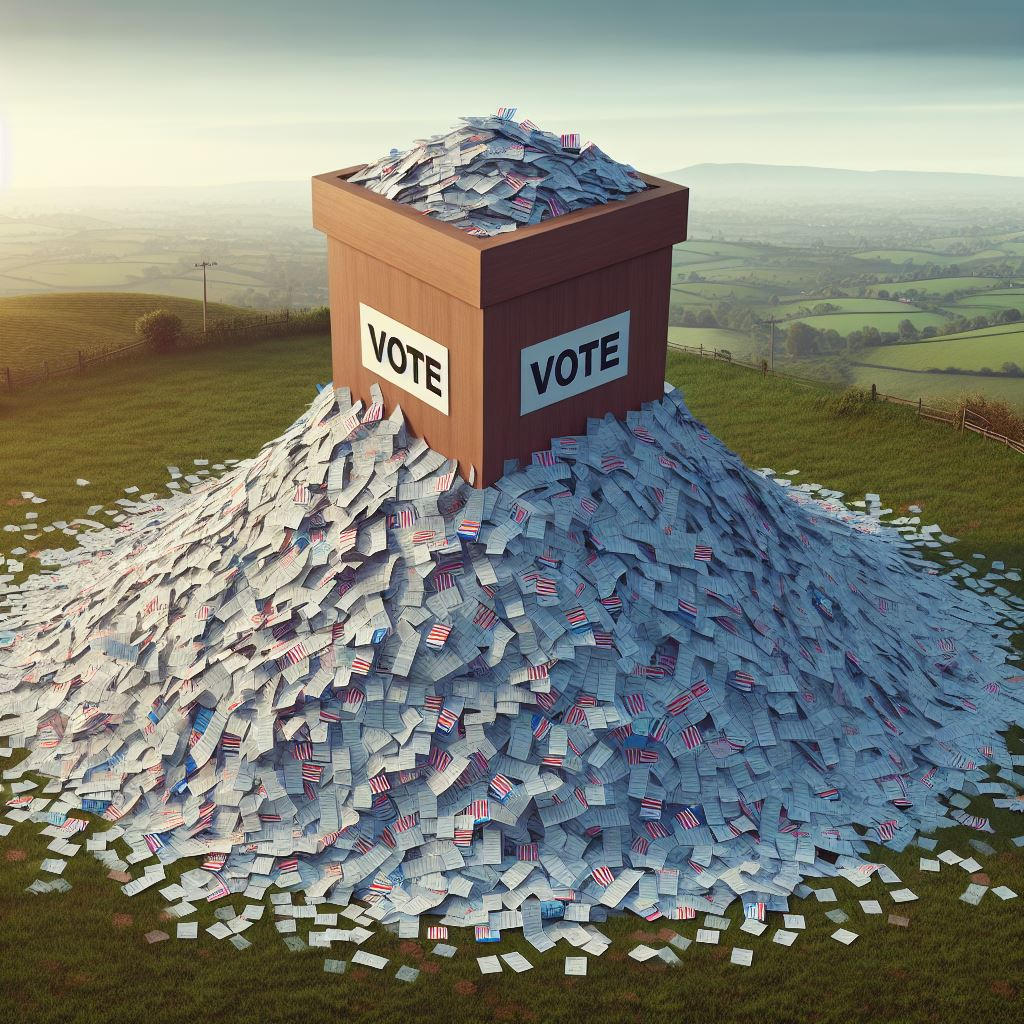
An AI generated image of a ballot box overflowing with election ballots in the countryside

Today is election day for much of the UK. It’s not a general election, as much as I would like it to be; that will be sometime between mid-June and mid-January. But here in Sowerby Bridge, we have two elections taking place:

As I am a card-carrying member of the Labour Party, I’ll be voting for them in both elections. It’s likely that Labour will win both too. Our local authority, Calderdale Council, is already a Labour-controlled council, as are the four other local authorities that make up West Yorkshire. And Tracy Brabin, the incumbent mayor, will almost certainly be re-elected. Although very little local polling has taken place, Labour are polling significantly ahead of all other parties nationally.

If you are voting today, remember that you need to take some photo ID with you. This will be my second election where photo ID has been required, but may be your first. Even though the actual rate of electoral fraud was almost completely insignificant before voter ID rules were introduced.

New mayoralties

Over in York, my parents will be able to vote for an elected mayor of York and North Yorkshire for the first time. This will be a more interesting contest, as York tends to lean towards Labour and the Liberal Democrats, whereas the wider (and more rural) county of North Yorkshire leans Conservative. If David Skaith wins the mayoralty for Labour, it will mean that the Conservatives really are in trouble when they finally call a General Election.

There will also be mayoral elections for the first time in the North East and East Midlands, and the Conservative mayors of Tees Valley and the West Midlands will be hoping to be re-elected. Again, should these mayoralties fall to Labour, it’s a sign that the Conservative party are a spent electoral force.

London mayoral election

And there’s the London mayoral election, where Sadiq Khan will be looking to become the first modern mayor to be elected for a third time. The ULEZ seems to be the key issue here; it was a key part of Khan’s manifesto and most of his rivals want to scrap or curtail it. The exception seems to be Count Binface, who instead wants to expand free parking to electric vehicle users between Vine Street and the Strand. Except for those who drive a Tesla.

We’ll get most of the local council elections tomorrow, with the mayoral election results coming in over the weekend. It certainly promises to be an interesting few days in British politics.

Some predictions for 2024

An AI-generated image of some felt art of a fortune teller with a crystal ball that says 2024 on it

Now that the year has started, I’m going to make some predictions for the rest of 2024. If only because it’ll be interesting to look back in a year’s time to see what actually happens.

Twitter/X won’t become an ‘everything app’

When the overly impulsive billionaire took over Twitter, he announced that it would become an ‘everything app’, like WeChat is in China. Essentially, he’s using his Twitter acquisition to realise his late 1990s dream for x.com, which would offer a huge variety of financial services.

But Musk also has a track record for over-promising and under-delivering. Look at the ‘full self driving’ mode offered on his Tesla cars, which, well, isn’t. His other firms, like The Boring Company, have also scaled down their lofty plans. So I don’t expect X/Twitter to offer much more than it does now by the end of the year.

I expect the core social media aspect of X/Twitter to continue to whither away over the year, thanks to declining user interest and lower advertising revenue. However, I still expect it to be around by the end of 2024 – I don’t think Musk is ready to throw in the towel and shut it down, or sell it at a massive loss.

Labour will win the 2024 General Election

We know that there will be a General Election in the UK this year, although not precisely when it’ll happen. Labour consistently leads in the polls, and has had some unprecedented by-election victories. I don’t think we’re looking at a repeat of 1997, when Labour won by a landslide, but I would expect a comfortable majority. How much change a new Labour government would be able to make partly depends on when the election is, but I’m not expecting the state of the country to massively improve by the end of the year.

Oh, and Sadiq Khan will win a third term as Mayor of London.

There will be a ceasefire in Palestine

Hamas’ deadly attack on Israel on the 8th October has to be condemned, but Israel’s response has been despicable with thousands of innocent civilians losing their lives. I expect Israel to find itself increasingly isolated on the world stage and a ceasefire will be inevitable by the spring of 2024. Unfortunately, I can’t see it being a route to lasting peace in the region, but any reduction in hostilities has to be better than this.

But the war in Ukraine will continue

I’m less optimistic about the war in Ukraine, which has been largely at a stalemate for the whole of 2023. Russia still intends to hang on to the territory that it has seized, including Crimea, whilst Ukraine hasn’t been able to make major advances. Meanwhile political issues in the USA mean that funding for Ukraine to carry on fighting isn’t guaranteed.

Energy prices in the UK will start to fall again

It will be a few days before we get official confirmation from the National Grid, but I’m calling it now: 2023 was the year renewables overtook fossil fuels as the largest contributor to British electricity generation. In the 12 years I’ve been running National Grid: Live at grid.iamkate.com electricity generation from fossil fuels has fallen from an average of 25.1GW to 10.2GW, while renewables have risen from 2.5GW to 10.8GW.

— Kate Morley (@kate) 2023-12-31T12:14:09.211Z

In 2023, the UK generated more electricity from renewable sources than from fossil fuels, for the first time. Whilst UK consumer energy prices went up by 5% on Monday, I anticipate that the cost of electricity will start to fall as more renewable power sources come online. The newly-operational Viking Link Interconnector means that we can trade electricity with Denmark, and the biggest wind farm in Scotland is now online.

That being said, there’s an imbalance in the UK as most wind power is generated in the north of England and Scotland, but the highest demand is in the south of England. And our energy grid doesn’t have capacity to move this, which means that some northern wind turbines have to be turned off and gas-fired power stations turned on – costing money and contributing to climate change. However, there’s been a big up-tick in home solar installations like ours which may help, albeit on a small scale.

The UK will do okay at Eurovision this year

In 2023, the Eurovision song contest was hosted in Liverpool. The 2022 winners Ukraine couldn’t host it safely due to the ongoing war, and the UK came second – our best result for over 20 years. And then despite what I thought was a good song from Mae Muller, we came second-from-bottom.

For 2024, Olly Alexander is representing the UK. As lead singer of Years & Years, I have some high expectations. I doubt we’ll win, but I would disappointed if we’re not mid-table. Of course, we haven’t actually heard the song yet.

Trump won’t win the US Presidential Election

Trump will almost certainly become the Republican Party’s candidate for president, but with two states banning him from their ballots, his campaign isn’t going well. I know Biden isn’t terribly popular, and wish he had stepped aside for someone younger like Kamala Harris, but Trump has made it pretty clear that if he wins (and manages to get a decent Republican Senate and House majority) then he will take the US down a path of authoritarianism that will take a lot of time to unpick. And whilst millions of Americans seem to be okay with this, I doubt it’s the majority.

We also don’t yet know what impact Trump’s legal issues will have, or whether the Federal Supreme Court will overrule Colorado and Maine’s bans. I didn’t think Trump would get elected in 2016, and so I have been wrong about this before, but I hope people’s experiences of 2017-2021 will guide them to vote against him again.

So these are my predictions for 2024. We’ll see at the end of the year whether they happen or not. Meanwhile, have a look at some other predictions from Terence Eden and Diamond Geezer.

Oh, America

Like most of the world, I was rather shocked when I read the news on Wednesday morning, following the US presidential election. I didn’t want to write about it straight-away and give myself time to process it, but I’m still flabbergasted that someone as awful as Donald Trump could be elected to be the most powerful person in the world.

I’m not going to try to come up with my own theories about why it happened – I’ll leave that to those with more knowledge of the facts. Especially as I don’t live in America, nor have I ever visited. But it brings back some painful memories of earlier this year, when it was announced that a relatively narrow majority of those who voted in the EU referendum voted to leave. And it reminds me of 2004, when George W Bush was re-elected US president with a greater share of the vote.

I don’t have any solutions, but America and the world have been in bad places before, and we’re still here. There’s an analogy I’ve heard where everyone is on a plane with an incompetent pilot; if he/she crashes then we all die so we need to work together to make sure we stay in the air. Whatever happens, the next four years have become very uncertain.

And I appreciate that as a white, able-bodied, straight middle-class male who doesn’t even live in America, it’s easy for me to say that. If I wasn’t at least one of those things, then I would rightly have more reason to be terrified. We need to stick together and be good allies to each other, and hope that we will all get through this alive.

I’m backing the Liberal Democrats

A note: this was written in 2010. As of 2017, I became a paid-up member of the Labour Party, and remain so as of the beginning of 2025.

I was intending to delay this announcement until closer to the election on May 5th, but recent events have inspired me to post this entry much earlier than planned.

It probably comes as only a minor surprise that I will be voting LibDem two weeks on Thursday. Thus far I have voted LibDem in every election since I reached 18, bar the previous general election when I voted for the Green Party due to dissatisfaction with the local LibDem parliamentary candidate. This time I have no such issue, and believe more than ever that voting for the LibDems is worth it.

There are several reasons why I will vote this way:

1. Policies

The party is the one I agree with the most (or, disagree with the least). As someone who works in higher education, I get to see first-hand some of the financial hardship that students have to go through to get a degree. Years ago, university was free for UK students; now, most students will borrow an average of over £20,000 to fund their education. It’s meant more students staying at home with their parents, rather than getting their first taste of independence at age 18. Further limits have meant that those with degrees already, who want to do a second degree in a new subject, have to pay eye-watering fees of at least £6,000 per year with many charging over £10,000 per year – and that just covers tuition; books, accommodation, printing, food etc. all have to be paid for as well, and you can’t get a student loan to cover it. This has stopped many people with degrees in less employable subjects going back to University to be tomorrow’s doctors, pharmacists, civil engineers, researchers and other professions where a relevant degree is necessary. This country needs graduates, yet only the LibDems are committed to abolishing tuition fees.

Not one Liberal Democrat MP voted in favour of the Digital Economy Act, which has now been passed into law and puts in place a number of potentially draconian new rules for dealing with illegal file sharing, and the party stated that it will repeal it if elected. As it happens, the act was passed due to support from the other two parties. It may just be one act, but for me this was a deciding issue for this election. While some high-profile Labour MPs did oppose it, such as Tom Watson, it was clear that the Labour whip was in favour of it.

The Liberal Democrats opposed the war in Iraq, which, admittedly, did free the country of the tyranny of Saddam Hussain but also lead to a war which was started without a United Nations mandate, probably illegal under UK law, has caused a significant amount of destabilisation in the country and the wider middle-east region and resulted in the deaths of a large number of our serving armed forces. The LibDems are also against the renewal of our Trident nuclear missile arsenal, which would be incredibly expensive and would come at a time when both the USA and Russia have agreed to reduce their stockpiles of nuclear weapons.
Vince Cable warned before the global economic meltdown started that the economy was in trouble and that banks were taking too much risk. While we’ll never know what could have happened if the LibDems were in power at the time, I trust Cable to manage the economy better than it has been.

I also respect Dr Evan Harris, the LibDem’s science spokesperson, who backs evidence-based approaches to science (i.e. what every other scientist does) rather than be guided by the media and public opinion. The recent spats between the government and its drugs advisory committee show that scientific evidence should drive policy, not political witch-hunts and media pressure.

2. People

The first leaders’ debate showed that Nick Clegg can stand above his rivals and not to stoop to their levels of back-biting. It was telling that ‘I agree with Nick’ was used by both other candidates several times during the debate, and Clegg was a much more confident speaker. There are also some people in Labour and the Conservatives that I really don’t like – Lord Mandleson, who just needs a black helmet and cape to complete the transformation into Darth Vader; and Chris Grayling, the shadow home secretary who recently said that discriminating against gay couples was fine in some circumstances. There’s Philip Davies, previously MP for Shipley and seeking re-election, who won’t be opposed by UKIP because he’s sufficiently far-right for them – this is an MP who voted against legislation to combat climate change and gay rights. And there’s the 3 Labour MPs who are claiming legal aid to defend themselves against allegations that they claimed illegitimate expenses using taxpayers’ money. And my local Labour MP hasn’t exactly done much to win my vote of late, having neither acknowledged nor responded to my communications regarding the Digital Economy Act. I could go on, but I trust the people in the Liberal Democrat party more than their opposition.
Oh, and they have an MP called Lembit Opik, who dated one of the Cheeky Girls. That’s awesome.

3. Profile

I would bet a small amount of money that there are a number of people who would have voted for the Liberal Democrats previously had they had a realistic chance of being elected, but have instead voted tactically. After Thursday’s debate, the Liberal Democrats shot up in the polls due to Clegg’s admirable performance and have stayed equal or above Labour for a few days now, and so are in with a chance of winning the election (or at least putting up a very good showing). For too long, they have been seen as the ‘other’ party, or an ‘also-ran’, covered in the news and satire programmes purely for balance. Thursday’s Have I Got News For You, which was broadcast at the same time as the debates, was a prime example of this. Suddenly the election has become a definite three-horse race, and I think people will be surprised at the level of support the Liberal Democrats actually have.

4. The third way

The political systems in many countries has become polarised and the United States is a good example – there’s the Republicans, the Democrats, and then a handful of minor parties that very few people know or care about. In the UK we’re lucky that we have 3 viable parties, giving a wider spectrum of policies and views, and this needs to be preserved.

5. Socking it to Murdoch

This is a personal thing but the power that media barons, like Rupert Murdoch, have over public opinion is sometimes quite frightening. Murdoch owns two of our largest newspapers – The Sun and The Times – and has a large stake in the Sky News TV channel (and his son is Sky’s chief executive). I understand that Labour and the Conservatives have often tried hard to lobby Murdoch and his cronies to back their candidates and it seems that he’s backing the Tories this time around, based on The Sun’s absolutely fair and reasoned support for the party (yeah right…). If the Liberal Democrats do well, it would show Murdoch and the media elite that their powers over the electorate aren’t as strong as they’d like to think (see also this comment piece).

6. Real change

The Conservative campaign has all been about change, but personally I don’t think they have changed a huge amount since they were ousted in 1997. I also hold things like Section 28, the disastrous privatisation of the railways and subsequent Hatfield rail crash and lack of public service investment against them from their previous time in power. While I do concede that Britain has been better off under Labour (minimum wage, human rights act, economic growth, equal opportunities), there’s so much more that could be done and I don’t think Labour are capable of doing it. The Liberal Democrats have not been in power at a national level before, so they’re the only major party that, in my mind, can bring real change.

May 6th is 16 days away and a lot could change, but unless something horrific and unexpected happens, I’ll be voting for the Liberal Democrats. And I hope many of you will join me.