Operation Ouch: Brains, Bogies and You

Our family of three appearing as skeletons at the Operation Ouch: Brains Bogeys and You exhibition

Last weekend, we made a return visit to the Science & Industry Museum in Manchester, to see the Operation Ouch: Brains, Bogies and You exhibition. This is the second consecutive Operation Ouch exhibition at the museum; last year, they had ‘Food, Poo and You’ which we visited in January. Twice in fact, as the first time I went with our (then) eight-year-old, and so we visited again a few weeks later as a family of three.

For those without kids (or grandchildren) in the 7-14 years old age range, Operation Ouch is a CBBC TV show hosted by twin doctors Dr Xand and Dr Chris, and in later series, joined by Dr Ronx who is probably one of the most visible non-binary people in UK children’s’ TV. Dr Chris is also the author of the book ‘Ultra-processed People’, which I reviewed back in 2023. As you would expect from a BBC series, Operation Ouch aims to inform, educate and entertain (the three principles on which the BBC was founded), so as well as teaching kids about science, it’s designed to be entertaining and disgusting too.

Inside Dr Xand’s head

The exhibition therefore follows a similar style. The idea is that you are shrunk down at the start, and enter a reluctant Dr Chris’ ear, where you can then enter different parts of his head to see how they work. There’s the brain, eyes, nose, ears, mouth, and a section on touch to cover all five senses. Unlike the previous exhibition, which was a linear journey through the digestive system, the layout is more free-form, with links between the sections and back to the core brain section.

Because it’s aimed at kids, the exhibition has lots of interactive elements. We particularly liked the screen which monitors your movement and displays an image of you as a skeleton. In the eyes section, there’s some optical illusions to try out, and, as someone with hearing loss, I appreciated the ears section too. Here, you could see how cochlear implants work; I don’t have one yet, but might need one in future. There’s also a demonstration of how your hearing changes over time, as you lose your ability to hear certain frequencies. Our nine-year-old could hear everything, Christine could hear two of them and I could only hear one, even when using the telecoil through my hearing aids.

In all, we spent about an hour in the exhibition, but could have spent longer.

Elsewhere in the museum

Having only visited last year, we mainly just came to see the exhibition. In recent years, there hasn’t been much of the museum available to see; of the five buildings that used to make up the museum, only one (the New Warehouse) has been open. The Air and Space Hall permanently closed in 2021; this was across the road from the rest of the museum and is now in use as a co-working space. The 1830s buildings, consisting of a warehouse and the original Manchester Liverpool Road railway station, are also closed for refurbishment, and due to re-open in 2030 for their 200th anniversary.

The good news is that The Power Hall has re-opened, as of Friday last week. We’ll plan to visit next year, when the next exhibition is on.

Accessibility

The Science and Industry Museum as a whole is pretty good for accessibility, and this extends to the Operation Ouch exhibition. All video content has subtitles and BSL interpretation, and any audio content that you can listen to includes a telecoil system for hearing aid users. The exhibition is all on one level.

Whilst the museum as a whole is free to enter (donations welcome), the Operation Ouch exhibition is a paid-for addon. Essential carers can get a free ticket when purchased with a regular-priced ticket.

The only on-site parking is for Blue Badge holders. There are various smaller pay-and-display car parks nearby, if you don’t mind parking under an unlit railway arch. Alternatively, there’s a multi-storey NCP car park at the Great Northern Warehouse, which is expensive but probably safer and more secure. This is a short walk away.

The nearest railway station and tram stop is Deansgate-Castlefield, which is reachable from literally every other Metrolink stop. There’s a lift down to street level at the tram stop, and then it’s only a short walk to the museum.

The Art of the Brick exhibition in Leeds

Various large animals made out of Lego at the Art of the Brick exhibition

A couple of weeks ago, we went to see The Art of the Brick, an exhibition of Lego sculptures by Nathan Sawaya which is currently visiting Leeds.

Sawaya is an American sculptor who primarily uses Lego to make his pieces. As you enter the exhibition, there’s a short film where you get to hear more about Sawaya and how he works, before you continue into several rooms with different Lego sculptures. Each room broadly has a theme.

Some are quite abstract – humanoid shapes, with a single colour of brick. But there are also animals – many life size – and some Lego depictions of famous sculptures like Michaelangelo’s David, or of paintings like Edvard Munch’s The Scream. Some sculptures are designed so that you can see inside them – most are hollow. Almost all of them are made using standard sized Lego bricks – there’s very few of the bespoke pieces you get in some official Lego sets nowadays.

At the end of the gallery is the ubiquitous gift shop, and also a huge pit full of Lego for little ones to play in.

For me, my favourite bit was the animals – the models are quite detailed, and are a bit like those you would see at Legoland.

It’s not a very big exhibition – we got around it in about an hour, and it cost us about ÂŁ30 for the three of us. The exhibition has been on a world tour and only has Montreal, Marseille and Schenectady to go; it was in London last year. If you do decide to go, use the promo code AOTB10LEEDS to get 10% off. It’s around until the end of next month.

The Cat That Slept for a Thousand Years

A photo of The Cat That Slept for a Thousand Years

Whilst I’m not quite done writing about our holiday in Wales, I’m going to squeeze this blog post in here because it’s about a special exhibition which closes a week on Sunday: The Cat That Slept for a Thousand Years at the Manchester Museum.

Fundamentally, it’s just a giant inflatable cat – there’s (someone else’s) small child in my photo above for scale. It’s illuminated, and its tail and ears twitch every now and again. The room it’s in has low lighting, and soothing background music. And yes, you’re welcome to touch the giant cat. It’s like a huge sensory room.

In addition to this, there are some feline objects from the museum’s collection alongside, and before you enter the space with the cat, there’s a fictional short film about how the cat was ‘found’ by scientists in the Antarctic.

It’s a bit of fun, and I imagine younger kids, and those with additional needs who respond well to soothing sensory environments, will love it. The exhibition, like the rest of the museum, is free, but donations are welcome and you do need to book a timed ticket to manage crowds. It wouldn’t be much of a sensory space if everyone piled in there all at once.

The rest of the Manchester Museum

If Swarm is correct, then this was our seventh visit to the Manchester Museum – and yet, as far as I’m aware, I’ve never blogged about any of our six previous visits. Which is a shame, as it’s one of our favourite museums, and a worthy winner of this year’s European Museum of the Year prize.

Like Jodrell Bank, it’s part of the University of Manchester, and has been open since 1867. More recently, it re-opened in February 2023, after an 18 month closure. This saw the opening of a new exhibition space (where the giant cat currently is) and several additional permanent galleries. It’s also actively involved in repatriations of some of the artefacts in its collections to the communities and societies where they belong. Whilst we were there, visitors were encouraged to contribute to a consultation about the display of an Egyptian mummy, and whether it’s still appropriate to display human remains in this way nowadays.

Our favourite bit is the Vivarium, which is the only part of the museum with live animals – namely frogs and lizards. The live collections originate from the university’s zoology department, and the museum is involved in breeding programmes for rare species of frogs. There’s more in the Manchester Frog Blog.

Accessibility

Though housed in a late 19th Century building, the Manchester Museum has, as mentioned, had a number of refurbishments in recent years, and it tries hard to be as accessible as possible. Though it’s on multiple floors, there are lifts and stairs can be avoided. Wheelchairs are available to hire.

It’s a short walk from Manchester Oxford Road station, along, appropriately enough, Oxford Road. It is, however, some way away from the nearest tram stop (St Peters Square) but there are plenty of buses that pass right outside the entrance. For car parking, the University of Manchester’s Car Park D is a short walk – it’s a multi-storey with almost 1000 spaces, including 8 for electric vehicle charging (both medium 7 kW Type 2 chargers and some rapid chargers).

As mentioned above, entry to the Manchester Museum is free, but donations are welcome.

Cute at Somerset House

The Cute exhibition at Somerset House in London.

After we spent the morning at the Bank of England Museum, the second place we visited on our trip to London was Somerset House for their Cute exhibition.

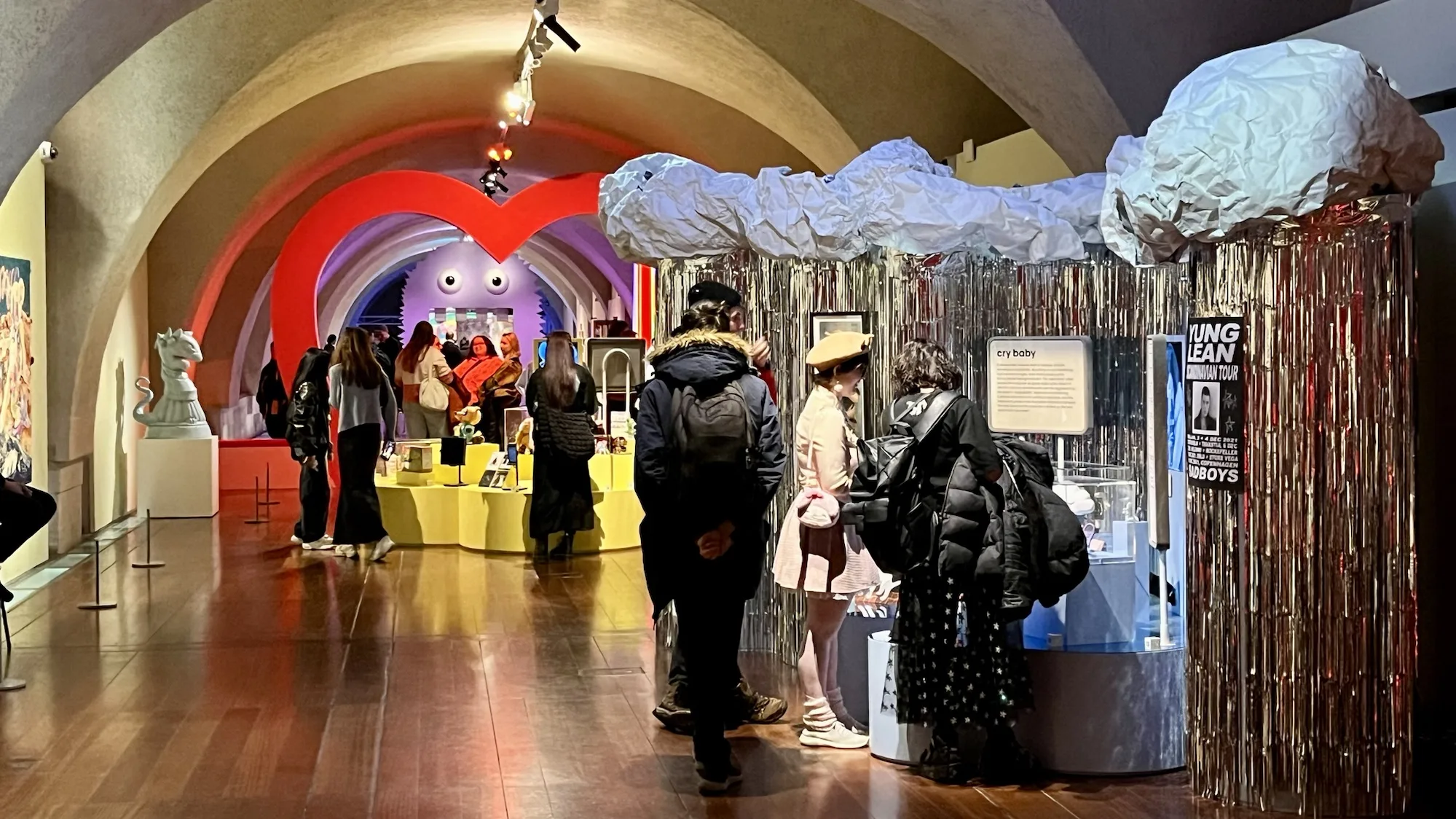
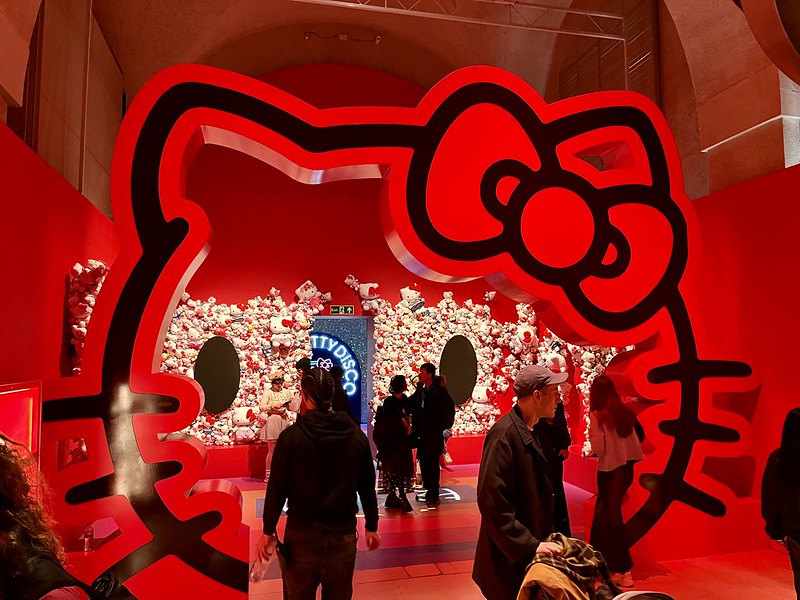
Like previous exhibitions at Somerset House, Cute includes some new commissioned art and existing pieces, as well as donated memorabilia. Back in 2021, we went to an exhibition about the Beano, and this filled the same space in the South Wing. It’s an exploration of cute things and its impact on society, including kawaii.

Hello Kitty

The exhibition also marks the 50th anniversary of Hello Kitty, and a large section of the exhibition is devoted to the memorabilia collected by one person. Including Hello Kitty Spam.

There are some interactive parts too. There’s a room with some arcade games, old and new, including some indie games like Froggy Pot.

Some of the art produced for the exhibition is AI generated, and the theme image features a kitten with a unicorn horn and seemingly seven paws. I suspect that they’ve kept this in because it shows the weird-er side of cuteness.

Pop-up cafe

Alongside the exhibition is a pop-up Hello Kitty themed cafĂ©. We had to queue to get in, as it’s a small space, but the food was nice albeit very full of sugar.

The exhibition runs until the 14th April, so you’ve got about five weeks to go to see it. We went on a Friday when walk-up tickets were available, but I imagine it’ll be busier at weekends and so you may wish to consider pre-booking. You can also look at all of the objects online at cute.guide.

Accessibility

The southern entrance to Somerset House is the closest to the exhibition, and is very close to Temple tube station on the District and Circle lines. It’s also close to Waterloo Bridge. Whilst there are stairs, all are duplicated by several lifts giving access to the exhibition, which currently have furry insides. Access packs, containing large print guides, noise-cancelling headphones, magnifying glasses and a stress ball, are available to borrow from the box office.