
V&A Cast Courts and Design Gallery

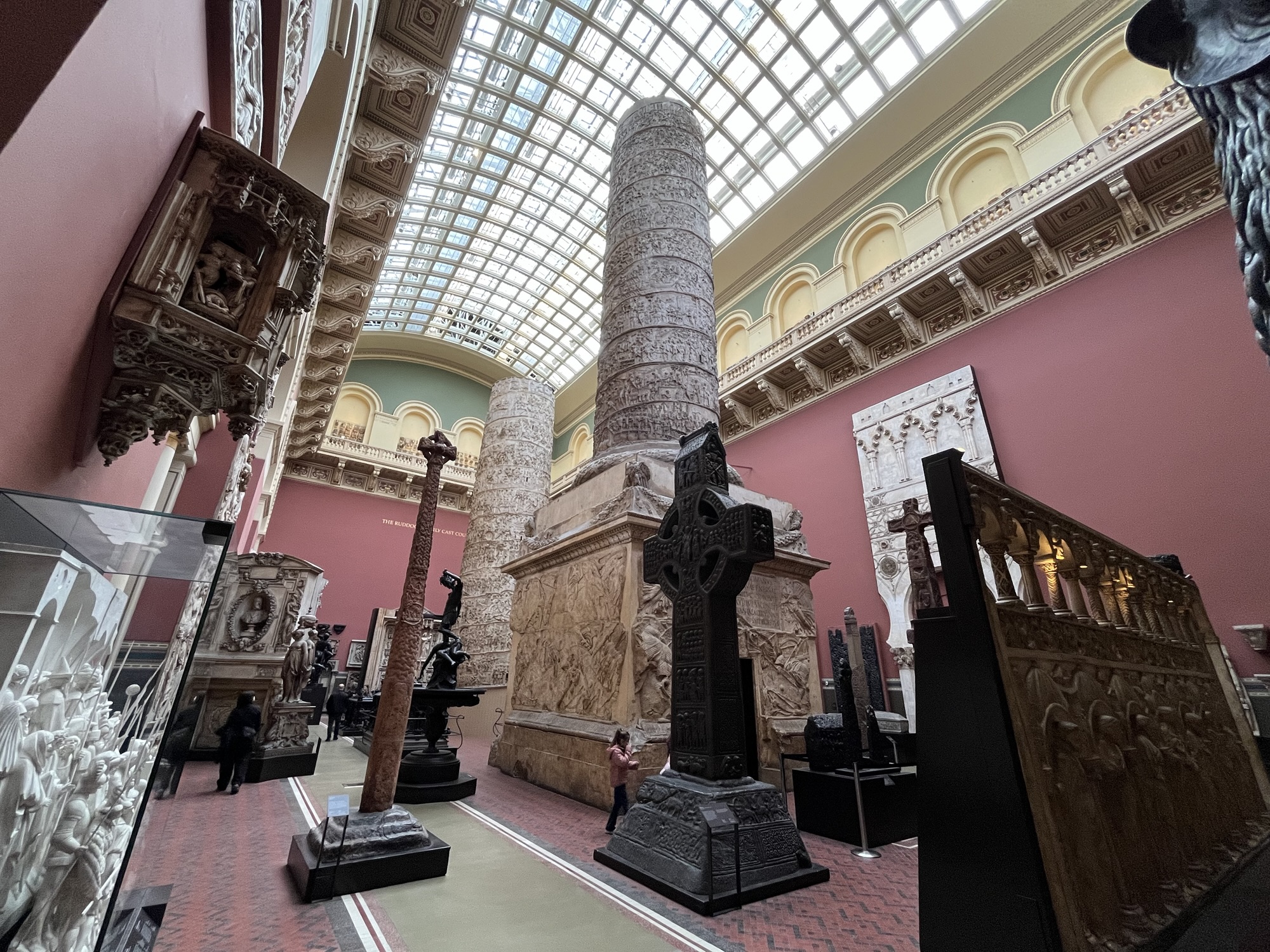
A photo of the Cast Court at the V&A

This is the fourth of my blog posts about last month’s trip to London. After visiting the Natural History Museum, we walked across the road to the V&A, where we visited the Cast Courts and the Design 1900-Now Gallery.

As I mentioned in my write-up of Banksy: Limitless, I’m not massively in to art, and so most of what the V&A offers isn’t of interest to me. Christine likes it though, and she has visited the V&A more often than I have. This time, she insisted on taking me to the Cast Courts on the ground floor.

Cast Courts

These three rooms are huge, extending to the full 25 metre height of the building. Their size is by necessity, as they contain some of the largest objects in the V&A’s collection.

As the name ‘cast’ suggests, these are plaster casts of various famous artefacts that exist elsewhere. There’s a cast of Michaelangelo’s David, for example, complete with a plaster fig leaf that was put over his manly bits when Queen Victoria visited. By far the biggest is a cast of Trajan’s Column, which is so big that it appears in two pieces. The cast courts were built as part of the original museum in the 1870s, and are now rather tightly packed with various pieces.

They’re impressive spaces, and it would be hard not to be wowed when walking in to them for the first time.

A photo of an Apple II computer and disk drive on display at the V&A

Design 1900-now

Whilst art may not be my thing, design and architecture are. So we went upstairs to the Design 1900-now gallery, which features 250 objects that show how design has changed over the past 126 years.

As well as furniture (including a standing lamp designed by Salvador Dali), there’s also technology here. There were two Apple computers on show; an Apple II, and a much newer MacBook that had been deliberately disassembled as it contained documents from Edward Snowden. There are also examples of objects that have been recently acquired, such as a Lababu.

The information included with each object is concise but thorough, but by virtue of being in central London, the limited space means that many objects are not on show here. Indeed, V&A has over a million objects in its collection, and has recently opened the V&A East Storehouse in Hackney Wick to allow visitors access to more of its objects. There’s also the Young V&A in Bethnal Green, which we visited in 2024.

Accessibility

Entry to the museum is free, but like most free museums, some special exhibitions require paid-for tickets. The main entrances are step-free, but not the entrance from the Museum tunnel that links to South Kensington tube station which is the nearest. Knightsbridge is the nearest step free tube station.

There is step-free access to all parts of the museum, but as it’s an old building that has been added to over time, step-free routes may take longer than some more direct ones. Disabled toilets are available, but for a Changing Places toilet, you’ll need to go across the road to the Science Museum.

Kate Lycett’s Lost Houses

Bankfield Museum

Running a stately home is a lot of work – you only have to watch shows like Downton Abbey to see why. (note: I have never watched Downton Abbey.) Organisations like The National Trust spend millions every year to keep their properties going. Not all houses are lucky enough to have someone maintain them and some have fallen into disrepair or been demolished.

With this in mind, artist Kate Lycett has painted a series of pieces called the Lost Houses of the South Pennines, which has gone on display in Halifax’s Bankfield Museum. All of the paintings are of houses and stately homes in Yorkshire which are no longer standing, such as Manor Heath in Halifax (now Manor Heath Park) or Horton Hall near Bradford.

What makes Kate’s paintings stand out is her attention to detail. All of the paintings show the houses as if they were still in their heydays – lights on, and with an almost ethereal glow, giving them life again. Gold leaf has been woven in to good effect.

Alongside each piece is a description of the house – who built it, what it was used for, and its ultimate fate. Photographs are also provided, as are Kate’s scrapbooks that she used during her research. Ironically for an exhibition at a Calderdale Council venue, many of those houses were demolished by its predecessor organisations. Dry rot seemed to be a major problem in several properties but I think money (or the lack thereof) has been the major factor in most of the houses’ demise.

We’ve visited twice – Christine and I were lucky to be invited to the opening night by a mutual friend of the artist, but we also popped in with my parents at the weekend. It looks like it’s been pleasingly popular.

All of the paintings are for sale by sealed auction bid, but you can also purchase limited numbered edition prints that are signed by the artist. These include the gold leaf that the originals have. The exhibition runs until early April, and is free to visit.

Wakefield and the Hepworth Gallery

Hepworth Gallery

On Saturday, Christine and I went to Wakefield, to visit the Hepworth Gallery, a new art gallery and museum built to house the collections of Barbara Hepworth, along with some works by other artists and sculptors inspired by her. The gallery is located next to the River Calder and is in easy walking distance from Wakefield Kirkgate station. Despite costing £35million to build, entry is free, and you can easily spend a couple of hours here.

The architecture of the building is interesting – it’s a thick concrete shell in the 1960s brutalist style, but with a clever use of windows to let in a reasonable amount of light. Of course, the thick concrete walls mean that you probably won’t have a working mobile phone in here.

I didn’t take any pictures inside as photography isn’t allowed (being modern art, most of the works are still under copyright restrictions) but I did take plenty out and around the gallery. It’s sited in an area of Wakefield that is in need of regeneration, so hopefully this will act as a catalyst to get people and businesses into the area.

Chantry Chapel of St Mary the Virgin

Across the road is Wakefield Bridge and the Chantry Chapel of St Mary the Virgin, a 14th century chapel on the bridge itself – one of only four in such a location and the oldest surviving example. Although it’s around 650 years old, it is still regularly used for church services. Certainly worth a look if you’re about.

Although I’ve lived in Yorkshire all my life, this is the first time I’ve been to Wakefield, bar passing through on the train, and so we went into the town to have a look around. Parts of the city centre are very run down, although work is going on to regenerate it, including the new Trinity Walk shopping plaza which, like the Hepworth Gallery, opened a few weeks ago. It ties in with a refurbished market, with a striking overall roof.

The city, which is the smallest of the three in West Yorkshire, still has some way to go before it’s looking as nice as Leeds city centre. In particular, the smallest of its two railway stations, Wakefield Kirkgate, was described by the previous secretary of state for transport Lord Adonis as probably the worst ‘medium-large’ station I have seen in Britain[source], and having seen it for myself I can see why – those buildings that are still standing are boarded up, it’s dirty, there’s no staff around, there’s paint peeling off the walls and just looks generally dilapidated. Not a nice welcome to the city. The other station, Wakefield Westgate, whilst not the most pleasant of stations, at least has some amenities and a staff presence.

It’ll be interesting to go back to Wakefield again in a couple of years, once some of the regeneration projects have progressed further. We also didn’t visit the cathedral or the Wakefield Museum, so they’re there for a future visit.

Creative Commons License
Except where otherwise noted, the content on this site is licensed under a Creative Commons Attribution-ShareAlike 4.0 International License.