
The RSPB Big Garden Birdwatch

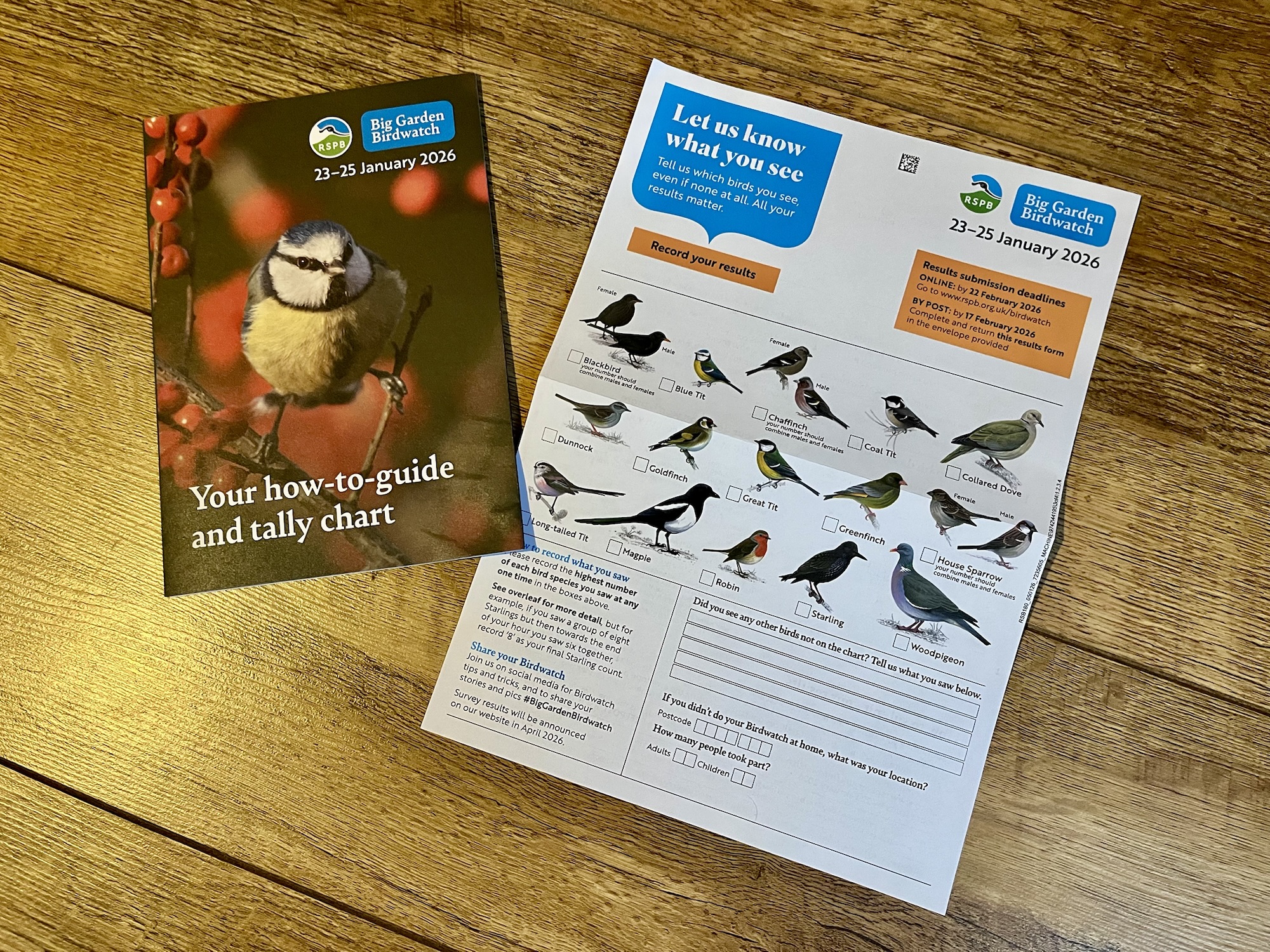
A photo of the guide and tally chart for the RSPB Big Garden Birdwatch

If you have a garden, and a spare hour this weekend, you could take part in the RSPB’s annual Big Garden Birdwatch. It’s a citizen science project that allows the RSPB insights into which birds are most common in British gardens, and identify trends over time.

The RSPB Big Garden Birdwatch normally takes place on the last weekend of every January. Anyone with a garden can take part – you don’t need to be an RSPB member. In fact, even if you don’t have a garden, you could go to a public park, or monitor a shared space from a balcony. The aim is that you record the birds that land in the space during a one hour period.

If you’re really keen, you can count the birds in more than one place. For example, if you have both a front and a back garden, you could spend an hour counting birds in one, and then a second hour counting the birds in another. The key aim of the Big Garden Birdwatch is that as many open spaces as possible are monitored, for an hour each, over the course of three days.

How to take part in the Big Garden Birdwatch

You don’t need to be a knowledgable birdwatcher to take part. We signed up some time ago, and so the RSPB sent us a pack in the post (pictured above). It’s a bit late for posting things now, so there’s a downloadable PDF which includes the most common species of bird that you’re likely to see. You can tick them off – but remember to count how many of each species you see too.

After the hour is over, you can submit your results online. The form will be open until the 22nd February, so there’s no rush. You can also post your results to the RSPB, but the form is quicker and will accept a wider list of birds. So if you’ve been really lucky and spotted (for example) a jay or a sparrowhawk, then you’re probably better submitting online. We’ve previously had both in our garden, but not during a Big Garden Birdwatch session.

Our 2024 holiday: The Alnwick Garden

A photo of the water cascade at the Alnwick Garden.

This is the third blog post about what we did on our 2024 holiday to Northumberland. Yesterday was about Seahouses, and today is about our visit to The Alnwick Garden and Lilidorei.

Alnwick is probably best known for its castle, and the gardens are adjacent and on land that was owned by the dukes of Northumberland. Whilst there have been formal gardens here for many years, these were mostly in a state of disrepair for much of the 20th century. Work to renovate the gardens started in the 1990s with a public opening in 2001. Since then, further phases have seen the gardens expand.

The Poison Garden

My wife Christine is a pharmacist, and so there was no question about us visiting The Poison Garden within the Alnwick Garden. Opened in 2005, this locked garden is full of poisonous plants; as such, entry is only permitted as part of a guided tour in small groups. The tour is good, as it underlines how many of the plants have legitimate medicinal uses as well as being poisonous. There are also posters about famous murderers who poisoned their victims, and what they used. It’s an opportunity to see a cannabis plant, as the garden is also involved in drug education and so has a license to grow one legally.

Elsewhere within the Alnwick Garden there’s a willow maze, which makes for a dark, tranquil space as the willow has grown over it, and plenty of water features. There’s also a more traditional walled garden at the top of the site, and a cherry tree orchard that would be fantastic to see in the spring. The Treehouse restaurant is in a massive treehouse – but you need to book table in advance. Other places to eat are available.

A photo showing an overview of Lilidorei at the Alnwick Garden

Lilidorei

Adjacent to the Alnwick Garden, but with a separate entrance, is Lilidorei – a new attraction opened in 2023 as essentially a huge kids play area. It has probably the biggest climbing frame I’ve seen, as well as sandpits and a walk around a series of themed huts. Each hut is supposedly home to a tribe, such as goblins, dwarves, elves, sprites and others. It’s probably most suitable for kids aged 4-10, and our eight-year-old loved it. There was an Olympics themed activity whilst we were there too.

Taken together, the Alnwick Garden and Lilidorei are a full day out. You can view the rest of my photos on Flickr.

Accessibility

Being a newer attraction means that accessibility is really good – there’s wheelchair access everywhere and a changing places toilet is available. Extensive accessibility information is available on the Alnwick Garden web site. There’s a car park nearby shared with the castle, and you can buy combined tickets for the garden and Lilidorei (but not the castle). A discount is available for Max card holders.

Alnmouth no longer has a railway station – the building is now home to Barter Books, famous for re-popularising the Keep Calm and Carry On poster. The nearest railway station is Alnmouth, from which you can catch a bus to Alnwick, and then there’s a free Alnwick Attractions bus that runs around the town during the summer months and school holidays.

The Brontë Garden at Sowerby Bridge station

Brontë Garden

Last month a new garden was officially opened at Sowerby Bridge railway station. It’s called the Brontë Garden, and is maintained by volunteers from the Friends of Sowerby Bridge Railway Station. It sits on a small parcel of land next to the car park, opposite platform one.

The name comes from the station’s slightly tenuous link with the Brontë family. The Brontës hail from over the hills in Haworth, in the Worth Valley, but one of the Brontë siblings was employed at Sowerby Bridge station at its time of opening in the 1840s. He was Branwell Brontë, brother of the three famous sisters Emily, Anne and Charlotte. He was later appointed at another station further up the line at Luddendenfoot – this station succumbed to the rationalisation of the railways in the 1960s and no longer exists.

The Brontë Garden at Sowerby Bridge railway station

The garden isn’t particularly big but does house a bench and small gravelled area, along with some planters built using old railway sleepers. There’s also a restored luggage trolley, with opened suitcases serving as planters.

As well as the garden, the Friends of Sowerby Bridge Railway Station look after various other planters on the platforms, many of which are sponsored by local businesses. It’s a relatively young group, having only been formed in November 2010 (co-incidentally about the same time I moved to Sowerby Bridge). Whilst they are a voluntary group, they’ve done quite a bit to make the station look nicer – a hard ask, thanks to its brutal concrete architectural style.