
Cliffe Castle Museum and Gardens

A photo of the outside of Cliffe Castle Museum

On Bank Holiday Monday, we went to Cliffe Castle Museum and Gardens in Keighley, which is about a 40 minute drive due north from where we live in Sowerby Bridge. We’d been to the gardens before on Good Friday in 2024, but the museum itself was closed and so we went to nearby East Riddlesden Hall instead.

History

Like Penrhyn Castle, Cliffe Castle was never a defensive castle, nor is it all that old as castles go – it’ll be celebrating its 200th birthday in the next few years. Instead, it was originally a smaller country house called Cliffe Hall which was then bought and expanded by the Butterfield family in 1848, adopting its current name in 1878. The expanded building gained a ballroom and conservatories, along with a tower over the main entrance.

In 1949, the castle and its grounds passed into public ownership, with financial assistance from a local benefactor, Sir Bracewell Smith. Smith also funded the building of an octagonal art gallery on the side, and it opened to the public as a museum in 1955. This replaced the previous Keighley Museum at Victoria Hall, which is now used as an events space.

A wide angle photo of the Octagonal gallery at Cliffe Castle

Inside Cliffe Castle

Cliffe Castle is a typical ‘local authority museum’ (a bit like The World of Glass in St Helens) in that its exhibits are an eclectic mix of objects bequeathed to the local authority and its predecessor organisations. However, they are grouped together in themed galleries, so it’s not a complete hodgepodge, and most objects come with detailed descriptions.

On entering, there are several rooms set out from Cliffe Castle’s time as a stately home – namely the reception room and drawing room. These are full of period furniture and some musical instruments. You also get to see the lavish decorations on the walls and ceiling.

Whilst there’s no set route around the museum, we next went into the Working Landscapes gallery, which shows artefacts from local crafts and trades from the past such as weaving and clog-making. That led onto the Archaeology Gallery, which includes various hoards of coins and other artefacts excavated in the area. The most recent of which was the Riddlesden Hoard, found in 2014, consisting of over 100 Roman coins.

Next, we went into what was the Butterfield’s ballroom, but is now the Natural History Gallery. This is full of taxidermied animals, the vast majority of which are either native to the UK or are/were regular visitors. Some of these stuffed animals are quite old, and so are rather faded or just badly stuffed, presumably by someone not familiar with what the animal looked like when it was alive. But it’s a decent-sized collection.

The Airedale gallery tells the geological history of the area, including many fossils, and then there’s a mineral gallery with lots of gemstones and geodes – some of which are quite large.

Upstairs galleries

Upstairs, there’s a small gallery of stained glass windows that have been rescued from local churches and halls. The majority of these windows were designed by William Morris or people working for him.

Then there’s a gallery focussing on Keighley’s local history, with various objects on show, ending with a live beehive. The last bit that we went into was the octagonal art gallery that was added in the 1950s, which has two levels.

Exhibitions

When we visited, there were a couple of small exhibitions. One was about the Keighley Cougars, the local rugby league team which is approaching its 150th anniversary, and the other marks 80 years since the founding of the Yorkshire Wildlife Trust.

Overall, we spent a little under two hours in the museum. This was mainly because we were going at the speed of our ten-year-old – I have no doubt that we could have spread it out to three hours or more if we’d had more time to engage with the exhibits. That’s not to say that there aren’t lots of things to keep kids entertained; there are various opportunities to dress up, or practice weaving, and there are trail guides that can be picked up in the entrance.

The gardens

Cliffe Castle’s gardens have undergone a relatively recent renovation. They are on a hillside, with some impressive water features at the bottom, a childrens’ playground in the middle and then a series of glasshouses and aviaries along the side. The aviaries are home to finches, budgies, cockatiels and, um, guinea pigs, with the glasshouses featuring more topical plants and succulents. There’s a wooded area at the very top, but we haven’t been into that.

Accessibility

The ground floor of the museum is all on one level with no steps, although wheelchair users will need to use a side entrance as the main entrance has a couple of steps. Sadly there’s no lift, although the majority of the exhibits are on the ground floor so those unable to use stairs can still see most of the museum. There is a disabled toilet; those needing a Changing Places toilet will need to go to Keighley Leisure Centre which isn’t too far away.

Entry is free, although a £3 per person donation is recommended. Normally the museum is closed on Mondays, but is open on some bank holidays.

There is a small car park on site, which is free. However, it has a maximum stay of three hours, probably because it’s so small. It was almost full when we got there, before the museum had opened. There is additional parking at the nearby Keighley Retail Park, but check the restrictions there too. The nearest electric car charger is at Keighley Leisure Centre, which is a rapid charger on the GeniePoint network.

Keighley railway station is a 20-25 minute walk from Cliffe Castle, with half-hourly trains to Leeds and Bradford and less frequent trains to Carlisle and Lancaster. Keighley bus station is a 15-20 minute walk; the 903 bus runs roughly hourly between 10am and 4pm Mondays-Saturdays and gets you much closer to Cliffe Castle.
Our 2026 holiday: Plas Cadnant Hidden Gardens

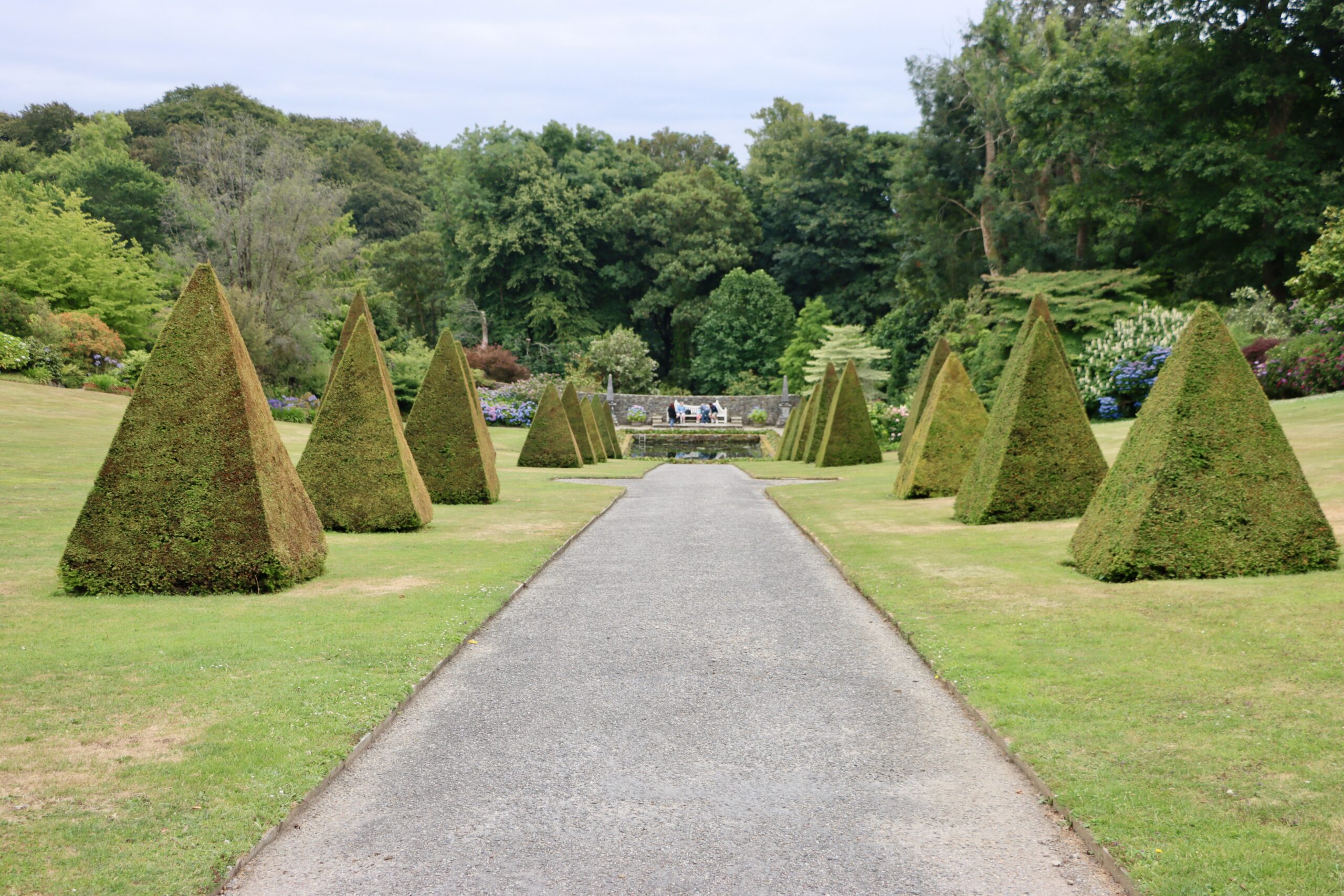
A photo of the formal part of the Hidden Gardens at Plas Cadnant

On our last full day in Wales, we crossed the Menai Strait (via the Menai Suspension Bridge which celebrates its 200th anniversary this year) to visit the Hidden Gardens at Plas Cadnant in Anglesey.

The Hidden Gardens at Plas Cadnant are not that well hidden – once you cross the bridges onto Anglesey, they’re quite well signposted. On arrival, you enter the formal walled garden, with topiary shrubs, lawns and a pond, but beyond there is a wooded area and a ravine with more informal planting. Here, the paths twist and turn, and so you’re never quite sure what you’ll see around the next bend. Our ten-year-old really liked this bit, and it felt a bit like a smaller version of Biddulph Grange in Staffordshire. A stream runs along the bottom of the ravine.

It’s a very peaceful place, that felt really lush just as the drought was starting to turn everywhere else a shade of brown. You can, apparently, see red squirrels in the trees, as grey squirrels were eradicated from Anglesey around 10 years ago, but we didn’t spot any.

We were mostly going at our ten-year-old’s pace and so spent just over an hour there, but it’s possible to spend longer – especially if you spend more time looking at the plants and flowers.

Accessibility

The formal garden at Plas Cadnant is mostly step-free, and there is a step-free route into the wooded area. However, there are steep slopes and steps down to the stream, so not all of the site is accessible to wheelchair users. Toilets are available; if you need a Changing Places toilet then there’s one that complies with older standards within a mile’s drive at Pili Palas Nature World (which we haven’t yet visited).

Car parking is on a grassy field next to the garden, which also doubles as sheep grazing. As such, there are no electric car charging facilities on site, but there is a rapid charger on Wood Street in the nearby town of Menai Bridge. The nearest railway station is at Llanfair­pwllgwyngyll­gogery­chwyrn­drobwll­llan­tysilio­gogo­goch (no really) but it’s about an hour’s walk; the walk from Bangor station is only a little further and it gets a more frequent service. There are also bus services from Bangor to Menai Bridge from where it’s a short walk.

There’s a café there, with free Wi-Fi available in the café. If you picked up the May issue of Gardeners’ World Magazine, you can get 2-for-1 entry to the garden.

Our 2025 holiday: Plas Newydd

A photo of Plas Newydd, looking up from the sea wall along the Menai Strait

After visiting Beaumaris Castle in the morning, the second place we visited on Anglesey was Plas Newydd (Welsh for ‘New House’). It’s a large country house overlooking the Menai Strait, originally started in the 15th Century but substantially rebuilt in the 18th Century. Nowadays, it’s in the care of the National Trust, who look after both the house and its gardens. The house is presented largely as it would have been in the 1950s.

We went around the house first. Not all of the rooms are open to view; though the National Trust have cared for it since 1976, until around 10 years ago people still lived in the property. The dining room is home to a huge painting by Rex Whistler, which was the largest ever canvas painting in the UK when it was unveiled in the 1930s. A previous owner of Plas Newydd, Henry William Paget, fought in the Battle of Waterloo where he lost a leg – the house has an exhibition about him including one of his prosthetic legs. He was awarded the title of ‘Marquess of Anglesey’ for his bravery.

The 5th Marquess of Anglesey, Henry Cyril Paget, was a rather flamboyant character who inherited Plas Newydd in 1898. He converted the chapel into a theatre, where he performed in what we would now most likely describe as drag. Whilst he was born into great wealth, ultimately he ended up bankrupt six years later in 1904, and died the following year. Many of his costumes were subsequently sold in the ‘Great Anglesey Sale’. However, some photographs survive, and visitors are invited to dance in one of the rooms, as the 5th Marquess would have done.

The gardens at Plas Newydd

Gardens

There are some formal gardens at Plas Newydd, on the slope down to the Menai Strait, and there are great views across the Strait towards Caernarfon. There’s also plenty of parkland, including an arboretum. Anglesey is also one of the few remaining places in Britain with wild populations of native red squirrels, and there’s a feeding station in the arboretum. We didn’t get a chance to visit this, unfortunately, and we didn’t see any red squirrels during our time in Anglesey.

As it’s the summer holidays, there were plenty of activities for kids as part of the Summer of Play event that runs until the end of this month.

Accessibility

For the house, only the ground floor is accessible to those who can’t use stairs. There is a step-free route from the car park to the house, but not all routes across the parkland are step-free and it is on a slope.

When we visited, five electric car chargers were being installed in the car park – these appear to be operational now, offering 7 kW medium-speed charging on the RAW Power network. Bus services pass the site on Mondays-Saturdays, or it’s a roughly 2 mile walk from Llanfair­pwllgwyngyll­gogery­chwyrn­drobwll­llan­tysilio­gogo­goch station, if you want to catch the train.

Newby Hall

Newby Hall

Over the Mayday weekend, Christine and I went to Newby Hall with my parents. It’s a privately owned manor house, which, along with its extensive gardens, is open to the public. I used to go there a lot when I was younger as there’s a brilliant adventure playground for kids, but this was my first visit there in a long time.

I’ve uploaded the photos that I took to Flickr. There’s a miniature railway with a train in the colours of UK train operator Grand Central, which was a little amusing, and at this time of year there are plenty of gorgeous flowers. Plus there’s a very nice farm shop as well.

It’s not quite as impressive as Chatsworth, but it’s still a good day out, and caters for almost everyone.

Creative Commons License
Except where otherwise noted, the content on this site is licensed under a Creative Commons Attribution-ShareAlike 4.0 International License.