
Now that the weather is improving a bit, and the days are getting longer, we’ll be planning to make the most of our National Trust membership by getting out and visiting places. In this blog post, I’m going to detail all the National Trust properties that we can get to from our home in Sowerby Bridge, West Yorkshire, within a maximum of 90 minutes driving team (one way). We’ve visited the majority of them, and I’ve blogged about many of them, so this will hopefully serve as a useful guide for me to see where we haven’t been to.
I’m armed with my copy of the National Trust 2025 handbook, and have been through all the properties listed that I know we can get to.
Part one: Properties we’ve been to
I’ll start with the places that we’ve been to before.

Hardcastle Crags
Starting with the most local is Hardcastle Crags, in the hills above Hebden Bridge. I’ve never blogged specifically about our visits to Hardcastle Crags over the years, but it’s been mentioned in passing a few times. Most recently, I mentioned how the main visitor centre at Hardcastle Crags is off-grid, and it came up in last year’s book review as several scenes in Juno Dawson’s Her Majesty’s Royal Coven series take place there. Our most recent visit was in 2023, and it gets a mention in my year-end review. Over the years, I’ve been many times, as it was reachable by train and on foot from Bradford. I’m sure we’ll end up back there in time.

Beningbrough Hall
Beningbrough is close to where my parents live in York, and so I’ve been a few times – the most recent time was in 2022. I blogged about our 2017 visit.
Beningbrough Hall is, I suppose, typical of what you think of when you imagine a National Trust property – a big, stately home, with nice gardens.

Brimham Rocks
Another place I used to go to a lot whilst growing up, and again whilst at university. Brimham Rocks is home to various rock formations, many of which have been given names and backstories over the years. We last visited in 2014, so over 10 years ago and so we’re probably due a repeat visit at some point.

East Riddlesden Hall
This is the nearest indoor property to where we live, on the outskirts of Keighley. We’ve been a few times, with the most recent visit just last year. East Riddlesden Hall is a smaller site, so best for half a day, and isn’t as grand as some other country homes. If anything, that makes it more interesting. There are also gardens at the back.

Fountains Abbey and Studley Royal
One of the National Trust’s larger estates, Fountains Abbey and Studley Royal Water Garden includes the ruins of an abbey and monastery, a water garden with ponds and fountains, a stately home, a church, a water mill and a huge deer park. It’s big enough to require two separate car parks and entrances.
Our last visit was in early autumn in 2020, during a time when we could meet relatives outdoors. It was the first time I’d seen my parents face-to-face in almost six months, and would be the last time in a while too. Prior to that, our previous visit was in 2015, so again, we’re probably due another trip.
Mount Grace Priory
Mount Grace Priory is rather pushing the 90 minute journey time. I’ve been before with my parents, but it was many years ago. Both English Heritage and National Trust members get in free, as it’s jointly managed by both organisations.
It’s another ruined church and monastery (Henry VIII had a lot to answer for) but on a smaller scale than Fountains Abbey. There’s also a 13th Century Manor House, and formal gardens.

Nostell
I mentioned Nostell earlier this month as somewhere we’d planned to go, but the weather had other ideas. We’re back to large country house and formal gardens territory here; Nostell is well-known for having masses of snowdrops at this time of year. Inside the house is a range of Chippendale furniture.
I’ve been twice; once with Christine and my parents, and once with our nine-year-old when they were much younger. We haven’t been as a family yet, and I haven’t previously blogged about it.
Nunnington Hall
Nunnington Hall is another place I’ve been to as a child, but not as an adult. Again, it’s pushing the 90 minute journey time – it’s actually further away than Mount Grace Priory, but on slower roads. That being said, it’s also somewhere that we could go when staying in York with my parents.
The hall is smaller than others, but hosts regular exhibitions, and the garden has been completely organic for over 20 years.
Treasurer’s House
Being as it is in York city centre, I’ve been to the Treasurer’s House a few times. It’s so named as it was the home given to whoever was the Treasurer at the nearby York Minster. It’s also very haunted, and on Hallowe’en one year I went on a ghost tour. Though I’ve been past it a few times in recent years, I haven’t visited as an adult.

Wentworth Castle Gardens
Wentworth Castle Gardens is one of the newest properties to join the National Trust’s portfolio, having been taken over as recently as 2018. We went in 2021, on a gloriously sunny day that let us see the flowers in the gardens in full bloom. More work has been undertaken since, and so we’re probably due another visit.
The house is still in use as the Northern College, and so tours have to be pre-booked on certain days of the year.

Gawthorpe Hall
The most recent National Trust property that we went to was Gawthorpe Hall. We went at the end of August. It’s also a smaller property; whilst there is extensive parkland, the gardens are small. It’s fine for half a day.

Hare Hill
Hare Hill is a nice, peaceful garden in Cheshire, and home to lots of rare trees. It’s not very big – it was enough for a morning, but not a full day out. Thankfully, there are other National Trust properties nearby, including…

Nether Alderley Mill
Nether Alderley Mill is a medieval corn mill, that has been restored to working order, and one a few that survive to this day. Indeed, it was still in commercial use as recently as 1939, using the power of water to mill corn.
We combined our visit with Hare Hill, back in September 2022, which is nearby. It’s only open on Thursdays and Saturdays during the summer months, and visit is by guided tour only. There’s also limited parking.

Lyme
Lyme is not far from Stockport, and it’s another larger site with a big country house, formal gardens and a deer park. There’s plenty to do and it’s certainly one for a full day out – especially if you want to walk out to a viewing point with a view across most of Greater Manchester. We went in June 2021, and previously I had been in my late teens as well.

Quarry Bank
Another top-tier National Trust property, this time on the western side of Greater Manchester and not far from Manchester Airport. Quarry Bank is big, with the main attraction being a restored cotton mill. It’s now a museum, and has lots of hands-on activities for kids. Elsewhere, there are formal gardens as well as a huge kitchen garden, and a hydroelectric generator with a fish bypass system. My first visit was in 2017, and we went back in 2019 and 2020.
Speke Hall
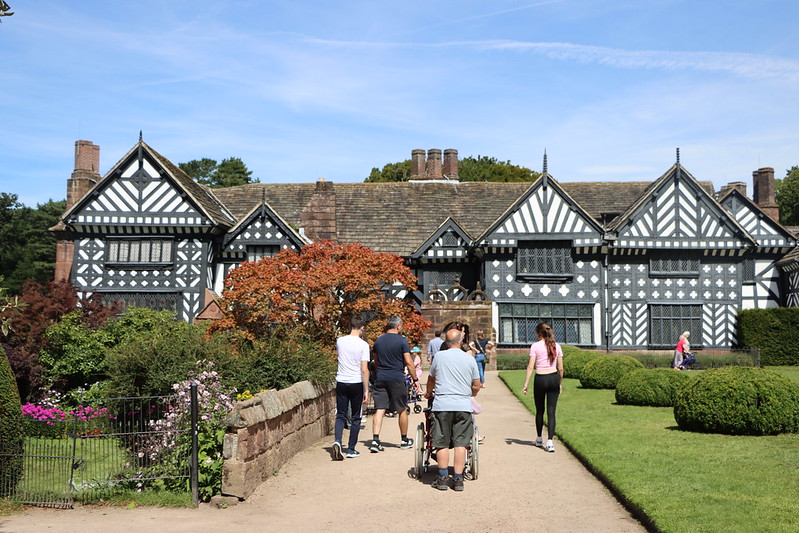
Speaking of properties near airports, Speke Hall rubs up against the runway of Liverpool John Lennon Airport. If you haven’t already guessed from the architecture, it was built in Tudor times, and Catholic priests were hidden there (like I said, Henry VIII had a lot to answer for). It was restored in the 19th century, so a lot of the interior decor is in the Arts and Crafts style.
Outside, there are extensive gardens, including a ‘secret’ garden accessible by a tunnel, a maze, and a story trail for kids. We’ve been a couple of times, in winter 2019 and August 2022.

Tatton Park
Another large site, although the National Trust is only responsible for part of it. That means members have to pay for parking, and the farm. That said, the farm is worth it, as it’s home to many rare breeds and plenty of talks about the animals.
The gardens at Tatton Park are really good. On the times we’ve visited, we’ve only had time for the farm and the gardens; we haven’t been into the houses yet. Yes, there’s more than one house there; the one pictured, and a medieval house now known as Tatton Old Hall. Our visits were in May 2019, May 2021 and June 2022.

Biddulph Grange Garden
Biddulph Grange is in North Staffordshire, and again at the limits of how far we would go in a day. I went there lots of times as a kid, as I had family nearby, and it’s one of my happy places. To call it simply a ‘garden’ isn’t doing it justice – there are lots of different themed areas, with various follies and hiding places. The Japanese garden is my favourite. Our recent visits were February 2019 and during lockdown in August 2020, seeing as it’s mainly outdoors. I haven’t blogged about our visits before.
Later this week, I’ll post part two – the places where we’ve not been to yet.
