A recovery update

A photo of a jar of calcium and vitamin D supplements, and a box of Levetiracetam tablets

It’s been four weeks since I last wrote about my recovery, following my seizure in May. Because August is my busiest month at work, most of this month’s blog posts were written in advance and so I haven’t talked about what has happened with my health since last month. Things have happened and so it’s about time for an update.

I had a third seizure

Earlier this month, I had seizure number three. Number one, as mentioned, was in May and resulted in me breaking both my arms; seizure number two was in June. I managed not to have a seizure in July, but then had a minor one earlier this month. Like the second time, I was already in bed, so I didn’t fall and my head was supported. And again, like last time, Christine was there and was able to time it. As per Epilepsy Action’s advice, it’s not really necessary to call for an ambulance for seizures lasting less than five minutes, and once I’d come round, we all went to bed. I even went off to work as normal the following morning, with only a sore tongue from when I’d bitten it to show for it.

I’ve been fine since, although my neurologist advised my GP to increase the dose of my anti-seizure medication, Levetiracetam (more commonly known by its brand name, Keppra). I’m still on a relatively low dose for now though. It also, unfortunately, resets the 12 month seizure free period that I need to have to get my driving licence back. So, I won’t be able to do any of the driving for next summer’s holiday either.

I have a formal epilepsy diagnosis

Speaking of my neurologist, I had a call with them at the end of last month, where they stated that I met the requirements for a formal diagnosis of epilepsy. This, incidentally, was before seizure number three.

We’re still trying to work out what is actually causing the seizures, as there doesn’t seem to be a specific trigger. I’ve had two electroencephalograms (commonly known as an EEG or ‘brain wave scan’):

  • a standard EEG test last month, which came back normal and included a strobe light test
  • a ‘sleep deprived’ EEG test last week, where I stayed up all night, and then had the test first thing in the morning. That meant that I fell asleep during the test, and so they could monitor my brain activity whilst asleep. I then spent the rest of the day in bed. I’m still waiting for the rest of this.

Meanwhile, my ENT surgeon is looking at booking me in for an ear procedure that may help, whilst I await the results of another CT scan.

I also have an osteopenia diagnosis

On top of all of this, last week my DEXA scan results came back, showing that I have low bone density for someone of my age. This would likely explain why I ended up fracturing both arms during my first seizure. The medical term for having low bone density is osteopenia, and people with osteopenia are at greater risk of developing osteoporosis if it’s not managed well. I’ve probably developed it partly as a side-effect from having been on steroid-based asthma medication for over 30 years, but being able to breathe is important to me so I’ll take the compromise.

The good news is that osteopenia doesn’t need to be managed with medication – regular vitamin D and calcium supplements are usually sufficient, as is regular exercise and avoiding smoking and excessive alcohol consumption.

I still have some further blood tests to do, just to make sure that there’s nothing else causing my osteopenia that needs flagging up.

My mobility is getting there

I’m starting to regain strength in my arms, and my dexterity and mobility is improved. There’s some way to go before things are back to normal – I still struggle with getting things over my head, and putting a backpack on and off is a bit of a challenge, especially when wearing a coat. But I can do almost everything on my own now, with Christine just helping a little bit with showering and sorting out my shirt collars, for example.

I’m also in significantly less pain – whilst I’m still taking paracetamol and/or ibuprofen most days, it’s more as a response to acute pain flare-ups, rather than keeping chronic pain at bay.

I’m back at work full-time

I’ve been back at work full-time this month, and worked the extra hours for Clearing as per usual. Whilst I have been a little more tired on an evening than I would have expected to have been before May, I feel I’m coping well.

So I’m getting there. There’s still more tests and procedures to come, but I reckon I’ll be closer to my pre-May normal by the end of the year. I’m already not far off.

Surrendering my driving license to the DVLA

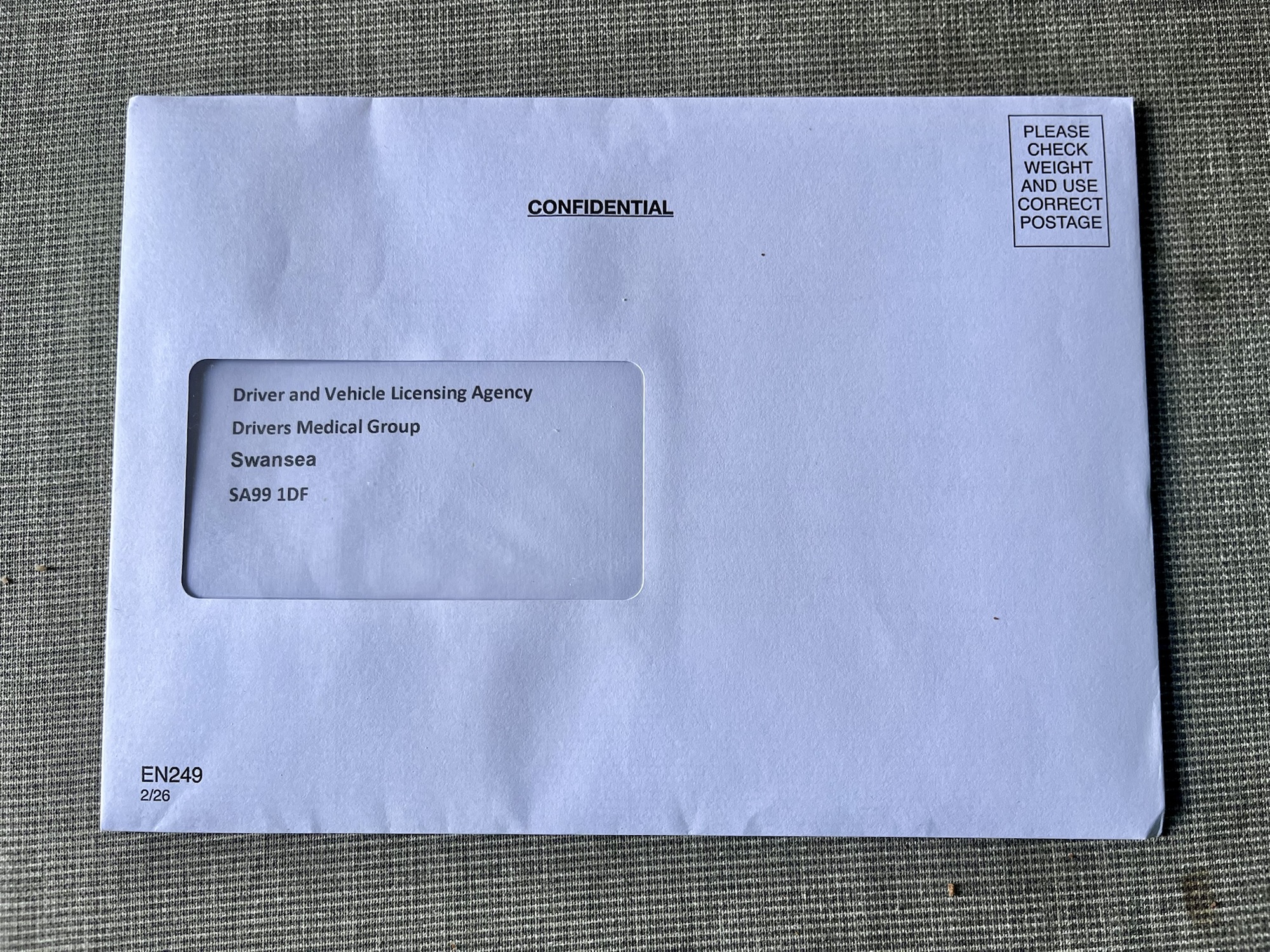
A photo of an envelope addressed to the medical team at the DVLA. My surrendered driving license is inside.

The good news is that I was discharged from hospital on Wednesday.

The bad news is that, as I’ve now had two seizures in six weeks, I’ve had to surrender my driving license to the DVLA. I can’t get it back until a doctor confirms that I haven’t had a seizure for 12 months, so it’ll be next summer at the earliest before I can drive again.

Reporting to the DVLA

The doctors who were treating me in hospital advised me to contact the DVLA to tell them I was no longer fit to drive. This is done online and is quite thorough, although you probably won’t get an immediate outcome. As it was, I received a letter through the post a couple of days later, confirming my unsuitability to drive and with a pre-addressed envelope to send my license back in.

As much as it will be a pain not being able to drive for at least the next 12 months, we’ll manage. Christine thankfully passed her test 18 months ago and so she can drive. Once I start going back to work in the office, I can take the train – we bought our house before I passed my driving test and so public transport remains an option for me.

Meanwhile, I’m taking anti-seizure medication twice a day and will have some further tests and scans to narrow down what’s caused the seizures. This may include surgery in future, but, fingers crossed, I won’t have another seizure in the next 12 months. Obviously, if I do, then the 12 month counter resets.

The need to self-report

Unlike most other European countries, it is an individual’s responsibility to tell the DVLA that they’re no longer fit to drive. And, unfortunately, some people carry on driving despite being told not to, sometimes with deadly consequences. It’s a particular problem with older drivers with failing eyesight, and who end up in prison for causing death by dangerous driving rather than enjoying their retirement. Nobody wins.

Hopefully, in future, there will be a system set up for healthcare professionals (doctors, but also optometrists and others) to report people unfit to drive to the DVLA directly, rather than relying on self-reporting. That way, people unfit to drive who are reluctant to give up driving can be forced to do so. It would need enforcement, and arguably resources to help people find alternative transport, but could save lives.

In any case, I understand why I can’t drive and have done what I’m legally required to do. I would never want to be responsible for injuring someone (or worse) because of a seizure whilst driving. And even if all I do is injure myself or damage the car, driving against medical advice will almost certainly invalidate my car insurance, leaving me out of pocket. It sucks, but driving right now just isn’t worth the risk to me or anyone else.

Back in hospital

I’m writing this from my hospital bed, having been re-admitted on Sunday. I had a seizure at home, and this time Christine and our ten-year-old were there to witness it.

Last month I had a fall at home, which I put down to feeling faint but a seizure hadn’t been ruled out. Now it seems like a seizure was the most likely explanation. This time, I was lying down, so no broken bones, but my first memory after coming around was when the paramedics had arrived. This resulted in my first ever trip in the back of an ambulance.

During this hospital stay, I’ve had another CT scan, and an MRI scan as well. I may have some kind of infection which hasn’t been cleared by the medication I was given last time, but we’ll see. I’m also now taking anti-seizure medication, and I cannot drive a car for at least another six months.

I’m hoping to be discharged today.

Hiatus

This is a short blog post that I am tapping out on my phone. Since Thursday last week, I have been in hospital, having had a fall at home which resulted in me fracturing bones in both my shoulders (specifically necks of humerus).

I’ve now exhausted the scheduled posts that I’d written before the fall, and both arms need to be non-load baring for another five weeks or so to allow them to heal, so I’m going to have to take a blogging hiatus for now. Which is a shame; I was working on my views of this year’s Eurovision entries when the fall happened.

See you all soon, hopefully when I no longer have T-rex arms.

Shapewear: is it worth it?

Recently, my Facebook feed has been full of adverts for male shapewear – essentially vests which push your tummy in. The idea being that you can hide a beer belly and look more confident. Of course, the adverts have lots of before and after videos of men who have squeezed themselves into one of these vests.

Of course, when it came to writing this, none of the adverts showed up for me to take a screenshot.

Whilst I rarely drink beer nowadays, it’s fair to say I’m more portly than I used to be. Between the start of the Covid lockdown five years ago, and the summer of 2021 when things started re-opening again, my waist size increased by a couple of inches. It used to be that I did around 30 minutes of brisk walking every weekday, but despite my efforts to get out during lockdown, I don’t do as much exercise now as I used to.

Therefore, on the face of it, shapewear offers an easy solution – squish your belly into a tight-fitting vest to look better. But besides the price of these vests, I’ve been hesitant to try them, for a couple of reasons.

Shapewear health risks

A quick search with a well-known search engine brought up this article from BBC Science Focus about the ‘hidden health risks of shapewear’. Feel free to read it, but the summary is that shapewear may not be suitable for people who experience issues with breathing, digestion, skin irritation or who have nerve or circulatory issues. And I tick two of those boxes: I’m asthmatic, and, without wanting to go into TMI, I have some digestive issues. Wearing shapewear regularly could exacerbate both of those.

Health risks aside, forcing your body to look a certain way, or only feeling confident if you’re wearing shapewear, isn’t a healthy relationship with your body. I’m reading (well, listening to the audiobook of) You Are Not A Before Picture by Alex Light (sponsored link), which is a really good book about the history of the diet industry, and how to have a good relationship with your body regardless of its size. It also dispels the myth that fat = unhealthy and thin = healthy. For more, see HAES – Health At Every Size, which offers advice for healthcare professionals who work with differently-sized people in a way that is affirming and supportive.

So, no – as much as I’m not a big fan of my sticky-out-tummy, I won’t be trying to force it into a restrictive vest.

Fully-vaccinated and ready for winter

A screenshot of the NHS winter vaccinations page

We’re halfway through October, the weather is getting colder and the nights are getting longer. So, it’s also time to get your winter vaccinations.

I’m asthmatic, and so I qualify for a free flu vaccine each year. I’m also eligible for a free Covid-19 booster; my last one was two years ago, but it looks like the eligibility rules have changed in my favour.

I had both vaccines last week. Apart from some tenderness in my arms where I had the vaccines injected, no side effects for me thankfully. Back in 2021, my first dose of the Covid-19 vaccine (AstraZeneca) gave me a fever for a few days, but subsequent vaccinations (Pfizer and Moderna) have been much milder.

You’ll probably find that, if you’re eligible for a free flu vaccine on the NHS, your GP surgery will contact you to ask you to make an appointment. For the Covid-19 vaccine, I was able to book this myself on the NHS app.

Getting vaccinated privately

If you don’t qualify for a free vaccine, but still want to get protected, you can pay for one privately. Boots will charge you £22, and Superdrug £20 (or £10 if you have their loyalty card). Alternatively, check with your workplace; my employer offers vouchers for a free flu vaccination with Boots to all employees who aren’t otherwise eligible for one on the NHS.

The Covid-19 vaccines are rather more expensive – about £100 at Boots, although some may sell them for less, with the cheapest Novavax vaccine costing £45.

If I didn’t get them for free on the NHS then I would probably pay for the flu vaccine. The last time I had flu was in October 2003. The fact that I can remember the rough date 21 years later shows how much I’m happy to have the vaccine to avoid going that again. I was eligible for a flu vaccine back then too, but managed to get flu before I could get vaccinated.

As for Covid-19 – I’ve definitely had it at least once since March 2020, an almost certainly twice. In both cases, it was just like a bad cold (but over more quickly). But I also lost two friends to that virus in 2020, and so I know how serious it could be.

RSV and pneumococcal vaccines

If you’re 65+ or pregnant, then you may also be eligible for one or two other winter vaccines: RSV, against the respiratory syncytial virus, and pneumococcal, against some forms of pneumonia and meningitis. If your GP surgery hasn’t already been in touch, have a chat with them if you meet the eligible criteria.

And remember, vaccination isn’t just about protecting yourself. Not everyone can have vaccines, but if you’re vaccinated, you’ll help to prevent the spread of diseases which continue to kill thousands of people in the UK each year.

Neil’s guide to surviving a cold

Giant porcupines

I’ve been feeling pretty rotten this week, having caught a particularly nasty cold. Presumably from Lizzie; she’s had a cold for a few days now and so her face has been constantly covered in snot. And she likes giving us kisses now, which is cute, but also a sure-fire way to pick up her germs.

I have still gone to work as normal, and I thought I’d write about what I do to get through a rough patch.

Please be aware that I’m not a medical professional, and none of this should be considered medical advice. If a medical professional advises you to do something else, follow their advice, not mine. This is just what works for me.

Get up and get clean

When you’re feeling rough, either because you’re ill or experiencing a decline in mental health, there’s a temptation just to stay in bed. And, if you’re so ill that you really cannot get yourself out of bed, it may be best to stay there – if you have ‘flu for example. But maybe call NHS 111 if this happens, just in case it’s something more serious.

If you can get yourself out of bed, then do. Have a shower, and put on clean clothes. Brush your teeth. Shave, if you have facial hair. You probably do these things anyway, but make a special effort to do so. If you’re feverish, then you may have shed a lot of sweat, so getting yourself clean and fresh should help.

Get some fresh air

Go outside, even if it’s just for a few minutes. If you can’t, at least try to get a window open. I felt noticeably better as soon as I got out of the house.

Go to work, if you can

This is a subjective point. I have a desk job, so work isn’t too strenuous; plus, this week a lot of people were off so the office was quiet. Also, I take the train to work, so there was no need to drive; I would have been less likely to go in otherwise. Being at work, seeing other people and being productive actually made me feel better.

Drink plenty of fluids

I mentioned fever sweats – you’re more likely to get dehydrated when you’re ill, so drink plenty of water. Avoid alcohol; the odd hot toddy is probably okay but too much alcohol can leave you dehydrated and feeling even worse. Stick to no more than one average-strength alcoholic drink a day.

Take paracetamol

Paracetamol (acetaminophen to Americans) is cheap, and can help ease your symptoms. Adults can usually take two tablets no less than four hours apart (but always read the label).

Get plenty of rest and avoid stress

Finally, whilst I do advise getting out during the day, rest is also really important when you’re ill. Go to bed early, and avoid doing too many strenuous or stressful activities so that your body has time to recover.

Fitbit Alta HR review

I’ve recently upgraded my fitness tracker, and now own a Fitbit Alta HR (sponsored link). I’ve previously owned a Charge, and a Charge HR, and this review will mostly focus on the differences between the Alta and the Charge. I reviewed the Fitbit Charge in October 2015.

Improvements

Compared with the Charge, the Alta HR is narrower, and the metal bands either side of the display make it feel more solid. I find that it fits my wrist better and it’s lighter, so it feels more comfortable. I feel happier wearing it when asleep than I did with the Charge models.

Battery life is much improved over the Charge HR, with the Alta HR typically lasting a full week on a full charge. You can also view the current battery status on the device itself, as it’s one of the screens that displays along with your step count, calories burnt, distance travelled etc.

Notifications are expanded beyond phone calls; the Alta HR will also notify you of text messages (and show the sender and first few words), and calendar events if you wish. If you’ve turned on Fitbit’s hourly movement tracking, then if you haven’t done 250 steps in the last hour, you’ll get a nudge at around 10 minutes to the hour to get up and move around.

In my experience, the Alta HR was better at synchronising throughout the day with my phone than the Charge models, which would sometimes go a few hours at a time without a proper synchronisation. This may be a quirk with my phone though.

Disadvantages

If you’re switching from a Charge to an Alta HR, you’ll need to turn off the floor climbing tracking. There’s no altimeter in the Alta HR and so you won’t be able to track how many floors you’ve climbed.

There’s no button on the Alta HR, so you have to wake the display either by raising your arm or double-tapping the screen. Also, the screen doesn’t automatically illuminate when you receive a notification. This probably improves the battery life but makes it a little harder to check your status quickly.

The screen is much bigger, and has a higher pixel density than the Charge. But it’s orientated lengthways, so when reading a message you’ll need to twist your arm. It also means that it’s not wide enough to display more than three digits of your step count, so once you hit 1000 steps, it’ll display ‘1.0k’ and then ’10k’ once you hit 10,000 steps. However, below this, a series of five dots shows whether you’re at 20, 40, 60, 80 or 100% of your daily goal.

Finally, your existing Charge or Charge HR charging cable won’t work with the Alta HR. It has a much improved cable that clips on to the device, but it’s incompatible with other models. You may want to order a spare cable.

Verdict

On the whole, I agree with this Gizmodo review – this is probably the best fitness tracker for most people. £10 more will get you the Charge 2, which overcomes some of the limitations of the Alta HR, but is bigger and probably less comfortable. If you’re the sort of person who wants to record their floor climbs, easily view GPS data, or practice relaxing breathing, go for the Charge 2. If not, then the Alta HR is a very good, comfortable fitness tracker.

30 days of Fitbit

Back in February I was lamenting my lack of exercise whilst on paternity leave. And following an Easter weekend where I had some particular sedentary days, I decided to set myself a challenge: meet my 10,000 step goal on my FitBit, every day, for 30 days. Day 1 was the 30th March.

I didn’t blog about it at the time as I decided that it would be better just to do it on the quiet, without public pressure. Not meeting my target would let me down, but I’d have also let other people down if they knew. Christine knew – she deserved to know why I’d disappear downstairs from an hour and do housework on an evening – but I didn’t make a big public declaration.

The good news? I managed it. Day 30 was Thursday, and I even managed to make it to 32 days so as to encompass every day in April. Today would be day 33, but it’s nearly 5pm and I’ve barely managed 3000 steps; I think I deserve a rest day.

Hitting my target every day varied in difficulty. On some days, I could reach 10,000 steps with ease. At work, I could reach 8,000 without much extra effort, but found that walking to a toilet further away from my desk, and taking regular breaks to stretch my legs, helped to push things on a bit. This was helped by a recent new feature added to the FitBit app, which encourages you to take at least 250 steps each hour through a series of red dots. So far, my best is being active 13 of the 14 hours that fall between 6am and 8pm – I’ve yet to get all 14, but it’s a good motivator.

I was hoping for some kind of FitBit badge to appear to reward me for doing this, but sadly there isn’t one. Which is a shame. And whilst I don’t plan to challenge myself again any time soon, I hope that this will ensure that I keep up with some good habits to keep my step count up.

Vaccinations

Our baby is now 12 weeks old, and has had their first round of vaccinations. These should have been given at 8 weeks, but our town was flooded out at the time of birth, and this included our GP surgery.

The first round is four individual vaccines. One of these, the rotavirus vaccination, is given orally as drops, but the rest are needles. These are the 5-in-1 vaccine (diphtheria, tetanus, whooping cough, polio and Hib), Pneumococcal, and the brand new Meningitis B vaccine. Sadly some older children aren’t and there is pressure for it to be made more widely available.

As you’d perhaps expect, our little cherub wasn’t very happy about the needles, although it can’t have been worse than the various blood tests in their first week of life. This was as a result of developing jaundice, which required regular blood tests to monitor. Some pre-emptive Calpol (or rather generic-brand Paracetamol Suspension for Infants – it’s the same thing) hopefully helped. Later on, our baby was a little feverish, but more Calpol helped and has been fine since.

Whilst we didn’t really ‘choose’ to vaccinate our baby, there is no way that we would have opted out of the vaccinations. Christine and I are both in favour of vaccinations and the protections it gives people. I always have the ‘flu jab every year, which I get free because I’m asthmatic, but also because ‘flu is horrendous. Christine gets it free as well, as she is professional healthcare worker.

By ensuring that our baby is vaccinated, we’re not just protecting them, but others as well; not everyone can receive vaccinations, either because they’re too young or have compromised immune systems. Herd immunity is important.

The next round of vaccinations will be in a few weeks, for the 5-in-1 and rotavirus vaccines again, along with Meningitis C. Whilst it won’t be a pleasant experience at the time, it’ll be far better than for them to contract those diseases.

Creative Commons License
Except where otherwise noted, the content on this site is licensed under a Creative Commons Attribution-ShareAlike 4.0 International License.