Our 2026 holiday: Plas Cadnant Hidden Gardens

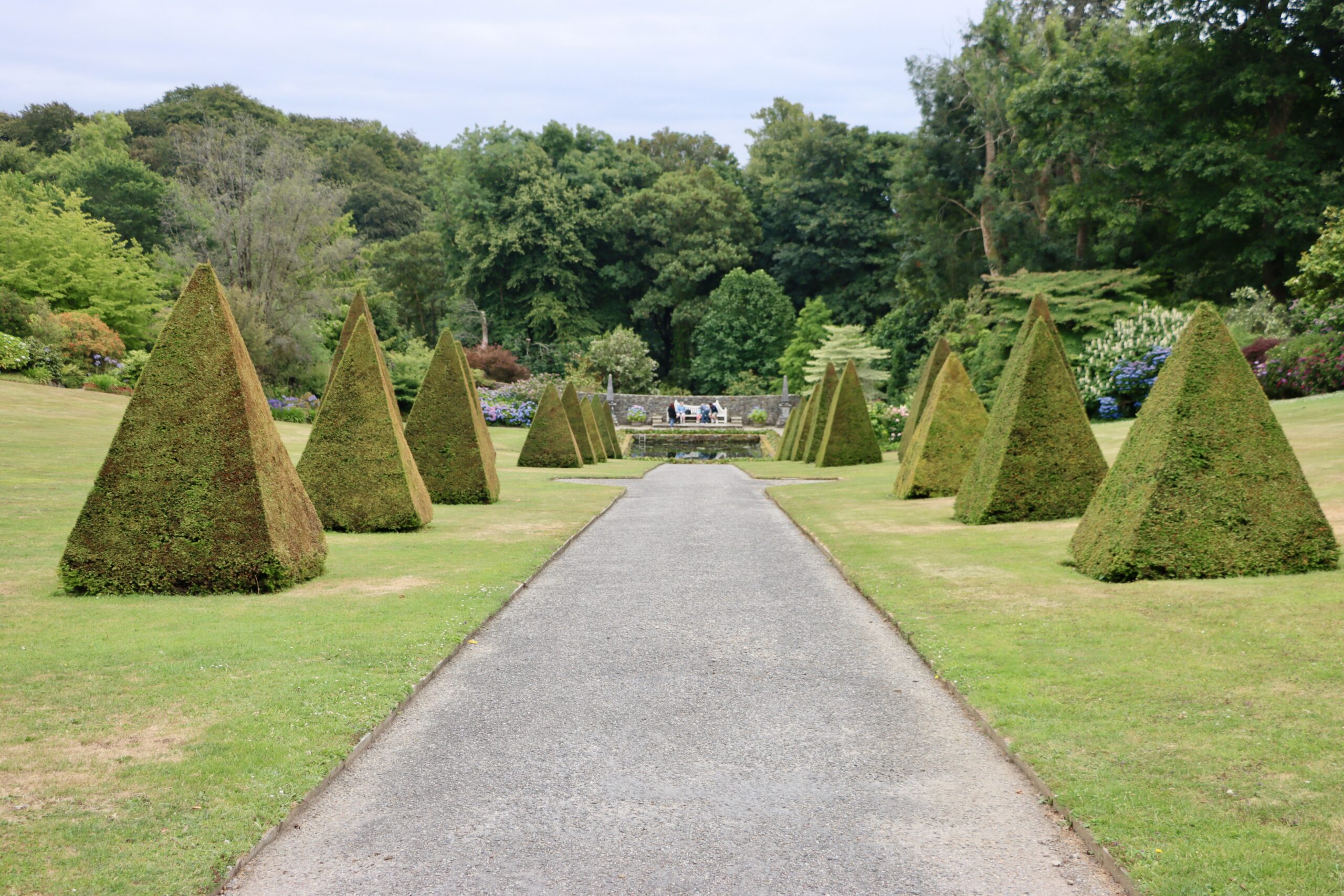
A photo of the formal part of the Hidden Gardens at Plas Cadnant

On our last full day in Wales, we crossed the Menai Strait (via the Menai Suspension Bridge which celebrates its 200th anniversary this year) to visit the Hidden Gardens at Plas Cadnant in Anglesey.

The Hidden Gardens at Plas Cadnant are not that well hidden – once you cross the bridges onto Anglesey, they’re quite well signposted. On arrival, you enter the formal walled garden, with topiary shrubs, lawns and a pond, but beyond there is a wooded area and a ravine with more informal planting. Here, the paths twist and turn, and so you’re never quite sure what you’ll see around the next bend. Our ten-year-old really liked this bit, and it felt a bit like a smaller version of Biddulph Grange in Staffordshire. A stream runs along the bottom of the ravine.

It’s a very peaceful place, that felt really lush just as the drought was starting to turn everywhere else a shade of brown. You can, apparently, see red squirrels in the trees, as grey squirrels were eradicated from Anglesey around 10 years ago, but we didn’t spot any.

We were mostly going at our ten-year-old’s pace and so spent just over an hour there, but it’s possible to spend longer – especially if you spend more time looking at the plants and flowers.

Accessibility

The formal garden at Plas Cadnant is mostly step-free, and there is a step-free route into the wooded area. However, there are steep slopes and steps down to the stream, so not all of the site is accessible to wheelchair users. Toilets are available; if you need a Changing Places toilet then there’s one that complies with older standards within a mile’s drive at Pili Palas Nature World (which we haven’t yet visited).

Car parking is on a grassy field next to the garden, which also doubles as sheep grazing. As such, there are no electric car charging facilities on site, but there is a rapid charger on Wood Street in the nearby town of Menai Bridge. The nearest railway station is at Llanfair­pwllgwyngyll­gogery­chwyrn­drobwll­llan­tysilio­gogo­goch (no really) but it’s about an hour’s walk; the walk from Bangor station is only a little further and it gets a more frequent service. There are also bus services from Bangor to Menai Bridge from where it’s a short walk.

There’s a café there, with free Wi-Fi available in the café. If you picked up the May issue of Gardeners’ World Magazine, you can get 2-for-1 entry to the garden.

Our 2026 holiday: Castell Caernarfon

A photo looking into Caernarfon Castle from one of the tallest towers

Following our visit to Penrhyn Castle, which looks like a fortified castle but isn’t, the next day we went to Castell Caernarfon (Caernarfon Castle), which is a fortified castle. It’s one of the four that make up the UNESCO World Heritage Site; we visited Conwy and Beaumaris last year, leaving Harlech for a future visit.

The castle sits on the edge of the Menai Strait (Caernarfon pretty much translates as ‘castle overlooking Anglesey), and, like Conwy, the town of Caernarfon has walls around it which adjoin the castle.

History of Caernarfon Castle

As per the other three castles that make up the UNESCO World Heritage Site, the current castle at Caernarfon was commissioned by Edward I of England in the 13th Century. However, it was built on the site of an older, 11th Century motte and bailey castle. As Caernarfon was to be Edward’s administrative centre of North Wales, it was built on a much grander scale that the other castles and so is significantly bigger.

However, like Beaumaris, the money ran out before it was completely finished, with work ending in 1330, almost fifty years after it was commissioned. So, parts of Caernarfon castle were never fully completed, such as the King’s Gate which forms the modern day entrance to the castle. Apart from a brief period during the 1294 Welsh rebellion, Caernarfon remained in English hands, including during the Glyndŵr rising in the 15th Century. It played a role in the English Civil War in the 17th Century, but was then abandoned until the 19th Century when repairs began to be undertaken. These repairs were more extensive than to other castles such as Beaumaris, and saw parts of the castle reinstated rather than preserved as ruins.

In the 20th Century, the investiture of the Prince of Wales was conducted twice at Caernarfon. This ceremony was promoted by the local MP David Lloyd George, who later became Prime Minister. The first investiture was of Prince Edward in 1911, who later became King Edward III, and the second was in 1959 which saw Prince Charles (now current King Charles III) be invested by Queen Elizabeth II. This was broadcast on TV and recordings are available to view at the castle, as well as the throne used by Queen. Following Charles’ ascent to King in 2022, Prince William has become Prince of Wales, but I gather neither Charles, William or the Welsh Government have much desire to hold another ceremony.

Visiting Caernarfon Castle

We spent 3-4 hours at the castle, and managed to see most of it. You can walk along the outer walls, and go into most of the towers. Some of the towers have attractions inside them:

  • There’s a museum for the Royal Welch Fusiliers, who are best known for having a goat as their mascot – entry is included as part of your ticket for the whole castle and they have their own gift shop.
  • The North East Tower has a ‘800 years of history in 8 minutes’ looping video.
  • There are also exhibitions about Edward I’s wife, Eleanor of Castille, and a chess board showing the roles of various Welsh princes and how they unsuccessfully challenged Edward I.

When we visited, there were also wooden cannons that you could use to fire ping-pong balls, courtesy of Dan’s Cannons. Our ten-year-old loved these. The courtyard inside the castle is quite large and so events take place there from time to time.

Compared to Beaumaris and Conwy, there is a lot more to see at Caernarfon Castle and you can probably stretch it out to almost a full day.

Accessibility

Caernarfon Castle has undergone a relatively recent accessibility upgrade, and so there is now a lift in the King’s Gate to the battements. This offers step-free access to the top of the King’s Gate and some of the castle walls for the first time. However, much of the rest of the castle is only accessible by stairs, and in some cases, quite narrow spiral staircases. Indeed, the courtyard isn’t all flat and so the video room in the North East Tower is only reachable by steps, even though ramps could probably be installed.

There are disabled toilets on site, and whilst there isn’t a Changing Places toilet in the castle, the nearest one is only a short distance away at the station for the Welsh Highland Railway.

The castle is in the care of Cadw, so Cadw and English Heritage members get in free. I was also able to get free entry with my CSSC membership and some photo ID.

We parked at a long-stay pay-and-display car park next to the castle. This doesn’t offer any electric car charging facilities; the nearest car park with chargers is the Shell Car Park, to the north of the town near Morrisons (which also has two rapid chargers but time limited parking).

British Rail closed the railway line through Caernarfon in 1970 as one of the final Beeching closures. The Welsh Highland Railway runs narrow-gauge tourist trains from Porthmadog, but there are usually only a couple of trains each day. There are regular bus services to the town from Bangor which is the nearest surviving National Rail station.

Free Wi-Fi is available across the site. The café in the King’s Gate is currently closed, but there is another café in the courtyard with outdoor bench seating, selling sandwiches and cakes.

Other things to see in Caernarfon

Whilst me, our ten-year-old and my parents were happy to explore the castle, Christine wasn’t so keen and explored the town instead. By the castle is Cei Llechli, which is home to a number of shops and artist studios. There are, of course, the walls around the town, but you can only walk along short sections.

Our 2026 holiday: Penrhyn Castle

A photo of the outside of Penrhyn Castle

As National Trust members, it’s inevitable that we would end up at a National Trust property in Wales. We didn’t manage to squeeze in Pehrhyn Castle on last year’s holiday, but we made an afternoon visit this year.

If you approach Bangor going west on the A55 North Wales Expressway, you get a decent view of Penrhyn Castle on your right. Unlike the other castles in North Wales that make up the UNESCO World Heritage Site, Penrhyn Castle isn’t a fortified castle and mostly dates from the early 19th Century.

History of Penrhyn Castle

There has been a country house on the site of Penrhyn Castle at least since the 15th Century, built by Gwilym ap Griffith who assisted Owain Glyndŵr in the Glyndŵr rebellion. By the 18th Century, the estate had come into the ownership of the Pennant family, and Richard Pennant commissioned an architect to remodel the house as a Gothic villa.

In the early 19th Century, Richard’s heir George Hay Dawkins-Pennant went further and commissioned the castle we see today. On the outside, it resembles the aforementioned fortified castles, but inside it is a very opulent country house with intricately carved stonework, plasterwork and wood carvings. At the time, this cost £123,000, which is equivalent to over £100 million today, and it shows.

The Pennant family earned their vast fortunes primarily via two means: slate, and slavery. The slate came from the nearby Penrhyn Quarry, now also a Zip World attraction like the Llechwedd Slate Caverns. It, and almost all the surrounding land viewable from the castle, were owned by the Pennant family, many of whom spent time as representatives in the Houses of Parliament as either MPs or Lords.

Meanwhile, across the Atlantic Ocean, the Pennant family owned multiple slave plantations in Jamaica. Slavery was abolished in 1834, against the Pennants’ wishes who were outspoken against abolition. Compensation was paid to the slave owners (not the now-freed slaves themselves); the Pennants owned 764 slaves, and received £14,683 compensation (around £18 million today). In 1951, ownership of Penrhyn Castle passed to the National Trust, so it has been in their care for 75 years.

It’s the National Trust’s largest property in Wales, and has been heated by biomass since 2016.

A photo taken inside the Great Hall at Penrhyn Castle

Inside Penrhyn Castle

A visit to the castle itself starts off in the Great Hall, which is huge and resembles a church, thanks to its stained glass windows, vaulted ceilings and stone carving. It’s very much a show of wealth and power, and indicative of the sorts of guests that the Pennant family sought to entertain. Queen Victoria stayed there in 1832, before the castle was completely finished, and in later years, William Gladstone visited.

You also get to see the library, with its carved wooden ceilings as an entertaining space primarily for male guests. There’s a huge dining room, and an opportunity to see many of the bedrooms.

It’s perhaps unsurprising that the castle became Grade I listed in 1966.

The castle also used to house a small museum about narrow gauge railways, which are common in Wales. That has now closed, but one of the steam locomotives remains, and the space is due to be redeveloped into a museum that has a wider focus on North Wales’ industrial past.

The Gardens

I would love to tell you about the gardens at Penrhyn Castle, but our visit was just in the afternoon and so we didn’t have time to see them. After we had been around the house, and given our ten-year-old time to burn off energy in the adventure playground, there wasn’t time.

The walled garden is a short walk from the castle itself, and you can read about it on the National Trust’s web site.

Accessibility

Penrhyn Castle is mostly on flat ground, and there is step free access to the ground floor of the castle and the rest of the grounds – presumably including the gardens. The upper floors of the castle are only accessible by climbing stairs; visitors unable to manage these can instead watch a video tour. Standard disabled toilets are available; the nearest Changing Places toilet is a short distance away at Bangor University.

There’s a large, free car park on site, which includes four Standard-Plus AC chargers for electric vehicles, on the RAW Power network. The half-hourly number 5 bus from Llandudno to Bangor calls at the end of the driveway, from which it’s a mostly flat one mile walk to the main entrance. The nearest railway station is in Bangor, which to the south of the city centre and is around 500 metres from the bus station.

Being one of the National Trust’s upper tier properties, entry prices are a little higher than some (currently £18 per adult) but National Trust members get in free. If you’re not a member, it’s worth keeping an eye on Money Saving Expert’s Deals Page, as you can sometimes get free or discounted day passes, and Octopus Energy often give away discounted passes to their customers through their Octoplus Rewards programme.

There’s a café in the castle – again, we didn’t visit, but I imagine it’ll be standard National Trust café food, including their Scone of the Month. I also didn’t check for Wi-Fi, as I had a decent enough phone signal, but usually this is available in National Trust cafés and ticket kiosks and is typically free.

We’re in Wales

A photo of Mostyn Street in Llandudno in Wales, looking towards the Great Orme

As mentioned at the start of the month, we’re off to Wales again for our summer holiday, and by the time you read this, we should have been there a couple of days. We’re staying near Conwy again, in a rented holiday cottage, as a group of five – me, Christine, our ten-year-old and my parents.

We were unsure whether this holiday would happen; I’ve had my injuries to recover from, and my Dad was unwell earlier in the year too. And there was a major wildfire not far from where we’re staying. But my Dad and I have recovered sufficiently, and the fire seems to be under control and has not spread to the cottage we’re renting for the week.

Weather-wise, it looks like quite a nice week, but cooler than it has been recently. Which I’m appreciating.

There will still be regular blog posts going live whilst I’m away, as I’ve written plenty in advance. Having spent most of the month working part-time, as part of a phased return to work, has meant I’ve had more time for writing new blog posts. So, I’ve made the most of it and ensured that there’s content for the rest of this week and next.

Once I’m back, I’ll start writing about the places we visited and what we got up to. See you then.

Jumping into July

A photo of Conwy castle taken through the gap in the town wall.

Here we are, into the latter half of the year. I’m continuing to recover, and this month sees us go on our annual summer holiday.

Recovery update

I’m slowly regaining mobility in my arms, following my fall, and I’m generally in less pain now. I’m still not fully back to normal, but may be closer to normal mobility by the end of the month. At least I’ve been able to help out with more of the housework; Christine and I normally split tasks relatively evenly, so a lot has fallen on her.

This month should also see me returning to work in the office on occasional days – until now, all my work has been at home.

I have a bone density (Dexa) scan coming up this month, as for someone to break both arms in the way I did at my age is unusual. I expect it won’t show anything concerning but my GP wants me to have one anyway.

Summer holiday

In the latter half of the month, once the schools have broken up, we’re off for a week’s holiday in North Wales. We’re actually staying in the exact same place as last year – it was nice, convenient, and there are plenty of things that we didn’t get to do last time. In fact, my potential to-do list has enough for a potential third holiday next year, although I doubt we’ll make it three years in a row.

Weather permitting, we’d like to go up Yr Wyddfa (Snowdon), although we’ll probably be taking the train to do so. We also plan to go down some kind of mine one day, and visit the Welsh Mountain Zoo.

As I’m not currently permitted to drive, Christine will be doing all of the driving this time. Which part of me feels bad about; however, I did all of the driving on our 2018, 2019, 2021, 2022, 2023 and 2024 holidays, so maybe this will help balance things.

New tech

I mentioned at the start of the year that we’d be looking at getting a replacement laptop for home use. Christine bought one earlier this year, and now I have one on the way too so that we each have our own device. I’ll blog about it once it has arrived and I’ve had a chance to play with it.

Heading off on holiday to North Wales

A photo of the village of Portmeiron in North Wales

Later today, we’re off on our annual summer holiday. This year, it’s a week in North Wales, where we’ll be staying in a rented holiday cottage.

As usual, we’re going with my parents, who have kindly paid for the accommodation for all five of us. It also gives our nine-year-old chance to spend time with their paternal grandparents – as my parents live in York, they’re just a little too far to see on a regular basis.

Like last year’s holiday to Northumberland, this holiday is a domestic holiday; although Wales is a separate country from England, it’s not a separate nation state and so we don’t need to worry about having different currency, passports, plug adaptors and the like. And there’s no biosecurity restrictions, so we can bring and take back as much cheese as we’d like.

We are driving there, and it’ll be in our new electric car. Naturally, I’ve spent some time before we leave scoping out where we can charge the car whilst we’re there, but it’ll be its first distance test. A full charge should be enough to get us all the way there.

We’ve already started a list of where we’d like to go. This may well include Portmeiron, as pictured in the header image. That photo was taken the last time we were in North Wales, back in 2018. What we actually end up doing will, of course, depend on the weather.

I’ve written more than a week’s worth of blog posts in advance, so there’ll be no gap in blogging whilst I’m away.

Our 2024 holiday: Beamish

A photo of the main street in the 1900s town at Beamish

This is the eighth, and final, blog post about what we did on our 2024 holiday to Northumberland. Previously, I wrote about Cragside, and today is about our visit to Beamish.

‘Wait a minute’, you may be thinking, ‘Beamish isn’t in Northumberland’. And you would be right – Beamish is in County Durham. But we called in on the way home and so I’m counting it as part of the holiday.

Beamish is an outdoor, living museum – very similar to the Black Country Living Museum that we visited back in May. It’s split into different areas, each representing a different time period, from the 1820s through to the 1950s. I’ve been a few times, and all three of us last visited in 2019 for my 35th birthday.

Beamish is huge, and it’s now just about impossible to see everything in one day. So, as we’d been before, we strategised and focussed on visiting a few key areas that we wanted to see.

The 1820s landscape at Beamish. There is a thatched-roof cottage in the foreground

1820s Landscape

This is the area set 200 years ago, around Pockerley Old Hall, a farmhouse and one of the few buildings that was in situ and not rebuilt on the site. Elements of the farm have been there since the 15th century. At the farm, there are a few horses and pigs to see, and a brand new tavern where we had lunch.

This area is also is home to a waggonway, which was a predecessor to the railways and has a replica of Puffing Billy to haul visitors up and down a short section of track.

A old fashioned bus parked outside the church in the pit village at Beamish

1900s pit village

Jumping forward, and there’s the pit village – a small community around a coal mine, set around the peak period of coal production in the area. You can go down the Mahogany Drift Mine, which was a real mine – if you go down a closed off mine road and keep going you’ll end up about a mile away. The village shows how people lived – there’s a school, church and several miners’ cottages.

Two houses and a police station in the 1950s town at Beamish

1950s town

This bit was still being built when we last visited, and is now mostly complete. In a way, this felt like the oddest bit of the museum seeing as the houses are just like those that friends used to live in. You can go into the houses, and they have been decorated as they would have been when new. There’s also a playground and a high street with a toy shop, cinema and appliances shop. You can book to have your hair done in a 1950s style, and there’s a fish and chip shop.

It’s the first time in a while that a setting in Beamish reflects a time in living memory.

A tram and a bus in the 1900s town in Beamish

1900s town

Joined onto the 1950s town is the 1900s town, one of the older sections of Beamish and probably the most well-known. It’s expanded somewhat over the years and includes many transplanted buildings, including a bank, sweet shop, pub, co-operative store and a pharmacy. It’s certainly the busiest bit of the museum and the most complete.

This was all we had time to see – the weather was starting to turn, and we had a two hour drive home ahead of us, so we missed the 1940s home farm, the 1950s farm and the fairground.

A tram at Beamish

Getting around Beamish

Beamish is a large site, and unless you’re super fit, you’ll probably want to make use of the transport options provided. One of the things Beamish is known for is its tramway, which forms a circuit of the site and connects most (but not all) of the areas. At peak times, there are three trams in operation. They’re all heritage trams, although not all from the North-East of England – one is from Oorto, although painted as if it was from South Shields.

For the areas not reachable by tram – namely the 1900s Pit Village and the 1950s Town – there are a series of heritage buses running. These are all diesel, but there’s a plan to run electrically-powered trolleybuses into the 1950s town in future.

Wheelchair users can use a replica classic bus which has had a foldaway lift added at the back. It’s an on-call service reserved for those with mobility issues.

Accessibility

Accessibility at Beamish is pretty good, considering that there are lots of old buildings – you can tell that some thought has gone in to ensuring access where possible. But that doesn’t mean that every building is accessible, although the newest areas like the 1950s town are the most accessible. Indeed, the 1950s town is home to a Changing Places facility, and many of the buildings have lifts to access upper floors where needed. There’s an extensive accessibility guide on the web site.

Tickets for Beamish are valid from one year of purchase; as mentioned, it’s more than one day out and so you can visit as many times in the subsequent 364 days without paying again. At time of writing, tickets are around £28 each for adults and £17 for children. A Max Card discount is available on tickets bought on the day. However, I would recommend buying tickets in advance as we had to queue for quite a while to purchase them on arrival.

There are regular direct buses from Newcastle, Sunderland and Chester-le-Street. Chester-le-Street is also the nearest mainline railway station, served by regular Transpennine Express and occasional LNER and CrossCountry services. The bus services seemed well-used when we went, and drop you right outside the front entrance.

Our 2024 holiday: The Farne Islands

A photo of the Farne Islands.

This is the fourth blog post about what we did on our 2024 holiday to Northumberland. Previously, I wrote about The Alnwick Garden, and today is about our visit to The Farne Islands.

I’ve mentioned the Farne Islands in my previous posts about Seahouses and Bamburgh Castle. They’re a collection of 15-20 islands just off the Northumberland coast – the number of visible islands depends on the tides. People have lived on the islands in the past, but nowadays there’s no year-round human residents. They’re now looked after by the National Trust.

Whilst humans may no longer live there, plenty of birds and seals make it their home instead, and so there are plenty of boat tours from Seahouses to go and see them. We went on a two hour tour with Billy Shiels; ours was a ‘non-landing’ tour that visited several of the islands but didn’t dock at any of them. Other tours do land at one or two of the islands; if you’re a National Trust member then you can land for free but non-members have to pay a landing charge.

A photo of an Atlantic Puffin sat on a rock on the Farne Islands

Bird life on the Farne Islands

Probably the biggest draw for people visiting the Farne Islands is the opportunity to see Atlantic Puffins. They’re not there all year round – indeed, when we visited a couple of weeks ago, they were grouping up to get ready to fly out to sea. They’ll stay out at sea until the spring, so we were lucky to see them. Indeed, we probably saw thousands of them – swimming, flying, eating or just lounging around on the rocks. Puffins are one of my favourite birds – I’ve seen a few at a distance at RSPB Bempton Cliffs in East Yorkshire, but I had never been this close to them before. I managed to get lots of photos of them, and it was amazing to see them flying overhead.

Besides the puffins, we saw shags, razorbills, cormorants, oyster catchers, eider ducks, terns and kittiwakes. Indeed the kittiwakes still had some quite fluffy chicks in their nests on the rocks when we visited.

A photo of a grey seal sat on a rock, on the Farne Islands

Grey seals

As well as the birds, there were hundreds of grey seals. Many of the females were pregnant, so there will hopefully be lots of pups in the autumn. Whilst we saw plenty lounging around on the rocks, there were a few out swimming as well. At other times of the year, it’s possible to see thousands of seals on the islands.

The boat trips are not cheap – expect to pay around £25 per person for a two hour trip. But it was absolutely worth it – I keep using the word ‘amazing’ but I can’t think of any other words to describe what an experience it was. We got really lucky with the weather too – nice and sunny with not too much wind. It was definitely one of my top life experiences.

Our 2024 holiday: Seahouses

A photo showing a view across the harbour at Seahouses in Northumberland.

This is the first of a series of blog posts about what we did on our 2024 summer holiday. We stayed in Seahouses, a small village on the Northumberland coast, in a rented holiday cottage.

Seahouses is nice – much smaller than other seaside resorts like Blackpool or Scarborough and less brash. There was just the one amusement arcade, for example, which was in a relatively unassuming building away from the seafront. The main reason for Seahouses becoming a village was its harbour, which is known as the ‘North Sunderland Harbour’, as it acted as the harbour for the neighbouring village of North Sunderland. This village has nothing to do with the better-known City of Sunderland in the next county to the south.

The name ‘Seahouses’ came about from the small houses built around the harbour by the fishing community, and mainly came into use when the North Sunderland Railway opened. That’s now gone, having closed in the 1950s, and there’s a car park where the railway station used to be.

Many of these ‘sea houses’ are now holiday cottages, and if you walk down one of the streets you’ll see that most of the houses have key safes outside. I suspect that, in the winter, Seahouses gets a lot quieter than during the peak summer tourist season.

What’s there to see in Seahouses

We arrived late on the Friday night, and so we had a wander around the village on Saturday morning. As mentioned, there’s lots of holiday cottages and the harbour. There’s also plenty of gift shops, restaurants and a few pubs. At one time, there would have been many smokehouses, selling smoke fish – indeed, it’s believed that the kipper was invented in Seahouses. Nowadays, there’s just one smokehouse left: Swallow Fish.

There’s plenty of seabirds to watch. As well as the usual seagulls, we saw oyster catchers, sandpipers and a couple of grebes in the sea. There are also several eider ducks in the harbour.

Seahouses is also the main launch point for boats to the Farne Islands and Lindisfarne, which we visited later in the week (blog posts to come). There’s also a lifeboat station which is home to one of the larger lifeboats, and a tractor to haul it to the sea – plus the usual RNLI shop.

It’s a pretty little village and, if you’re not staying, maybe somewhere to look at on the way through. You can view more of my photos on Flickr.

Accessibility

As mentioned before, Seahouses’ railway station was closed in the 1950s. The nearest railway station is at Chathill, but it only gets a token service of two trains per day towards Newcastle-upon-Tyne, and there’s no connecting bus service. The 418 and X18 run every four hours (so collectively there’s a bus around every two hours in each direction) which connect to Berwick-upon-Tweed, Alnwick, Morpeth and Newcastle. With this in mind, you’re probably going to want to drive to Seahouses, and it’s on the Northumberland Coastal Route which is a signposted route along mostly B-roads.

In terms of getting around once you’re there, obviously it’s a coastal village and so there’s a slope down to the shore. Whilst there are steps in places, you should be able to find an alternative sloped route where needed. A public changing places toilet is available in the village.

Back from our holidays

This is another pre-recorded post – I’m actually writing this a couple of weeks ahead of time – but by the time you read this, we’ll be back from our 2024 summer holiday. We went to Northumberland, and stayed in the coastal village of Seahouses.

As mentioned in my domestic holidays post, we decided to have a holiday in England as my dad has had some periods of ill health recently, and wouldn’t have managed the driving that we normally do when we go to France. But it was also an opportunity to visit somewhere that I’ve only ever passed through; I haven’t had the chance to actually see some of the places that we’ve visited before properly. Which, considering that Northumberland is only three hours away by car, is a bit of a shame.

Consent

I also didn’t want to talk about where we were going in advance. Now, whilst this blog doesn’t attract the readership that it once did, I am also conscious that what I write here is public. And so I don’t really want to state exactly where I am at any given time, just in case someone uses that information against me. Of course, you may just decide that you like me and want to meet up with me, but I’d rather you didn’t – or at least, you contact me first and get my consent.

And it’s with consent in mind that covers my other reason for being vague about where I’m going. When it comes to my holidays, it isn’t just me going but my parents, my wife and our eight-year-old. And it’s our eight-year-old in particular whose identity I want to protect. I avoid using their actual name or gender on here, because they are too young to give informed consent for this to be public information. I don’t think they’re old enough to have a conversation about what a blog is, or that any information that I put up about them is public and likely to be available forever. Because even if I delete old posts (and a lot are missing), they may live on in places like the Web Archive.

Our eight-year-old watches lots of videos on YouTube Kids now (which is part of the reason for us cancelling Disney+), and many of these feature young kids. Now, obviously their parents are more comfortable with this, but it makes me cringe. It’s worth reading this Teen Vogue article about kids of influencers. I want my child to enjoy their time as a child, and I don’t want to have a difficult conversation when they’re older about all the things that I’ve shared about them in public.

Anyway, back to the holiday

Okay, so this blog post didn’t quite go the way I expected it to. Once I’ve had time to download and edit the photos that I’ve taken, I’ll be posting a series of blog posts about the things that we did whilst we were away.

Creative Commons License
Except where otherwise noted, the content on this site is licensed under a Creative Commons Attribution-ShareAlike 4.0 International License.