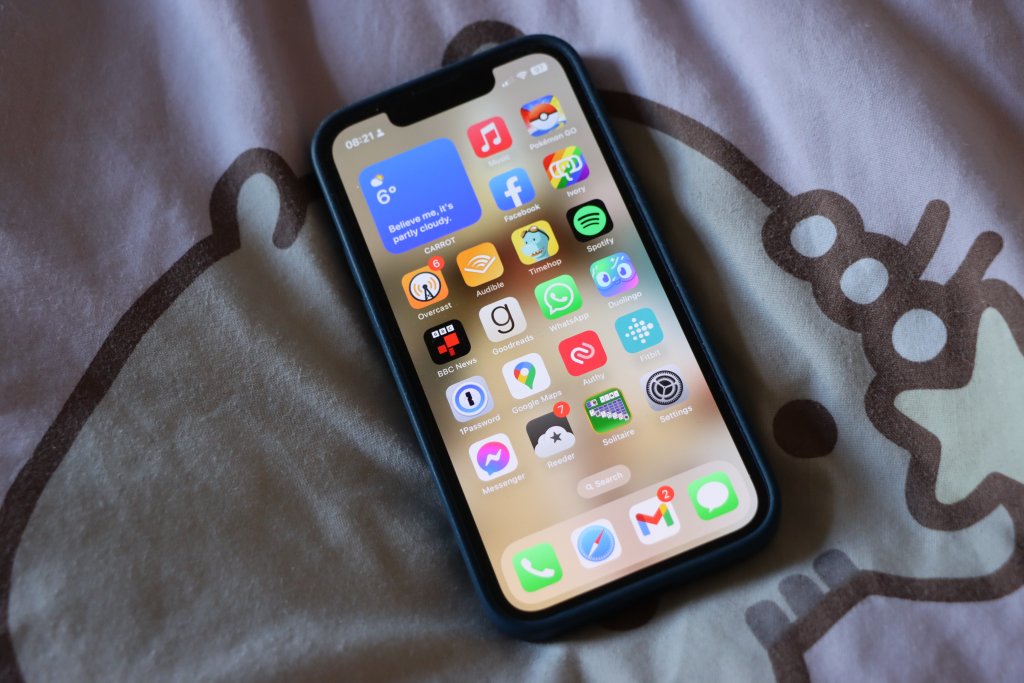
I’ve recently added a wrist strap to my phone. This is primarily on the back of Terence Eden’s advice for mobile security. As well as advising the use of a password manager, password/biometric lock and not sideloading apps from shady sources, he also mentions physical security of the handset.
Whilst my phone “only” cost around £700, I’ll only finish paying it off next month. If you have an iPhone Pro Max with the maximum 1 terabyte of storage, you’ll have paid £1600 which is a lot of money to lose. Some Samsung Android phones also cost serious cash to buy new nowadays too.
I often have my phone out when walking around, mainly for playing Pokemon Go. All it takes is someone brazen enough to snatch it out of my hand for it likely to be gone for good. So I’ve finally decided that a wrist strap would be a good idea in the hope of preventing this.
Both the strap, and the phone case I use, are relatively cheap ones from AliExpress – collectively costing less than £5. The case has a pair of holes for threading a strap through, but you can also buy wrist straps that attach to the bottom of any phone case if yours doesn’t have holes. Somewhat annoyingly, the holes are on the left side of the phone, and I’m right-handed.
My wrist strap itself is adjustable, so you can tighten it around your wrist and reduce the risk it falling (or being pulled) out of your hand.
Whilst I was mainly motivated to reduce the risk of my phone being stolen, having a wrist strap also reduces the risk that you’ll drop your phone. As well as reducing the risk of the phone being damaged, it means you’re less likely to drop it in places where it can’t easily be retrieved. Maybe if Rebekah Vardy’s agent had a strap on her phone, she wouldn’t have ‘accidentally’ dropped it in the North Sea. Snide remarks aside, I use my phone’s camera quite a bit, so having a wrist strap makes me more confident that I’m not going to drop it into a lion enclosure at a zoo or something.
Just a quick word of caution though. If you keep your phone in a pocket, make sure you tuck the wrist strap in as well so it’s not hanging out. Otherwise, counter-intuitively, it might make your phone easier for pick-pockets to steal.
So, in the second of my two blog posts about things we’ve done to make our holidays a little easier, I’m going to talk about eSIMs, and how you can use them to get cheaper data when travelling. The first post was on using a tag to pay for motorway tolls in Europe from Monday.
An eSIM is an ’embedded SIM’. So, unlike a SIM card that you put into your phone, an eSIM is built in. However, newer phones make this eSIM re-programmable, and so you can download a profile to change your eSIM to a different network. Normally, this is in addition to whichever physical SIM card is in your phone.
What this means is that you can have your regular SIM for making calls and sending/receiving SMS messages, and then a different eSIM for data. This can be a local eSIM, so you don’t have to pay roaming charges. And, because your regular SIM is still there, you’re still reachable on your regular phone number.
Buying an eSIM from Airalo
Whilst in France, I bought my eSIM from Airalo. You install their app, purchase your eSIM, and then install it so that your phone can use it. It’s straightforward, and the eSIMs are not expensive. I paid $10 for a 3 GB eSIM that was valid for 30 days, which was sufficient. By contrast, I would have spent £2 per day to roam with Three, which would have added up to £20. $10 is roughly £8, so it saved a little money. Airalo also offers ‘Airmoney’ which is essentially cashback on each purchase, that can be accumulated towards buying more credit.
When you have both a regular SIM and an eSIM active, your phone should show the signal for both. In my case, I was connected to Bouygues for voice and SMS, and Orange for data.
If you use an iPhone, then you’ll need an iPhone XR, XS or XS Max or later. These were the models announced in September 2018, so unless you have a very old iPhone, you should be able to use an eSIM. Obviously support for Android phones will vary by manufacturer; my wife has a Samsung Galaxy phone of a similar age and this didn’t support an eSIM.
Whilst there are other eSIM retailers besides Airalo, this is the one I have experience with. If you want to try them yourself, then if you use the code ‘NEIL6715’ when signing up, you’ll get $3 credit.
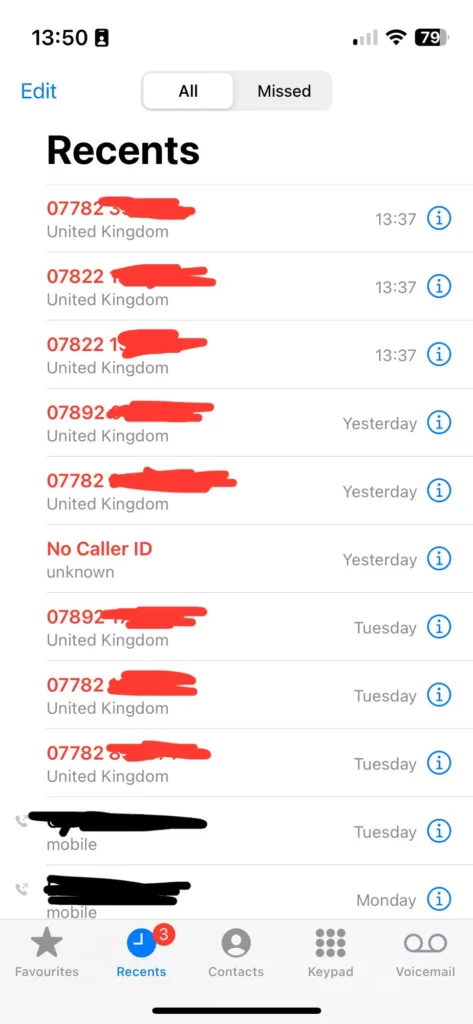
Over recent weeks, I’ve been plagued by calls from numbers not in my contacts. Sometimes, as per the screenshot, I’ll get three calls from three different UK mobile numbers within seconds of each other. So, I’ve enabled Silence unknown callers on my iPhone.
I made a mistake by answering the first call, and it turned out to be some kind of cryptocurrency scam. However, it wasn’t just a random dial; they had my name and email address as well as my phone number. This suggests that they’ve hoovered up my personal data from a previous breach – possibly the Patreon breach of 2015, but there have been many others.
Since then, I’ve been getting three or four calls at a time, usually twice per day. It’s a different number every time, so whilst I may have not been fully convinced it was a scam when I answered the first time, I am convinced now. I’ve tried to hide the numbers in the screenshot because the numbers have almost certainly been faked and probably belong to innocent people. It also suggests to me a deliberate effort to get around call blocking apps like Truecaller, for which I have a premium subscription.
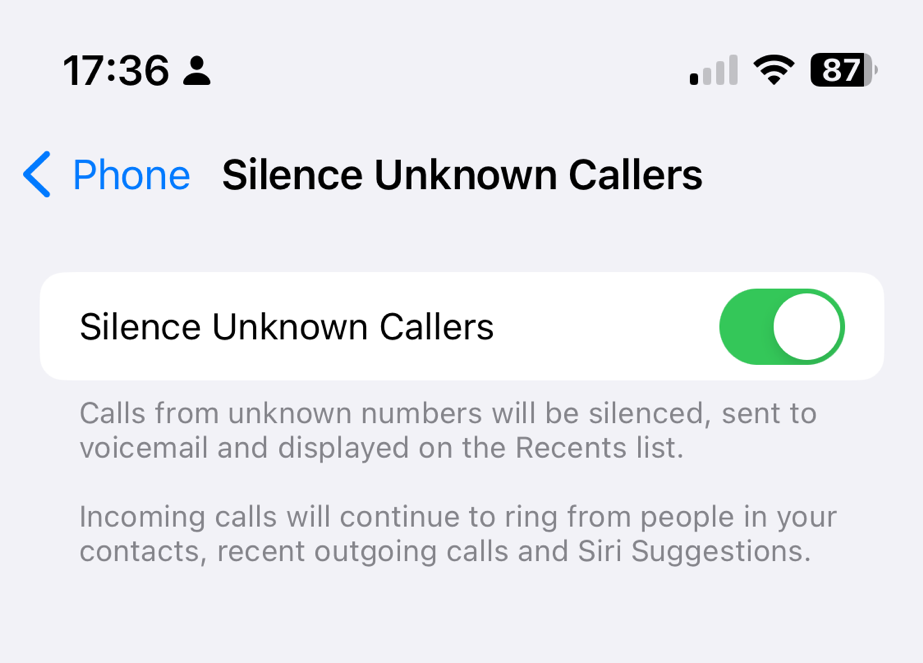
What this means is, if people call me, my phone will only ring if the number is in my contacts, if I’ve called it recently, or it’s a ‘Siri suggestion’. The latter could include numbers in recent text messages and emails, for example.
If you want to enable this yourself, open Settings on your iPhone, go to Phone and then scroll down to ‘Silence Unknown Callers’.
I’ll keep this on until the random calls stop. At the time of writing, they’ve slowed down but haven’t stopped completely. Maybe they’ll get the hint in time.
iPhone 13 Mini (blue, 128 GB), bought in spring 2023
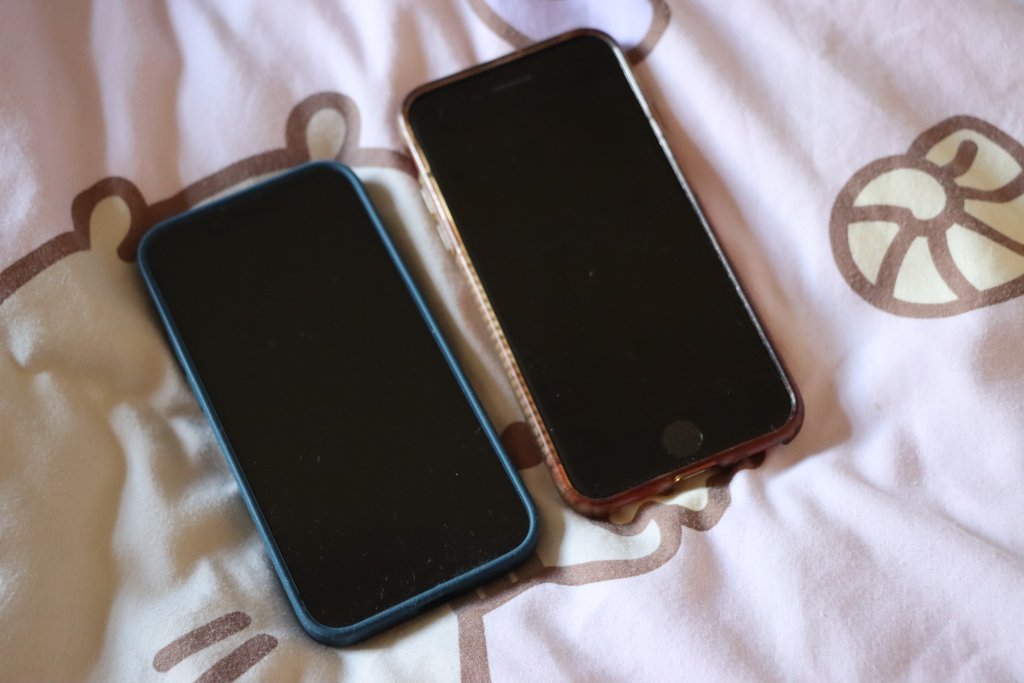
As you can see, with each model I’ve kept it a little longer than the previous one. Before my first iPhone, I would generally keep a phone handset for 18-24 months at a time, and indeed that was the case with my first iPhone – it was on its last legs by the time I traded it in. Its replacement, the iPhone 5 laster a little longer but I had issues charging it after a while. The iPhone 5s laster slightly longer again, but in the hot summer of 2018 its battery started expanding and the back was coming away from the phone body, so I decided it was high time for a replacement.
I was hoping to get my iPhone 8 to make it to five years, and in late 2021 I even had the battery replaced to give it some extra life. Alas, this new battery was also starting to wear out – I would have to recharge my phone more than once a day to get through.
Whilst I could have had yet another new battery fitted, I suspect that Apple won’t support such an old model much longer with new iOS updates, and they were offering up to two years 0% finance on new models. I’m not eligible to upgrade with my current phone network, as I’m on a 2 year fixed SIM-only contract, so buying the new phone direct from Apple on 0% finance seemed like the best option.
Apple conveniently provides a Compare iPhone models tool, and so I was able to decide between the various models on offer to work out which was best for me. As you may note from the above, my purchases of the 5s and 8 were at times when physically larger models were available, but I’ve generally preferred the smaller iPhone models. That pretty much ruled out buying an iPhone 14, as there’s ‘mini’ version available – and it was also £200 more than the iPhone 13 Mini.
Apple also offers its iPhone SE range, and the current third generation is essentially an iPhone 8 body with iPhone 13 internals. However, that means a smaller screen, and Touch ID rather than Face ID, as well as a more basic camera, slower 5G, less water resistance and no support for MagSafe, when compared with the iPhone 13 Mini.
The iPhone 13 Mini is also slightly smaller and lighter (albeit by a mere four grammes) than the iPhone SE. Despite this, the screen is bigger, as the bezel is smaller – it doesn’t need to accommodate the home button for Touch ID.
As for the iPhone 14, as well as it being too large for my liking and more expensive, it’s not much of an upgrade. Again, there’s an even better camera, the ability to make SOS calls via satellite, crash detection and slightly better battery life, but the processor is the same as the 13 Mini and SE; the only benefit is one extra GPU core.
Having had the new phone for a week, I’ve appreciated the extra speed, and the convenience of Face ID which seems to work well, even when I’m wearing glasses. The transfer process from old phone to new also went pretty well and I was mostly up and running on the new phone in a couple of hours – some of which was spent installing iOS 16.4. The new camera is also great and I’ve taken a couple of photos with the ultra-wide aperture lens (giving a fish-eye appearance).
Hopefully I’ll be able to keep this new phone going for the full five years. Whilst it’s always nice to have the latest and greatest device, I also appreciate the cost savings of not upgrading regularly. If everyone held onto their phones for several years, I’m sure there would be wider environmental benefits.
As I mentioned on Monday’s update/apology, I recently upgraded to an iPhone 8. It’s a 64 GB Product(RED) model; whilst the front looks like the space grey model, it’s got a red back, and includes a donation to (RED). (RED) is a non-profit that raises money for HIV/AIDS charities, and there’s no extra cost to consumers over the price of an equivalent iPhone in one of the other colours.
I had planned to wait until the autumn to upgrade, either to buy one of the new iPhone models or get an older model at a cheaper price. But I was essentially forced to upgrade early. My previous iPhone was a 5S, and the battery had started expanding to push the front cover away from the case. An expanding battery is a very bad thing; it means it’s at risk of exploding.
In the interim, I tried using my old iPhone 5, which I still had as a backup phone. However, Apple has dropped support for the iPhone 5 and so it can only run iOS 11. Furthermore, many apps won’t run because it lacks a 64-bit processor which the 5S and all subsequent models have. Pokémon Go is one such example; with other apps, only older versions run.
Jumping from the 5S, which is 2013-era technology (although I bought mine in 2015) to the 8, which was released last year, is a big leap. The 8 is much faster. I’m also warming to the larger screen; in 2015 I decided to buy a 5S rather than a 6 because I wasn’t keen on the bigger surface area. But the bigger screen is great for apps like Google Maps.
The lack of a headphone port isn’t an issue; I switched to Bluetooth audio a couple of years ago. In a similar vein, I had been using a wireless charger case for my 5S and already have wireless charging stands at home and at work. The battery life of the 8 seems better than the 5S had even when new. And whilst I take most of my photos on my Canon DSLR camera, I’m impressed with the camera on the 8. Live photos is a fun gimmick but it’s nice when taking photos of our two-year-old as it captures some of their mannerisms. Finally, I’ve noticed that I tend to have a better signal on this phone compared to previous models; I’m guessing it supports additional frequencies, or newer versions of the mobile standards.
Upgrading to the iPhone 8 has meant taking on a rather more expensive contract. I’m now limited to 4 GB of data per month; my previous contract had unlimited data, although in reality, I never hit 4 GB in a month anyway. I’m still with 3, who I’ve been with for almost 8 years now.
As for the iPhone X, as much as it looks impressive, right now it’s unaffordable for me. I imagine that whatever phone I get next, will be a descendent of the X. Hopefully, that won’t be for another three years at least, provided this new iPhone 8 lasts as long as my 5S did.
As for Apple’s tablets, there’s a new iPad Air, but with the ‘Air’ moniker dropped. It’s now just known as the iPad, but uses the same form factor as the iPad Air. Externally it looks the same, but the chip has been bumped up from an A8X to an A9, which brings better performance. It’s available with either 32 or 128 gigabytes of storage, and the cheapest model is £339. This is a significant price cut from the £379 iPad Air 2 that it replaces.
The iPad Mini remains at version 4, and, interestingly, is now only available with 128 gigabytes of storage. Consequently, the cheapest iPad Mini is £419, which is only £10 cheaper than the new 128 GB iPad; back in 2014, the difference was £80 between the equivalent 16 GB models. I suspect that Apple plans to stop selling small form-factor tablets in the near future, which would be a shame as I think it’s a nice size.
Replacing my iPad
My current tablet is a 16 GB iPad Mini 2, which was a present for my 30th birthday in 2014. I use it daily, both at home and at work. At home, it’s effectively my primary computer. I use it far more than my Mac, which, being a desktop, is fixed in one place. Being able to use it anywhere in the house is a major advantage when looking after a small child.
At work, it’s useful in meetings as I don’t need to print off reams of documents beforehand. I also find it handy at events, for checking information whilst away from my desk. And it provides entertainment whilst travelling; I can read Pocket articles or magazines whilst commuting to work.
However, its screen is badly cracked. The screen has already been repaired once, for which I paid about £40 to a shop in Bradford. The workmanship wasn’t great and the home button sticks sometimes. In any case, I broke the screen again literally only a few weeks later. A decent repair job on the screen is likely to cost around £100, or around a third of the cost of a new iPad.
Advantages and disadvantages
There would be several advantages of buying a new, standard-sized iPad:
Larger screen, which would suit me as I read a number of digital magazines.
Touch ID.
Being able to use two apps in split-screen mode (my iPad Mini 2 only supports slide-over).
Faster processor.
More storage, as I often run out of space with only 16 GB.
Being eligible for continued iOS updates, as I suspect Apple may drop support for the iPad Mini 2 after iOS 11.
And some disadvantages:
I like the smaller size and lighter weight of the iPad Mini.
A new case would be needed – Christine hand-made my current one, but I doubt she will have time to make a new one for me.
I would also need a new Bluetooth keyboard, although as Lizzie likes playing with my current one I’m sure she would like to keep it as a toy.
Although the large crack on my iPad’s screen is unsightly, I’m seriously considering holding out with it, until I can afford to buy a new model. Right now, money is tight, and I can’t really justify paying for repairs to my existing model, or for buying a new one.
I could, of course, consider an Android tablet, which may be cheaper. But I’m worried that I would then have the additional expense of buying replacement apps again and getting used to an unfamiliar operating system. The current best Android tablets cost around the same as an iPad, and a cheaper model may not be any better than what I already have.
I’ll revisit this in the summer, when I’ll hopefully have some more money. By then, we will hopefully know more about iOS 11, and which devices it will support. That could sway my decision further.
Over the Christmas break, my iPhone would randomly decide that I was in my office. I’d have an app open that used my location, but instead of showing me where I actually was, it’d suggest that I was in Bradford. Which isn’t so useful when, in reality, you’re at home, or in York.
It caused particular problems when using Google Maps for directions, as it’d randomly jump to Bradford and then back again. Swarm was basically unusable. And it completely broke the ‘Track Exercise’ function of the Fitbit app. I had to actually uninstall and reinstall the Fitbit app a couple of times because it wouldn’t let me stop the exercise. This was even after restarting the app.
Turning Wifi off helped. Apple’s iPhones, and indeed many other devices, use the SSIDs of available Wifi networks to approximate your location. This is done by querying a web service, which means that you can still get an approximate location even when indoors, and out of view of GPS satellites. But turning off Wifi was hardly a long term solution.
How to actually fix the location problem
A bit of Googling uncovered this article about fixing your location. It offers several solutions, depending on whether the issue affects just one application, or all. In my case, it was all applications, and the solution that worked was the fifth on the list. This involves resetting your phone’s location and privacy settings.
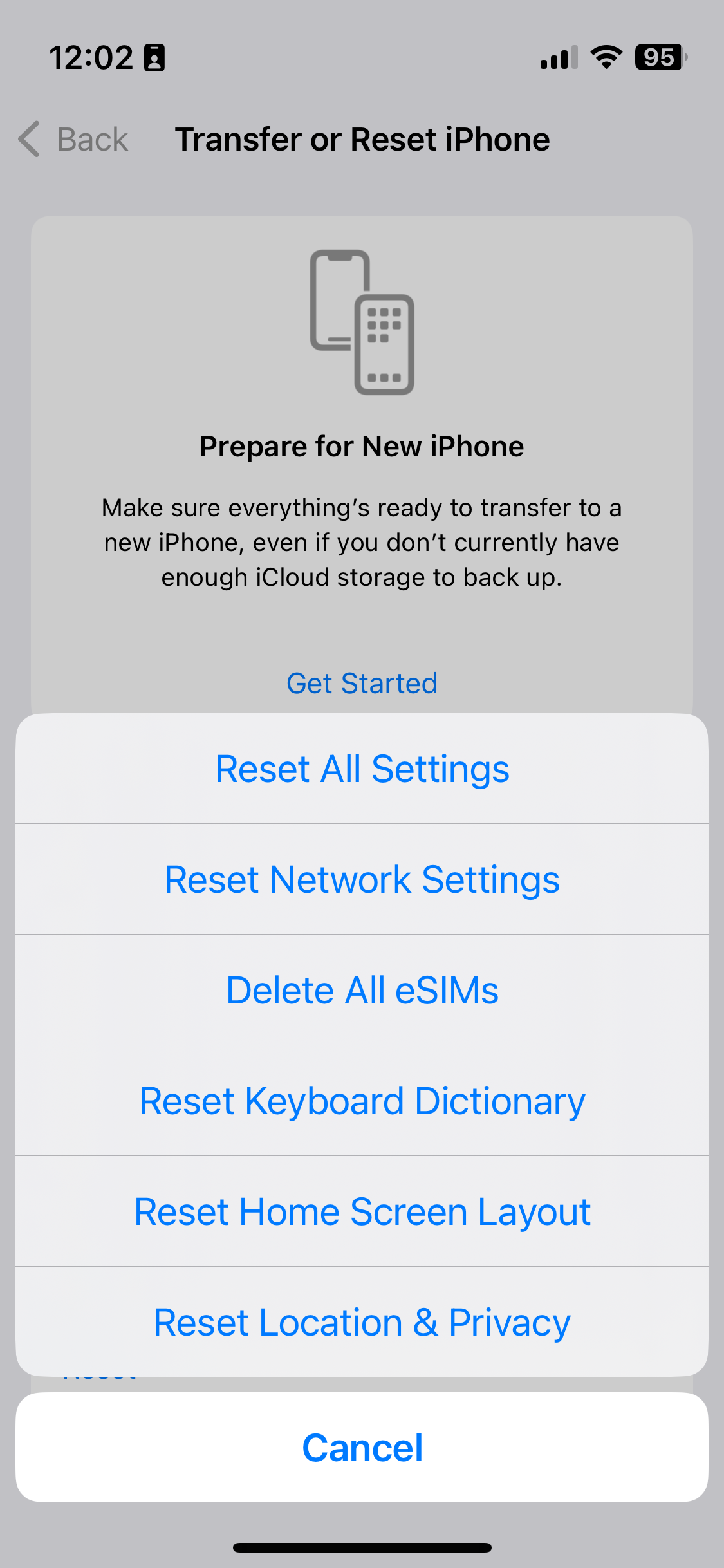
To do this, open Settings, and choose General. Then, scroll right down to the bottom and choose Reset, then select ‘Reset Location & Privacy’ – on iOS 10.2, this is the last option. Your device will ask you for your unlock password – pop this in, confirm, and hopefully your device will get the location correct from now on.
There is a drawback to doing this, however. You’ll have noted that this resets both your location and privacy settings. This means that any apps that you have granted access to your contacts, photos, calendars, camera, microphone, media library and so on will need to request them again. Although, oddly, apps will retain their location permissions, along with any permissions regarding background app refresh, notifications or mobile data access.
Despite these issues, it was a relief to fix the problem.
This blog post was updated in November 2023 with an updated screenshot, but the instructions are broadly the same.
Later today I will have a brand new iPhone 5S, which I ordered on Friday. I wasn’t expecting to need a new phone so soon but sadly my current iPhone 5 is not in a good way.
The need to upgrade
I bought my iPhone 5, along with a new two-year contract, in September 2012, shortly after launch. My iPhone 4 had pretty much conked out: it kept randomly rebooting, and was getting rather slow. However, by September 2014, my iPhone 5 was still in good shape. Sure, the battery life wasn’t as good but it still worked fine. So instead I took out a new 12 month SIM-only contract with the intention of keeping my iPhone 5 until next year.
Unfortunately, more recently, my iPhone 5 has developed a fault with the Lightning port. It will only charge if I plug a cable in at a certain angle – and if the cable becomes even slightly loose, it won’t charge. Whilst I can usually get the cable in a good enough position to charge it at home, it’s almost impossible to do when out and about unless you actually hold the cable in position. And there have been several occasions when the cable has been knocked slightly and I’ve ended up starting the day with a phone on 30% battery.
It’s been like this for a while but it seems to have got worse of late. I’ve tried cleaning out the Lightning port as best I can, and I’ve used many different cables, but it still doesn’t work properly.
It may be fixable, but as the battery life isn’t great either, I decided that really, I’d be best with a new phone.
Rule-breaking
Co-incidentally, I recently received an ‘exclusive’ offer from Three, the network I’m with, to upgrade early to a new iPhone 6. Normally ending my contract now, and not when it ends in September, would incur a penalty, but Three were willing to waive these charges if I signed a new two-year contract with them. I registered my details on their ‘rulebreakers’ page and got a call back later on Thursday to discuss the deal.
The offer was for a brand new iPhone 6, in my choice of colour, at no up-front cost, with a 2-year contract that included 2 GB of data (including tethering), unlimited calls, unlimited text messages and a few other perks. The catch was that the monthly charge would be £46 per month, and it was only the 16 GB model. I’m currently paying £18 per month for a SIM-only deal so this would be a huge hike in my monthly payments – more than 2.5 times higher.
But I agreed to it – I needed a new phone, and I’d be getting Apple’s latest and greatest model. Even though I had the opportunity to home test an iPhone 6 in September, and found it rather too big for my liking.
Cutting too many corners
At first, I didn’t think the lack of storage would be an issue. My iPad Mini 2 is the 16 GB model, and whilst I don’t have much space left on it, it does just about everything that I need it for.
My iPhone 5, however, is the 64 GB model. And it turns out I was using half of the space on it. At first I thought these were things I could do without – a 2.5 GB full HD quality episode of Sherlock, for example. But after deleting the stuff I didn’t use, and then the stuff I occasionally used, and then stuff that I didn’t really want to delete but would do if I absolutely had to, I was still using over 20 GB of space. Essentially, if I wanted to get by on a 16 GB phone, I’d have to make do with not having all the apps I wanted, all my photos, or all of my music. And it’d be a compromise that I’d have to live with for the two years of the contract. A contract that would be costing me over £1000 over the two years.
The lack of storage might not have been so bad if it weren’t for the limited data allowance as well. Whilst I’ve only ever used more than 2 GB in a month once or twice, if I have less storage capacity on my phone then I’d need to store more data in the cloud, which would eat further into my data allowance. A small capacity phone and unlimited internet might have worked, as would a large capacity phone and limited internet, but not the worst of both.
Cooling off
I’m fortunate, in some respects, that I’d agreed to this over the phone, which meant that I was legally entitled to a 14-day ‘cooling off’ period, as per the Consumer Contracts Regulations. And in fairness to Three, they made me fully aware of my rights to cancel on the phone call and what to do. So on Friday I called them, and cancelled the upgrade, which was done without any fuss. After all, I’ll still have a contract with them until September. The iPhone 6 had already been dispatched at this point, so I’ll need to refuse the delivery when it comes today.
With that sorted, I ordered a new 32GB iPhone 5S direct from Apple. Whilst not as big as my current 64 GB model, I can comfortably get by with 32 GB of space – and Apple doesn’t offer larger storage on the 5S anymore. It cost £499, which I can pay off from my credit card over the next few months, and even with a bit of interest, it’ll save me around £180 over two years, assuming that I stay on an £18 per month contract. And the phone is unlocked too – whilst I’m happy with Three and don’t intend to switch networks, if I do, then I can take my phone with me.
I also prefer the size of the iPhone 5S to the 6. I’m not bothered about a bigger screen and would prefer a device that I can use with one hand, for the times when I’m standing on a train and need to hold onto a grabrail, for example. Whilst it is last year’s model, Apple tend to offer updates for 3-4 years after release, so it should be good until September 2018. And there aren’t many other improvements to the iPhone 6 that are relevant to me: I don’t have any 802.11ac wifi devices and Apple Pay hasn’t been launched here yet.
With hindsight I should have turned down the ‘rulebreaker’ deal in the first place, as soon as I heard it was a 16 GB model, but I guess desperation got the better of me. I’m fortunate that I’ve been able to cancel without penalty, and been able to find a solution that serves me better. Even if it does mean using last year’s model.
It’s almost August, so I’m within a couple of months of my initial 24 month mobile phone contract with Three coming to an end. I bought my iPhone 5, along with a new contract, in September 2012.
At the time I decided to go for a new contract because my current phone at the time, an iPhone 4, was not in a good state. It would randomly reboot around once a week, and sometimes when it came back up it would ask to be connected to iTunes, as if it hadn’t been activated. The battery life was starting to get rather poor by this point as well. Rather than spend money on a new battery and hope that it would also fix the reboot problem, I decided to take advantage of the launch of the iPhone 5 and just get a new phone. And because iPhones are so expensive when bought without a contract, I took on a new two year contract at the same time.
This time, my iPhone 5 is in a better state by comparison. Admittedly it too doesn’t have the same battery life as it did when I got it, but that is to be expected, and I have backup batteries in both my usual bags to top it up if needed (which actually isn’t that often). It’s as reliable as it was when I got it, and thanks to the improvements in iOS 7, it’s more useful now than it was two years ago. And iOS 8 will hopefully make it even better.
So, unless the rumoured iPhone 6 is amazing and has must-have features, I’ll sit it out and stick with my current model for the next twelve months. Not only will I not have the upfront cost of a new handset but a SIM-only contract will be much cheaper – around £14 per month instead of the £34 per month I’m paying now, saving me £240 over the year, or £5 per week.
Christine is in a similar position with her phone as well, so hopefully between us we’ll have the capacity to save quite a bit of money over the next year. There’s no point having the latest and greatest model if the current one works fine, and does everything I need it to. I’d rather have the extra money.
I was pretty-much bang on about the two new iPhones – the cheaper 5C and the premium 5S. There were so many leaks of information that these were expected by many, and so it was a bit of let-down when Apple were unable to surprise us. As predicted there would be a new processor, which was indeed the A7, although the M7 co-processor to manage the motion sensors was a surprise. And as expected the iPhone 5S will ship with a fingerprint scanner on the home button.
The iPhone 5C is, as expected, a cheaper plastic phone, but it’s not significantly cheaper than the iPhone 5 was. Unless Apple will be selling it more cheaply in emerging markets and then pricing it higher in the more lucrative Western markets.
Both handsets will actually come in five versions (so ten in total), with different models for different networks, due to the big variation in frequency bands for 4G LTE. Vodafone is listed in the UK, meaning that the 5S and 5C will work on its 4G network. The iPhone 5 didn’t because Vodafone and O2 will be using the frequency bands that were freed up when analogue terrestrial television broadcasts were turned off last year. Whilst O2 isn’t listed, as the original launch partner for the iPhone in the UK I expect this is an oversight and that they will offer 4G services on the new handsets, and I expect 3 will do as they will offer 4G on the existing iPhone 5 last this year.
Apple have unexpectedly returned to the case market with new cases for both models. There’s also a new docks – one for the 5 and 5S, and one for the 5C.
Retiring of the old models.
Nope. Got this wrong. The iPad 2 and iPhone 4S are still on sale, and even the iPhone 4 will be available in China. Apple did kill off one its phones though, and surprisingly it was the iPhone 5. The 5C and 5S will therefore completely replace it. Normally Apple keep at least the previous two models on sale, although the third-generation iPad with retina display was retired after 8 months so it’s not completely unheard of.
The iPod Classic gets a stay of execution
I fully expected Apple to finally give the iPod Classic the Old Yeller treatment, but it’s still on sale, surprisingly. There were no major changes to the iPod range yesterday (with one exception, see below) and my hope of a 128 GB iPod Touch didn’t become a reality.
No NFC
As expected, Apple have not added support for NFC to their phones. I agree with Apple that Bluetooth SMART has more potential than NFC.
No Apple TV changes
Sadly there are no changes coming to the Apple TV, despite my hopes. Apple needs to offer more services on the platform if it hopes to be competitive against rivals like Roku, particularly outside of the US.
And everything else
We didn’t get to see the much-rumoured smart watch yesterday. I imagine Apple are working on one but are waiting until they can offer something significantly better than the competition. Samsung released its Galaxy Gear smartwatch to very mixed reviews last week and I’ve heard quite a few people have been underwhelmed by the Pebble smartwatch. Maybe next time.
After two years, the Cards app for iOS, which allowed you turn your pictures into greetings cards, was discontinued. I don’t know anyone who used this so this isn’t surprising. That being said, I don’t know anyone who uses the ‘Stocks’ app that comes with every iPhone and can’t be deleted, yet it’s still there in iOS 7.