
Broadband speeds

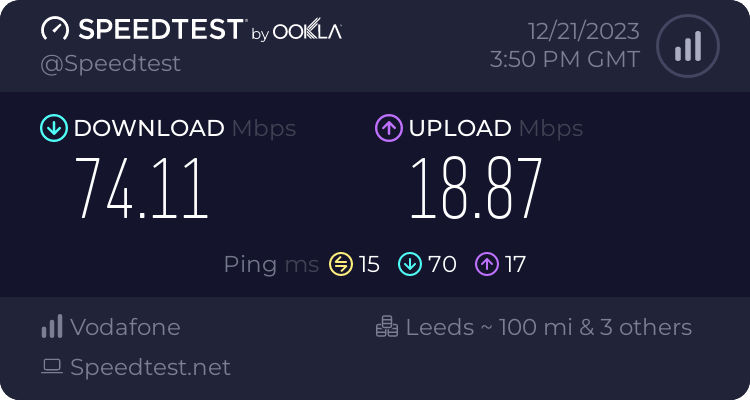
Speedtest.net results from our Vodafone broadband

So last month, we switched our broadband to Vodafone, which also meant that our internet speeds increased from about 30-40 Mbps to around 70-80 Mbps (as per the above Speedtest.net result).

80 Mbps is sadly the fastest speed that we can probably get here. I live in Sowerby Bridge, a small town in the Calder Valley and our options for internet access are limited. In some respects, we’re lucky to have access to Fibre to the Cabinet (FTTC). This means that the cables providing fixed line broadband internet are fibre optic as far as a metal box a couple of streets away. But the cables from that box to our house are a series of thin, copper cables, and current VDSL2 technology means that much higher speeds are unlikely to be possible.

Over Christmas, we stayed with my parents in York. Being a bigger and more affluent city, there are more options available for broadband internet. In addition to the FTTC service provided by BT Openreach, there’s also:

  • Cable broadband from Virgin Media. These cables were laid in the 1990s by Bell CableMedia, which became Cable & Wireless, then NTL, and finally Virgin Media. Whilst they’re also an FTTC solution, the cables from the cabinet to the home include a much larger coaxial cable.
  • Full fibre broadband from Sky and TalkTalk. York’s streets and pavements were dug up again in the late 2010s to install a FTTH (Fibre to the Home) network, which takes fibre optic cables all the way into people’s homes.

My parents have had cable broadband since this became available in the early 2000s. Initially this was just 512 Kbps, but speeds have increased over the years, and this was the test result whilst I was there at Christmas:
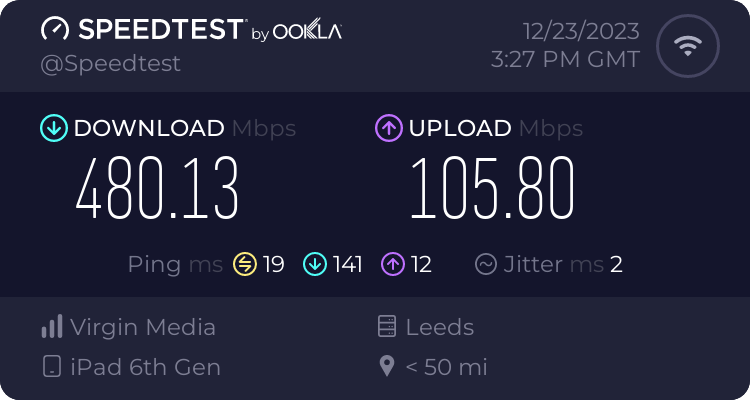
Virgin Media broadband test result

So my parents get broadband speeds that are six times faster for downloads, and nearly three times faster for uploads. And if they wanted to, they could switch to a FTTC broadband solution that could easily double those speeds.

Here in Sowerby Bridge, our best hope for faster broadband is that CityFibre bring their FTTC network in a few years time. So far they’ve installed fibre optic cables in Pye Nest, which is the community between Halifax and Sowerby Bridge, but their web site says there are currently no plans to reach us. Virgin Media did install some cables nearby a few years ago, but they seemed to bypass our street unfortunately.

There is wireless broadband to consider, but we get a weak 4G signal as we’re in a steep valley. 5G is available up the hill in Halifax and may make it down here in future. But, for now, I think 80 Mbps on a fixed line is the best that I can expect.
Switching to a new ISP

Last month, we switched to Vodafone as our new Internet Service Provider (ISP) at home.

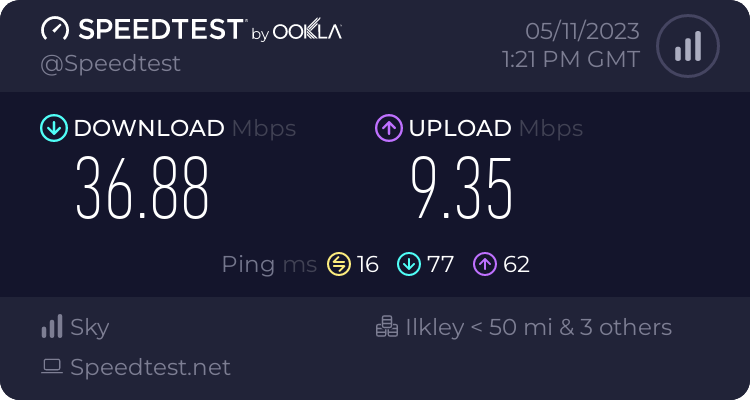
We’ve been with Now Broadband (Sky’s budget brand) since autumn 2018, who, at the time, could offer us faster speeds for less money. And they’ve been pretty good; when I was working at home full-time during lockdown, I rarely had any issues. Our bandwidth was sufficient for me to participate in online meetings whilst our (then) four-year-old watched Netflix in another room. Our typical download speeds were in the 35-40 Mbps:

Speedtest.neet results from the 5th November 2023, showing 36.88 Mbps download and 9.35 Mbps upload on our old ISP, Now Broadband

But then Now raised their prices by £9 per month. They probably told us that they would do this, but I have no recollection of being informed in advance.

Finding a new ISP

Meanwhile, Vodafone could offer faster speeds and a new router, for £2 less than Now before the price rise. So, we would be getting a better service, and paying £11 less per month for it than if we stayed with Now.

We used the MoneySavingExpert broadband comparison tool, which showed that Vodafone was the cheapest big name that didn’t have a poor customer service rating. Shell Energy were cheaper, but their customer service isn’t great and they’ve just been taken over by Octopus Energy who don’t currently offer broadband.

I signed up using Quidco (referral link) and should get £82.50 cashback in late spring, so factoring that in, what a savings.

The switchover took a couple of hours, and seemed to happen early in the morning, so by 7am we were already online with Vodafone. And the speeds are much better – around 75 Mbps download and 19 Mbps upload, so almost twice as fast. Considering that this is over DSL, I’m impressed with how fast it is.

Speedtest.neet results from the 21st December 2023, showing 74.11 Mbps download and 18.87 Mbps upload on our new ISP, Vodafone Broadband

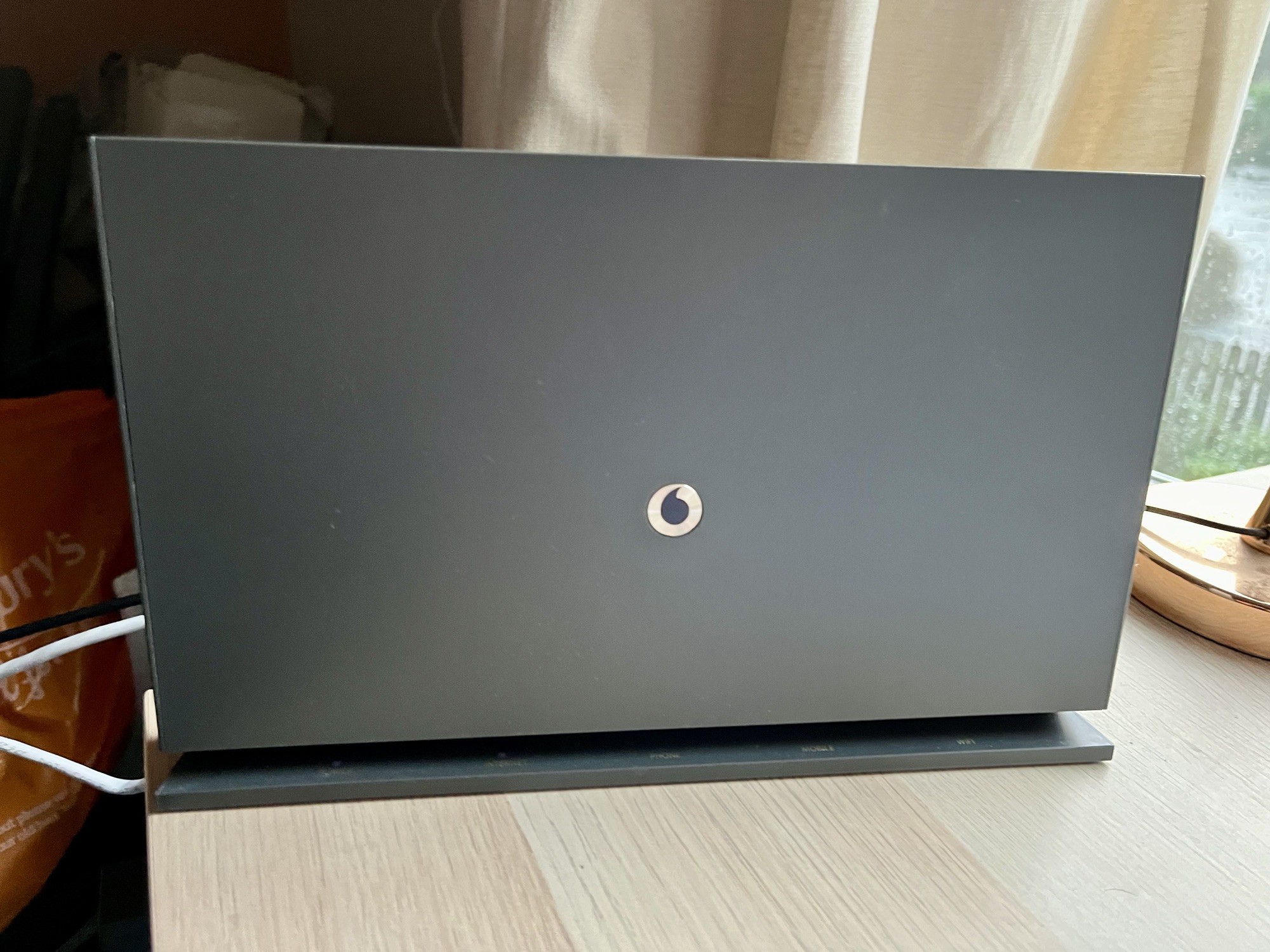
The new Vodafone broadband hub is also better than the basic Now broadband router that we had previously. It has four 1 Gbps Ethernet sockets for a start, compared to just two on the Now router; this means I no longer need a separate Ethernet switch. It also looks nicer; it’s free-standing but has mounting holes on the back for screws.

Digital Voice Line

The hub also supports Digital Voice Line, where your phone calls are made over the internet, rather than PSTN. Openreach intend to switch off the analogue phone network in two years time, so switching now is timely. This means that our landline phone plugs into the hub, rather than the micro-filter attached to the master phone socket. That being said, since the switchover, our phone hasn’t actually worked. The fact that it took me several days to realise shows how much we use our landline, but I’ll need to get on to Vodafone to have them look into it.

As with all changes to a new ISP, over the first few weeks there was a little instability with the connection. But it’s settled down now and works well. The other issue I had early on was with connecting to my Raspberry Pi externally, as port forwarding didn’t seem to work properly. This was a bit of a gut punch, considering how much effort it took me to get Home Assistant working with HTTPS, but it seems to be sorted now.

If it’s been a while since you switched your ISP, I would recommend that you do a quick check to see if you can get a better deal elsewhere. Broadband providers make a lot of money from people who just let their contracts auto-renew. Even if you’re happy with your current ISP, you could try haggling with them to see if they can offer you a cheaper package.

A rant about BT

Communication

Earlier this week I said that our flat move had gone well and in particular that our phone line would be activated on Thursday, i.e. yesterday. It hasn’t.

Christine got a voicemail message from BT (with whom we have our phone and broadband) asking her to ring them. After being on hold for quite a while, someone finally answered, but initially didn’t know why we ringing. Eventually, we were told that there was a problem with the phone line and that the activation would have to be put back. We could have a working phone by Friday (today), but with a different telephone number, and that the broadband wouldn’t be working until Thursday next week – a week later than we’d been told originally.

To make it worse, we’re not receiving a discount on the monthly bill for the time (nearly 2 weeks) when we’ve been unable to use our phone line or broadband, so we’re effectively paying for a service that we aren’t getting.

Initially I had praise for the way BT handled our move – our first call to them assured us that it would be a quick, simple process which would allow us to keep our number. A few days without phone and internet access would be inconvenient but understandable. But having no internet for the best part of two weeks seems excessive, especially as there’s no financial compensation. And really, does it take a whole week for someone to drive over to our local exchange and press a few buttons?

The problem isn’t necessarily with BT Retail, with whom we pay the contract with, but seemingly with BT Openreach, the subsidiary of BT which owns and operates the telephone lines and exchanges in the UK. To me, they seem to be a very expensive and inefficient outfit which only serves its own shareholders, i.e. the BT Group. Although it’s regulated by Ofcom, other parties have very little say in how it’s run.

In Britain, we don’t have that many alternatives to broadband via phone lines. Virgin Media’s cable network is good, but generally limited to large towns and cities – no good for my small town. Wireless broadband over 3G mobile networks is an option: prices are coming down to be comparable with fixed-line internet, there’s no need to install anything apart from plugging in a Mifi router and they can even be bought on pay-as-you-go contracts. But wireless suffers from latency issues, making it poor for use in online gaming, and again, it’s not always available. We’re also some years away from better and faster 4G networks.

Maybe it’s high time for the ownership of Openreach to change; its shares could be split amongst the other large ISPs in the UK (Sky, Talktalk, Orange, Virgin Media etc.) so that all have a say in how its run; it could be made a not-for-dividend company answerable to Ofcom like Network Rail for the railways; or completely re-nationalised. The last one is a long-shot, but any of those should improve accountability to its direct customers (the ISPs) and regular home users.

In the meantime, I’ve paid for an extra 2 GB of data to be added on to my mobile contract with 3 for this month. Thankfully it only costs £5, and 3 don’t charge extra for internet tethering or using your phone as a personal hotspot, so I’m only partially out of pocket. I’ll still be pointing this out to BT in a letter.

In an age when I can order a book at half 4 in the afternoon, and have it on my desk at work at half 9 the following morning, how does it take so long for phone lines to be connected? Is BT’s equipment really that old and archaic, or is their lack of accountability and need to shore up profit margins the driving force here?