
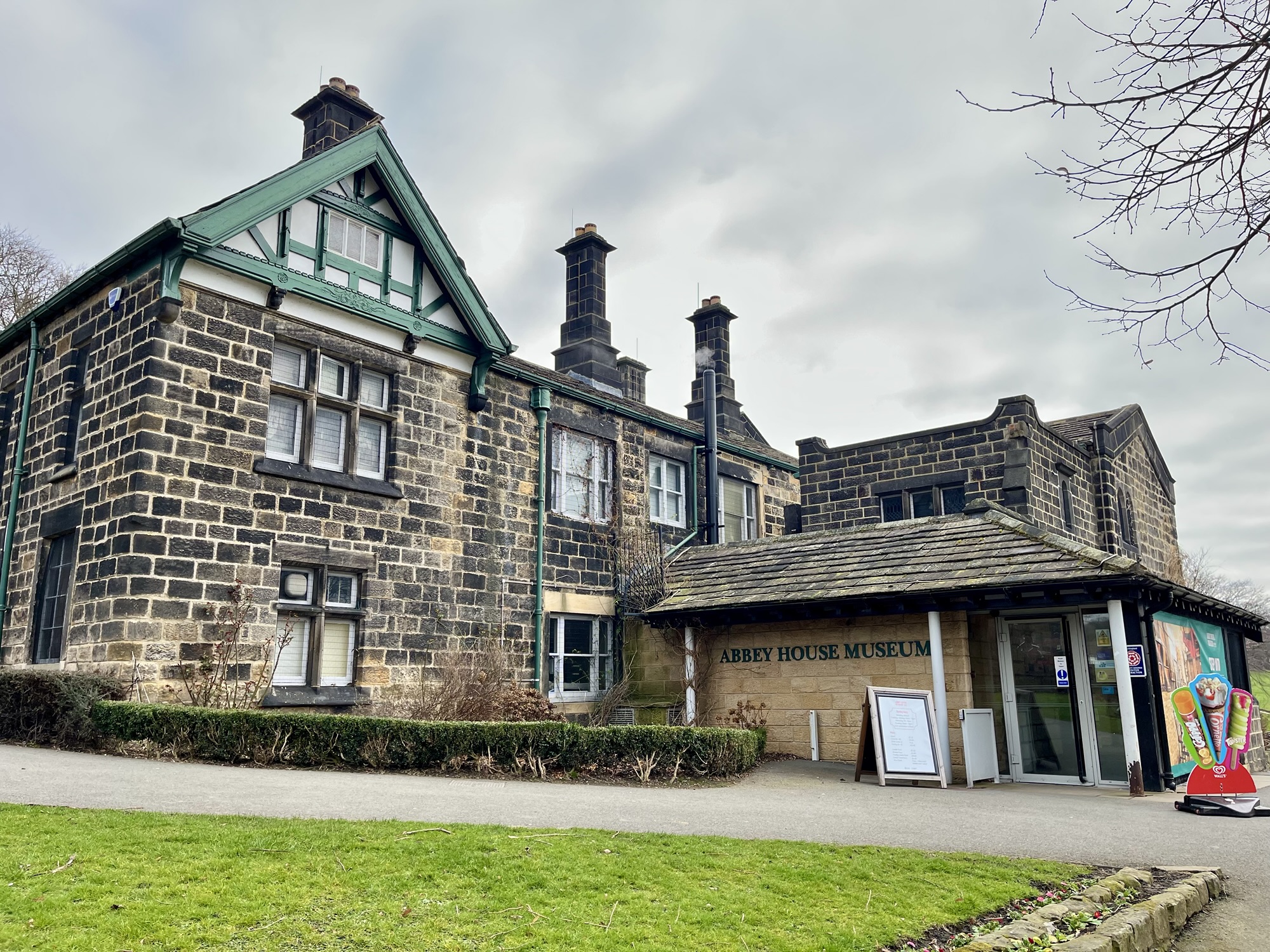
Abbey House Museum

A photo of the outside of the Abbey House Museum.

Last weekend, I took our nine-year-old to the Abbey House Museum in Kirkstall, near Leeds. We’ve been a couple of times before, and it’s a nice little museum to visit for half a day. It’s also recently been reprieved from closure, but in the long term it needs more people visiting it to be viable.

The Abbey House Museum is essentially in three parts. The first is a recreated Leeds street scene, with various shops and houses that have been saved and transplanted into the museum. There’s a pub, a pharmacist, a general store, and many others. It’s a bit like Kirkgate in the York Castle Museum, but on a smaller scale. It’s designed to show how ordinary, working class Loiners would have lived in the past.

Exhibitions

Next, you go upstairs to an exhibition space. Previous exhibitions that we’ve seen have included one about various common household objects from the past now considered dangerous, back in 2019. Older Lego bricks contained various heavy metals like cadmium, there were sore throat pastilles containing potassium chlorate which can spontaneously combust, and there were plenty of things with asbestos in them. The last time we went, which was in 2021, the exhibition was about the Leeds music scene and various bands and venues.

This year’s exhibition is called ‘Story Time‘, and is all about children’s stories. Expect to see lots of books and toys, both old and new.

In the next room are various entertainment machines, which can tell your fortune or show an animated diorama. They require one or two old pennies, which can be obtained from an exchange machine that takes modern day British currency. Each 1d coin costs 10p and so have a pound coin spare if you want to try every machine.

The final space is the childhood collection. There’s a collection of dollhouses and toys, spread across several rooms.

The street scene at the Abbey House Museum

History of the Abbey House Museum

The Abbey House Museum gets its name from Kirkstall Abbey, across the road, and it used to be the gatehouse. Parts of the building date back to the year 1152, and after Henry VIII dissolved the monasteries (yes, him again!) it was repurposed as a farmhouse. It became a museum in 1927, and so hopefully it’ll be able to celebrate its 100th anniversary now that it has been saved from closure.

Expect to be able to spend half a day at the museum – we combined our visit with a trip to Tropical World, but you could pop across the road to the abbey itself as well, if you want to make a day of it.

Accessibility

Access at the Abbey House Museum is pretty good. The street scene does have some uneven floors and narrow doorways, but there is a lift. A Changing Places toilet is also available, and there is a Max Card discount as well. There used to be a café in the museum but this is now only open as a picnic room for school visitors – instead, the Abbey has a café and there’s a pub nearby.

Free parking is available (at the time of writing, though note that Leeds City Council has recently introduced modest parking charges at many of its sites), and it’s on major bus routes from Leeds city centre. If you’re arriving by train, it’s roughly equidistant from both Headingley and Kirkstall Forge stations – both of which are about a mile’s walk.

Kirkstall Forge – Yorkshire’s newest station

A photo of the platforms at Kirkstall Forge railway station

Earlier this summer, Yorkshire gained a new railway station on the outskirts of Leeds. Called Kirkstall Forge, it’s located on the Airedale and Wharfedale lines which offer commuter services from the Aire and Wharfe valleys into Leeds and Bradford. And on Wednesday, I went to have a look at it.

Kirkstall Forge gets its name from a large forge that used to exist on the site. It was demolished, leaving a huge area of brownfield land, ripe for development. And it happened to be right next to a railway line. So the site’s developers contributed a sizeable amount of money to ensure that a station could be built. After all, houses near railway stations tend to command higher prices.

The station has been a long time coming; plans were first drawn up 17 years ago in 1999, but it wasn’t until 2014 that all of the funding became available. Construction started later that year, although its location on the River Aire’s flood plain put its opening back to June.

As it was a nice day on Wednesday, I walked to the station from Leeds, along the Leeds-Liverpool Canal. It’s about five miles and took me a bit over an hour to get there. Of course, I was about a third of the way there before I realised that Google Maps wasn’t showing a footpath from the canal towpath to the station. Thankfully, a quick Google search verified that there was indeed a path to link the station to the canal. Indeed, thanks to the footbridge at the station, access to the canal in this area is now greatly improved.

The station itself is nothing special. Two platforms, a footbridge with lifts, a couple of waiting shelters, some seats, a ticket machine and a passenger information system. The latter two of these were out of order, showing a scrolling message about checking the paper timetables. Welcome to 2016, everyone.

Considering that a train passes through the station every 10 minutes in each direction, surprisingly few actually stop there. The basic service seems to be hourly in each direction, to either Leeds or Shipley and Bradford Forster Square. A handful of services instead go to Ilkley or Skipton, but these seem to be limited to peak times.

It might seem a bit of a waste then, to spend millions on a station with such a basic service. But then, there isn’t yet much to serve here. Whilst I’m sure that the forge site will be covered with hundreds of new houses in a few years, right now there was only a little construction taking place. Still, I was not the only person to catch the train towards Bradford, at around 4pm.

Kirkstall Forge, for now, retains the crown of Yorkshire’s newest station, but not for too much longer. South of Bradford, Low Moor station is under construction, on the site of the ill-fated Transperience museum, and is due to open next year. Well, hopefully – it’s already behind schedule after an uncapped mine shaft was found right where one of the lifts was due to be installed. There’s still a big gap in the Bradford-bound platform, at time of writing.

Scott managed to visit Kirkstall Forge before me and wrote about it – and I largely agree. Maybe in a few years, the station will be able to better justify its existence.