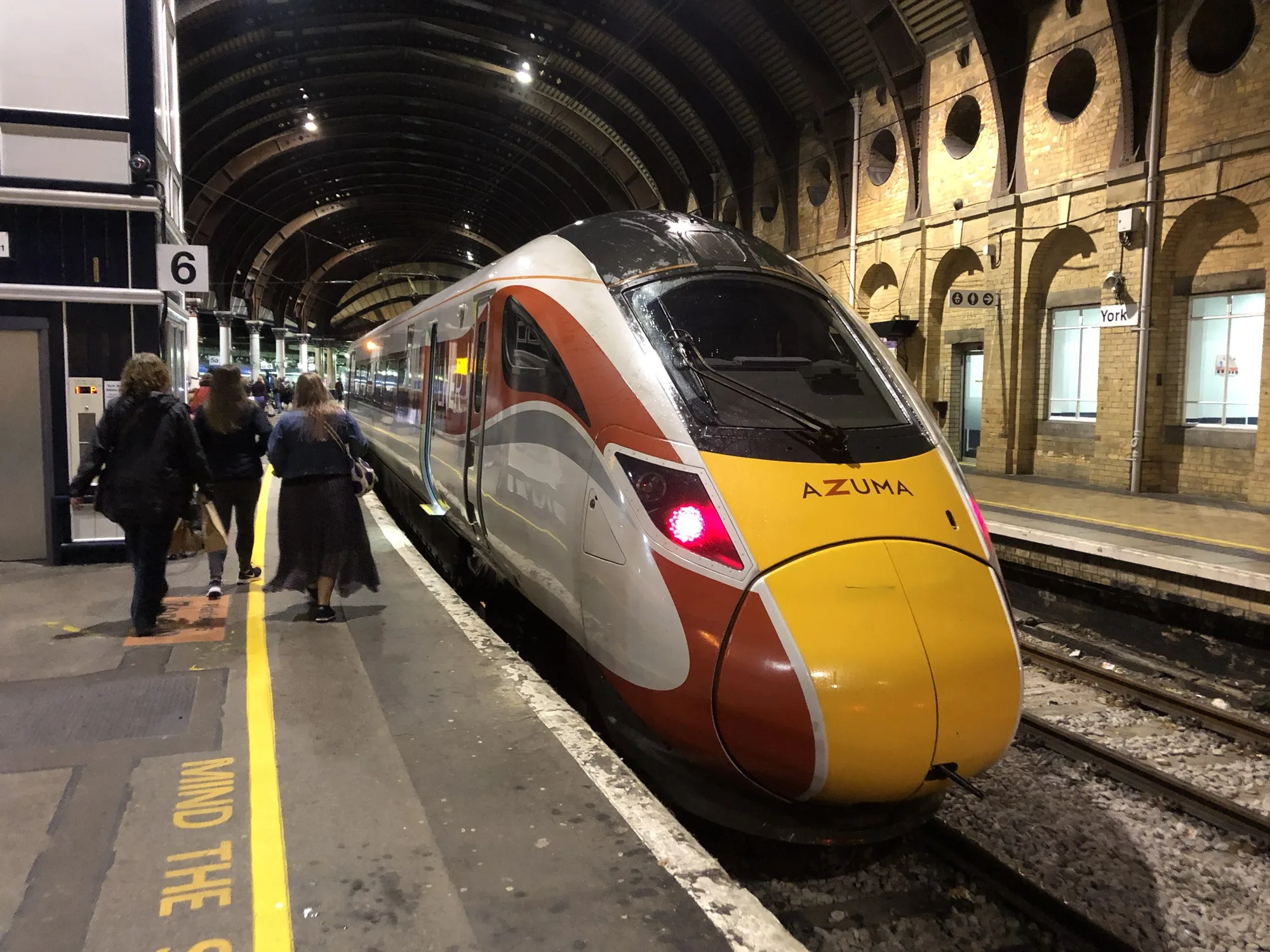
We managed a couple of trips on the new Elizabeth Line; it was partially open on our last trip to London in 2022 but we didn’t need to use it then. The stations are impressive and I appreciated the greater accessibility, but I couldn’t help but feel that the trains themselves already look a little tired. It may be the use of grey interior panels; they felt a little dark and not as bright internally as other new trains elsewhere. It’s good to see it being well-used despite being opened for less than two years.
We normally manage one trip to London each year – we missed 2020 for obvious reasons, but also didn’t manage to go last year either. We may have a shorter visit later this year, but with journeys taking 3 hours each way and the costs, it’s not something that we can do on a whim.
Well, actually, I’m writing this on Saturday 24th. I tend to write blog posts in bulk at the weekends, and then schedule them to go live every other day over the week. In any case, I’m unlikely to have time to write much today, as this morning I’m at work and then we’re off to London tonight for a long weekend.
But as the opportunity to publish a blog post on the 29th only comes around once every four years, here you go. And I missed 2020 as I wasn’t blogging then. Had I been, I’d have probably said something about the-then looming pandemic. Ironically, I wrote this on the 29th February 2016:
Maybe something interesting will happen on this day in 2020, but you’ll have to wait another four years to find out, I’m afraid.
Not all of London’s museums are in the centre of the city. The East London suburb of Bethnal Green is home to the V&A Museum of Childhood, home to a wide range of toys from several decades.
Now that our 18-month-old is an easily-bored toddler, we felt that we needed to go to a museum that would keep them interested. Thankfully, a museum filled with toys fits the bill, especially during school holidays. It’s technically part of the Victoria and Albert Museum, but doesn’t focus on art and sculpture like its larger Kensington sister museum.
A lot of the toys are enclosed in big glass cabinets, but there are some interactive exhibits. The most popular of which was simply a big pile of differently sized cardboard boxes, perpetuating the oxymoron that children are sometimes more interested in the box than the toy inside. Upstairs there was a sandpit, and we arrived just in time for an interactive story-telling session.
Our 18-month-old also enjoyed the sensory exhibit, with bubble tubes and multi-coloured lights. Christine and I appreciated the range of toys, which included the very old and the quite new. At the back is a large display of dolls houses, lit up as if in a large night-time scene.
We didn’t have the time to see everything as we had to go to meet a friend in the afternoon, so we only had a fleeting glance at the upstairs exhibits (sandpit aside). There’s quite a good café in the central atrium of the museum, which seemed quite busy even before lunchtime.
Entry to the museum is free, and it’s just up the road from Bethnal Green tube station on the Central Line. The museum itself is fully accessible but the nearby tube station doesn’t have step free access. We brought Lizzie in her sling as we knew we’d struggle with a pushchair.
I’ve talked briefly about our recent trip to London. It was our second trip with our toddler, but last time I drove us all down. This time, we went via train, and we brought a pushchair.
Our toddler now has two pushchairs. There’s the big Bugaboo Chameleon, which we’ve used since birth, and a lighter folding pushchair. The latter fits in our car boot more easily and can be stowed away in luggage racks, but it’s not so good on rough ground and doesn’t have a rain cover. So we still use the Bugaboo now and again, if it’s wet or we’re going somewhere off the beaten track. But for London, we took the lighter pushchair.
On the whole we coped well. The only station where we had major problems was Kew Bridge, a South West Trains station near where we were staying. Although it’s a simple two platform station with a footbridge, there’s no step-free access, and a very wide gap between the train and the platform edge.
We coped okay with the Underground. King’s Cross St Pancras has lifts serving all of its platforms, following a comprehensive rebuild of the station to tie in with the new Eurostar station. This is a major improvement over 2004, when I travelled to London with a friend in a wheelchair. It took two of us to balance the chair on the main escalator. Fortunately we were heading for Olympia, and both Earl’s Court and Kensington (Olympia) stations had lifts even back then.
This time, we were heading for Waterloo, to take a train to Kew Bridge (as mentioned before). Though not the most direct route, we were able to take the Victoria Line to Green Park. Lifts were installed at Green Park in 2012, ahead of the Olympic and Paralympic Games. Changing at Green Park took quite a long time, with some long walks between the platforms. Had we been able to use the escalators, I expect this would’ve been quicker.
Then, onward to Waterloo on the Jubilee Line. When the Jubilee Line was extended in the late 1990s, all of the new stations had step-free access from the beginning. Unfortunately, at stations like Waterloo, this didn’t include existing lines, so although it’s possible to get from the Jubilee Line to the street and mainline station without steps, you can’t change to the Northern, Bakerloo or Waterloo & City lines.
Step-free Tube guide
Transport for London (TfL) publishes quite a good step-free Tube guide. Whereas the basic tube map only shows stations with step-free access from the street to the platform or train, the guide goes further. For example, there is step-free interchange between the Bakerloo and Victoria lines at Oxford Circus, but no lifts to the exit. Others, like Cannon Street, have step-free access in one direction only. A map is provided and it greys out stations and lines that are not accessible. The whole of the Bakerloo Line south of Oxford Circus is missing, for example, as is the whole of the Waterloo & City Line.
It also tells you how wide the gap between the train and platform is at those stations which are accessible, and there are some detailed notes. For example, changing trains at Kew Gardens requires a 600 metre walk on nearby streets.
It’s perhaps also worth mentioning that the entire Docklands Light Railway, and Croydon Tramlink are step-free, should you find yourself in East or South London.
Future improvements
TfL is rebuilding a number of Tube stations, and these should all gain step-free access. Farringdon and Blackfriars recently became accessible as part of the Thameslink Programme, and Crossrail… sorry, “The Elizabeth Line”, will see many other stations gain lifts. These include Ealing Broadway, Paddington, Bond Street, Tottenham Court Road, Moorgate, Liverpool Street and Whitechapel.
Additionally, TfL are rebuilding Victoria and Bank stations, with plans for Camden Town. Again, these should all become step-free when the work is complete. Frustratingly, the recent rebuild of Shepherd’s Bush tube station on the Central Line, to tie in with the opening of the Westfield shopping centre, did not include the addition of lifts, apparently due to costs.
In a couple of months time, Christine, our one-year-old and I are off down to that there London for three nights. Typically, we go to London once or twice a year.
Travelling down
Our last visit was in October, and we travelled down by car for the first time. This was because we went via Oxford, but also because of the logistics of managing a 10-month old baby on a train for three hours each way was daunting. Especially when you add in all of the extra paraphernalia that you need to haul around with a small baby. Last time, we had to take plenty of food, changes of clothes, nappies etc.
This time, our toddler will be approaching 18 months old, and so we’re going to attempt the train. We’ll do without a pushchair, as our toddler should still be small enough to carry in a sling, and can walk short distances now. And, apart from a few snacks, our toddler doesn’t need their own food, as they’re happy eating from regular menus now.
It’ll also be cheaper. Fuel and parking cost us around £60 last time, plus the pressure of driving. Christine hasn’t passed her test yet and I can’t supervise her, so I have to do all of the driving. By contrast, two standard class adult returns with a Two Together Railcard booked last month cost us just £41. And, we’ve accumulated enough Nectar points to get two £20 Virgin Trains East Coast vouchers, so we actually only paid £1. That’s cheaper than the Megabus.
Staying over
Booking well in advance also ensured a cheap hotel stay. When booking accommodation, my usual tactic is to check the major budget hotel chains one by one, and then an aggregator like Expedia or Lastminute.com (which are often not the cheapest). Typically, we end up staying in a hotel in the IHG group, as I’m an IHG Rewards member, but they didn’t come out cheapest this time.
As usual, we’re not staying in central London. London’s public transport is really good, and the cost of travelling a bit further out is usually much less than the price of a more central hotel room. This time, we’re staying near Kew, in south-west London.
London attractions
The hotel is handy for the London Museum of Water & Steam, which I’ve not heard of before but it looks interesting. It’s in an old pumping station, and now tells the history of London’s water supply. This will be the second London pumping station that we’ve visited, after going to Crossness in 2015. It looks like it’ll be good for kids – especially if it’s a nice day where Lizzie can play outside.
The Musical Museum is also nearby and we may visit, depending on time.
Further away is the Museum of London Docklands. We popped in for about an hour on our last visit, but were only able to see the gallery on the top floor, about slavery and the history of the area. So we’d like the see the rest of the museum, but also the special exhibition on the archaeology of Crossrail that runs until November.
The Hunterian Museum has been on our to-do list for some time. Sadly, it closes next month for a three year refurbishment, so it’ll be shut when we visit.
Seeing friends
We try to make time to see friends when we’re in London, and so, in addition to the above, we’ll plan to meet up if we can. There’s a lot to fit in to a three night stay but we’ll do our best.
Next week, Christine, our baby and I are off to London for a few days. It’ll be our first trip as a family of three there; I last went in January on my own when our baby was only a few weeks’ old. It’ll also be the first time I’ve ever driven to London, as we’ve always taken the train or coach in the past.
I’m driving because we’re also visiting family on the way, but also because of the amount of luggage we’ll need. Babies may be small, but they also need several days worth of food and nappies, a pram, travel cot, high chair and other things. So whilst Christine and I could do several days in London with a rucksack each, with a baby, we’ll need the car.
We’re staying in a hotel in north London that’s easily reached by car and has parking, but is also close to a tube station. Once we’re there, I have no intention of driving in central London – congestion charge aside, I’m not keen on driving in city centres. And whilst London Underground is not great for prams or wheelchairs, our baby thankfully tolerates being carried in a sling.
Part of the reason for our visit is so that I can go to the HE Show at Olympia – if you’re going as well, drop me a line. We’re also planning to go to the Tower of London, as it’s been many years since I visited, and Christine has never been. It’s expensive, unless you have lots of spare Tesco Clubcard tokens like we do.
I always look forward to trips to London, partly because we always make a point of seeing friends who live there when we go, but also because there is so much to do. It makes a change from a few years ago when I developed a general dislike of the place. Back then, I also had access to free train travel and so could visit London (or, indeed any British city) whenever I wanted to. Perhaps I like London more nowadays because I only get to go there once or twice each year, and it usually requires weeks of forward planning – I can’t just decide to go there on a whim like I used to.
The four hour session, split into two halves, was chaired by two members of the House of Lords, Lord Inglewood and Lord Witty, and the speakers represented various users of big data in the UK. These included the ABPI, whose members carry out research and development into new medications, Dunnhumby, who worked with Tesco to launch the original Clubcard in the 1990s, academics and industry partners.
The talks given by the speakers were interesting, and focussed more on policy and high-level overviews, rather than technical details. For example, whilst Hadoop was passively mentioned on some slides, there wasn’t much about deployment and how it works. But there was some discussion about database design, as companies move away from traditional relational databases to big data capturing solutions.
Privacy implications came up several times as well, an irony not lost on one of the speakers who noted that the event coincided with Data Privacy Day. In particular, there was a focus on how to design systems with privacy in mind, but also that the UK’s and Europe’s more restrictive privacy laws may be part of the reason why the world’s biggest data users – GAFA (Google, Apple, Facebook & Amazon) – are all based in the US.
I came into the seminar essentially wearing two hats. My main reason for attending was as a blogger (or ‘freelance writer’ according to the attendance list), but data analysis is also one of my roles at work. However, we’re not yet at the stage where we’re using ‘big data’ – most of our data is all within standard relational databases and I can’t see that changing any time soon.
As always, such events also offer a chance to network and it was good to speak with some of the other attendees. As you’d expect from a more high-level seminar, this was an event for people with suits and ties, and not t-shirts and hoodies. Many were from government departments, regulators and other public sector bodies, as well as large organisations such as the BBC and Arqiva.
I came away with plenty of notes, and some action points to perhaps bring up at work. Channel 4’s Viewer Promise video was mentioned as great example of best practice for explaining their privacy policy – far better than pages and pages of legalese. Maybe universities could do something similar to explain the student contract at enrolment.
This day was made possible by Dell, but all thoughts are my own.
This is the third in a series of posts about what we did on our recent trip to London.
After lunch, we decided to head back towards central London. We could have caught the DLR from Cutty Sark and gone back the way we came, but instead, we caught a Thames Clipper waterbus from Greenwich Pier. The Thames Clippers are a fleet of catamarans that run up and down the River Thames in central London, and are currently sponsored by MBNA. Recently, they have started accepting Oyster cards as payment, and so we thought we’d give them a try, seeing as none of us had been on one before.
Although they operate on water, as they are catamarans rather than regular boats, they’re actually very quick. Certainly quicker than catching a bus, and probably competitive with the Tube – worth knowing the next time there’s a strike or signalling problems. You can sit outside at the back, but there’s a large amount of indoor seating too, and the seats are very comfortable – far better than most other forms of public transport. There’s even on board bar serving coffee, snacks and alcohol. And whilst I’m not usually one for getting sea sick, the Thames Clippers are pretty smooth and so even if you normally get queasy on a ferry, you shouldn’t have issues with these.
As well as being quick, you can get a very different view of London’s landmarks. We travelled from Greenwich to London Bridge Pier, which took us under Tower Bridge and offered a square on view. It was worth it to take photos.
The two main downsides of the Thames Clippers are waiting times and cost. Although they are regular, we just missed one at Greenwich and it was around 15 minutes until the next one. Whilst that’s more frequent than many bus and rail services outside the capital, it doesn’t compare so favourably with buses or the Tube.
It’s also rather on the pricey side. I think we paid £8 for our journey on our Oyster cards, which is significantly more expensive than other forms of public transport. Whilst people can and do commute to work on the Thames Clippers services, they’re really aimed at tourists who are happier to pay a higher price. Still, you get a comfy seat, a fast journey, and get to see parts of London from new angles, so it’s worth the extra cost.
This is the second in a series of posts about what we did on our recent trip to London.
After visiting the Cutty Sark, we took the short walk to The Old Brewery. Originally, this was the brewery of the Old Royal Naval College, opened in 1836 in Greenwich. In 2010, the Meantime Brewing Company moved in; at first, this was their main brewery but nowadays most of their beers are brewed elsewhere. Some brewing equipment remains, but the rest of the brewery is now a bar and café, owned by Meantime.
Meantime is one of my favourite brewers, and I’ve sampled most of their range of beers before. So I was pleased to have the opportunity to visit, even if it was just to have lunch in the café. As you’d expect, the full range of Meantime’s beers are available, either on tap or in bottles, and we had a happy couple of hours getting merry on good beer.
A northerner like me would find the food and drink a little pricey, but then it is in London, and slap bang in the middle of a UNESCO World Heritage Site to boot. Meantime’s beers are on the expensive end of the spectrum anyway.
The Meantime Brewing Company had humble beginnings, back in 2005, and was one of the first ‘craft beer’ breweries in the UK. However, this year it was taken over by SABMiller, the world’s second largest brewing conglomerate. This has seen some of its production moved to the Netherlands, where its beers are produced alongside Grolsch. SABMiller is itself in the process of being acquired by its largest rival, Anheuser-Busch InBev.
Whilst Meantime may no longer have its hipster credentials, they still produce good beer, and The Old Brewery is worth popping in to if you’re in Greenwich. You may struggle to get a seat at lunchtime, although there is plenty of outdoor seating if it’s a nice day.
On the Saturday, we went to visit the Cutty Sark, a ship in a dry dock in Greenwich, east London. The ship was built in the late 19th century, initially to deliver tea from Asia to Britain. In 1954, the ship was moved to a dry dock in Greenwich, and became a tourist attraction. I first visited it with my parents in the 1990s.
In 2006, the Cutty Sark was closed to visitors to allow it to be restored; forty years of standing on its keel meant that the ship began to sag. Despite a major fire, the ship re-opened as a museum in 2012, now raised on a series of supports. The dry dock has been glassed in, to make it an all-weather attraction, and to mimic the effect of the ship on water. This also means that visitors can walk under the ship for the first time, and there’s now a café at the bottom of the dry dock.
The tour starts inside the ship’s hold, with various displays telling the history of the ship and the cargo it carried. Some of these are interactive, and I particularly enjoyed the bench seats which simulate the swaying of the boat on rough sees. You then climb up to the top deck, which has been extensively restored, and you can pop into the captain’s quarters.
At £13.50 per head for adults, it is a little pricey for somewhere that most people will spend a couple of hours at, but discounts are available. We used a 2-for-1 voucher from Days Out Guide as we’d travelled to London by train. Cutty Sark DLR station is just around the corner so it’s easy to reach by public transport.
It was nice to see the Cutty Sark again, having been as a child. The restoration has been done very well, and the glass enclosure is a nice touch.