Running a stately home is a lot of work – you only have to watch shows like Downton Abbey to see why. (note: I have never watched Downton Abbey.) Organisations like The National Trust spend millions every year to keep their properties going. Not all houses are lucky enough to have someone maintain them and some have fallen into disrepair or been demolished.
With this in mind, artist Kate Lycett has painted a series of pieces called the Lost Houses of the South Pennines, which has gone on display in Halifax’s Bankfield Museum. All of the paintings are of houses and stately homes in Yorkshire which are no longer standing, such as Manor Heath in Halifax (now Manor Heath Park) or Horton Hall near Bradford.
What makes Kate’s paintings stand out is her attention to detail. All of the paintings show the houses as if they were still in their heydays – lights on, and with an almost ethereal glow, giving them life again. Gold leaf has been woven in to good effect.
Alongside each piece is a description of the house – who built it, what it was used for, and its ultimate fate. Photographs are also provided, as are Kate’s scrapbooks that she used during her research. Ironically for an exhibition at a Calderdale Council venue, many of those houses were demolished by its predecessor organisations. Dry rot seemed to be a major problem in several properties but I think money (or the lack thereof) has been the major factor in most of the houses’ demise.
We’ve visited twice – Christine and I were lucky to be invited to the opening night by a mutual friend of the artist, but we also popped in with my parents at the weekend. It looks like it’s been pleasingly popular.
All of the paintings are for sale by sealed auction bid, but you can also purchase limited numbered edition prints that are signed by the artist. These include the gold leaf that the originals have. The exhibition runs until early April, and is free to visit.
On the Saturday, we went to visit the Cutty Sark, a ship in a dry dock in Greenwich, east London. The ship was built in the late 19th century, initially to deliver tea from Asia to Britain. In 1954, the ship was moved to a dry dock in Greenwich, and became a tourist attraction. I first visited it with my parents in the 1990s.
In 2006, the Cutty Sark was closed to visitors to allow it to be restored; forty years of standing on its keel meant that the ship began to sag. Despite a major fire, the ship re-opened as a museum in 2012, now raised on a series of supports. The dry dock has been glassed in, to make it an all-weather attraction, and to mimic the effect of the ship on water. This also means that visitors can walk under the ship for the first time, and there’s now a café at the bottom of the dry dock.
The tour starts inside the ship’s hold, with various displays telling the history of the ship and the cargo it carried. Some of these are interactive, and I particularly enjoyed the bench seats which simulate the swaying of the boat on rough sees. You then climb up to the top deck, which has been extensively restored, and you can pop into the captain’s quarters.
At £13.50 per head for adults, it is a little pricey for somewhere that most people will spend a couple of hours at, but discounts are available. We used a 2-for-1 voucher from Days Out Guide as we’d travelled to London by train. Cutty Sark DLR station is just around the corner so it’s easy to reach by public transport.
It was nice to see the Cutty Sark again, having been as a child. The restoration has been done very well, and the glass enclosure is a nice touch.
This is the first of at least two posts about what Christine and I got up to last week whilst we were in Dublin – the focus of this one being about the attractions we visited, in no particular order.
Guinness Storehouse
Allegedly the most-visited attraction in Ireland, the Guinness Storehouse tells the history of Guinness, which is probably the most well-known brand of stout in the world. Although Guinness is still brewed in Dublin, on a huge site just outside the city centre, the Storehouse is across the road and not part of the main brewery site. Consequently everything inside is simulated or are static models, rather than actual, in-use brewing equipment like you would see on a tour of a microbrewery.
It’s one of Dublin’s more expensive attractions, however we spent a few hours here so it was somewhat worth it. Except that neither me or Christine particularly like Guinness – Christine hates beer altogether, and although I like stout and porter from time to time, I’ve never enjoyed Guinness in the past. And, sadly, our visit was to be the same – despite being shown how to pour my own pint, I still didn’t like it. The restaurants inside are very good though, with an above average food selection and many menu items using Guinness as an ingredient. For beer-haters, there is some interesting displays about Guinness’ advertising and how beer is made.
The Old Jameson Distillery
If Guinness is Ireland’s best known beer, then Jameson is its best known whiskey. Like the Guinness Storehouse, the Old Jameson Distillery is no longer an active distillery. Production was moved to the southern Irish city of Cork in the 1970s, although here some of the displays were active. It’s a guided tour, taking about an hour, with eight volunteers being picked for a whiskey test at the end. You should definitely volunteer if asked, as you get to try shots of Jameson’s whiskey, Jack Daniels’ bourbon, and a blended Scotch whiskey, to compare the three styles. Christine was chosen – I didn’t volunteer because I don’t like neat whiskey, but enjoyed a Jameson and ginger beer drink at the end, and a really nice Irish coffee in the bar. Again, a pricier attraction but we enjoyed this more than Guinness.
Dublin Zoo
Christine and I love visiting zoos so we spent most of last Monday at Dublin Zoo, as many other attractions in the city are closed on Mondays. It’s quite a big zoo, and whilst it has fewer animals than some others it does have some big enclosures. It was quite quiet when we went but it was a weekday and not especially nice weather, so at other times it will probably be busier. We were also wisely advised to take a packed lunch, as the food offerings there are not great. It’s home to two species of tiger (both very endangered), red pandas (my favourite animal), otters, lions, various apes, penguins and many others. The entry price is in line with other zoos over here in Britain.
Natural History Museum
After you’ve visited the zoo, have a look at the ‘dead zoo’ – yes, it’s really known as that. Though significantly smaller than its London namesake, and less interactive, the Natural History Museum has an extensive collection of stuffed animals. The ground floor is set aside for species native to or resident in Ireland, with everything else upstairs. The two balcony floors are currently out of bounds due to a lack of fire exits but most of the exhibits are viewable. Some of the specimens are very old, and were stuffed at a time when people were less familiar with exotic animals, so there are some slightly dodgy examples of taxidermy on show. Entry is free, although it is shut on Sunday mornings and all day Monday. Set aside a little over an hour for a visit.
Temple Bar
The Temple Bar is a district of Dublin which is home to many pubs and restaurants – the above pub gets its name from the area, rather than the other way around. It’s nice for a stroll through but livens up on an evening.
General Post Office
I’ve already briefly mentioned this one, but it’s worth a look. As well as being the main post office for the city, there is a small museum inside, which tells the history of Ireland’s postal service. In particular, there is quite a bit about its role in the Easter Rising of 1916, which set in motion various events over the next decade which ultimately led to Ireland’s independence from the United Kingdom. It’s only €2 to get in, and kept us occupied for up to an hour. You can also post letters and postcards into the oldest postbox in the country, and any mail collected from it will get a unique cancellation stamp.
Dublin Castle
We decided not to do the guided tour of Dublin Castle, which costs money, but there were plenty of bits to walk around for free. Follow the signs to the tearooms, and you will go past several boards with information about the history of the castle, and its wider role in Irish history. You can also cross a bridge into Dubh Linn Gardens, at the back of the castle, which are nice to walk around.
Kilmainham Gaol
Another historical attraction worth visiting is Kilmainham Gaol. Though it’s been many years since prisoners were interned there, it forms an important part of the history of the nation. The population exploded during a crime wave brought on by the potato famine – as the potato crop failed for several years running, those without food had to steal to survive, and many were caught. But in the early twentieth century many of those involved in campaigning for Irish independence, and those that opposed the Irish Free State in the Irish Civil War, were imprisoned and executed here. There’s both a small museum, and a guided tour of the main jail.
The jail isn’t in the centre of Dublin and is a good 20 minute walk from the Guinness Storehouse, itself away from the city centre. If you’re not up for a long walk, you may wish to catch the bus out here. It’s worth the long trip though.
On Saturday, whilst Christine was working, I took myself off to the Museum of Transport, Greater Manchester. I’ve been meaning to go for a while, but the recent opening of Queens Road Metrolink station nearby has made it somewhat easier to get to. Although railway engineering works, and the temporary closure of the Metrolink platforms at Victoria station, meant that it was still something of a trek taking a couple of hours each way from Sowerby Bridge. Normally, it’d take around an hour.
Anyway, the museum. It’s in the Cheetham Hill area of Manchester, to the north of the city centre, and is housed in the back of what was the Queens Road tramshed for Manchester Corportation Tramways – now used by First buses as a bus depot. It’s home to a wide variety of buses that operated in or are linked with Greater Manchester, plus a few other bits and bobs. But mostly buses – other forms of transport were not very well represented.
There are three trams, only one of which is complete (a horse tram). Of the others, one is Metrolink 1000, a half-tram mock-up of what would become the production T68 tram series. The T68s have only recently been retired from revenue service in Manchester and I imagine that a production model may enter the collection when one is preserved. The other bit of tram is the lower passenger compartment of what was originally a double decker tram, in the process of being restored.
There are also re-created transport offices, as well as an extensive collection of bus tickets, roller blinds and old signs. But, buses form the main attraction here.
On the whole I found it interesting but it’s not as good as other transport museums – particularly the excellent London Transport Museum. You definitely need to be more of a transport geek to enjoy it, and I’m sure Christine would have been bored stiff by it had I dragged her along. (I very nearly did last summer, but we ended up going bra shopping instead.)
The museum is open three days a week – Wednesdays, Saturdays and Sundays, or all week in August. Entry is only £4 for adults, and free for accompanied under-16s, which is good value for a museum that can keep your average transport geek occupied for a couple of hours.
Our reason for visiting was for the twice-annual Leeds Steampunk Market. It had moved to Armley Mills from its usual venue of Left Bank near Burley Park. Rather than being arranged in one place in a main hall, this time the market was spread out across the museum and over the four floors, including outside. This made it seem less busy, but well over 600 people had come through the door on Saturday, and the numbers were looking similarly healthy on Sunday when we visited. A 50% discount for those who came dressed in costume may well have helped, and indeed Christine and I took advantage of this.
This was our third visit to the Steampunk market and we have now both amassed the basic Steampunk outfit. Sadly we didn’t take any photos this time (bar the Instagram image above) but my spray-painted gold goggles attached to a top hat made an outing. I suppose over time we’ll be able to come closer to some of the outfits that the more committed followers of the Steampunk subculture have. As usual there were some excellent costumes on show by other attendees.
As for the actual museum at Armley Mills, I managed to take a few photos (uploaded to Flickr of course) but to be honest we will need to go back and actually look at the exhibits properly next time. Especially as in some cases it was difficult to tell if something was a museum artefact or a piece of Steampunk art.
The next Steampunk market in Leeds will be at the White Cloth Gallery on November 30th and December 1st. I may be there.
Normally we take a rolling case with us to London. This time we packed lightly and ensured that all of our clothes fitted into a rucksack (for me) and a shoulder bag (for Christine). This meant that we could use lockers and cloakrooms in the various museums that we visited, which were free or cost considerably less than the Left Luggage facilities at stations.
For a nice view of the River Thames, go to Blackfriars station. It has recently been rebuilt, and now spans the Thames with entrances on both the north and south banks, however more importantly big glass windows have been provided. The photo taken above was taken from Platform 1, looking east, and frames Tower Bridge really well.
We saw a pair of urban foxes. They didn’t make any of these noises. It’s not the first time I’ve seen an urban fox but I hadn’t been so close to one before.
On our second night in London we stayed at the Pullman Hotel on Euston Road – roughly halfway between St Pancras and Euston stations. It’s not a hotel we’d normally be able to afford but it was definitely worth staying at (certainly better than our Friday night hotel). You also get brilliant views of London from the upper floors, and you don’t need to have a room there to use the lifts.
We had a mosey out to the Thames Barrier, which as of 2005 is much easier to get to thanks to the Docklands Light Railway. Alight at Pontoon Dock, and then have a nice stroll through Thames Barrier Park which is in itself quite a nice place.
The Museum of London is well worth visiting. It’s free and offers an interesting history of the city, from early settlers to the present day. There’s even a small collection of items from last year’s Olympic Games. We didn’t have chance to visit the Museum of London Docklands this time though.
The Wellcome Collection looked interesting but most of it is closed until the spring, so we didn’t spend much time there. The bookshop is excellent though.
The British Library also has an exhibition of interesting texts in its archives, including two of the four surviving copies of Magna Carta, which will be 800 years old in a couple of years’ time. There’s enough there to kill time for an hour or so.
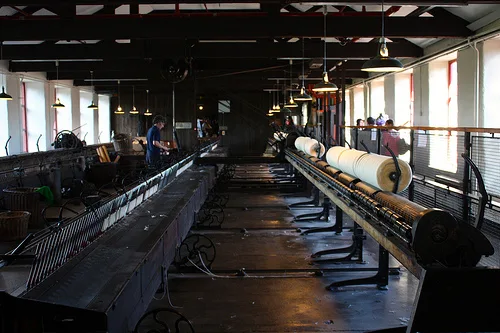
A few weeks ago Christine and I went to the Calderdale Industrial Museum in Halifax. The museum opened in 1985, but sadly closed only a few years later and has been mothballed ever since. A group of volunteers called CIMA are working to get the museum open again, and the 10th August was one of their regular open days where visitors could have a look around. I’ve uploaded the photos of my visit to Flickr.
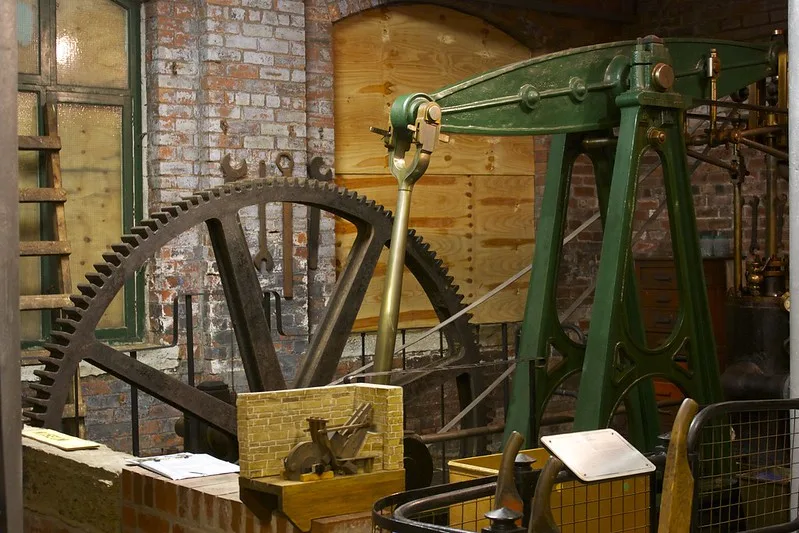
Not all of the museum is accessible; the volunteers have been working for a couple of years but some parts are still out of bounds. However, there are three floors of exhibits, which include stationary engines like the one pictured, weaving machines and histories of some of the major companies that were founded in Halifax. These include Percy Shaw’s catseyes company, Mackintosh – maker of Quality Street and now a part of Nestlé, and the Halifax Bank.
A lot of the windows are still boarded up and not all of the light bulbs had been replaced, so the museum is quite dark. The paintwork on the walls needs some attention as well, as shown in some of my photos.
It was my first visit, but Christine had been as a child, back when the museum was open properly in the 1980s. I think she was disappointed at how the museum had been left to rot for so long. The volunteers have done well but will have their work cut out to get the museum back to where it was when it was closed, never mind taking it forward. I also got the feeling that the local council, which still owns the museum, isn’t being 100% co-operative.
There are also question marks hanging over the museum’s future. It backs on to The Piece Hall, which in January will under-go a 15-month modernisation, and it is next to the proposed site for Halifax’s new central library. The plans may see the museum building being cut down somewhat, although the artists’ impressions do at least show it so hopefully it’ll still be around in future.
There are two more open days planned for 2013, on the 14th and 15th September as part of the national Heritage Open Days events. If you’re in the area I would definitely recommend a visit – it’s easy to get to as it’s just around the corner from Halifax station. Entry is free, but I’m sure CIMA would be delighted if you were able to donate some money to help them get the museum open again more often.
It’s not often that I ask you, dear readers of this blog, to sign a petition. But please can you take a few seconds of your time to sign a petition to Save the National Media Museum in Bradford.
The museum, along with the National Railway Museum in York, and the Museum of Science and Industry (MOSI) in Manchester, are threatened with closure. Their parent company, Science Museum Group, cannot afford to run all three in addition to the Science Museum in London, due to cuts in funding from central government. It is therefore said that one of these will have to go.
I really, really hope that none of them close. As a child, I loved going to visit them and have also been recently as an adult, and enjoyed them all. Putting the museums against each other in a fight for survival is therefore not helpful.
But, I’m particularly keen for the National Media Museum to stay open. It’s the one big visitor attraction in Bradford city centre, with a strong reputation. Closing it would be an absolute disaster for a city which has fallen on hard times over recent years. Racial tension fuelled riots in the summer of 2001. In 2003, demolition work started on a new shopping centre, to be built by Westfield, but ten years on and there’s just a big hole in the ground. Meanwhile the recession has caused many of Bradford’s other shops to close, leaving even bigger gaps in the city centre.
Last year’s opening of the City Park, with its excellent mirror pool and fountains (a magnet for kids on hot sunny afternoons), was a big step in the right direction and shows that the city does have positive momentum. And, hopefully, work will start on our long-awaited shopping centre this year. But all the good work could be undone if the National Media Museum closes. Because people will stop coming to Bradford, and then more local shops and business will go under. It’s a horrible thing to even contemplate.
So please, sign the petition. And if you’re free tomorrow (Saturday), why not visit the museum? There’ll be a mass ‘visit’ of the museum at around 12pm. It’s free to get in, and it’ll show the powers that be that this museum is important, not just to Bradford but for the country as a whole. It is, after all, part of our national collection.
Today Christine and I took advantage of the fact that we both had annual leave and went on a day trip to Harrogate. Unfortunately it was rather cold, wet and very windy, so it wasn’t the most enjoyable visit.
We visited the Royal Pump Room Museum, which is built above two of Harrogate’s famous wells and charts the history of the town. It’s a nice little museum in an interesting building, which takes around an hour to get around. Oddly there’s also a small exhibition of Egyptian artefacts there as well.
No visit to Harrogate would be complete without a visit to Betty’s. Admittedly Betty’s isn’t unique to Harrogate; there’s two in York, one in Ilkley one in Northallerton and a second tea room and tea house at RHS Harlow Carr, but unlike the team rooms in York the queue for lunch isn’t usually snaking out of the door and around the block. In fact, we could pretty much walk straight in when we visited at midday today, although it was, of course, a Monday in February – not exactly peak tourist season.
I like Harrogate because it has character, and many of its Edwardian and Victorian buildings have been well-preserved. We don’t go there very often, as it takes a good two hours to get there by train from Sowerby Bridge, but it’s a nice day out.
Some of the photos that I took are already on Flickr. I also uploaded several from our last visit in May 2010, as apparently I didn’t upload those at the time. Which makes me wonder what else I haven’t uploaded to Flickr over the years.
Today we took the time to visit the People’s History Museum in Manchester. I actually hadn’t heard of it until yesterday, when we were looking for something to do as a couple having spent all of yesterday playing games (me, World of Warcraft; Christine, Guild Wars) and not really spending much quality time together.
The museum has been around since 1990, and was originally called the National Museum of Labour History. Indeed, there is a large focus on the history of workers’ rights, the rise of trade unions and the foundations of the Parliamentary Labour Party. That being said, it covers a wide range of subjects, especially the history of democracy in the UK. And Manchester is an ideal place for it, as it was the scene of the 1819 Peterloo Massacre, and the historic home of the Co-operative movement is nearby in Rochdale.
It sits in two buildings: the first is a modern extension, opened in 2010 and housing the main body of the museum. The other is the older Pump House building which was one of the three pump houses for Manchester’s Hydraulic Power system, for which there is an exhibition at MOSI about it. The Pump House holds the two temporary exhibition spaces, and when we visited there was a photography exhibition about the Oldham Road, and a special exhibition about the Temperance movement – again, a political ideology with strong northern roots. Pleasingly, the museum’s café stocks a range of temperance drinks, albeit alongside beer.
I found it really interesting, although it does have a rather left-wing political agenda. To me that’s not a bad thing but I could imagine some Tories feeling uncomfortable there. I actually learned a surprising amount of things that I wish I’d been taught at school, about this country’s history.
The museum is free to enter (donations welcomed) and is open most days of the year, although I’d advise against visiting next week as one of the permanent galleries is closed to rotate some of the exhibits. For once, I’ve already uploaded the photos to Flickr, as well as others that I took elsewhere in Manchester today.