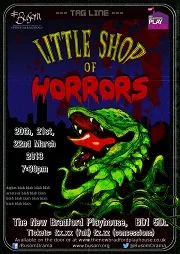
Little Shop of Horrors

This coming Thursday, my wife Christine will be featuring in an amateur production of Little Shop of Horrors, along with other students from the University of Bradford where I work. It’s on at The New Bradford Playhouse and runs until Saturday.

As well as playing a character in the show, Christine has been helping out for a number of weeks now, and I also spent much of the weekend helping and/or hindering the technical team as they set up in the theatre. It promises to be a good show, and the puppets they’re using look really good.

So, if you’re available on Thursday, Friday or Saturday nights this week, we’d both very much appreciate it if you were able to come along. Tickets can be purchased online here.

HMV’s fall into administration

String Quintet

Last night, it was announced that HMV was to appoint administrators to run the business as it was no longer viable on its own, putting the jobs of over 4000 people who work there at risk. HMV is the last remaining music store in the UK, as over the years Tower Records, Track Records, MVC, Borders and, most recently, Zavvi and Woolworths (to name a few) have all met a similar fate.

Thinking back, the last time I went into HMV was over two years ago, ironically enough to buy some headphones for my iPod, so I could listen to all of the music that I’d bought online. Which is one of the major challenges that HMV faces – many people are now buying music downloads rather than physical CDs, and music downloads in the UK are dominated by Amazon and Apple’s iTunes.

Sure, HMV does sell music downloads and owns 50% of online retailer 7digital, although it’s not as popular as its rivals and tends to be more expensive. But then HMV actually does pay its fair share of taxes in the UK, unlike some other businesses, and its prices are probably higher as a result. Supermarket competition is also a big factor, as Tesco, Sainsbury’s, Morrisons and Asda all sell music and DVDs in their larger stores.

But people still buy CDs. It’s hard to give an MP3 to someone as a gift – especially at Christmas – and there will always be those who prefer to own physical objects. Downloads are great until you realise your in-car CD player doesn’t have an iPod adaptor, or your computer’s hard drive gets corrupted and you lose all of your music files.

How much of HMV will exist in future remains to be seen. It has around 35% of the UK’s CD market and quite a lot of its stores are profitable; hopefully once the failing stores are closed then the business will be able to continue trading, as happened to GAME recently. GAME is an interesting example; in Bradford, through its mergers with Gamestation and EB Games, it ended up with 3 shops within five minutes walk of each other. And this was a pattern repeated across many other towns and cities. Now it generally just has one store and seems to be doing okay. It’s sad news for the staff laid off from the stores that closed, of course, but at least it didn’t disappear forever.

But other recent high street failures haven’t had such a happy ending. Last week, camera retailer Jessops went into administration and within two days had closed all of shops for good. Unfortunately Jessops were in a hard market; few people buy compact cameras any more, as more and more people have smartphones which can take almost-as-good photos, and have the ability to share them on Facebook and Instagram straight-away, rather than waiting until you get home and empty your memory card. And independent camera shops seem to be holding up the top end of the market, especially with second-hand lenses and cameras. Jessops seems to have disappeared into the widening gap between the two.

Robert Peston, the BBC’s business editor, is quite philosophical about HMV’s collapse; in essence, it’s a sign that banks are letting almost-dead businesses fail, to free up money to lend to those that are doing well and growing. That’s not good news for the people working for these ‘zombie’ companies but a sign that, in time, things will get better.

Whilst changing shopping habits, with a move to digital downloads, are one of the reasons for HMV’s problems, another big problem for all retailers is that many people just don’t have much disposable income nowadays. We’re only just out of a double-dip recession, but last year our economy was bolstered by the Olympics and so it’s possible that Britain will be back in recession for a third time since the credit crunch later this year. Public sector pay is increasing at a measly 1% – less than the rate of inflation – and MPs voted to do the same to benefits. Unemployment isn’t as high as it could be but the fall of Jessops, and Comet just before Christmas, has resulted in thousands losing their jobs just recently. So to me, the economy is also to blame, and by extension those in charge of this country’s economic policy as well.

I’m near the end of this post, but before that I’ll come back to the topic of Bradford. In Bradford, HMV is on Broadway, a street that should, by now, lead into the new Westfield Shopping Centre, had it been built (construction will hopefully start later this year). It’s one of the few shops left there; GAME closed, as mentioned earlier, and children’s clothing retailer Adams closed down a couple of years ago. Jessops was around the corner until last weekend. What was once one of Bradford’s main shopping streets barely has anything left on it, as more and more struggling high street chain stores fall by the wayside.

I really hope that at least some of HMV’s stores stay open. It would be a shame to lose such a big name, especially as it’s the last of its kind.

Disclaimer: This site carries advertising via Amazon and Apple iTunes.

Bingley Music Live 2011

Jon Fratelli

Having enjoyed it last year, when we heard that acts such as Feeder and Eliza Doolittle would be playing Bingley Music Live Christine and I snapped up tickets a few months back. The festival was last weekend and, like last year, we had a good time. Though the price of a weekend ticket has gone up by a fiver, there were some bigger acts this year, as well as a smaller, second stage designed around kids and families. Also changed from last year were the toilets; thankfully, the toilet area hadn’t turned into a smelly quagmire by Sunday unlike in 2010. Unchanged were the astronomical drinks prices but I guess that’s par for the course for most festivals.

This was also the first time we went to all three days – last year we skipped the free Friday night events but we made it this year to see the Young Guns. Sadly they’d arrived late and their set was cut to 20 minutes; plus, there appeared to be some technical problems making them sound very flat. A shame because they’re one of my favourite up and coming bands.

I won’t do a full review as my friend Phil has done a much better job at his blog .wav Goodbye – read his reviews of Friday, Saturday and Sunday. Some of the sets from the likes of Feeder, Athlete and Eliza Doolittle were excellent, and worth the ticket price on their own merits – seeing the other acts just added to the value.

As it sold out a few weeks ago (the first time it’s sold out in advance in the five years it’s been running), plans are already afoot for 2012 and tickets went on sale today. I think we’ll wait to see which acts are confirmed first though – whilst the line-up has been good these past few years, I’m not willing to gamble £40. Even if the tickets being sold now are ‘limited edition’ – whatever that implies.

Hopefully next year we’ll be able to make some other festivals – Sonisphere in particular could be good if the right bands are playing. We’ll see.

30 Day Song Challenge Day 30

It’s the final day! Apart from one day earlier in the week, I’ve managed to post something every day for the past 30 days, and I’m feeling quite impressed with myself.

So, day 30 of the 30 Day Song Challenge is a song that makes you want to help the world, help the environment, end poverty, help society…. Frankly, I couldn’t think of one, and as it’s such a nice, warm, sunny spring day, I’ve chosen “Hard To Beat” by Hard-Fi which suits the mood, I think. It’s from their album Stars of CCTV, which available from iTunes and Amazon.

I’ll try to stay in the habit of posting stuff regularly on this blog, although I can’t guarantee a post every day like there has been for the past month. Still, I hope you enjoyed this small insight into my musical tastes!

30 Day Song Challenge Day 1: Your Favourite Song

Monty Picon

I’m going to give the 30 Day Song Challenge a go. You’re asked to post a different song each day – your favourite, least favourite, guilty pleasure, or that best describes you. I’ll try to embed YouTube videos where possible so that you can listen to them yourself, but as some of the official videos have embedding blocked I won’t always be able to do this. This will mean a lot of extra posts, but it’s only for a month if you don’t care for it…

Day 1 is your favourite song. This is rather difficult, as I don’t have an all-time favourite song. Instead, I’m going to choose a song that has been one of my favourites for over 15 years, and I still enjoy listening to today: “Set You Free” by N-Trance. Even though it’s been around a long time, it has aged well and as far as I’m aware it still gets played at nightclubs quite a bit (I wouldn’t know for sure because I haven’t been clubbing in ages…).

Bingley Music Live 2010

Reef

Yesterday Christine and I went to our first proper music festival: Bingley Music Live. It’s certainly not one of the biggest festivals, with only 15,000 tickets available, and it doesn’t draw many big names. The main acts this year were mostly bands that were at the peak of popularity some years ago, namely The Buzzcocks, Public Image Ltd., Reef and James.

Bingley Music Live is in its fourth year and is organised by Bradford Council with no corporate sponsorship. Despite this, tickets are only £30 for the full weekend, and the Friday event has free entry as well. The small size of the festival means there’s only one stage, and there’s no campsite, but then I think most people who go live locally.

I’ll be going back today for the Sunday bands, although this time I’ll be bringing more of my own drinks. £2 for a small bottle of cola is frankly scandalous.

Solid Gold Chartbusters

I’m afraid I am about to post a music video which ranks as one of the most annoying songs of all time:

Once you have watched it, and presumably received relevant counselling, I’ll explain myself.

The song is called “I want a 1-2-1 with You”, unsurprisingly, by a band calling themselves the Solid Gold Chartbusters, but who are actually better known as The KLF. It wasn’t a very big hit, being released in the run-up to Christmas in 1999 along with other novelty songs.

But it’s notable for being one of the first songs to use a ringtone as part of the main melody, in this case the default tone used by Nokia phones. Of course, in 1999 we didn’t even have polyphonic ringtones, never mind MP3s, so it was a series of beeps. And the “1-2-1 with you” idea was almost certainly inspired by the UK mobile network One2One, originally part of Cable & Wireless and since bought out by Deutsche Telekom and re-branded T-Mobile.

Why am I mentioning this? In 2005, some marketer who probably deserves a rather painful death came up with the idea of combining the Crazy Frog ringtone with the song Axel F, in this instance covered by the Bass Bumpers. This song, rather unfortunately, went on to be UK number 1 and spawned a whole album of songs which were mercilessly destroyed by El Frog. At the time, it was claimed that this particular cover of Axel F was the first time that a ringtone had been made into a single, as opposed to the other way around which is what normally happens. While it was the first ringtone-based song ever to be number 1, it certainly wasn’t the first song to be released.

It also happened to one of those random songs that I vaguely remember seeing on MTV 10 years ago that for some reason surfaced in my mind, and so I decided to share it. You’re probably wishing I hadn’t, though.

Wikipedia names your band

Via Waxy Links is a meme called Wikipedia Names Your Band. Here’s how you do it:

  1. Go to a random Wikipedia article – the name of the article becomes your band’s name.
  2. Go to Random Quotations – the last 4-5 words of the last quotation on the page are your the title of your first album.
  3. Go to Flickr’s “Explore the last 7 days” and choose the third picture – this will be your album cover.

Put them all together, and you get something like this:

The components for mine were:

There are many other covers on the Buzzfeed page, some of which are very good.

My iPod Mini arrived!

A photo of a green iPod Mini being held

At long last, my iPod Mini arrived this morning. It’s now on charge, connected to the bundled transformer that is almost as big as the device itself. Unfortunately I won’t be able to do all that much with it until my laptop is repaired because neither my dad’s laptop or my parents’ PC have USB2 ports, although once I have iTunes installed and have the device fully-charged I’ll try anyway. Experience tells me that if you charge the device fully on first use you can greatly extend the battery life of a device so I’ll wait a few hours.

Still, I’m excited at the fact that I can call myself an ‘iPod owner’ 🙂 .

Apple Lossless Encoder

One new iTunes feature that slipped by me was the new ‘Apple Lossless Encoder’. Unlike music formats like MP3, AAC and Ogg Vorbis, lossless encoding results in no loss of quality – the music file sounds exactly like the original. The downside to this is that files compressed using lossless compression are typically quite a bit larger than their lossy counterparts.

With the largest iPod topping 40GB it’s hardly surprising that Apple have adopted this – I’m sure the majority of people will never fill that much (even I have only 6-7GB) so the extra space can be set aside for higher quality files. What is surprising is that Apple chose to adopt their own format, and not one of the (many) other lossless encoding formats.

If you thought there was a format war amongst lossy encoders then you’ll be knocked back by how many lossless ones are out there. There’s at least 14, although not all of them are as good as each other. Thankfully, lossless formats are easier to compare since output quality isn’t a factor, but a good format will have quick encoding, a small output file size, many features, and would preferably be open source too.

The most popular is FLAC (Free Lossless Audio Codec), which is now being steered by the Xiphophorus Foundation who are also steering the Ogg Vorbis format. It’s arguably not the best format out there but it’s good enough and it’s entirely open source. It’s well represented on almost all platforms and is even in some hardware players. Monkey’s Audio is a little faster but isn’t so well supported, being restricted to Windows and a command line encoder in Linux. Although it is open source, development has been a little slow of late, and it lacks some features compared to FLAC. Shorten is another popular format.

Apple Lossless Encoder (or ALE for short – nice acronym), is, sadly, based on none of these. It’s a new format which is closed source and currently only works in iTunes (Mac and Windows) and through QuickTime, although a dBpowerAMP codec is apparently in the works. It is quite well featured, offering streaming and seeking support (which a surprising number of other formats lack), and is obviously supported on the iPod with the addition of the latest firmware update, so on paper it has a similar number of features to FLAC. It is, however, slower at encoding and decoding, and files are typically a megabyte or so larger, according to this comparison provided by the FLAC project, however this HydrogenAudio topic suggests it is faster. I’m guessing Apple may have optimised it for the PowerPC processor, in which case compile times on Mac OS X would be better than in Windows.

It’s just a pity that Apple took the decision to re-invent the wheel when good alternatives already exist, although this Macworld column reckons this is because Apple may want to add DRM to it in future so that punters can buy higher quality files from the iTunes Music Store. AAC was an open(-ish) format and look how quickly that was cracked. On the other hand, I doubt the record labels would be interested in giving away their songs on the internet at full quality, based on their previous boneheaded decisions.

There may also be reasons, such as patents or problems with embedding FLAC in the iPod firmware, but seeing as other hardware manufacturers have managed it this seems strange.

In any case, it’s an interesting development. Any support for lossless audio in iTunes is a good thing, I just wish that Apple had gone with the herd rather than go on a tangent and then confuse people. What I would like to know is whether the WMA import function of iTunes allows you to convert them to ALE, since then you wouldn’t lose any quality – I couldn’t find anything that suggested this in my research for this article.