
Why do I like trains so much?

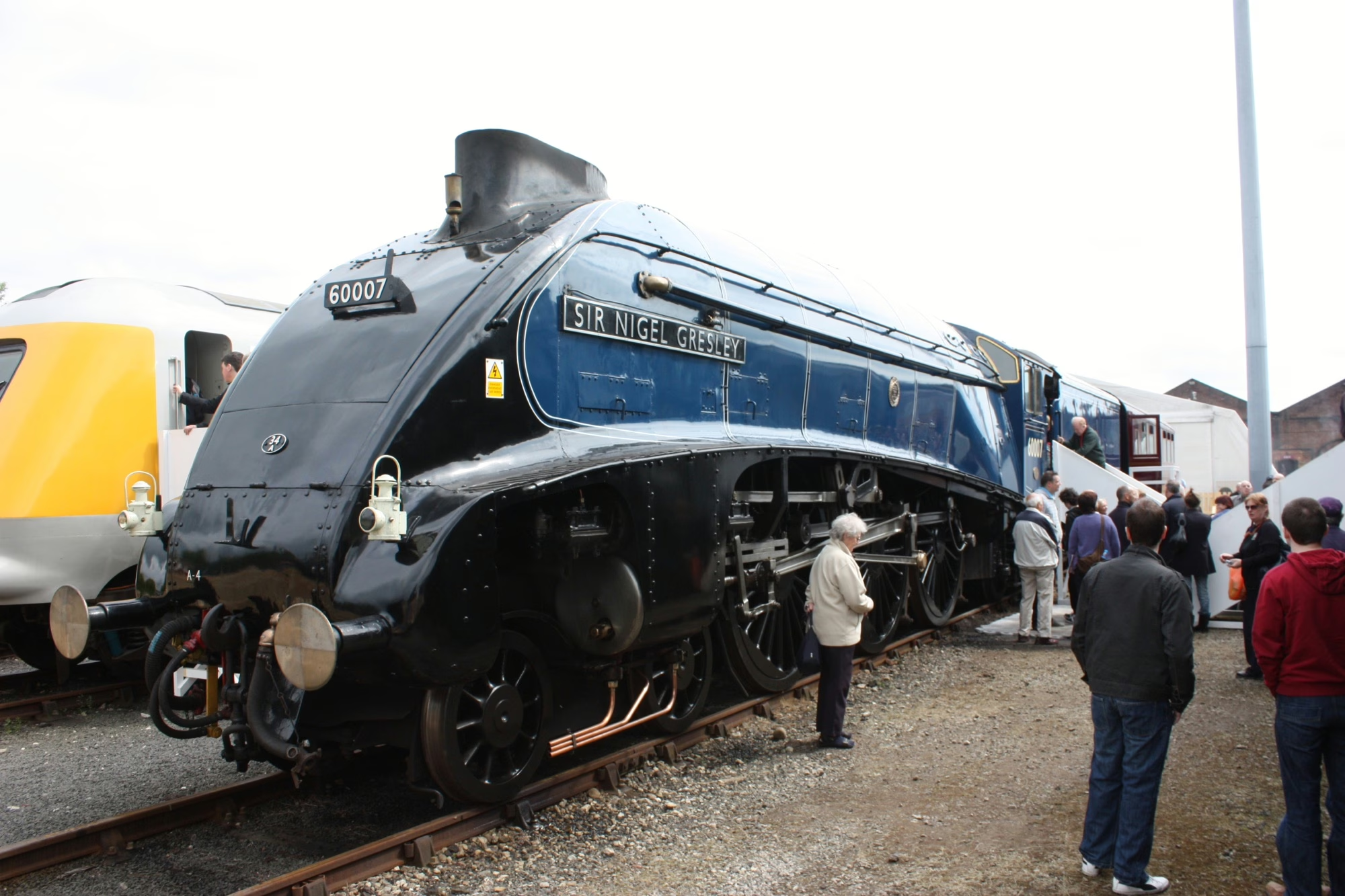
A photo of a steam train, named Sir Nigel Gresley. It is an LNER blue A4 Pacific named after its designer. This was exhibited at Railfest in 2012, at the National Railway Museum

If you’ve been reading this blog for a long time, you may have noticed that I write about trains and public transport quite a bit. Recent posts have included the railway station in Wales with the excessively long name, decarbonising London’s rail termini, renaming London Underground lines and the issues with the Central Line in London. Trains, and especially trains in Britain have been an interest of mine for as long as I can remember, and this is an attempt to rationalise why that is.

My dad worked for British Rail

Compared with the average young person in 1980s Yorkshire, I probably got more exposure to trains than other kids my age. This was because my dad worked for British Rail, in their civil engineering department. As such, we got employee travel benefits, meaning 20 days free travel per year and a steep discount on all other rail travel beyond that. As such, we travelled by train a lot; despite living in York, we would have regular day trips to London which was only a couple of hours away.

My parents still have their staff travel privileges, even though my dad retired from the railway over a decade ago. I unfortunately don’t, as I’m no longer dependent on them, but I was able to keep it through my time at university, which was nice.

I could see trains from my bedroom window

The window in my childhood bedroom overlooked mainly fields, but in the distance, I could also see trains on the East Coast Main Line. Our house overlooked one of the busier four-tracked sections, and so as well as London-Scotland Intercity trains, I could also see Transpennine and Crosscountry services, and a few freight trains. We were close enough to be able to make out train liveries and types, but not individual train numbers.

I have vague memories of seeing the engineering trains that were involved in the electrification of the line, which took place in the late 1980s, and experiencing the then new electric Intercity 225 trains that are now in their twilight years.

A photo of two trains at the National Railway Museum in York - an Intercity 125 High Speed Train on the left, and a red steam engine on the right

I grew up in York

York is an important junction on Britain’s railways, largely thanks to George Hudson (although he has a rather complicated legacy thanks to some dodgy financing). It has a much bigger station than many places of a similar size, and is where the East Coast Main Line meets branches from Harrogate and Scarborough to the north, and Hull and Leeds from the south. There are lots of places that you can get to from York without changing trains. So, the combination of easy journeys and free/discounted travel meant that I was able to go on lots of trips by train whilst growing up.

York is also home to the National Railway Museum, which I used to visit regularly as a child. As an adult, I haven’t been in a few years but we’ve taken our nine-year-old there at least a couple of times.

I didn’t pass my driving test until I was 31

It was August 2015, at the age of 31, before I passed my driving test. We bought our first car the following month.

However, that meant that I spent the first 13 years of my adult life largely reliant on public transport. In 2010, I moved out of Bradford, where I was working, to Sowerby Bridge, and this meant that I spent subsequent years commuting to work by train. And even now, I tend to prefer commuting by train – it’s rare that I drive to work, even though I have the option.

Also, in 2009 and 2010, when Christine and I were dating but not living together, one of us would get the train across the Pennines to see each other almost every weekend.

I read magazines about trains

Ever since I could read confidently on my own, I’ve been reading Rail Magazine. Indeed, I’ve had a subscription and/or read it through Readly or Pressreader for many years now, not missing an issue. Which, as it’s published every fortnight, is a lot of content.

For a time, I also read Modern Railways every month, although I stopped when it was no longer included with Readly. I haven’t subscribed because, whilst I appreciated the analysis in it, I just don’t have the time to read that as well. Indeed, recently I was six issues behind with Rail Magazine and only really caught up due to being ill at the end of October.

Consequently, my knowledge of British rolling stock is pretty good. Give me a photo of a passenger unit or locomotive that has run within the past 20 years in Britain, and I’ll probably be able to tell you its class number, when it was introduced, which company built it and where. Granted, it’s not the most useful superpower, although it did come in useful when advising a friend with sensory issues about which trains would be nosiest on a long journey.

I’m also not a trainspotter – I don’t note down individual unit numbers and I don’t actively spend time hunting out particular types of trains. Not that there’s anything wrong with having a hobby like that, if that’s something you enjoy. It’s just not for me.

So, I think, in a nutshell, that’s why I’m interested in trains.

RailFest 2012

Sir Nigel Gresley and Tornado

I went to RailFest 2012 at the National Railway Museum yesterday. As it’s still on until Sunday, I’ve decided to write about it now, just in case you have time to go and visit.

Firstly, if you’re not normally interested in trains, then, to be frank, RailFest probably isn’t for you. In essence, you have several items of the NRM’s own collection, mixed in with some visiting trains, both old and new. This is great for train geeks like me, but not so great for those without a passion for rail travel, like Christine, who did not accompany me on this occasion.

You can go onto the footplate, or into the drivers cab of many of the trains on show, and there are plenty of volunteers around to talk with you about the train. Plus, every train on show has an information board, with many answering the question ‘Why is this here?’ as some locomotives are notable. There’s Sarah Siddons, a Metropolitan Railway locomotive preserved by London Underground which is now Britain’s oldest working electric locomotive. Or a class 43 High Speed Train locomotive called 43159, which was part of a pair of locomotives that set the official world speed record for a diesel locomotive, and which is still in regular revenue service with First Great Western. And next to it is 41001, the sole remaining prototype locomotive for the High Speed Train which has just commenced restoration. And then there are the more well-known locomotives – both Mallard and Sir Nigel Gresley were available for footplate talks, as was Tornado, a steam locomotive built in 2008 to original LNER designs.

But in a way it was nice to be able to get up close to some of the trains that we see every day, or look behind the scenes in places where passengers don’t normally go, like the drivers cab. It was particularly interesting comparing the cab of 41001, which dates from 1972, with the cab of one of the Class 395 Hitachi trains which operate on High Speed 1 for Southeastern’s domestic high speed services (and the Javelin services for the upcoming Olympics) which were introduced 37 years later in 2009. Both seem to have a similar number of buttons and controls but the latter could do so much more.

There were also a number of train rides available on standard, narrow and miniature gauge trains, although I didn’t take this up even though they were included with the entry price – £13 for all day if bought in advance online. The site was quite busy, especially in the afternoon, and, unsurprisingly, most visitors were older men with cameras and excitable young boys. The museum itself is open as usual, and remains free to those who aren’t interested in RailFest.

If you are going, allow at least 3 hours for RailFest alone, on top of any time you want to spend in the rest of the museum. I’d also advise bringing your own food as the catering on the RailFest site is extortionate (best part of £10 for a cheeseburger, chips and a bottle of cola). And also think of lots of questions to ask, as the volunteers are more than happy to answer them. It’s well worth the visit.

London, the Howgills, Keswick and RailFest

Keswick Market Place

I’m back home now, after my various travels. As well as going to London last week, I spent the weekend with Christine and some friends from university in a bunk barn in the western Yorkshire Dales, near the Howgill Fells (a range of hills on the western border of the Yorkshire Dales National Park).

Thanks to the Queen’s Diamond Jubilee, we got not one, but two public holidays in a row, so yesterday was spent in the lovely town of Keswick (pictured above) and on Latrigg, a hill overlooking it. As for today, I was in York for RailFest 2012 at the National Railway Museum – and I’ll be blogging about that visit tomorrow.

Photos will be forthcoming, but I have quite a backlog of pictures to upload from earlier on in May – I’ve just put up the latest set from the May Day bank holiday weekend in York, which are mostly pictures of owls, as it happens. Hopefully the rest will appear there shortly – as I’ve mentioned, I took over 200 in London alone, and nearly another 100 since.

Being a tourist

Helmsley Castle

I spent the weekend being a tourist, twice in my home town of York. York is a city that, since I no longer live there, I have actually come to appreciate more. Whilst growing up there you took the historic buildings for granted, and the hordes of guided tours just got in your way. But now I see the city in a very different light.

On Friday afternoon, we spent a bit of time at the National Railway Museum – one of my favourite museums as a child, but my last visit was in 2007 (although I blogged about it last year). The main attraction is the return of Mallard, which spent many years in the main hall at the museum but was recently sent to the Shildon Locomotion Museum in County Durham; however, it’s in York on a brief visit and presently takes pride of place on the main turntable. The museum is undergoing a lot of renovation at present, which includes a new entrance hall, so there are fewer attractions than normal – the station hall in particular was rather sparse, which was a shame.

On Saturday, we eschewed York and headed up to the small market town of Helmsley, on the edge of the North York Moors National Park. In particular, we visited Helmsley Castle, parts of which date from the 12th century but has been mostly ruined since the British Civil War in the 1600s. It’s now looked after by English Heritage, and for a little under a fiver each for adults you can spend a couple of hours wandering around. There’s also a museum section, which shows some of the finds that have been excavated as well as information about the castle’s history and how it would have looked over various key periods in its history.

Finally on Sunday we went back into York city centre, partly for some sightseeing but mostly for shopping, for which York is very good. Whilst there aren’t many large branches of chain stores (with the exception of a large Marks & Spencer, split across two sites), there are plenty of smaller shops and thankfully most don’t sell tourist tat. There’s now a sausage shop on The Shambles, and we also called in at Betty’s for some of their fondant cakes which change regularly. We were hoping to go to the Jorvik Viking Centre – again, despite living in York I haven’t visited this in nearly 20 years – but it’s rather expensive unless you make a day of it and go to the other museums (DIG, Barley Hall and Micklegate Bar Museum) – a £16 ticket lets you into all four.

In a way, it’s refreshing to be a tourist in your home town. You can take time to go to the places that you walk past every day, and maybe discover things that you never knew existed. At the same time, you have the advantage of knowing your way around and knowing the best places to eat, or what to avoid. Whilst not every town is set up for tourism, if yours is, give it a try. You can even do it in places like Bradford.

National Railway Museum

Swag

I’ve been sent a package by the PA to the National Railway Museum’s Director of Fun, Sam Pointon. While it may not seem odd for a museum which is popular with families to have a director of fun, Sam is only 7 years old, and he’s been there for a year now.

Sam, or rather his PA, has asked me to write about my experiences with the museum and tell you about some of the events that are being held this summer, so here goes.

Like Sam, when I was his age, I was also very keen on trains – having a father who worked for British Rail helped as it meant lots of free rail journeys. I also grew up in York, home of the National Railway Museum and was a regular visitor. At one time, my mum took me almost every Sunday, even when there wasn’t free entry like there is now. My earliest memories were of its ‘Great Rail Exhibition’ in the former York Goods Station, as at the time the main hall was receiving a new roof. Now both the main hall and goods station are used for the museum and open to the public. Further expansions have added a workshop where you can see classic trains being overhauled and restored, as well as access to some of the museum’s archives.

Mallard

Moving out of York in 2002 has meant that my visits have been sadly less frequent. My most recent visit was in 2007 which included a trip on The Yorkshire Wheel, a London Eye-style big wheel which was unfortunately only a temporary attraction and is now elsewhere. As well as seeing classic trains from both the UK and overseas (there’s a driving car from Japan’s Bullet Train, for example), there’s plenty of information about the history of Britain’s railways, and various interesting artefacts.

This summer, a sand sculpture is being built from 20 tonnes of sand by the same people who created a sand sculpture of Charles Darwin in Centenary Square in Bradford last summer. There’s also a major 1930s exhibition, linked in to the recently restored streamlined steam engine the Duchess of Hamilton, which you can see in the photo at the top of the page.

The National Railway Museum is a really great museum and you can easily spend a day there. There’s plenty to do, whether you’re a young child or a grown-up child like me. Best of all, it’s free, and only a few minutes walk from York station. You should go and visit it sometime.