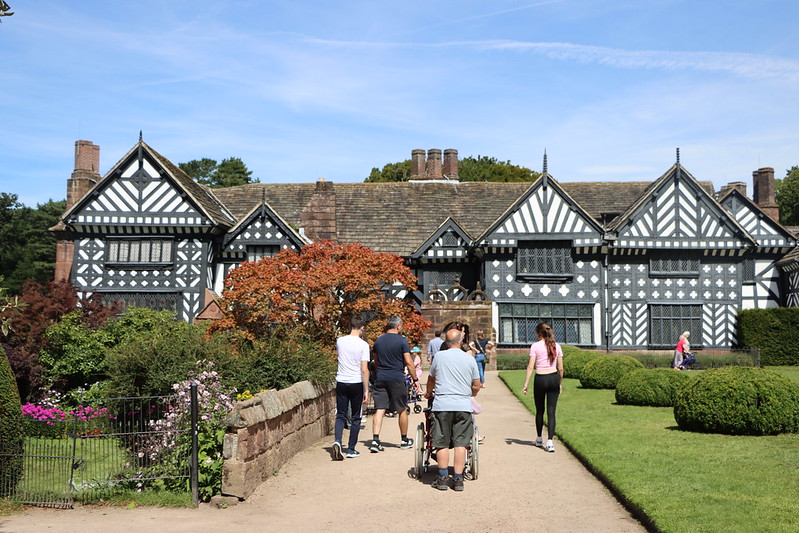
A couple of weeks ago, we went to Hardwick Hall in Derbyshire. It’s a National Trust property to the east of Chesterfield, and I’ll be honest, I hadn’t heard of it until a few weeks ago.
I came across it via this YouTube video from Auto Shenanigans. The M1 passes by Hardwick Hall, and when it was upgraded to be a ‘smart’ motorway a few years ago, the National Trust insisted that the new gantries must be painted brown, to blend in better. Anyway, it turns out Hardwick Hall is doable as a day trip for us, even though I didn’t include it in my list from last year. And, it’s something of a new year’s resolution for me to visit more National Trust places this year, so that we make the most of our annual membership.
History of Hardwick Hall
You can read a more detailed history of Hardwick Hall on the National Trust web site, but the building owes much of its design to Elizabeth, Countess of Shrewsbury who lived in the Elizabethan period. She was more commonly known as ‘Bess of Hardwick’, and her initials ‘ES’ appear all over the building. She had four husbands during her life, the second of which was William Cavendish. If the Cavendish name sounds familiar, it’s because the Cavendish family owned nearby Chatsworth and Bolton Abbey. Indeed, following Bess’ death in 1607, the hall passed to the Cavendish family’s ownership, where it remained until after the Second World War. Faced with a large tax bill, the Cavendish family bequeathed Hardwick Hall to the National Trust in 1956.
More recently, Hardwick Hall has been used as a filming location. You may recognise it as ‘Malfoy Manor’ in the film adaptations of the books-that-shall-not-be-named.
Nowadays, it is one of the National Trust’s ‘top tier’ properties, and so there are regular events there during school holidays. We visited towards the end of ‘Wintertide’, which saw the rooms decorated for an Elizabethan winter and a seasonable tale of mischief installed throughout the house and gardens. During the half term break next month, there’s a planned Valentines event for kids.
Hardwick Old Hall
On the same site are the remnants of an older grand house, now known as Hardwick Old Hall. Most of the outer walls remain, but there’s no overall roof or window panes. It didn’t burn down; instead, the stonework was gradually removed and shipped over to Chatsworth to support work there. It would have been cheaper to use existing carved stones, than to have new stone quarried. Whilst the wider Hardwick site is managed by the National Trust, Hardwick Old Hall is in the care of English Heritage. It was closed when we went, but re-opens in February.
Gardens and estate
The Hardwick estate covers around 2500 acres of parkland, and there are a number of signposted walks. This includes a sculpture walk, which we would have considered doing on a warmer day but decided not to.
The formal gardens around the house are enclosed within walls, and will probably look fabulous later in the year. Alas, there’s not much to see mid-winter,
Accessibility
There are two car parks at Hardwick Hall; the main one, close to the hall and the stableyard, and a second one at Hardwick Park Centre which is further away and down a hill. If you have accessibility needs, park at the main car park; there is also an accessible buggy that can take visitors to the hall. The stableyard includes a Changing Places toilet.
At present, there is one electric vehicle charging socket in the lower car park (type 2). Planning permission for chargers in the main car park has apparently been granted, but work hadn’t started yet as I type this.
Google Maps gave up when I asked it to work out public transport directions to Hardwick Hall; there doesn’t appear to be any local bus services and the nearest railway station is in Chesterfield.
Entry to the whole site is free for National Trust members, and English Heritage members get free entry to both Hardwick Hall itself and Hardwick Old Hall. A cheaper ticket that just covers the estate and stableyard (not the houses or gardens) is also available to non-members.
In my review of local National Trust properties, I somehow missed out Castlefield Viaduct in Manchester. It’s one of the newest, having only been open for a few years, and occupies an abandoned railway viaduct that crosses the Castlefield area of Manchester.
It’s a similar concept to the High Line in New York; take an abandoned elevated piece of railway infrastructure, plant things on it and open it to the public. The Castlefield Viaduct isn’t as long – around 330 metres, rather than 2.3 kilometres – and it’s not yet open as a through route. That will come in time, with work hopefully starting as soon as this year. When complete, it will open up a segregated walking route from the Manchester Central exhibition centre (still often known by its former name of G-Mex) towards Cornbrook.
History
The viaduct was built in 1892, by the same firm that built the Blackpool Tower. Trains would use the viaduct to access Manchester Central station (as was) and the Great Northern Warehouse. It was closed in 1969, after becoming surplus to requirements, and has stood empty ever since. A second viaduct runs parallel; this is still in use by Metrolink trams and forms the core section of the network.
Inside Castlefield Viaduct
About a third of the viaduct is open now, and it’s being managed by the National Trust. The first section has been largely left untouched – a hard path has been laid, but the original ballast has been left behind to show the wild plants that have grown there. The second section is a series of small gardens, each managed by a different local community group. These vary – one has various native Manchester trees whilst another incorporates a pond. Finally, there’s an indoor bit, where you can find out more about the extension plans. The back wall of this is glass, so you can see the rest of the viaduct beyond.
If it weren’t for the neighbouring Metrolink viaduct alongside, this would be a quiet and tranquil place, but trams pass about every two minutes. The viaduct also crosses a railway line that is frequently used, so there are regular rumbles as trains pass.
Accessibility
The viaduct is open between 10am and 5pm every day except Mondays and Tuesdays. Though it’s managed by the National Trust, entry is free even if you’re not a member. Donations are encouraged to support the next phase of work to open it as a through route.
As it was designed for trains, it’s all on one level, and you can get up to the viaduct by using the lift at the nearby Deansgate-Castlefield Metrolink stop. Accessible toilets are also provided.
Now, I’m reasonably sure that I’ve visited Little Moreton Hall before, but if I did, it would’ve been in the 1990s. Certainly, I don’t have any photos of it saved anywhere. In any case, neither Christine, nor our nine-year-old had visited before.
Little Moreton Hall probably classes as being one of the National Trust’s medium-sized properties. During the English Civil War in the 17th Century, the Moreton family backed the Royalists loyal to Charles I. The hall was later confiscated by the government, and much of the surrounding land ended up being used for farming. So whilst the hall itself has survived, it sits on a relatively small site – unlike other grand homes in the countryside, you don’t spend five minutes driving through parkland full of deer.
Wonky
What Little Moreton Hall is best known for is that it’s very wonky. If you look at the photo above, it’s as if someone accidentally dropped the hall from a height, and it’s got bent out of shape. The reason for its wonkiness is partly due to a lack of deep foundations, but also its owners adding a third floor on top without taking the extra load into account. As such, the Long Gallery on the top floor has a very uneven floor, and until quite recently remained out of bounds for visitors. The National Trust has had to work hard to sure up the building and allow all parts to be opened to the public.
Originally the hall was H-shaped, with the dining hall and what is now a tea room in the oldest part. Subsequent extensions have made it look like an inverse ‘C’ from above. Around the hall is a moat, and access is via a bridge and through a gateway, above which sits the Long Gallery. Oh, and the original toilets, which opened out onto the moat. Lovely.
As well as the hall, on the island formed by the moat are some small formal gardens. They’re not very extensive – it’s a small site after all – but they’re well maintained. The moat itself is home to a number of different species of duck.
Inside Little Moreton Hall
The interior is laid out largely as it would have been during its heydays in Tudor times. The family crest for the Moreton family features a wolf, and so there are a number of toy wolves, dressed in different outfits, dotted around the rooms. There’s also a focus on how people in Tudor times slept, as a result of a research project with the University of Manchester. In those days, people would sleep propped up on pillows, to aid digestion, and have various sleepy herbs around to help them nod off. One of the beds has an embroidered bed spread featuring these herbs.
The Long Gallery at the top is probably the highlight – it has plenty of windows and so is a very light space, especially on the sunny day that we visited.
Accessibility
As befits an old house known for its wonkiness, access isn’t great. There is step-free access to the hall, where you can view photos of the other rooms, but to see them in person you’ll need to be able use steps. The Long Gallery is atop quite a narrow spiral staircase.
Limited parking is available on site; you may struggle to find a space on weekend afternoons in the summer. There are no electric parking facilities; we ended up charging our car in nearby Congleton where there are two sites with rapid chargers (though neither were working). An infrequent bus service between Alsager and Congleton runs Monday-Saturday, and at three miles away, Kidsgrove is the nearest railway station.
The next place we went to on our 2025 holiday to North Wales was Bodnant Garden. It’s another National Trust property, and consists of the formal gardens attached to the larger Bodnant Estate.
Bodnant Garden is located to the south of where we were staying, in the Conwy Valley. The garden itself began to be developed in 1874 (so just over 150 years ago), when the Pochin family bought the estate at auction. Over time, the garden was extended multiple times, and is now home to a number of prize-winning trees. It came into the National Trust’s care in 1949, but the rest of the Bodnant Estate remains family-owned.
If you look at the prices for Bodnant Garden, you’ll see that they’re towards the higher end of the scale compared to some National Trust properties. That’s no accident – Bodnant Garden is huge, and we ended up spending all day here. Being as it was the summer holidays, there was a Wallace and Gromit Augmented Reality Trail running, although today was its last day, sorry. Our nine-year-old really enjoyed doing the trail, which included some hands-on activities too.
The Wallace and Gromit trail took us to the far end of the site, and then we made our way steadily back along the stream that flows through it. There’s lots to see – even if you’re not a big horticulturalist, it’s still very pretty.
In all, we probably saw about two thirds of what was there – we missed some of the fringes as it is just so big. Indeed, there is more than one café there; one at the entrance, and another near the Old Mill towards the middle of the site. It’s definitely somewhere I’d consider going to again, and taking a different route around.
Accessibility
You enter the site at the top, and then there are slopes down to the stream – some more gentle than others. The map shows a couple of step-free routes that encompass most of the site, but there are some steep slopes. Most of the paths are gravel.
There are two electric car charging sockets in the car park. On the plus side, they’re both completely free to use, however, one is a medium-speed 7 kW Type-2 charger, and one is just a 3-pin plug. We ended up having to use the latter with our granny charger, but then we were there all day, and it was free after all. It managed to charge our Nissan Leaf up from 31% to 59% over around five hours.
The nearest railway station is Tal-y-Cafn on the Conwy Valley Line, however, it’s a 40 minute walk, it’s a request stop, and there are only 6 trains per day (4 on Sundays). If arriving by public transport, a better bet is the number 25 bus, which runs from Llandudno and calls at Llandudno Junction station. That being said, there’s still only one bus every two hours.
Nearby attractions
The Bodnant Estate also runs an adjacent garden centre, and Bodnant Welsh Food is a short drive away. We nipped into the shop there, although it was rather expensive and didn’t have a great range.
On the other side of the valley, and about a ten minute drive away, are the Conwy Water Gardens. We didn’t go as the TripAdvisor reviews aren’t great; it seems like somewhere that used to be better than it is now.
The app is, appropriately enough, called National Trust Tracker, and it lets you view nearby National Trust properties and track those that you have visited. You can either view them as a list, split by county, or on a map.
There’s also a Statistics tab, which gives you some insights into the properties I’ve visited. I’ve recorded visits to 29 in the app – the actual number will be higher, but I’ve limited it to those where I can record an exact date that I last went. That means that I’ve not included any visited in childhood. Overall, I’ve been to 4.6% of all National Trust properties in England, Wales and Northern Ireland.
You can also see how many visits you’ve made each year, your top region (which is Cheshire for me) and your favourite day to visit (Sundays, perhaps unsurprisingly).
After visiting Beaumaris Castle in the morning, the second place we visited on Anglesey was Plas Newydd (Welsh for ‘New House’). It’s a large country house overlooking the Menai Strait, originally started in the 15th Century but substantially rebuilt in the 18th Century. Nowadays, it’s in the care of the National Trust, who look after both the house and its gardens. The house is presented largely as it would have been in the 1950s.
We went around the house first. Not all of the rooms are open to view; though the National Trust have cared for it since 1976, until around 10 years ago people still lived in the property. The dining room is home to a huge painting by Rex Whistler, which was the largest ever canvas painting in the UK when it was unveiled in the 1930s. A previous owner of Plas Newydd, Henry William Paget, fought in the Battle of Waterloo where he lost a leg – the house has an exhibition about him including one of his prosthetic legs. He was awarded the title of ‘Marquess of Anglesey’ for his bravery.
The 5th Marquess of Anglesey, Henry Cyril Paget, was a rather flamboyant character who inherited Plas Newydd in 1898. He converted the chapel into a theatre, where he performed in what we would now most likely describe as drag. Whilst he was born into great wealth, ultimately he ended up bankrupt six years later in 1904, and died the following year. Many of his costumes were subsequently sold in the ‘Great Anglesey Sale’. However, some photographs survive, and visitors are invited to dance in one of the rooms, as the 5th Marquess would have done.
Gardens
There are some formal gardens at Plas Newydd, on the slope down to the Menai Strait, and there are great views across the Strait towards Caernarfon. There’s also plenty of parkland, including an arboretum. Anglesey is also one of the few remaining places in Britain with wild populations of native red squirrels, and there’s a feeding station in the arboretum. We didn’t get a chance to visit this, unfortunately, and we didn’t see any red squirrels during our time in Anglesey.
As it’s the summer holidays, there were plenty of activities for kids as part of the Summer of Play event that runs until the end of this month.
Accessibility
For the house, only the ground floor is accessible to those who can’t use stairs. There is a step-free route from the car park to the house, but not all routes across the parkland are step-free and it is on a slope.
When we visited, five electric car chargers were being installed in the car park – these appear to be operational now, offering 7 kW medium-speed charging on the RAW Power network. Bus services pass the site on Mondays-Saturdays, or it’s a roughly 2 mile walk from Llanfairpwllgwyngyllgogerychwyrndrobwllllantysiliogogogoch station, if you want to catch the train.
Directly north of Conwy, where we were staying, is Llandudno, a seaside resort that was largely developed in the mid 19th Century. Much of the land that Llandudno stands on was marshlands, owned by Lord Mostyn, and many of the buildings were planned and designed around the same time. As such, particularly along the seafront, there’s an aesthetically pleasing uniformity across the town.
Away from the seafront, the main street is Mostyn Street, and many shops have glass overhangs like those in Harrogate. However, it’s clear that the decline of the high street has affected Llandudno and I noticed a number of empty shops, including what looked like a large M&S. It turns out M&S merely moved to a new store a little further out of town, rather than leave the town entirely as it has done with Bradford, Hull and Huddersfield in recent years.
Llandudno Pier
Stretching out into the Irish Sea is the Grade II listed Llandudno Pier, dating from 1877. It’s the longest in Wales, and remains privately owned. It was also voted Pier of the Year this year, despite it recovering from damage from Storm Darragh at the end of last year. As piers go, there’s a decent mixture of shops – our nine-year-old particularly appreciated the Lego minifigures shop. At various times in its history, it’s been possible to catch ferry services from the far end of the pier, but no such services are currently running.
The Great Orme
The Great Orme is the name given to the headland to the north of Llandudno. As mentioned, Llandudno itself is former marshland and so is very flat, and mostly at sea level. Meanwhile, the Great Orme rises to a height of just over 200 metres and is a prominent feature on the landscape. Because it’s surrounded by low-lying land, the Great Orme feels like a mountain, but it isn’t – parts of the village of Queensbury, near Bradford, are twice as high for example. It would need to be around three times taller – 610 metres – to be considered a proper mountain.
Much of the Great Orme is owned by the National Trust, but it’s managed on a day-to-day basis by the local authority who operate the facilities there. In the Summit Complex, there’s a café and a shop; there also appeared to be a bar, but this was closed when we visited. There’s also a visitor centre with history about the Great Orme, including its lighthouse.
Across the Great Orme are plenty of sheep, and some Kashmir goats which are descended from a pair gifted to Queen Victoria. There’s also a species of shrub called the Wild Cotoneaster, which is critically endangered and only found on the Great Orme.
The Great Orme Mines
Inside the Great Orme are seams of malachite, a copper ore, mixed amongst the sandstone. These have been mined for over 4000 years, although mining activity ended in the late 19th Century. In 1987, ahead of the building of a new car park, an archaeological dig was ordered, and the mines were rediscovered. That car park never got built, as the dig is still ongoing, with part of it opened as the Great Orme Bronze Age Copper Mines.
The opening up of the mines changed our understanding of Bronze Age history; it was previously thought that bronze tools weren’t used in Britain until the arrival of the Romans. But tools were found in the mines, made using copper from the mine and tin imported from Cornwall.
Today, you can go into the first two levels of the mines, which go around 18 metres underground. This includes a huge cavern, which was excavated by hand and is now home to several stalagmites and stalactites. So far, nine levels have been excavated, with more likely to be found as the excavation continues. Our nine-year-old enjoyed it, and it was good to compare it with the 19th and 20th Century mines that we visited last year at Beamish and the National Coal Mining Museum for England.
The Great Orme tramway
There are a few ways up the Great Orme. If you’re feeling especially athletic, you can walk up, but it’s quite a steep climb. You can drive – there’s a car park at the summit – or catch a bus. Both standard public buses, and an open top minibus for tourists, run to the summit.
You can also travel by cable car, from just above the pier in Llandudno. But, for me, the best way up is on the Great Orme Tramway. Opened in 1902, this runs from Llandudno up to the summit, and is Britain’s last surviving cable-powered tramway. It’s actually two separate tramways; passengers have to alight at the halfway station to switch from one tram to the other. The halfway station, rebuilt in 2001, also doubles as the workshops, and there are large windows so that you can see the winding gear for the cables.
The tramcars are all original, although the 2001 upgrade did introduce some modern equipment. Whilst the tramcars were hauled using cables, they also previously used overhead cables for communication. The 2001 upgrade replaced this with a radio system, so whilst the tramcars retain short trolley poles at each end, they’re no longer used in service.
The lower section of the line runs along several streets, which is unusual for a cable-powered tramway. Both sections operate on the funicular principal, so as one tramcar goes up, another goes down. It’s mostly single track, with each section having a passing place in the middle.
Accessibility
Llandudno station is at the end of a short branch line from Llandudno Junction, and receives regular local services from Chester and Manchester. Less frequent services run to Cardiff; in the past, direct trains to London Euston have operated but not since 2008.
We parked at the Victoria Shopping Centre, which is central to the town and has a multi-storey car park. We didn’t need to charge our electric car there, but there are 12 Type 2 chargers offering up to 22 kW available, on the Roam network. As mentioned, there is also a car park at the top of the Great Orme.
The pier is all on one level. The Great Orme tramway has limited capacity for wheelchairs, which need to be folded whilst on board, and there are steps up to the tramcars.
We’re back from our 2025 summer holiday in North Wales. Actually, we’ve been back a week now but it’s taken me a little time to sort the photos. I’ll be writing about the places we visited over the next couple of weeks, and today I’m starting with Conwy.
Situated on the North Wales coast, at the mouth of the Conwy Estuary, Conwy is a small town with a big castle. It retains its walls, which still run around almost all of the town and have only been breached in one location. Indeed, many stretches of wall are available to walk along.
Our rented cottage was just outside the walls, but was within walking distance.
A short history of Conwy
The town of Conwy was built by the English as a fortified town in the 13th Century. However, they weren’t the first people to occupy the site; in the 12th Century, some monks had founded an abbey there, known as Aberconwy Abbey. When the English, led by King Edward I, came along, they forced to monks to build a new abbey further up the Conwy Valley to the south. The castle was built first, followed by the town, and all use the same hard local stone. It’s probably due to the hardness of the stone, that the castle and walls have survived so long.
In the 14th Century, Welsh forces managed to seize the castle and the town, and held it for 3-4 months before negotiating a surrender. Inside the town, Aberconwy House was built around this time and remains the oldest surviving building within the town. It’s owned by the National Trust is open four days a week (Wednesday to Saturday) as a second-hand bookshop.
Whilst accessible by sea, it wasn’t until the 19th Century that road and rail access to Conwy became viable, and with it its rise as a tourist destination. In the late 20th Century, the whole town and castle became a UNESCO World Heritage Site.
Conwy bridges and tubes
The first bridge to be built across the Conwy Estuary was the Conwy Suspension Bridge, which will be 200 years old next year. It was designed by Thomas Telford, who was responsible for the first roads along the North Wales coast. The bridge still stands, albeit only open to foot traffic nowadays, and is managed by the National Trust. It’s open as a permissive footpath, so you don’t need to pay to cross it.
Telford’s suspension bridge is the world’s oldest surviving ‘modern’ suspension bridge. It could be seen as a dry run for another bridge that Telford designed, the Menai Bridge, further along the North Wales coast and spanning the Menai Strait between the British mainland and Anglesey.
Later on in the 19th Century, Robert Stephenson designed the Conwy Railway Bridge, which was built alongside Telford’s suspension bridge. This brought the North Wales Main Line railway to Conwy, on its way to Holyhead on Anglesey. This bridge is a tubular bridge – a pair of big metal girders, which were erected off site and lifted into place. Each hollow girder carries one of the two railway tracks. Stephenson also designed a tubular bridge to cross the Menai Strait, resulting in the Britannia Bridge. However, the Britannia Bridge was badly damaged in a fire in 1970, and was rebuilt to have two decks, with the railway below and the A55 North Wales Expressway up top.
By the 1950s, Telford’s suspension bridge was becoming a bottleneck, and so a third bridge was opened in 1958, the Pont Conwy (Conwy Bridge). I believe that it was at this point that a gap in Conwy’s walls was made to fit the wider road through. This is a much more plain, low-lying bridge that sits alongside Telford’s suspension bridge, to the north, with Stephenson’s tubular bridge to the south.
Whilst the Pont Conwy relieved one bottleneck, Conwy itself remained a pinch point for traffic heading to the port of Holyhead, where ferries go onwards to Ireland. The streets, and the gateways in the town’s walls are only wide enough for one lane of traffic, and to this day there’s a one-way system around the town. So, in the 1990s, the A55 North Wales Expressway was diverted into a tunnel, which runs under the Conwy Estuary. This was built using a (at the time) pioneering method of immersed tubes, buried in the riverbed. Nowadays, the A55 is all dual carriageway from Chester in England, through to Holyhead, apart from the Britannia Bridge. In fact, the road through Conwy and Colwyn Bay is a ‘secret motorway’, with motorway restrictions but standard green signs for a primary ‘A’ road.
Conwy Castle
The castle and town walls are managed by Cadw, the Welsh counterpart to English Heritage. Whilst the walls are free to walk on, you’ll need to pay to enter the castle. There’s a shop and visitor centre next to the town’s main car park, and this leads to a bridge across the B5106 Llanwrst Road and into the castle. Originally, there would have been a set of steps and a drawbridge, but a mini roundabout sits where the steps were.
Since it was constructed in the 13th Century, it’s fallen into ruin and then been repaired several times, but it was taken out of military use in the 17th Century following the English Civil War, and later stripped of all of its iron and lead. It’s now a ruin, although a reasonably well-preserved one, and visitors can climb most of the towers and walk along the walls. The last major investment in 2012 saw the construction of the new visitor centre, new information boards and several sculptures installed.
As it’s a ruin, there’s not masses to see there, although I feel that Cadw have done a better job of presenting the castle than their English counterparts did at Warkworth Castle. You could probably spend 1-2 hours here, depending on how interested you are and how many steps you’re willing to climb.
Other things to see in Conwy
On the waterfront, there’s the Smallest House in Great Britain, as recognised by Guinness World Records. Our nine-year-old went in on their own – we didn’t, as you have to pay. There are various boat tours on offer, mainly up and down the Conwy Estuary.
As you’d expect from a town that has a reputation for tourism, there are plenty of small shops to look around. Opposite the castle is The Knight Shop, which as well as selling various imitation swords and armour, has a fantastic range of mead. Including sparking mead, which I’ve never previously come across. We bought a bottle to try later.
Accessibility
Conwy has a railway station, although it’s a request stop with short platforms and not all trains that pass through are scheduled to stop. That being said, it’s a relatively easy walk from the nearby Llandudno Junction station, which has more regular services.
There’s a small car park inside the town walls, but there’s a larger one off Llanwrst Road which is linked to the town by a foot tunnel under the railway. I’m not aware of any public electric car chargers in or around the town, but there’s a Tesco and a Lidl at Llandudno Junction that we used for charging. There are regular bus services, and an open-top tourist bus regularly runs between Conwy and Llandudno.
For the castle, it’s possible to enter the castle without needing to climb any steps, but once inside you won’t be able to go into any of the towers without using stairs. Cadw and English Heritage members get into the castle for free, and there are discounts for Blue Light card holders, and members of the armed forces. Foster families with a Max Card can also get a discount, but people with disabilities will need to show proof of receipt of DLA or similar.
Goddards is in York, and in fact is in walking distance of where I grew up. It was owned by the Terry family, they who introduced the world to the Chocolate Orange, and later on became the regional offices for the National Trust. I don’t remember it being open when I was younger, but nowadays you can pop in and see the gardens at weekends.
Rievaulx Terrace
Again, stretching the 90 minute journey time but it’s also closer to York, where my parents live. The village of Rievaulx is just outside the pretty little market town of Helmsley, and is better known as the home of Rievaulx Abbey. The Abbey is a ruin (yet again, Henry VIII had a lot to answer for) and managed by English Heritage. But above the abbey is Rievaulx Terrace, home to some formal gardens, woodlands, and a couple of folly temples. The National Trust suggest that you combine a trip with nearby Nunnington Hall if you want to make a day of it.
Beatles’ Childhood Homes
Going over to the West Coast, and you can visit the childhood homes of John Lennon and Paul McCartney. Access is by guided tour only, and has to be booked in advance with pickup from either Liverpool South Parkway station, or Speke Hall. There are only four tours offered each day, but they’re available seven days a week, except in low season when the houses are closed on Mondays and Tuesdays. Whilst many Beatles tours in Liverpool will take you past these houses, this is the only way that you can actually go inside.
The Hardmans’ House
Another house of a similar vintage in Liverpool is The Hardmans’ House, offering a chance to see how people lived in the 1950s. It was home to Edward Chambré Hardman and his wife Margaret – Edward was a well-known portrait photographer, so you can also see his dark room, and a selection of photographs. Currently it’s closed until May, and then only open on Fridays and Saturdays, with pre-booking advised.
Little Moreton Hall
I feel like I may have been to Little Moreton Hall in the past – as with nearby Biddulph Grange, we have family nearby. But I certainly don’t remember anything about it, so if I have been, it must have been a very long time ago. It’s a similar-looking Tudor house to Speke Hall and has an actual moat. Over the years, various bits have been added to it, making it probably one of ‘wonkiest’ houses that you would ever see.
Rufford Old Hall
Another Tudor survivor is up near Ormskirk. Rufford Old Hallmay have been visited by William Shakespeare during his teenage years. As well as the house, there are large gardens and woodland to explore, and so if you’re not a member then it’s one of the higher-priced National Trust properties. But that should mean that there’s plenty to do there.
So there’s only six places that we haven’t yet been to within 90 minutes travelling time, and three of them have limited opening hours. That being said, I think we’ll make plans to go to Little Moreton Hall and Rufford Old Hall in the near future. As I mentioned at the start of the year, our summer holiday this year will be in North Wales, and there’s no shortage of National Trust properties up there either.
Now that the weather is improving a bit, and the days are getting longer, we’ll be planning to make the most of our National Trust membership by getting out and visiting places. In this blog post, I’m going to detail all the National Trust properties that we can get to from our home in Sowerby Bridge, West Yorkshire, within a maximum of 90 minutes driving team (one way). We’ve visited the majority of them, and I’ve blogged about many of them, so this will hopefully serve as a useful guide for me to see where we haven’t been to.
I’m armed with my copy of the National Trust 2025 handbook, and have been through all the properties listed that I know we can get to.
Part one: Properties we’ve been to
I’ll start with the places that we’ve been to before.
Hardcastle Crags
Starting with the most local is Hardcastle Crags, in the hills above Hebden Bridge. I’ve never blogged specifically about our visits to Hardcastle Crags over the years, but it’s been mentioned in passing a few times. Most recently, I mentioned how the main visitor centre at Hardcastle Crags is off-grid, and it came up in last year’s book review as several scenes in Juno Dawson’s Her Majesty’s Royal Coven series take place there. Our most recent visit was in 2023, and it gets a mention in my year-end review. Over the years, I’ve been many times, as it was reachable by train and on foot from Bradford. I’m sure we’ll end up back there in time.
Beningbrough Hall
Beningbrough is close to where my parents live in York, and so I’ve been a few times – the most recent time was in 2022. I blogged about our 2017 visit.
Beningbrough Hall is, I suppose, typical of what you think of when you imagine a National Trust property – a big, stately home, with nice gardens.
Brimham Rocks
Another place I used to go to a lot whilst growing up, and again whilst at university. Brimham Rocks is home to various rock formations, many of which have been given names and backstories over the years. We last visited in 2014, so over 10 years ago and so we’re probably due a repeat visit at some point.
East Riddlesden Hall
This is the nearest indoor property to where we live, on the outskirts of Keighley. We’ve been a few times, with the most recent visit just last year. East Riddlesden Hall is a smaller site, so best for half a day, and isn’t as grand as some other country homes. If anything, that makes it more interesting. There are also gardens at the back.
Fountains Abbey and Studley Royal
One of the National Trust’s larger estates, Fountains Abbey and Studley Royal Water Garden includes the ruins of an abbey and monastery, a water garden with ponds and fountains, a stately home, a church, a water mill and a huge deer park. It’s big enough to require two separate car parks and entrances.
Our last visit was in early autumn in 2020, during a time when we could meet relatives outdoors. It was the first time I’d seen my parents face-to-face in almost six months, and would be the last time in a while too. Prior to that, our previous visit was in 2015, so again, we’re probably due another trip.
Mount Grace Priory
Mount Grace Priory is rather pushing the 90 minute journey time. I’ve been before with my parents, but it was many years ago. Both English Heritage and National Trust members get in free, as it’s jointly managed by both organisations.
It’s another ruined church and monastery (Henry VIII had a lot to answer for) but on a smaller scale than Fountains Abbey. There’s also a 13th Century Manor House, and formal gardens.
Nostell
I mentioned Nostell earlier this month as somewhere we’d planned to go, but the weather had other ideas. We’re back to large country house and formal gardens territory here; Nostell is well-known for having masses of snowdrops at this time of year. Inside the house is a range of Chippendale furniture.
I’ve been twice; once with Christine and my parents, and once with our nine-year-old when they were much younger. We haven’t been as a family yet, and I haven’t previously blogged about it.
Nunnington Hall
Nunnington Hall is another place I’ve been to as a child, but not as an adult. Again, it’s pushing the 90 minute journey time – it’s actually further away than Mount Grace Priory, but on slower roads. That being said, it’s also somewhere that we could go when staying in York with my parents.
The hall is smaller than others, but hosts regular exhibitions, and the garden has been completely organic for over 20 years.
Treasurer’s House
Being as it is in York city centre, I’ve been to the Treasurer’s House a few times. It’s so named as it was the home given to whoever was the Treasurer at the nearby York Minster. It’s also very haunted, and on Hallowe’en one year I went on a ghost tour. Though I’ve been past it a few times in recent years, I haven’t visited as an adult.
Wentworth Castle Gardens
Wentworth Castle Gardens is one of the newest properties to join the National Trust’s portfolio, having been taken over as recently as 2018. We went in 2021, on a gloriously sunny day that let us see the flowers in the gardens in full bloom. More work has been undertaken since, and so we’re probably due another visit.
The most recent National Trust property that we went to was Gawthorpe Hall. We went at the end of August. It’s also a smaller property; whilst there is extensive parkland, the gardens are small. It’s fine for half a day.
Hare Hill
Hare Hill is a nice, peaceful garden in Cheshire, and home to lots of rare trees. It’s not very big – it was enough for a morning, but not a full day out. Thankfully, there are other National Trust properties nearby, including…
Nether Alderley Mill
Nether Alderley Mill is a medieval corn mill, that has been restored to working order, and one a few that survive to this day. Indeed, it was still in commercial use as recently as 1939, using the power of water to mill corn.
We combined our visit with Hare Hill, back in September 2022, which is nearby. It’s only open on Thursdays and Saturdays during the summer months, and visit is by guided tour only. There’s also limited parking.
Lyme
Lyme is not far from Stockport, and it’s another larger site with a big country house, formal gardens and a deer park. There’s plenty to do and it’s certainly one for a full day out – especially if you want to walk out to a viewing point with a view across most of Greater Manchester. We went in June 2021, and previously I had been in my late teens as well.
Quarry Bank
Another top-tier National Trust property, this time on the western side of Greater Manchester and not far from Manchester Airport. Quarry Bank is big, with the main attraction being a restored cotton mill. It’s now a museum, and has lots of hands-on activities for kids. Elsewhere, there are formal gardens as well as a huge kitchen garden, and a hydroelectric generator with a fish bypass system. My first visit was in 2017, and we went back in 2019 and 2020.
Speke Hall
Speaking of properties near airports, Speke Hall rubs up against the runway of Liverpool John Lennon Airport. If you haven’t already guessed from the architecture, it was built in Tudor times, and Catholic priests were hidden there (like I said, Henry VIII had a lot to answer for). It was restored in the 19th century, so a lot of the interior decor is in the Arts and Crafts style.
Outside, there are extensive gardens, including a ‘secret’ garden accessible by a tunnel, a maze, and a story trail for kids. We’ve been a couple of times, in winter 2019 and August 2022.
Tatton Park
Another large site, although the National Trust is only responsible for part of it. That means members have to pay for parking, and the farm. That said, the farm is worth it, as it’s home to many rare breeds and plenty of talks about the animals.
The gardens at Tatton Park are really good. On the times we’ve visited, we’ve only had time for the farm and the gardens; we haven’t been into the houses yet. Yes, there’s more than one house there; the one pictured, and a medieval house now known as Tatton Old Hall. Our visits were in May 2019, May 2021 and June 2022.
Biddulph Grange Garden
Biddulph Grange is in North Staffordshire, and again at the limits of how far we would go in a day. I went there lots of times as a kid, as I had family nearby, and it’s one of my happy places. To call it simply a ‘garden’ isn’t doing it justice – there are lots of different themed areas, with various follies and hiding places. The Japanese garden is my favourite. Our recent visits were February 2019 and during lockdown in August 2020, seeing as it’s mainly outdoors. I haven’t blogged about our visits before.
Later this week, I’ll post part two – the places where we’ve not been to yet.