Regenerative braking in electric cars

My Nissan Leaf dashboard showing that it has regenerated enough energy through regenerative braking to add three miles to the range

One of the benefits of most electric cars (and many hybrid cars) is regenerative braking – recovering the energy created from braking to charge the battery. It’s something that most petrol and diesel cars can’t do, and it allows electric cars to extend their range slightly.

Regenerative braking is something that electric trains have done for many years (indeed most electric passenger trains in the UK have regenerative braking), but it’s something that is probably new to car owners.

The first law of thermodynamics

If you’ve studied physics, you may be familiar with the first law of thermodynamics. This law dictates that energy can’t be destroyed and it can only be changed from one form to another. When you press the brake pedal to slow your car down, the energy from the brake force has to go somewhere.

On a internal combustion engine (ICE) car powered by petrol or diesel, your car will slow down by the friction created when your brake pads are pressed against your brake discs. The energy is therefore wasted as heat, and braking gradually wears your brake pads down over time.

Electric cars brake slightly differently. They still have brake discs and brake pads, but when you want to brake, the electric motor can work in reverse. The resultant kinetic energy can then be converted into electrical energy that is fed back into the battery, rather than being wasted as heat. From what I understand, this is done using magnets; if you think back to GCSE Science, you’ll remember that a magnet, combined with motion, produces electricity.

Additional range

That additional energy flowing back into the battery can therefore extend the range that your car can achieve on a full charge. We’ve actually noticed the charge level go up whilst driving downhill. An example is when we’re heading home from Manchester; to reach Sowerby Bridge, we exit the M62 at its summit point which is 372 metres above sea level, and descend around 300 metres. Typically, the charge goes up around 2% over the 8 miles from the M62 to Sowerby Bridge.

One thing to note is that your battery needs some capacity to accept the extra charge from regenerative braking. Therefore, if your car is 100% charged, there won’t be any regenerative charge. On our car, regenerative braking is limited above 80% charge.

Overall, depending on the types of roads, regenerative braking tends to add between 5 and 10% more range, which equates to between 7 and 14 miles. As well as allowing you to drive further on a full charge, it also saves a bit of money.

Reduced brake wear

Because you’re using the car’s electric motor to slow down, you should also find that your car’s brake pads and brake discs suffer less wear and tear. Again, this will save you money, as the discs and pads won’t need replacing as often as they would in an ICE car. It also reduces your car’s emissions; not only do electric cars not have any tailpipe emissions, but the particulate emissions from your brakes is also reduced compared to an equivalent ICE car.

How much regenerative braking your car will do, will depend on its mode. On our Nissan Leaf, in standard and eco driving modes, it will do a moderate amount of regenerative braking. But if we pop it into e-pedal mode, which is its one-pedal driving feature, the motor brakes more aggressively to regenerate more energy. We tend to keep it in e-pedal mode almost all of the time, although it’s of less use on motorways, for example.

Regenerative braking is a nice bonus feature of electric cars, and helps them be more efficient. It also adds to their lower maintenance costs, through lower brake wear. It’s certainly something to consider when weighing up whether to buy an electric or hybrid car.

Some thoughts on the state of public electric car charging in 2025

A photo of my Nissan Leaf, with the car charging port open and a Type 2 cable plugged in.

So we’re about a month into owning an electric car, and in that time we’ve taken it on two long distance trips – our holiday in Wales, and to the Midlands and Oxfordshire for a family birthday. As our Nissan Leaf only has a 150 mile range on a full charge, we were therefore reliant on public chargers to be able to continue our journeys. This post is therefore some collected thoughts on our experiences, in case you are thinking about switching to an electric car.

Availability of charging bays

Across the UK, there are almost 42,000 places you can charge an electric car, according to ZapMap, with each location offering an average of two chargers and three connectors. However, sometimes you would encounter a charger with two bays, for two cars – but the charging machine could only charge one car at a time. This was a particular problem with the faster ‘Rapid’ chargers. There were a couple of occasions where we arrived at a charger, and could plug in a cable, but would have to wait because another vehicle was already charging.

Other times, we would get there and all the chargers would have been taken. On the way back from Wales, we visited Chester Zoo, which I’ll blog about later in the summer. There are 26 charging bays available, but on a summer Saturday in August, all were taken by the time we arrived at 10:30am. Thankfully, I could check their availability on an app, and was able to move our car around when one had become free around lunchtime.

There is a degree of etiquette when it comes to charging a car. For example, if your car has finished charging, then, if you can, it’s best to go back to it and move it to a standard space to free it up for someone else to use. Also, don’t hog a rapid charger if there’s a slower charger available that you have the time to use.

So far, we’ve not encountered a charging bay being ‘iced’, as in occupied by a standard petrol or diesel car with an internal combustion engine (ICE).

Only slower chargers available

Many public chargers are 7 kW ‘medium’ speed chargers. A full charge on one of these would take about six hours for our Nissan Leaf, and likely much longer for those with much bigger batteries. These chargers are fine for ‘destination charging’ – for example, at Portmeirion, where we were intending to stay for the whole day anyway. But they’re no good for a quick charge to continue a journey.

This problem will get better in time as more rapid and ‘ultra-rapid’ DC chargers are installed.

CHAdeMO, or the lack thereof

Our Nissan Leaf can charge from three types of plug:

  • Standard 3 pin plugs at around 2 kW for a slow charge
  • Type 2 plugs at around 7 kW for a medium charge
  • CHAdeMO plugs, for a rapid charge of around 40 kW

CHAdeMO is a Japanese standard, and a number of Japanese cars of a similar age to our Nissan Leaf were built with these sockets and sold worldwide. But it’s not the European standard for fast charging, which is CCS2. CCS2 looks similar to the type 2 socket, but with an extra bit on, and it’s DC rather than AC. We can’t use CCS2 chargers without buying a converter, and they’re expensive – at least £600.

A lot of rapid chargers will just have one or two CHAdeMO plugs. A good example was Northampton services on the M1, where a bank of 12 rapid CCS2 chargers have been installed, but only one CHAdeMO charger. Which, predictably, was already occupied by another Nissan Leaf. Thankfully, we managed to find somewhere else to charge.

I get the point that barely any new electric vehicles are being built with CHAdeMO connectors, but for those of us with such cars, it can be a pain when they’re not available.

All the apps

Public car charging apps are a bit like car parking apps, in that you may well end up with several of them installed. Early on, many public chargers could only be used using an app – I remember talking to someone who was a very early electric vehicle adopter, who said that having all the apps was the worst thing about it. Thankfully, many public chargers offer contactless payments with a credit card, which is much easier. And some accept an RFID card, which you can order from several places that you then link to a payment method. We’ve got one from Octopus Energy, which works most of the time, but not always.

But some still require you to download an app, sign up for an account, link a payment method and then start charging. The worst of these, in my view, is Pod Point, where you also have to top-up a balance before you charge. That means estimating how much you’re going to need to pay before charging, and then having any money left over held in a Pod Point account. Unfortunately, Pod Point are one of the bigger operators, having partnered with Tesco.

The other issue with apps is phone reception. We managed in Wales, but had we not had a signal, there would have been some places where we wouldn’t have been able to use the chargers.

No chargers where you need them

I mentioned ‘destination charging’ above, giving good examples of Portmeirion and Chester Zoo that allow visitors to charge whilst they’re there. This is one of the key advantages of having an electric car, in that you can charge at somewhere you were planning to stop at anyway, rather than taking a detour to a petrol station.

But not all ‘destinations’ have charging. Whilst in the Midlands, we visited Cadbury World, which doesn’t yet allow its visitors to charge their cars. Which was a shame, although we did find a rapid public charger at an art-deco McDonald’s in King’s Norton.

Thankfully, it looks like more places are investing in charging infrastructure for their visitors. The National Trust, where possible, is installing chargers at many of its properties. And they’re potentially another income source for these attractions. Whilst some may offer free charging, as an incentive, most electric car drivers do expect to pay to charge. So whilst there is the upfront cost of installing electric car charging infrastructure, and then maintaining it, in the long run it could make a good return on investment.

Broken infrastructre

At home, our nearest rapid charger is a short walk away. But it’s been out of order for months, and we’ve seen a number of public chargers that were broken on our travels. This particular charger is in a local authority car park, and I understand that the council got funding to install it, but not maintain it. And last weekend, when we needed to use a rapid charger in Congleton in Cheshire, all of them across the whole town were faulty.

I wouldn’t say faulty chargers are a widespread problem, and most mapping tools for finding public chargers will indicate whether chargers are faulty if they have this data. That should reduce the risk of arriving at a charger with only a few watt-hours to spare, to find it’s out of order.

Charging at home is (almost) always cheaper

Electric cars make the most sense when you can charge them at home. Your home electric supply will (almost) always be cheaper than using a public charger. We’re on a fixed electricity tariff with Octopus, where we pay 20p per kWh. And that assumes that we’re charging overnight, without any contribution from our solar panels.

By contrast, even the cheapest public chargers are usually more than double that. Rapid chargers, especially those at motorway service stations, cost even more – typically 88p per kWh, so more than four times more expensive than charging at home. Part of the reason for this is that public chargers must charge you a higher rate of VAT. At home, your electicity bill has VAT at 5%, but public chargers have to charge 20% VAT.

If you need to use a public charger to top up your charge to get home, then it’s worth calculating how much you need to charge to get home. That way, you only need to charge your car by that much (plus maybe a bit extra) to get home, where the rest of the charge can be done more cheaply.

I say ‘almost’ always cheaper because you may get lucky, and find a free public charger. There aren’t many, but we came across two in Wales. Admittedly, one was a 3-pin plug, offering a very slow charge, and the other was a medium speed 7 kW charger. But still, it’s free electricity, and as we were away and reliant on public chargers, it was very welcome.

Hello to our new electric car

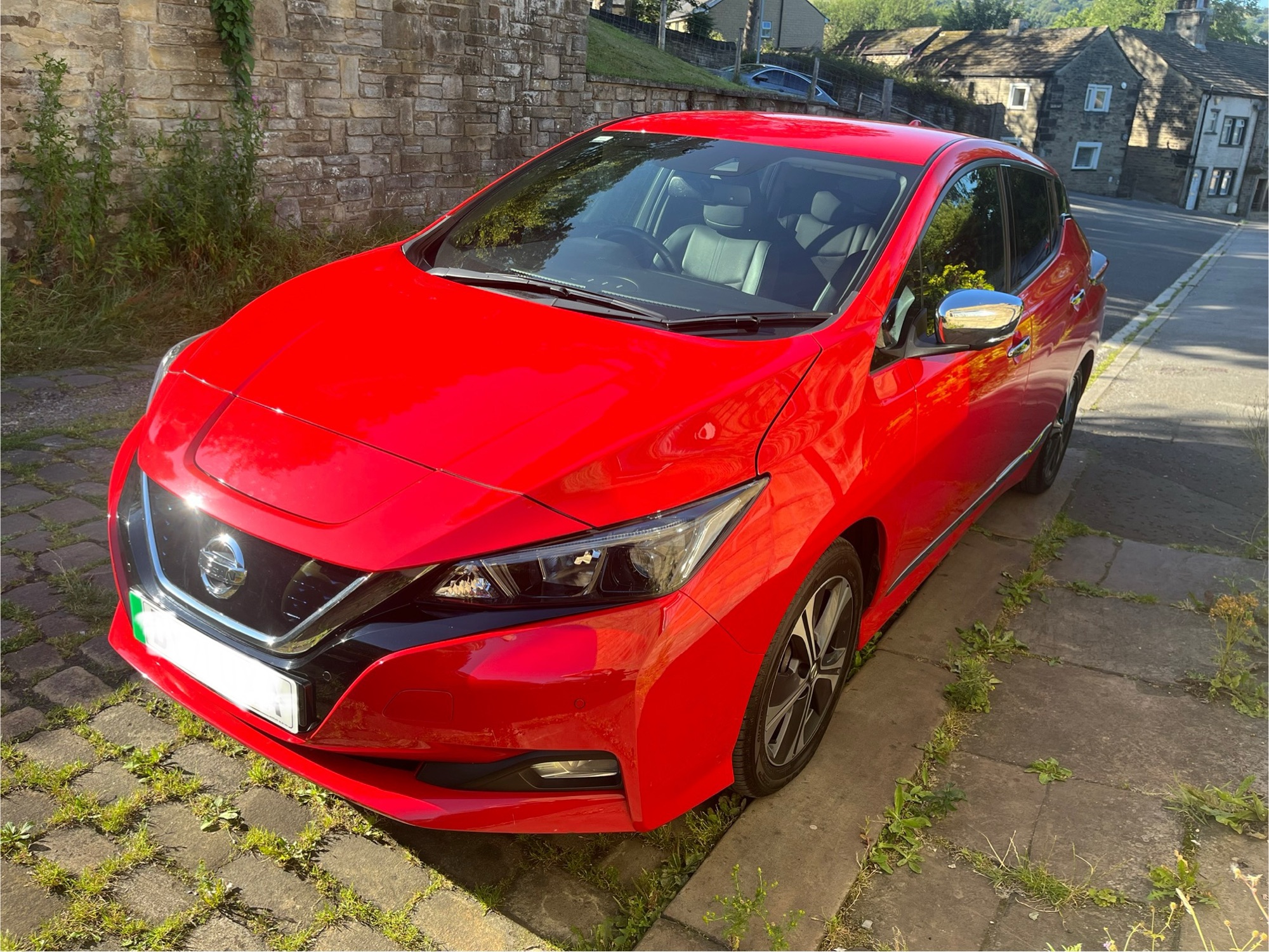
A photo of a red Nissan Leaf

Well, our journey towards an electric car is complete, as on Friday, we bought a new (to us) Nissan Leaf. It’s a second generation model, built in 2021, and replaces our diesel Peugeot 3008. It’s also our second Nissan, having previously owned a Nissan Note from 2015 to 2019.

Both of our previous cars have been around 6 years old when we’ve bought them, whereas this Nissan Leaf is less than four years old. It’s the ‘n-Connecta’ trim, so a mid-range model with a similar level of features to our Peugeot. Our local dealership also had a cheaper model with the ‘Accenta’ trim level, but we decided to pay more for the additional features that we were used to with the Peugeot.

Driving the Nissan Leaf

Like almost all electric cars, the Nissan Leaf just has one gear, so it drives like an automatic. I’ve only ever driven cars with a manual transmission before, and so this took a little getting used to. In particular, one quirk of the Nissan Leaf is the parking brake (i.e. handbrake) is foot operated, roughly where the clutch would be on a manual car.

The car has three driving modes: standard, eco, and e-pedal. Standard is best for motorway driving, giving you better acceleration at the cost of higher power usage. Eco is fine for day-to-day driving, but turning on e-pedal enables single pedal driving. That means that you press the accelerator pedal to go, and take your foot completely off the pedal to slow to a stop. As it the car brakes, the energy generated is then recovered to the battery – known as regenerative braking. As well as meaning you only need to keep your foot on one pedal most of the time, it’s also the most energy efficient way of driving.

Compared to the Peugeot, the steering is much lighter, and even in Eco mode, it’s got good acceleration. But most electric cars will accelerate faster than an equivalent car with an internal combustion engine.

In common with the Nissan Note, the legroom isn’t great when driving, but Christine finds it more comfortable to drive than the Peugeot.

Energy use

We’ve only had the car a couple of days, and have used around 40% of its charge across around two and a half hours of driving. This equates to about 40 miles. The Lithium-Ion batteries in most electric cars are less efficient in really hot weather, like what we’re currently experiencing in the UK as I write this. Therefore, you should keep your EV below 80% charged in hot weather (if you can). Indeed, when I picked the car up on Friday, the dealership had charged it to this level.

The maximum stated range of the Nissan Leaf is around 150 miles. That’s quite a bit less than our Peugeot, which could do around 400 miles on a full tank. And, of course, a key disadvantage of electric cars is that even a quick charge takes longer than fuelling a car with petrol or diesel. We’ll have to plan our longer journeys with recharge stops, although most motorway service stations include several quick charge points now. That being said, a quick charge should mostly recharge our Nissan Leaf’s battery in about 40 minutes.

Size

We deliberately decided to buy a smaller car than our previous Peugeot 3008. There are a couple of occasions each year, when the Peugeot’s extra capacity would be helpful, like holidays. But for 95% of the time, we were driving around a car that was bigger than we needed it to be. That’s a waste of fuel, and also makes it more difficult to park in narrow space.

Compared to the Peugeot 2008, the Nissan Leaf is around 5 cm (two inches) narrower, so parking should be a little easier. It’s also shorter in height, by around 10 cm (four inches). However, weirdly, it is actually longer – by around 30 cm (6 inches). It doesn’t look like it should be longer, but it is.

As such, the actual amount of space inside the Nissan Leaf is only slightly less than in the Peugeot. And on the few occasions that we may need extra space, we’ll considering hiring a roof box, which will also be easier to reach with the lower roof.

Charging

So far, I’ve only charged the car at home, using our dedicated Rolec EVO car charger. The previous owner of our car had set it to charge on an overnight schedule, so by default, it won’t start charging as soon as it’s plugged in. However, there is a dashboard button to over-ride this to start an immediate charge. Three lights appear on the dashboard, visible from outside the car, to show how charged the battery is.

On a ‘slow’ 7 KW home charger, expect a full charge to take around 6 hours. At present, I’ve knocked the current down to 16 Amps, so a full charge would probably take closer to 14 hours at this rate. This is where the equation to calculate power, voltage and current that you learned for GCSE Science comes in.

The Nissan Leaf supports two charging sockets. There’s a standard ‘Type 2’ socket, which only supports ‘slow’ chargers up to 7 KW, like our Rolex EVO. Then there’s a second ‘CHAdeMO’ socket, for use with supported fast chargers. Type 2 is essentially the European standard, and some public charge points only offer type 2 sockets, even for fast charging. Therefore, if we need to use a fast charger, we’ll need to find one that offers a CHAdeMO socket. Many do, but not all.

All the extra fancy gubbins

Being nine years newer than our previous car, our Nissan Leaf has lots of additional features:

  • Adaptive cruise control. I used cruise control extensively on the Peugeot and so pleased to have it on here. Combined with no need for gear changes, I can drive for longer without using any of the pedals with this on. ‘Adaptive’ means that it will slow down to match the speed of the car in front if needed, which I didn’t have before.
  • Built-in Apple CarPlay and Android Auto. Our Peugeot had the most basic entertainment system without a colour screen, so it’s nice to have these built-in. However, it only supports these over USB – if you want to use either CarPlay or Android Auto wirelessly, you need to buy a separate USB adaptor (sponsored link).
  • Heated seats and steering wheel. I suppose these will be useful in winter. Our nine-year-old seemed very keen on the idea of heated seats, until we pointed out that they still need to use a car seat until they’ve grown a bit more.
  • Remote start air conditioning and heating. Whilst the car is plugged in, you can use the Nissan app to remotely start the air conditioning or heating systems, so that your car is the right temperature before you set off. This also reduces the load on the battery.
  • Forward, rear and around view cameras. Our Nissan Note had no parking sensors whatsoever, whilst our Peugeot 3008 had standard rear parking sensors. The Nissan Leaf, meanwhile, offers a reversing camera, a forward camera, and ‘around view’ cameras. The around view gives you a top-down, ‘bird’s eye’ view of your car whilst reversing. This makes it much easier to park straight, especially if there are no white lines marking out the space. There’s also moving object detection.
  • Blind spot alerts. A small red light flashes on your wing mirror, along with an audible warning, if there’s something in your blind spot.

There’s a higher level of trim called ‘Tekna’ which adds a self-parking feature. That would have been lovely to have, but as we were buying used, we were limited to what was available at the dealership.

Compared to the Peugeot, the only things that I’m missing so far are:

  • The large storage box between the front seats (the Nissan Leaf has a smaller one)
  • The head up display, which showed the current speed and whether cruise control or the speed limiter was enabled.

The Nissan Connect app

The Nissan Connect mobile app allows you to control aspects of your car remotely, like checking its charge status or starting the heating or air conditioning. Alas, although I’ve downloaded the app, I can’t use it yet. The previous owner of my Nissan Leaf didn’t unlink the car from their account, and so I’m waiting for someone at Nissan to un-link it. Thankfully, the dealership gave me a copy of the DVLA ownership change confirmation and so hopefully that’ll be enough evidence.

Overall, we’re really happy with the Nissan Leaf. It’s easier to drive, easier to park, and should be much cheaper to run. I suppose it’s major test will be when we need to drive longer distances – like when we go on holiday next week.