
Full of your daily dose of fibre (broadband)

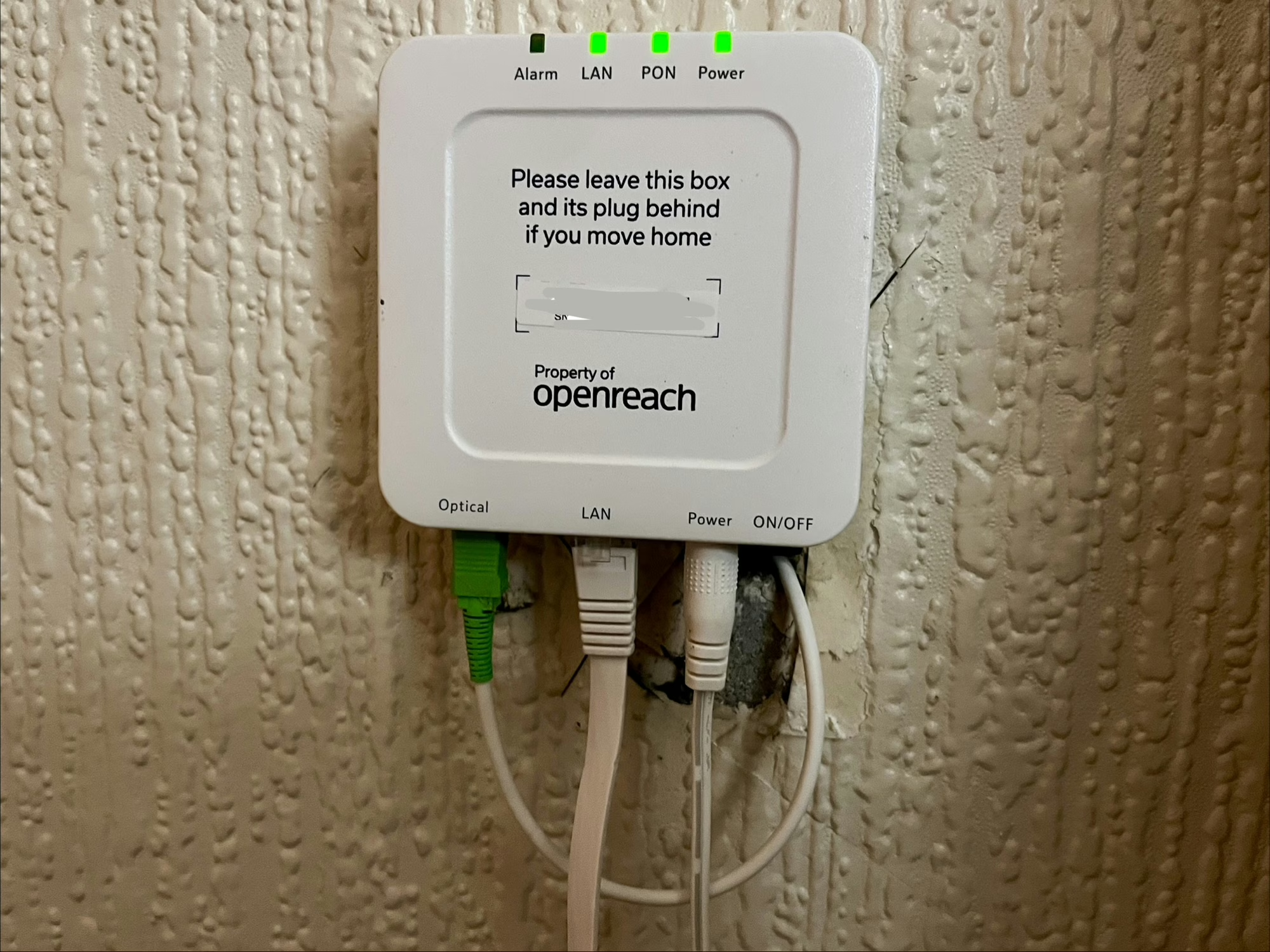
Our OpenReach fibre broadband Optical Network Terminal (or modem)

We’ve brought our home internet connection into the 21st Century and are now hooked up to Openreach’s full fibre broadband network. This is a full fibre-to-the-home (FTTH) connection, where the fibre optic cables run all the way into our house.

Previously, we had a fibre-to-the-cabinet (FTTC) connection, where there were fibre optic cables running to a street cabinet a short distance away. However, the final distance was the same copper cable installed when the house was first connected to the analogue phone network. And whilst we were able to get 80 Mbps speeds over that connection, that was really the limit of that technology. With fibre-to-the-home, we could get speeds of up to 1.6 Gbps, which is frankly ludicrous. When I started university in 2002, the entire university’s internet connection wasn’t even that fast. And yet, provided you’re willing to pay for it, you can get online at speeds that are over 30,000 times faster than dial-up.

Fibre broadband installation

The installation took around 3 hours. Although we pay for our internet service from a retail ISP, it’s Openreach (part of BT) who own the infrastructure and who will do the installation. For us, this involved replacing the copper cable from the nearby telegraph pole, removing the phone socket, and installing an Optical Network Terminal (ONT) – essentially a modem – inside the house. That’s what’s pictured above – you’ll note that it says to leave it behind if moving house. You then plug in your router to this using an Ethernet cable; your router will need to support PPPoE, which any router provided by your ISP will be capable of.

As part of the installation, we also changed to a new ISP, having previously been with Vodafone – more about that in a later blog post.

Once the installation is completed, you may have to wait up to an hour for your connection to start working again. I found I also had to restart the router, but once done, we were back in business.

No landline phone number

One decision we made this time is that we would no longer have a voice line. We had the option of paying extra for it, but the only people who call us on our landline nowadays tend to be scammers, so we decided it wasn’t worth it. Even though we’ve been living in this house for 10 years now, barely anyone has our landline number. If you do switch to fibre broadband and haven’t already been migrated to a digital voice line, then this will happen as part of the installation. That means that your phone is connected to your broadband router, rather than the wall socket. Indeed, the ONT doesn’t have a RJ-11 or BS 6312 socket to connect an analogue phone. It’s worth bearing in mind that your landline phone won’t work in a power cut if this happens.

This also means I can finally get rid of my supply of ADSL microfilters.

Speeds

We’ve actually gone for a modest 100 Mbps package. We were getting by quite well on 80 Mbps, and so for now we don’t really need the extra speed. As I write this, the installation was only completed a few hours ago, and so it’s too early to share what our new speeds are.

We may consider faster speeds in future, should our nine-year-old take up online gaming for example, and at least now the hardware is there to support it.

A rant about BT

Communication

Earlier this week I said that our flat move had gone well and in particular that our phone line would be activated on Thursday, i.e. yesterday. It hasn’t.

Christine got a voicemail message from BT (with whom we have our phone and broadband) asking her to ring them. After being on hold for quite a while, someone finally answered, but initially didn’t know why we ringing. Eventually, we were told that there was a problem with the phone line and that the activation would have to be put back. We could have a working phone by Friday (today), but with a different telephone number, and that the broadband wouldn’t be working until Thursday next week – a week later than we’d been told originally.

To make it worse, we’re not receiving a discount on the monthly bill for the time (nearly 2 weeks) when we’ve been unable to use our phone line or broadband, so we’re effectively paying for a service that we aren’t getting.

Initially I had praise for the way BT handled our move – our first call to them assured us that it would be a quick, simple process which would allow us to keep our number. A few days without phone and internet access would be inconvenient but understandable. But having no internet for the best part of two weeks seems excessive, especially as there’s no financial compensation. And really, does it take a whole week for someone to drive over to our local exchange and press a few buttons?

The problem isn’t necessarily with BT Retail, with whom we pay the contract with, but seemingly with BT Openreach, the subsidiary of BT which owns and operates the telephone lines and exchanges in the UK. To me, they seem to be a very expensive and inefficient outfit which only serves its own shareholders, i.e. the BT Group. Although it’s regulated by Ofcom, other parties have very little say in how it’s run.

In Britain, we don’t have that many alternatives to broadband via phone lines. Virgin Media’s cable network is good, but generally limited to large towns and cities – no good for my small town. Wireless broadband over 3G mobile networks is an option: prices are coming down to be comparable with fixed-line internet, there’s no need to install anything apart from plugging in a Mifi router and they can even be bought on pay-as-you-go contracts. But wireless suffers from latency issues, making it poor for use in online gaming, and again, it’s not always available. We’re also some years away from better and faster 4G networks.

Maybe it’s high time for the ownership of Openreach to change; its shares could be split amongst the other large ISPs in the UK (Sky, Talktalk, Orange, Virgin Media etc.) so that all have a say in how its run; it could be made a not-for-dividend company answerable to Ofcom like Network Rail for the railways; or completely re-nationalised. The last one is a long-shot, but any of those should improve accountability to its direct customers (the ISPs) and regular home users.

In the meantime, I’ve paid for an extra 2 GB of data to be added on to my mobile contract with 3 for this month. Thankfully it only costs £5, and 3 don’t charge extra for internet tethering or using your phone as a personal hotspot, so I’m only partially out of pocket. I’ll still be pointing this out to BT in a letter.

In an age when I can order a book at half 4 in the afternoon, and have it on my desk at work at half 9 the following morning, how does it take so long for phone lines to be connected? Is BT’s equipment really that old and archaic, or is their lack of accountability and need to shore up profit margins the driving force here?