Over the years, I’ve had five different types of railcard, to get discounted travel on Britain’s railways. I guess it’s one way of showing how my life has changed over the years.
Staff privileged travel card
Before he retired, my dad used to work for the railways, and this meant that he got free and discounted rail travel for himself and his dependents – i.e. myself and my mum. It was a pretty good deal: 20 days of free travel per year. Except each ‘day’ was actually 48 hours, so (for example) an outbound trip on a Saturday with a return on Sunday would only use one ‘slot’. These were recorded by writing the day on a credit-card sized piece of card, which was paired with another piece of card with my passport photo on.
Once the 20 free days were used up, or if I was saving them, I could get 2/3rd discount on any other tickets.
I was able to hold onto the card until my early 20s – basically, the point at which I was no longer a dependent of my parents and earning my own wage. I miss the days of being able to simply jump on a train to London from Bradford, to attend something like Open Tech, without having to pre-book tickets or worry about the cost. Oh, and did I mention that I was able to travel in first class too?
There were limitations. First class travel was for off-peak only, and there were no seat reservations. Indeed, I would have to give up my seat to a paying passenger if required. But considering how much long distance train fares cost even then, it gave me a lot of freedom in my early adult life. I have travelled first class since then – our return trip from St Andrews, and some London trips where we won upgrades using Seatfrog – but it’s not a frequent occurrence.
If you’ve read this and thought about a career in the railway industry, just be aware that staff travel privileges have almost certainly changed and may be nowhere near as generous as this nowadays.
Young Persons Railcard
Once I was self-sufficient – or at least, earning my own money through work – I had to get my own railcard. At the time, this was the ‘Young Persons Railcard’ but it’s now known as the 16-25 Railcard, which are the age ranges it’s open to. Like most railcards, it costs £30 per year, and gets you a 1/3rd off any train fares, with some exceptions. It does work at peak times, as long as the discounted ticket would cost £12 or more.
Despite the name, you can buy a 16-25 Railcard if you’re 26 or over, as long as you’re in full-time education. And, it doesn’t expire on your 26th birthday – indeed, you can buy one the day before your 26th birthday and it’ll still be valid for a year.
26-30 year-olds can now buy the 26-30 Railcard, but this wasn’t available when I was in that age range. It offers the same discount as the 16-25 Railcard, but it’s digital-only and not available as a physical card.
Two Together Railcard
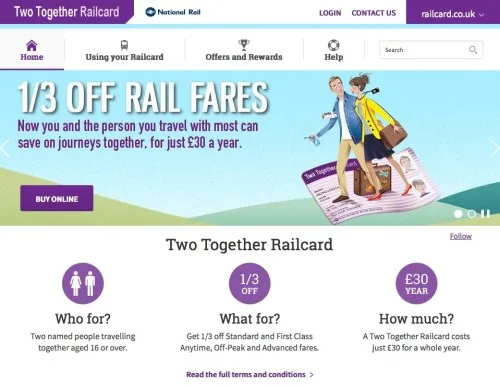
I wrote about this one in 2014, when it was still a trial in the West Midlands. Thankfully, the Two Together Railcard trial was deemed enough of a success for it to be rolled out nationally, and so Christine and I have had a few of these. As the name suggests, it allows two named people travelling together to get a 1/3rd off rail fares, but can only be used off-peak.
As it’s £30 to buy the card, I remember someone (probably Martin Lewis) doing a stunt at Euston station one day, finding two random people travelling to the same destination, and have them purchase a Two Together Railcard. Even though they were complete strangers, the £30 cost was less than the 1/3rd saving on the two tickets.
Friends and Family Railcard
Children under 5 travel free on the railways, but they need their own ticket from age five onwards. So, the next railcard we had was a Friends and Family Railcard. With this, you save 1/3rd on adult fares and 60% on child fares, and it’s valid for 1-4 adults and 1-4 children travelling together. Ours is a digital railcard and so it lives in the Trainline app, and can be used by myself and/or Christine when we’re travelling with our eight-year-old (and potentially up to three of their friends). For most of the UK, it can be used at any time, but it’s not valid for journeys within London and the South East during peak times.
Disabled Persons Railcard
I fully expected to carry on using a Friends and Family Railcard until our eight-year-old turned 16 and would need their own railcard (see above), but then I found out I was deaf. The definition of ‘disabled’ is quite broad for the Disabled Persons Railcard, and includes anyone who uses a hearing aid – even if your hearing loss isn’t severe or profound. I suppose this is because Railcards are a commercial paid-for product offered by the rail industry; I’m not (yet) eligible for a free bus pass, for example, which would be paid for by my local authority.
As with other railcards, you get a 1/3rd discount, but with no time restrictions. As such, I can use it on my commute to work, and in the year that I’ve had it, it has paid for itself several times over. You can’t (yet) use it to buy season tickets, so I have to purchase a return fare every day that I’m in the office. If another adult is travelling with you, they also get a 1/3rd discount too – they can be a friend, family member, carer, or anyone else really.
You do need to demonstrate that you’re eligible for the card; in my case, I had to email a PDF form to my local authority who stamped and returned it for me, to vouch for my deafness.
We’ll still keep our Friends and Family Railcard, as this ensures discounts for our eight-year-old too, but we’ve no longer any need for a Two Together Railcard. And, unless there’s some way that my hearing can be restored in future, I probably won’t need a Senior Railcard when I reach 60 either. Assuming that railcards are still around in 20 years time.