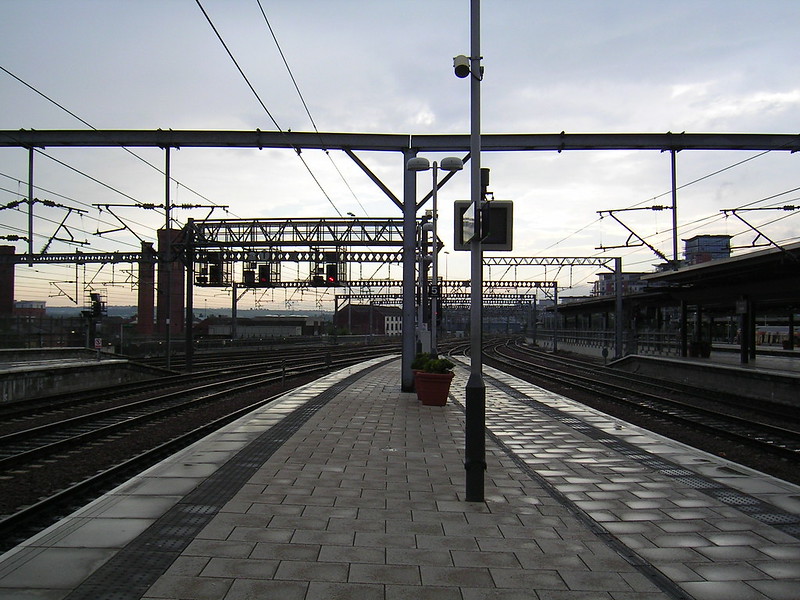
In my review of local National Trust properties, I somehow missed out Castlefield Viaduct in Manchester. It’s one of the newest, having only been open for a few years, and occupies an abandoned railway viaduct that crosses the Castlefield area of Manchester.
It’s a similar concept to the High Line in New York; take an abandoned elevated piece of railway infrastructure, plant things on it and open it to the public. The Castlefield Viaduct isn’t as long – around 330 metres, rather than 2.3 kilometres – and it’s not yet open as a through route. That will come in time, with work hopefully starting as soon as this year. When complete, it will open up a segregated walking route from the Manchester Central exhibition centre (still often known by its former name of G-Mex) towards Cornbrook.
History
The viaduct was built in 1892, by the same firm that built the Blackpool Tower. Trains would use the viaduct to access Manchester Central station (as was) and the Great Northern Warehouse. It was closed in 1969, after becoming surplus to requirements, and has stood empty ever since. A second viaduct runs parallel; this is still in use by Metrolink trams and forms the core section of the network.
Inside Castlefield Viaduct
About a third of the viaduct is open now, and it’s being managed by the National Trust. The first section has been largely left untouched – a hard path has been laid, but the original ballast has been left behind to show the wild plants that have grown there. The second section is a series of small gardens, each managed by a different local community group. These vary – one has various native Manchester trees whilst another incorporates a pond. Finally, there’s an indoor bit, where you can find out more about the extension plans. The back wall of this is glass, so you can see the rest of the viaduct beyond.
If it weren’t for the neighbouring Metrolink viaduct alongside, this would be a quiet and tranquil place, but trams pass about every two minutes. The viaduct also crosses a railway line that is frequently used, so there are regular rumbles as trains pass.
Accessibility
The viaduct is open between 10am and 5pm every day except Mondays and Tuesdays. Though it’s managed by the National Trust, entry is free even if you’re not a member. Donations are encouraged to support the next phase of work to open it as a through route.
As it was designed for trains, it’s all on one level, and you can get up to the viaduct by using the lift at the nearby Deansgate-Castlefield Metrolink stop. Accessible toilets are also provided.
I think most Brits are award of Llanfairpwllgwyngyllgogerychwyrndrobwllllantysiliogogogoch station’s claim of being the station with the longest name on the British Rail network. However, it’s more commonly known as ‘Llanfairpwll station’ and this is what appears on train destination boards. Indeed, its unnecessarily long name was a contrivance thought up by the railway company that originally built it in the 19th Century as a way of encouraging people to visit it by train. It roughly translates into English as ‘The church of St. Mary of the pool of the white hazels near to the fierce whirlpool and the church of St. Tysilio of the red cave’.
Llanfairpwll station today
Llanfairpwll station (as I will call it for the rest of this post) isn’t much of a station. It survived the Beeching cuts in the 1960s, but nowadays it gets a rather infrequent service. Going back towards the mainland, there was a wait of over an hour for the next train whilst we were there. And it’s a ‘request stop’ – if you want to get on a train, you need to make a clear signal to the driver of the train, as otherwise services will pass through at low speed. Similarly, if you’re on a train and want to get off there, you need to tell the guard that you want to do so, so that he/she/they can tell the driver to stop.
There are two short platforms – indeed, some trains that do stop there need to use selective door opening as they’re longer than the platforms – and a footbridge. Only platform one, for trains back towards the mainland, is accessible from the car park as there are no ramps or lifts on the footbridge. There is a gate leading from platform two, for trains towards Holyhead, but it would be a very long walk/wheel back into the town.
As well as being a request stop, Llanfairpwll station is unstaffed. The old station master’s house has been restored, but isn’t in use as far as I can tell. There aren’t even any facilities to buy a ticket here. I think Transport for Wales is missing a trick here, as tickets purchased from here could be collectors items. A machine could be installed that even just sells ceremonial platform tickets.
Tourist trap
The reality is that most people who go to Llanfairpwll station arrive and depart by road. The station retains a large car park, and the fact that this car park has bays for coaches tells you a lot. Next to the station is a large shop, run by James Pringle Weavers (in reality a subsidiary of Edinburgh Woollen Mill) which sells a range of merchandise with Llanfairpwllgwyngyllgogerychwyrndrobwllllantysiliogogogoch branded on it, amongst other things. I’m sure most people grab a couple of photos on the station platforms before going to the shop, and then moving on, without setting foot on a train. And yes, that’s exactly what we did too.
It’s nice that quirks like this still exist in places in the UK, but I feel like the station itself could be more front and centre. Perhaps, with longer platforms, better access, a more frequent service and some ticket machines, more people might actually visit Llanfairpwll station by rail.
The last time we went was, I believe, 2017, when our nine-year-old was only 2. I remember it not being a particularly enjoyable experience for them so we hadn’t been back since. But they seemed keen to go this year, and enjoyed it. The last time I blogged about it was in 2016, so maybe read that first.
Compared with previous years, I noted that most layouts now use Digital Command Control for operating the model trains. This allows modellers to control individual trains directly, rather than by selectively powering the tracks. It also allows the trains to have sound effects that react to their current operation (so sounds get faster as the train speeds up). Indeed, one layout seemed to be operated by tablet computers, rather than traditional handsets.
I also felt like there was more variety this year too. Certainly, there were more layouts set in modern times – it wasn’t steam engines all the way down. But it was also nice to see some non-British settings, including an interesting Chinese layout. China, apparently, was still using steam engines in revenue service as recently as the early 2000s, which seems hard to believe when you consider it’s now a world leader in high speed electric train services.
The other thing I noticed was the impact of 3D printing. Indeed, there was at least one 3D printing demonstration there. Being able to 3D print your own parts, model buildings and even model locomotives must be a big step forward.
The York Model Railway Show takes place every Easter at York Racecourse. Seeing as our nine-year-old enjoyed it this time, we may well be back next year.
Over the years, I’ve had five different types of railcard, to get discounted travel on Britain’s railways. I guess it’s one way of showing how my life has changed over the years.
Staff privileged travel card
Before he retired, my dad used to work for the railways, and this meant that he got free and discounted rail travel for himself and his dependents – i.e. myself and my mum. It was a pretty good deal: 20 days of free travel per year. Except each ‘day’ was actually 48 hours, so (for example) an outbound trip on a Saturday with a return on Sunday would only use one ‘slot’. These were recorded by writing the day on a credit-card sized piece of card, which was paired with another piece of card with my passport photo on.
Once the 20 free days were used up, or if I was saving them, I could get 2/3rd discount on any other tickets.
I was able to hold onto the card until my early 20s – basically, the point at which I was no longer a dependent of my parents and earning my own wage. I miss the days of being able to simply jump on a train to London from Bradford, to attend something like Open Tech, without having to pre-book tickets or worry about the cost. Oh, and did I mention that I was able to travel in first class too?
There were limitations. First class travel was for off-peak only, and there were no seat reservations. Indeed, I would have to give up my seat to a paying passenger if required. But considering how much long distance train fares cost even then, it gave me a lot of freedom in my early adult life. I have travelled first class since then – our return trip from St Andrews, and some London trips where we won upgrades using Seatfrog – but it’s not a frequent occurrence.
If you’ve read this and thought about a career in the railway industry, just be aware that staff travel privileges have almost certainly changed and may be nowhere near as generous as this nowadays.
Young Persons Railcard
Once I was self-sufficient – or at least, earning my own money through work – I had to get my own railcard. At the time, this was the ‘Young Persons Railcard’ but it’s now known as the 16-25 Railcard, which are the age ranges it’s open to. Like most railcards, it costs £30 per year, and gets you a 1/3rd off any train fares, with some exceptions. It does work at peak times, as long as the discounted ticket would cost £12 or more.
Despite the name, you can buy a 16-25 Railcard if you’re 26 or over, as long as you’re in full-time education. And, it doesn’t expire on your 26th birthday – indeed, you can buy one the day before your 26th birthday and it’ll still be valid for a year.
26-30 year-olds can now buy the 26-30 Railcard, but this wasn’t available when I was in that age range. It offers the same discount as the 16-25 Railcard, but it’s digital-only and not available as a physical card.
Two Together Railcard
I wrote about this one in 2014, when it was still a trial in the West Midlands. Thankfully, the Two Together Railcard trial was deemed enough of a success for it to be rolled out nationally, and so Christine and I have had a few of these. As the name suggests, it allows two named people travelling together to get a 1/3rd off rail fares, but can only be used off-peak.
As it’s £30 to buy the card, I remember someone (probably Martin Lewis) doing a stunt at Euston station one day, finding two random people travelling to the same destination, and have them purchase a Two Together Railcard. Even though they were complete strangers, the £30 cost was less than the 1/3rd saving on the two tickets.
Friends and Family Railcard
Children under 5 travel free on the railways, but they need their own ticket from age five onwards. So, the next railcard we had was a Friends and Family Railcard. With this, you save 1/3rd on adult fares and 60% on child fares, and it’s valid for 1-4 adults and 1-4 children travelling together. Ours is a digital railcard and so it lives in the Trainline app, and can be used by myself and/or Christine when we’re travelling with our eight-year-old (and potentially up to three of their friends). For most of the UK, it can be used at any time, but it’s not valid for journeys within London and the South East during peak times.
Disabled Persons Railcard
I fully expected to carry on using a Friends and Family Railcard until our eight-year-old turned 16 and would need their own railcard (see above), but then I found out I was deaf. The definition of ‘disabled’ is quite broad for the Disabled Persons Railcard, and includes anyone who uses a hearing aid – even if your hearing loss isn’t severe or profound. I suppose this is because Railcards are a commercial paid-for product offered by the rail industry; I’m not (yet) eligible for a free bus pass, for example, which would be paid for by my local authority.
As with other railcards, you get a 1/3rd discount, but with no time restrictions. As such, I can use it on my commute to work, and in the year that I’ve had it, it has paid for itself several times over. You can’t (yet) use it to buy season tickets, so I have to purchase a return fare every day that I’m in the office. If another adult is travelling with you, they also get a 1/3rd discount too – they can be a friend, family member, carer, or anyone else really.
You do need to demonstrate that you’re eligible for the card; in my case, I had to email a PDF form to my local authority who stamped and returned it for me, to vouch for my deafness.
We’ll still keep our Friends and Family Railcard, as this ensures discounts for our eight-year-old too, but we’ve no longer any need for a Two Together Railcard. And, unless there’s some way that my hearing can be restored in future, I probably won’t need a Senior Railcard when I reach 60 either. Assuming that railcards are still around in 20 years time.
Tomorrow, Christine, our three-year-old and I are off to London (actually for the second time this week, but that’s another story). We’re going by train, and, thanks to Seatfrog, we’ll be travelling in first class, at a relatively low additional cost, having already saved some money with railcards and advance booking.
Seat auction
In the UK, Seatfrog is available on LNER services on the East Coast Main Line. You buy your standard class tickets online, as normal, and then put your booking reference into Seatfrog. The day before departure, Seatfrog holds an auction; enter your bid, and if you win, your updated tickets appear in the app.
We bid £10 per ticket for our journey, and this won (the minimum bid was £5). However, there may be a higher reserve on some services – for our return, the reserve was £9. Upgrading to first class gets you a wider, reclining seat, the majority of which are leather upholstered on LNER services. Plus, free Wi-Fi, regular offers of tea and coffee, and, for journeys over an hour, a complementary meal. This is easily worth £10 a head and means we won’t need to buy extra food for our journey.
Of course, there’s no guarantee that you’ll win, and there’s no point bidding too high as you can buy an upgrade outright for £35 per ticket. At least if you’re outbid, no money is taken.
I suppose it’s a good way of filling vacant first class seats. I could also see this being useful for people travelling on business, who can only claim standard class travel on expenses. Seatfrog would allow you to trade up to first class from your own pocket if you’re happy to pay a bit extra yourself.
For now, Seatfrog is only available on LNER services, however, it’s run by an independent company and so it’s possible that other travel companies could adopt it – potentially airlines as well as train operators,
So, tomorrow we’ll be smugly sat in first class, knowing that we paid well under the odds for our tickets,
Today is April 1st – and whilst that’s normally an excuse for news outlets to publish satirical articles to wind up their audiences, today it marks a new chapter for train services in the North of England. The two key rail franchises – Northern, and TransPennine Express – both change hands today, with promises of major improvements to trains, track and stations.
‘No growth’
The previous Northern Rail franchise started in 2004, and was awarded to a consortium of Serco (to whom all your base are belong to) and Abellio, a subsidiary of Dutch state railways. Controversially, this was a ‘no growth’ franchise, awarded on the basis that there would be no expected growth in passenger numbers over the original seven year period of the franchise. As such, the franchisee was not required to make any investments in new or additional trains, or run extra services.
As it happened, passenger numbers did grow, year on year, even during the 2008-2009 financial crash. In ten years, passenger numbers at Northern Rail stations (including my home station of Sowerby Bridge) have near doubled, and services have become increasingly overcrowded. To Northern Rail’s credit, whilst no brand new trains have been introduced, some additional trains have been brought in from elsewhere in the country where they had become surplus to requirement. Northern Rail has also held onto older trains, rather than scrapping them, to maintain capacity. Consequently, train services have more carriages, more seats, and in most cases run more frequently now than in 2004.
So whilst Northern Rail has managed to go above and beyond its minimum requirements, I think it’s fair to say that it has merely been ‘coping’ with increased demand, rather than making an effort to generate new demand. And it’s not done much for its reputation for running old, increasingly-tired looking trains – many of which, bar a change in seat covers, still sport their original, 30-year-old interiors.
In particular, Northern Rail has been well-known for having a large number of Pacer trains. These were introduced as a mostly temporary measure in the 1980s, by taking Leyland bus components and bolting them onto single-axled freight wagons. 30 years on, and they still make up around a third of Northern’s fleet, despite having shorter carriages and poor ride quality.
TransPennine Express
Earlier in 2004, another of the north’s rail franchises was awarded to a consortium of First Group (based in Scotland), and Keolis, a French transport company partly-owned by SNCF (French state railways). Keolis was a minority partner in the joint venture and so the franchise was known as ‘First TransPennine Express‘ (FTPE), even though First Group operated its other franchises on its own (First’s Hull Trains is a joint venture, but it’s an open access service, not a franchised operator). Unlike Northern Rail, this was a growth franchise, and saw the introduction of 51 brand new Class 185 diesel trains, built by Siemens in Germany. Some nearly-new Class 170 trains were also brought in, and so within a few years the entire FTPE fleet was made up of modern trains.
Whilst some growth was accounted for, actual growth turned out to be much higher. FTPE was controversially denied permission to add a fourth carriage to its new Class 185 trains, nor was it able to procure any additional trains, and so overcrowding became a problem. This was eased somewhat recently, when 10 new Class 350 electric trains were introduced for its services on the West Coast Main Line between Manchester and Scotland following electrification work west of Manchester.
Northern administration
Whilst both franchises were extended beyond their original periods, ultimately the time would come to hold new open franchise competitions to choose new operators. Most franchises in the UK are awarded by the government’s Department for Transport (DfT), with the exception of Scotrail and the Caledonian Sleeper (awarded by the Scottish Government), Merseyrail (awarded by Merseytravel) and London Overground (awarded by Transport for London). The various metropolitan, district, city and county councils of the north clubbed together to form a new organisation called Rail North, and successful lobbying has meant that the new replacement franchises have been awarded jointly by Rail North and a new DfT office in Leeds. This means that control of the new franchises happens in the north of England, by staff who actually use the services, and not by ministers and civil servants based in London. Crucially, both new franchises will anticipate growth in passenger numbers, and reflect changes in passengers’ expectations.
Arriva Rail North
The Northern franchise was won by Arriva – originally a British bus company that now operates several other rail franchises (CrossCountry, Arriva Trains Wales, Chiltern Railways, London Overground and the Grand Central open access service) and was taken over by Deutsche Bahn (German state railways) a few years ago. Arriva operated one of the predecessor franchises to Northern Rail – Arriva Trains Northern – but this new franchise will not resurrect the old brand. Whilst the franchise will still be called ‘Northern’, there’s a new logo and I expect that trains will get new liveries in due course.
As part of the new franchise, there’s a commitment to withdraw the old Pacer trains by the end of 2019. They can’t be disposed of straight-away, as it will take time for replacement trains to be brought into service, but December 2019 is a practical deadline as well as a tactical one. From the 1st January 2020, all revenue-earning passenger trains in the UK must meet accessibility regulations; the Pacers don’t, and the cost of modifying them is likely to be prohibitive. Whilst withdrawing them from the Northern network is a franchise commitment, if some vehicles can be modified, they could end up elsewhere in the country.
To compensate for the loss of Pacers, some additional trains will be transferred from the TransPennine Express, Great Western and Scotrail franchises, but there will also be over 90 brand-new trains introduced. A contract for these was given to Spanish manufacturer CAF, and will see new 2 or 3 carriage Class 195 diesel trains, and new 3 or4 carriage Class 331 electric trains being introduced from 2018 onwards. CAF built Northern’s existing Class 333 trains in a joint venture with Siemens, as well as the Class 332 trains used on the Heathrow Express services. The trains will be built in Spain, rather than Britain, but Britain’s two trainbuilders (Bombardier in Derby and Hitachi in County Durham) have nearly-full order books and so there’s little spare capacity for them to be built here, even if this might help Britain’s beleaguered steel industry.
Arriva Northern’s remaining trains will be deep-cleaned and refurbished, with free wifi available on all trains once the equipment has been installed. Currently, just a handful of Northern’s trains offer wifi, and these all operate on electric commuter services in the Leeds area. Some services will be branded ‘Northern Connect’ – these will be the ‘intercity’ services and will offer seat reservations and the newest trains – something I hoped for in a blog post back in 2014.
Same old brand new you
The TransPennine Express (TPE) franchise was won by First Group outright this time, rather than as a joint venture. I expected there to be very little change from day one, but there’s a new logo and livery being launched today. The first two trains have already had the new look applied to them overnight. Interestingly, despite the franchise being awarded to First outright, the ‘First’ branding has been dropped, although this is in line with Great Western Railway (another First franchise) and Hull Trains, where the overt First branding has also disappeared.
Whilst FTPE invested in new trains around a decade ago, this new franchise will also see new trains, in the form of 19 Hitachi AT300 bi-mode trains (which will probably be Class 802 when delivered). Sporting five carriages, these will be much longer than TPE’s existing trains, and have a faster top speed of 125 mph (200 km/h). As bi-mode trains, they will use electric overhead wires where available, but will be able to fall back to diesel engines on lines which have yet to be electrified. These should arrive by the end of 2019, and will be built at Hitachi’s Newton Aycliffe plant in County Durham.
Whilst TPE have only ordered 19 new trains for now, they will have the ability to order extra trains should the need arise, as long as there is a business case for them. This should avoid the issue with the previous franchise, where FTPE were not able to order extra carriages despite issues with overcrowding.
New stations and infrastructure
Infrastructure like stations, track and signalling aren’t in the remit of train operating companies like First and Arriva, but changes to these will have an effect on the new franchises. In West Yorkshire, two new stations are under construction – one at Kirkstall Forge near Leeds, due to open imminently, and another at Low Moor, south of Bradford and just off the M606 motorway which will open this summer. Further new stations are likely, including one at Elland, one of the largest towns in the region without its own railway station.
Over in Manchester, work has started on the Ordsall Chord, a new link that will allow trains heading west from Manchester Victoria and Salford Central stations to loop back towards Deansgate, Manchester Oxford Road and Manchester Piccadilly. This will allow services from the Calder Valley to continue to Manchester Airport for the first time, and link Manchester’s two major railway stations. The Calder Valley line will also receive capacity improvements, allowing trains to run more frequently, and the TransPennine route via Huddersfield and Stalybridge to Leeds is due to be upgraded and electrified over the next 8-10 years.
High Speed 2 and High Speed 3 are also due to come into play over the next few years, although plans are not as progressed as the other upgrades.
No Subsidy
Some explanation as to why the previous franchises had lower levels of investment (or none at all) are to do with taxpayer subsidies. Northern Rail was one of the most heavily subsidised franchises in Britain, and FTPE was also in receipt of a small level of subsidy. The subsidies were required as income from fares (i.e. passengers buying tickets) would not be sufficient to cover the costs of running the trains. Whilst there’s an argument for withdrawing services that are not commercially viable, there’s also an argument that some services are important even if they lose money, and in any case, withdrawing train services has been very controversial ever since the 1960s.
Government policy is to try to shift more of the burden of train running costs to passengers, rather than taxpayers, and the aim with the two new franchises is that, by the time they both end, neither franchise will need a subsidy. In TPE’s case, the opposite is expected to happen, and so First will have to pay a premium to the government, rather than receive a subsidy. With Arriva, it should roughly break even, or receive a drastically reduced subsidy.
This is where Rail North’s lobbying has been effective. Their aim is to break the subsidy cycle – train services have been subsidised because they can’t attract enough passengers to be commercially viable, but there hasn’t been enough investment to make them commercially viable. I hope they’re right, and that investment in services will unlock latent demand. That way, both passengers and taxpayers will benefit, especially if there are no major rises in train fares.
Driver-only operation
An appropriately-timed press release by trade unions suggests that there are plans for some of Arriva’s trains to lose their guard. Currently, guards are responsible for opening and closing train doors, ensuring that the train is safe to depart stations, and for checking and selling tickets. It’s possible that, to cut costs, some services will move to ‘Driver-only operation’, where the driver takes over the safety and door operations. This will require trains and stations to be modified, with door controls installed in drivers’ cabs and CCTV cameras on trains and stations so that the driver can see the doors. But it means that guards can be replaced by less-qualified (and therefore cheaper) revenue protection officers on trains, who are freed up to just sell and check tickets. Some trains may not even have anyone else on board other than the driver.
Driver-only operation is widespread on commuter services in the south-east, and, as well as being cheaper to run, it’s arguably better for train reliability. I’ve experienced trains being stuck at stations with the doors shut for some time (up to 30 seconds) because the guard has been busy selling a ticket when the train has arrived; if that happens at multiple stations, then it can add up. But, trade unions are right to lobby to protect their members jobs (and I speak as a trade union member myself), and there are benefits to having a member of staff available to help with passenger concerns. It’s an issue that I feel neutral about.
Day 1
So, today was day 1 of the new franchises. Whilst TPE are rolling out their new brand very quickly, I gather that Northern are taking a steadier approach. It’ll be a couple of years before the major changes in Northern’s train fleet take effect, so in the meantime it’s likely that the trains will retain their current liveries (but with the new operator logo). The old ‘Northern Rail’ logos have already been removed from trains and stations, but staff will still wear their existing uniforms for the time being.
Travelling to work this morning, there was very little to show for the change in franchise, apart from the guard having a name badge in the new brand, and drawing attention to the new Low Moor station as we passed it at speed. As old trains get refurbished, and new trains arrive, I expect that the rebranding exercise will ramp up.
After being neglected for so long, it’s good that Northern rail users will finally see some decent, large scale investment in their railways. My only worry is that these improvements may not be enough – whilst the new trains are welcome, by the end of this franchise, Arriva Northern will have only made a net gain of around 16 trains, unless more are sourced from elsewhere. We shall see what happens.
It’s an event I’ve been going to from a very young age – both my Dad and I have an interest in railway modelling and there’s a large train set at my parents’ house in York. Although it’s gathering dust and hasn’t been used much over the last 10-15 years – I imagine that Dad planned to work on it in retirement but he’s been too busy doing other things.
So, the model railway show. It takes place over the Easter weekend and has run every year (I think) since the 1960s. Whilst I used to go every year, this was my first visit since 2013. There are a mixture of layouts, built by individuals and societies, as well as many trade stands.
The layouts vary greatly in size. Some are huge, requiring multiple people to operate, whereas others will easily fit in the back of someone’s car. The smallest was in a flight case, which used the diminutive ‘T gauge‘. Whilst many layouts used ‘OO’ gauge, which is the most widely available to those with trainsets at home, there were many others with bigger and smaller trains.
As you can imagine, model railways attract a predominantly older, male audience, but it’s popular with kids as well – footstools are available for hire for those otherwise unable to see the layouts. We didn’t take our baby this time as they’re a bit young, and it can be rather crowded – not ideal conditions for a pram. Maybe next year, when they can take an interest in what’s going on.
York is one of the larger exhibitions, both in terms of the number of layouts on show and also in length, as it runs over three days. Opening yesterday, it runs until tomorrow.
Tomorrow we’re off to the Trafford Centre to buy a washing machine. You may wonder why we’re travelling all the way to the far side of Manchester for something that we could buy more easily locally. As it happens, we have loads of John Lewis gift vouchers left over from our wedding, plus some more from completing online surveys from Valued Opinions and Ipsos i-Say, so in all it’ll work out cheaper. And we’ll be making a day of it.
Because we don’t drive, we’ll be taking public transport – a train to Manchester, and then a bus, as the trams haven’t made it that far yet. In all, this would normally cost around £30 – £21 for return train tickets and around £8-10 for the bus tickets. But, by combining discounts, we got the lot for £12. Here’s how:
Two Together Railcard
Because Christine and I travel together by train a lot, we have a Two Together railcard, which means we get a third off almost all train fares provided we buy the tickets at the same time and travel together. It costs £30 a year, although there are plenty of discount codes bringing it down to £27, and you can exchange Tesco Clubcard vouchers for one as well.
It’s one of the newer railcards, having been launched last year, and we’re on our second card. We got our money’s worth on one journey alone, when we went to Nottingham, and use it regularly.
Advance purchase tickets
Northern Rail, who operate the trains between us and Manchester, have only recently introduced discounted advanced purchase tickets on some routes. If bought before 6pm the previous day, you can get a significant discount on the cost of tickets versus buying them on the day. By buying advanced purchase tickets with our railcard, we got the price of our train travel down from £21 to £8 – not bad.
Plusbus
Plusbus is a not particularly well-known add-on for train tickets, that allows you to purchase discounted bus travel at your destination. You buy it as part as of the same transaction as your train tickets, and it essentially gives you unlimited bus travel at your destination for one day, on participating routes and operators.
I’ll be honest – this weekend will be the first time we’ll be using it, and I’m still not 100% convinced that it will be accepted on the buses that run between Manchester city centre and the Trafford Centre. But, it only cost an additional £2 per ticket, thanks to a special offer that is only running this month, so if it doesn’t then we’re only out of pocket by £4.
Additional discounts
We bought the tickets online at First Transpennine Express, even though we won’t actually be travelling with them at all. I chose them for three reasons:
They offer Nectar points at a rate of 2 points for every pound spent on train travel, so I earned 16 points for the £8 spent on the train tickets. I can then use these points for money off cinema tickets or shopping, for example.
They offer cashback via Quidco (referral link) – it’s only 1%, but that effectively saves a further 12p off the cost.
There are no additional booking, card or postage fees – you just pay for travel.
Disadvantages
The only downside to choosing an advanced purchase ticket is that it restricts us to travelling on certain trains. If we miss these trains, or want to vary our travel plans, then the tickets will no longer be valid and we’d need to buy new ones, probably at full price. Buying on the day costs more, but at least the tickets are fully flexible.
Normally one advantage of buying an advanced purchase ticket is that you also get a confirmed seat reservation as well. Northern Rail don’t offer seat reservations (despite running some long distance services) so the only real advantage of buying tickets in advance is the lower cost. Other operators do include seat reservations, so you could have two passengers: one who paid, say, £12 and got a guaranteed seat, and another who paid £80 on the day and who may have to stand.
And finally, before you ask – we’ll be having the washing machine delivered. I don’t think we’d get it home on public transport.
I’m a northerner, and I travel by train a lot. At least 95% of my journeys are with Northern Rail, a franchise run jointly by Serco (to whom all your base are belong to) and Abellio, which is owned by the Dutch government. The franchise was let in 2004 on a ‘no growth’ basis – the assumption being that passenger levels wouldn’t grow significantly during the franchise period, and so there was no real requirement for any extra trains or to increase service levels.
In reality there has been a huge growth in passenger levels in the north over the past ten years. Thankfully Northern has invested in some extra trains, although these are mostly old trains that other operators no longer need, and some services have been improved. But there haven’t been any brand new trains ordered, and whilst most have been ‘refreshed’ with a coat of paint, new flooring and seat covers, internally most of Northern’s fleet retains their original fixtures.
Around the time that the rail franchises in the north were re-jigged in 2004, the intercity services that Northern’s predecessor (Arriva Trains Northern) operated were mostly split off into a different franchise – First Transpennine Express. These services received new trains. Northern was left with mainly commuter and rural services, and the internal layout of its trains reflect this. But it still operates a few intercity services that I’ll get onto.
What makes a service ‘intercity’ anyway?
Simply put it’s a train service that connects two or more cities together, although I’d also state that the end-to-end journey time is over an hour, and it only calls at larger stations. Unlike short-hop commuter trains, where fitting on as many passengers as possible is the main goal, with intercity services you want to provide a more comfortable experience for longer journeys. To me, this means providing:
Refreshments, such as a trolley service or buffet car
First class accommodation
Wifi (free or paid-for)
Plug sockets
Seat reservations
Almost none of Northern’s services meet the above criteria, and yet some of its trains probably should. Here’s my list of “intercity” services that Northern runs.
Leeds – Nottingham
This is fresh in my mind as we took this train on Saturday. It’s actually a relatively new service that was first introduced in 2008. The full journey takes almost exactly two hours, taking in the cities of Wakefield and Sheffield, and the large town of Barnsley on the way. It’s actually not the quickest way between the two cities, as we found out coming back – taking an East Midlands Trains service to Sheffield and then a Crosscountry service to Leeds took marginally less time, even allowing for 20 minutes in Sheffield. This is probably because the direct train goes via Wakefield Kirkgate and the Erewash Valley Line, so whilst it is an express service that skips many intermediate stations, it still takes a long time.
Our mid-morning Saturday departure was on a two-carriage class 158 train, which had ample seats for the number of people using it. And whilst the 158s are the newest of Northern’s diesel fleet, they are showing their age somewhat. Case in point – I had to use the toilet and it took several attempts to get the door to close because we were going around a bend and its motor wasn’t powerful enough to cope.
Leeds – Carlisle
The service from Leeds to Carlisle was under threat of closure until around 25 years ago, when the line was reprieved. Nowadays there’s a train roughly every two hours, and each one takes a little under three hours to complete the journey. You could argue that this doesn’t qualify as being “intercity”; Carlisle isn’t a very big city, and it doesn’t pass through any other cities on the way. But it’s also the only one of the services that I’m writing about today which meets one of the five criteria I mentioned earlier.
Thanks to the Settle-Carlisle Partnership there is a trolley service on the train, between those two stations. It’s the only Northern-operated service where this happens though, because it’s provided by the Settle-Carlisle Development Company and not Northern themselves. Again, for the most part Northern operate class 158 trains on this service but not always.
York-Blackpool North
I used to catch this service from Bradford quite regularly when I lived there and Christine lived in Blackpool; later when we moved to Sowerby Bridge I also used to commute in on it on a morning, until the timetable change in May this year. It connects the cities of York, Leeds, Bradford, and Preston, which was granted city status in 2000, but also calls at Burnley, Blackburn, Halifax and Blackpool which are large towns. Travelling the full length of this service takes almost three hours.
Northern usually puts its class 158s on this service but I’ve also endured its older class 150 trains, which have narrower seats, no air-conditioning and only one toilet, on this route. Whilst the former is reasonably acceptable, the latter does not make for a good journey experience, especially for such a long period of time. I suppose it could be worse – it could be a Pacer, a train made of 1980s bus parts bolted onto a two-axeled freight wagon, which are sadly still common on many of Northern’s services.
Spending three hours on a train with no opportunity to buy refreshments on board, no wifi or sockets to plug in a laptop to do work on, and no guarantee of a seat, does not make for a good travel experience. And yet, passengers put up with this every day.
Next year the government will announce a new franchisee for the Northern franchise. Shortlisted are Abellio (on their own this time), Arriva and Govia, and the winner will take over in early 2016. I really hope that whoever wins puts some effort into improving the rail service in the north – but especially these services. Offering a decent intercity-standard service between the north’s major cities will hopefully encourage more people to travel, and allow them to make the best use of their time on board.
On Saturday myself and a group of friends went to do the Transpennine Real Ale Trail. Many of the stations on the railway line between Leeds and Manchester via Huddersfield have pubs serving real ale either on the station or nearby, and eight of these form part of an official trail.
Though it’s been done for years, the trail grew in popularity following the broadcast of Oz and James Drink to Britain, a BBC TV show with Oz Clarke and Top Gear’s James May which was broadcast in 2009. The number of people attempting the real ale trail increased significantly, although sadly many weren’t in it for the real ale. Go back a to any Saturday afternoon earlier this year and you would expect to see large groups of people – mostly men – frequently in fancy dress, drinking lager and engaging in anti-social behaviour.
A particular problem point was the small and usually quiet village of Marsden. Though Marsden has a pub right by the railway station, conveniently called The Railway, many prefer to go into the village to the Riverhead Brewery Tap and others. This BBC News video gives you an idea of how bad it was last year.
Since then, many of the pubs on the route have stopped serving lager and spirits on Saturdays, and will refuse service to those in fancy dress. In other words, patrons have to drink real ale or soft drinks. And, based on our experiences, it seems to be working – whilst a Saturday in late October is bound to be less busy than in mid-summer, the route was much quieter and the people there were better behaved. At Slaithwaite (pronounced ‘slowwwit’) station, Northern Rail had provided a couple of marshals to manage the numbers of people on the small platforms. And at Huddersfield there were a number of British Transport Police officers around, but that may be more to do with the local football team playing local rivals Leeds United at home that day.
On our visit, we went to six of the eight ‘main’ pubs on the trail. Starting at Stalybridge, we then called at Greenfield, Marsden and Slaithwaite, before then skipping straight to Dewsbury and then back to Mirfield. By this point it was getting late, so we didn’t go to Huddersfield or Batley this time around.
I’ve done Huddersfield many times before though, and the station actually plays host to two pubs. They’re both on platform 1 – The Kings Head and The Head of Steam – although the introduction of ticket barriers means that you need to exist the station to access them now. The Head of Steam is my favourite and has the largest overall drinks selection (including a good cider menu) but real ale drinkers tend to prefer The Kings Head as its ale selection is stronger.
It’s a good way to spend an afternoon with friends and I’m pleased that the solution to the problems with rowdy drinkers seems to have worked. Other ale trails are available around the country and this month’s CAMRA magazine has a special feature on pubs at stations, which seem to be enjoying something of a renaissance of late. CAMRA also published a book last year; it’s out of stock on Amazon unfortunately but is available in CAMRA’s own shop, and members get £2 off.