
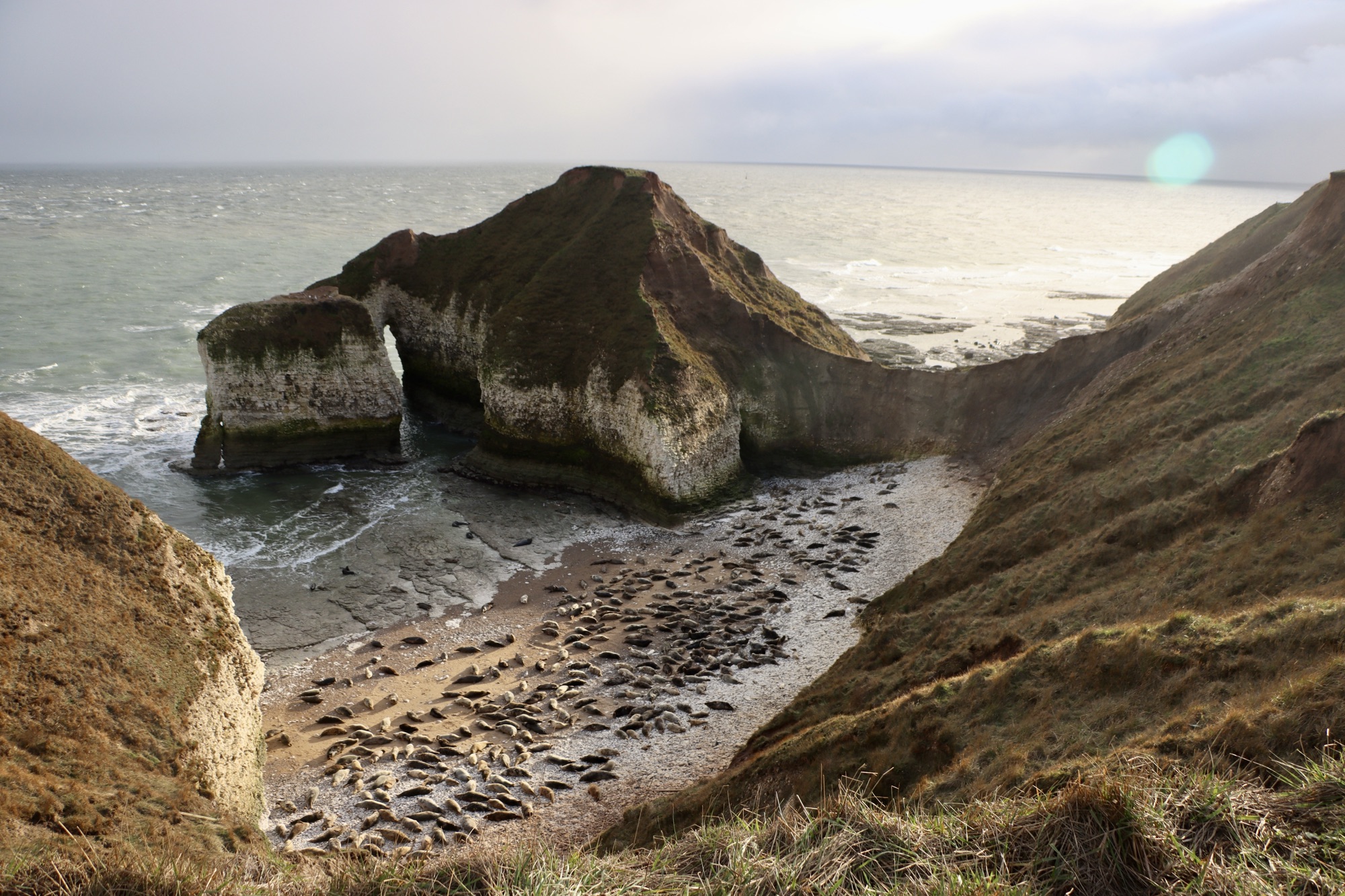
Visiting the seals at Flamborough Head

A photo of Flamborough Head, showing a cove with a beach that is full of resting seals

Every autumn, for the past few years, a large group of Atlantic grey seals make a temporary home on one of the beaches at Flamborough Head for breeding. And over the Christmas break, we popped along to see them.

The seals haven’t always gravitated to Flamborough. It’s only been in the past few years that they have appeared there. I used to go to Flamborough quite a bit when I was younger, as my paternal grandparents lived nearby and my Dad was brought up in nearby Bridlington. It may be a sign of a stronger seal population.

The best time to visit is really in October and November. This is the core breeding season, and so you are more likely to see seal cubs at this time. By the time we visited in late December, most of the cubs were mostly or fully grown. Still, there were probably 50-60 seals there – more than we saw on the Farne Islands in 2024.

Access down to the cove, where most of the seals congregate, is restricted. The population is being monitored by the Yorkshire Wildlife Trust, and we saw signage from the University of Hull’s marine biology unit who are involved in research there. However, you get a good view of them from a safe distance from the headlands.

A young seal sleeping on the beach at Flamborough Head

Accessibility

We parked at the Flamborough Head and Lighthouse car park, which is the nearest car park. It’s pay and display, or you can pay on the MiPermit app. Electric vehicle charging isn’t currently available in the car park – we used a rapid charger at the Co-op supermarket in the nearby village of Sewerby.

From the car park, there are unpaved footpaths down to the cliff edge. These are uneven and a little steep in places, and probably not suitable for wheelchairs. Also be aware that the cliff edge doesn’t have any railings or barriers, so bear this in mind if you have young children or dogs with you.

Bridlington is the nearest town with a railway station; from there, you’ll need to catch the number 14 ‘Coaster’ service which runs hourly and can drop you in Flamborough village. From there, it’s about a 10 minute walk.

Other things to see

Flamborough Head in itself is interesting from a geology perspective, as it’s a relatively hard chunk of chalk in an area where most of the nearby coastline is eroding away. You can tell that I studied this for A-level Geography, can’t you?

There is a café at the car park – we stopped there for lunch on our visit. I bet they’re glad that the seals are providing extra custom in the winter.

Flamborough actually has two lighthouses. The one that is currently in use dates from the early 19th century, although it’s now completely automated. It used to be open for tours, but it’s not open at present. The second is slightly further inland and known as the Chalk Tower – it’s the oldest surviving complete lighthouse in England and is now grade II* listed.

Nearby is Sewerby Hall, which is a manor house, gardens, and small zoo, and to the north is RSPB Bempton Cliffs. Plus, there are all the attractions in the seaside town of Bridlington, further along the coast.

Our 2024 holiday: The Farne Islands

A photo of the Farne Islands.

This is the fourth blog post about what we did on our 2024 holiday to Northumberland. Previously, I wrote about The Alnwick Garden, and today is about our visit to The Farne Islands.

I’ve mentioned the Farne Islands in my previous posts about Seahouses and Bamburgh Castle. They’re a collection of 15-20 islands just off the Northumberland coast – the number of visible islands depends on the tides. People have lived on the islands in the past, but nowadays there’s no year-round human residents. They’re now looked after by the National Trust.

Whilst humans may no longer live there, plenty of birds and seals make it their home instead, and so there are plenty of boat tours from Seahouses to go and see them. We went on a two hour tour with Billy Shiels; ours was a ‘non-landing’ tour that visited several of the islands but didn’t dock at any of them. Other tours do land at one or two of the islands; if you’re a National Trust member then you can land for free but non-members have to pay a landing charge.

A photo of an Atlantic Puffin sat on a rock on the Farne Islands

Bird life on the Farne Islands

Probably the biggest draw for people visiting the Farne Islands is the opportunity to see Atlantic Puffins. They’re not there all year round – indeed, when we visited a couple of weeks ago, they were grouping up to get ready to fly out to sea. They’ll stay out at sea until the spring, so we were lucky to see them. Indeed, we probably saw thousands of them – swimming, flying, eating or just lounging around on the rocks. Puffins are one of my favourite birds – I’ve seen a few at a distance at RSPB Bempton Cliffs in East Yorkshire, but I had never been this close to them before. I managed to get lots of photos of them, and it was amazing to see them flying overhead.

Besides the puffins, we saw shags, razorbills, cormorants, oyster catchers, eider ducks, terns and kittiwakes. Indeed the kittiwakes still had some quite fluffy chicks in their nests on the rocks when we visited.

A photo of a grey seal sat on a rock, on the Farne Islands

Grey seals

As well as the birds, there were hundreds of grey seals. Many of the females were pregnant, so there will hopefully be lots of pups in the autumn. Whilst we saw plenty lounging around on the rocks, there were a few out swimming as well. At other times of the year, it’s possible to see thousands of seals on the islands.

The boat trips are not cheap – expect to pay around £25 per person for a two hour trip. But it was absolutely worth it – I keep using the word ‘amazing’ but I can’t think of any other words to describe what an experience it was. We got really lucky with the weather too – nice and sunny with not too much wind. It was definitely one of my top life experiences.