
OneLife ID emergency medical wristband

A photo of my OneLife ID emergency medical wristband

Seeing as how, at the time of writing, I’ve had two seizures in two months, I’ve decided that I needed an emergency medical wristband, just in case I have another seizure. After reviewing various options, I settled on one from OneLife ID, and you can see a photo of it above.

The most well-known provider of emergency medical identity accessories is MedicAlert. But with that recognition comes a cost – not only do you have to pay for the bracelet or necklace upfront, but they also want at least £3 a month to make your medical information available. OneLife ID, by contrast, doesn’t charge an ongoing membership fee.

I went for their Sports ID wristband, and specifically one that includes a QR code that quickly brings up a page with my name, photo and year of birth on it. It’s engraved metal, with a silicon strap that’s similar to most smartwatches. As well as the QR code, there’s my name, my medical conditions, my wife’s phone number, and the URL that the QR code points to. Obviously, I’ve blanked out the details in the photo above, and the QR code leads somewhere else.

Accessing emergency medical information

On the back of the engraved panel is a 4 digit PIN code, so once someone has scanned the QR code, they then need to enter the PIN to access my medical information. This provides more detail about my medical conditions, as well as what medication I take, my NHS number, details of my local GP surgery and my blood group.

Clearly, if I’m having a seizure, I’m not able to give this information verbally, and so having a wristband on will hopefully help any Good Samaritans and medical professionals access my medical information quickly. As such, I wear the wristband whenever I’m out of the house. Of course, I really hope I don’t get another seizure – not least because it’ll reset the 12 month period that I need to be seizure-free before I get my driving license back. But if I do, then hopefully it’ll give members of the public the confidence to help me.

Meanwhile, at work, I have a printed A4 poster from Epilepsy Action pinned by my desk about what to do if I have another seizure.

Setting up my OneLife ID

The OneLife ID web site is a little dated, but setting up your profile is relatively easy and can be done as soon as your wristband has been produced. You can include as much or as little information as you want – there is, of course, a balance between privacy and making sure that you receive fast and accurate care.

My only concern long-term is that the OneLife ID web site closes down, making the wristband less useful. As I’m not paying a monthly or annual fee, there’s a risk that the company could shut down in the future. Should that happen, then hopefully by then I won’t be at risk of seizures any more.

There are other alternatives, and Epilepsy Action has a list of several companies selling emergency medical ID products. OneLife ID seemed the best fit for me, but it’s worth looking at the others as well.
Surrendering my driving license to the DVLA

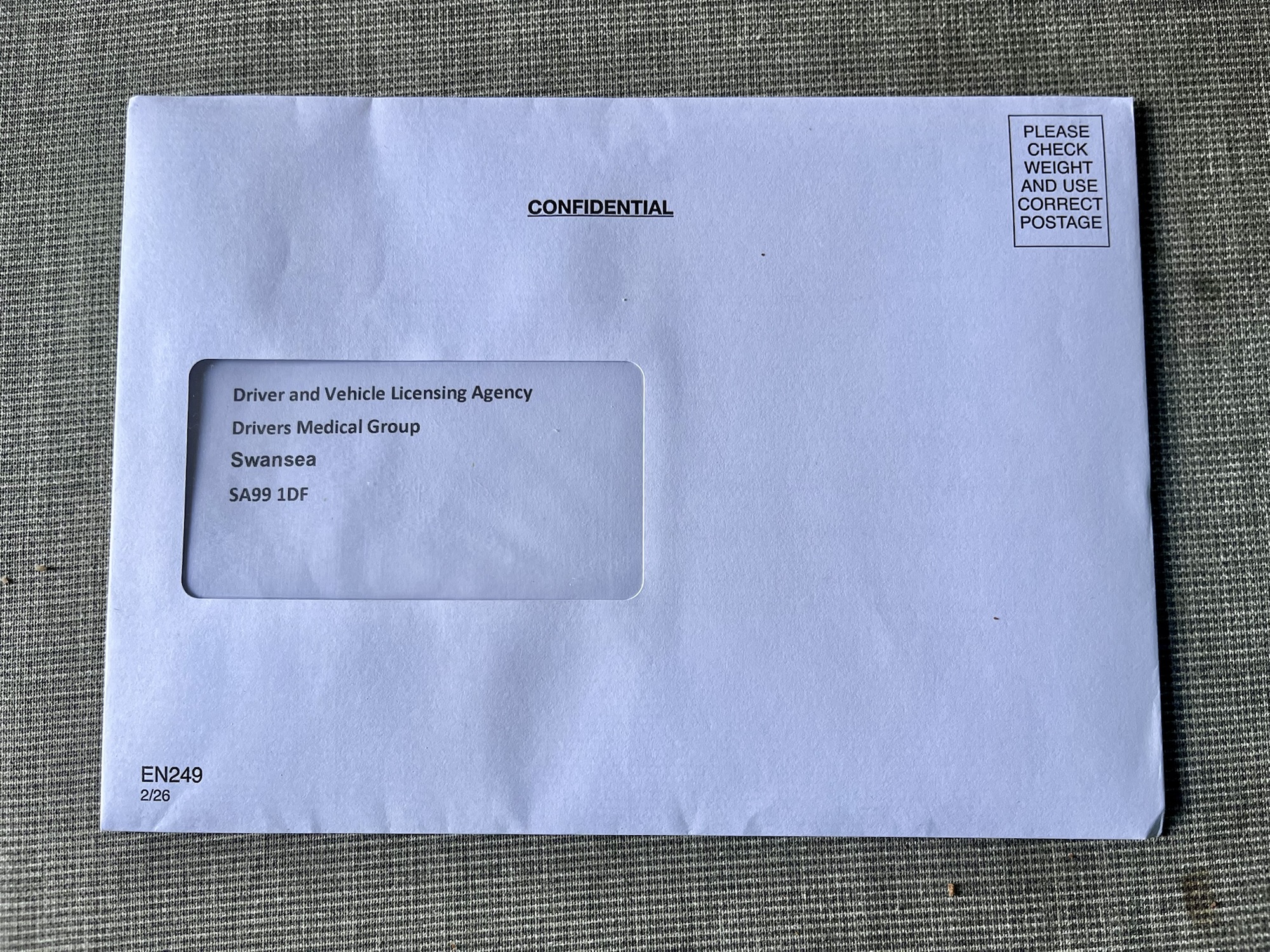
A photo of an envelope addressed to the medical team at the DVLA. My surrendered driving license is inside.

The good news is that I was discharged from hospital on Wednesday.

The bad news is that, as I’ve now had two seizures in six weeks, I’ve had to surrender my driving license to the DVLA. I can’t get it back until a doctor confirms that I haven’t had a seizure for 12 months, so it’ll be next summer at the earliest before I can drive again.

Reporting to the DVLA

The doctors who were treating me in hospital advised me to contact the DVLA to tell them I was no longer fit to drive. This is done online and is quite thorough, although you probably won’t get an immediate outcome. As it was, I received a letter through the post a couple of days later, confirming my unsuitability to drive and with a pre-addressed envelope to send my license back in.

As much as it will be a pain not being able to drive for at least the next 12 months, we’ll manage. Christine thankfully passed her test 18 months ago and so she can drive. Once I start going back to work in the office, I can take the train – we bought our house before I passed my driving test and so public transport remains an option for me.

Meanwhile, I’m taking anti-seizure medication twice a day and will have some further tests and scans to narrow down what’s caused the seizures. This may include surgery in future, but, fingers crossed, I won’t have another seizure in the next 12 months. Obviously, if I do, then the 12 month counter resets.

The need to self-report

Unlike most other European countries, it is an individual’s responsibility to tell the DVLA that they’re no longer fit to drive. And, unfortunately, some people carry on driving despite being told not to, sometimes with deadly consequences. It’s a particular problem with older drivers with failing eyesight, and who end up in prison for causing death by dangerous driving rather than enjoying their retirement. Nobody wins.

Hopefully, in future, there will be a system set up for healthcare professionals (doctors, but also optometrists and others) to report people unfit to drive to the DVLA directly, rather than relying on self-reporting. That way, people unfit to drive who are reluctant to give up driving can be forced to do so. It would need enforcement, and arguably resources to help people find alternative transport, but could save lives.

In any case, I understand why I can’t drive and have done what I’m legally required to do. I would never want to be responsible for injuring someone (or worse) because of a seizure whilst driving. And even if all I do is injure myself or damage the car, driving against medical advice will almost certainly invalidate my car insurance, leaving me out of pocket. It sucks, but driving right now just isn’t worth the risk to me or anyone else.

Back in hospital

I’m writing this from my hospital bed, having been re-admitted on Sunday. I had a seizure at home, and this time Christine and our ten-year-old were there to witness it.

Last month I had a fall at home, which I put down to feeling faint but a seizure hadn’t been ruled out. Now it seems like a seizure was the most likely explanation. This time, I was lying down, so no broken bones, but my first memory after coming around was when the paramedics had arrived. This resulted in my first ever trip in the back of an ambulance.

During this hospital stay, I’ve had another CT scan, and an MRI scan as well. I may have some kind of infection which hasn’t been cleared by the medication I was given last time, but we’ll see. I’m also now taking anti-seizure medication, and I cannot drive a car for at least another six months.

I’m hoping to be discharged today.

Creative Commons License
Except where otherwise noted, the content on this site is licensed under a Creative Commons Attribution-ShareAlike 4.0 International License.