Until now, plug-in solar panels haven’t been legal in the UK. If you wanted solar panels, you either had to have them professionally installed, or only use them with a battery that you kept separate from the energy grid. We had solar panels professionally installed on our roof in 2023. Meanwhile, a former colleague of mine had a series of fold-out portable solar panels that she uses with a portable battery for use in her campervan.
The UK is catching up with our European neighbours in this regard. In Germany, over half a million households already have these systems, which are known as Balkonkraftwerk and can be picked up for around £500. These plug-in solar panels can simply clip over your balcony railings. Seeing as the German supermarkets Aldi and Lidl are now widespread in the UK, I wouldn’t be surprised if these plug-in solar kits will start appearing in their middle aisles soon.
Because they don’t require a professional installation, they’re much more suited to people who rent their homes, and people who live in flats without access to a roof.
Why hasn’t plug-in solar been legal before?
So why is the UK only now catching up with Germany? Here’s an explanation from Terence Eden, who I credit with first making me aware of this:
The electricity grid needs to be capable of handling both import and export from households, and in the past it wasn’t very good at this. Nowadays, it mostly is, and so a big increase in people exporting excess electricity from their homes shouldn’t cause too many problems. Which is a relief, considering how many houses already have solar panels – it’s rare to see a housing estate with at least a couple of houses with solar panels on their roofs already.
It’s worth noting that you’ll be paid significantly less per kWh for exporting electricity; as it stands, Octopus pay 12p per kWh, versus typically 24p kWh for import. It was 15p per kWh until earlier this year. Most other suppliers pay even less, so if you’re not already with Octopus, maybe consider switching. Here’s my referral link – you’ll get £50 off your next bill once your first direct debit payment has been taken, and so will I.
In any case, if you’re considering a plug in solar kit, maybe also consider buying a battery that you can charge whilst it’s sunny. Anker’s SOLIX range is popular, and here’s a 2 kWh model that costs £999(sponsored link). That way, you can use the excess electricity yourself.
This will help the UK reduce its fossil fuels reliance
As energy secretary Ed Milliband says in the announcement linked above:
Global events demonstrate there’s not a moment to waste in our drive for clean power because there can be no energy security while we are so dependent on fossil fuels.
Oil and gas prices have shot up in recent weeks, thanks to the latest war in the Middle East. Allowing more households to start using solar power will reduce our reliance on burning gas to generate electricity, as well as being better for the environment and air quality. We spent a five figure sum getting our solar panels installed three years ago; now, many households will be able to get a small system for just a few hundred pounds. And I think that’s great news.
Back in 2023, the system we had installed cost around £11,000. We paid for most of it out of savings, topped up with a contribution from my parents and the rest was borrowed. We finished paying off the borrowed money at the end of 2024. So, on the basis that it has taken us three years to get to 25%, it means the full return on investment will probably take another 9 years. By then, we’ll still have a couple of years left on the mortgage, and our ten-year-old may or may not have left home by then.
Our system is from SolaX, and although they provide an app, I also transpose the data each month into a spreadsheet. What is notable is that 2023 was our best year – for example, in May 2023, our total savings were £136.78, made up of £85.90 of saved electricity and £50.88 of exported electricity. Over the course of the entire year, we saved £855.45.
Savings in 2024 were lower – £750.79. And last year was only a few pence higher at £750.96. Indeed, the weather last month was pretty terrible, as we only saved £11.43 and didn’t export anything. Suffice to say, we’ve already saved more this month with several days left to go. On average, our system saves us £65.48 per month on our electricity bill, and in some of the summer months, we actually get a net negative electricity bill as we export more than we use.
One thing we haven’t yet done is have our solar panels cleaned. It may be that, after being cleaned, they may allow more light in. However, having spoken to others online, they’ve found that it makes very little difference.
I think it’s important to be open about the savings we’re making. Whilst prices have come down – a similar system may cost around £9000 now – getting solar is a big investment, especially when paired with a battery. As such, I hope this information is useful if you’re considering getting solar and have a suitable property.
If you have a Solax inverter attached to your solar panels, and get your energy from Octopus, then you can now calculate your earnings using live tariff data in the Solax app. I gather this feature has been there for a few months, but I’ve only recently found out about it. Here’s how to set it up.
Firstly, open the SolaxCloud app. On the home screen, tap the Earnings section. At the top right, you should see an icon that looks like a calculator with a lightning bolt on it, so tap that. You’ll now see two tabs – ‘To Grid’ and ‘From Grid’.
Get your Octopus API key
Before we continue, you’ll need to generate an API key. Log into your online Octopus Energy account (on the web, not on the app). At the top, it should say ‘Hi, [your name]’, display your account number, and then show a link called ‘Personal Details’. Click that link.
You should now see several boxes, one of which is called ‘Developer settings’. Click the ‘API access‘ button.
Scroll down a bit, and you’ll see a box labelled ‘Your API key:’. Copy this key, and preferably save it in a password manager. You can only have one API key, but you can use it for multiple things – I use my key for the Octopus Energy integration for Home Assistant, for example. You can regenerate your key, but it’ll invalidate your previous key, and you’ll only be shown it once on the Octopus web site. That’s why it’s best to treat it like your password.
Whilst you’re on Octopus’ web site, make a note of your account number too, as you’ll need this in a moment.
Enable automatic tariff setting
Back to the SolaxCloud app. Below the ‘To Grid’ and ‘From Grid’ tabs, you should have two further tabs: ‘Customized’ and ‘Automatic’. Tap ‘automatic’.
A new box called ‘Tariff provider’ appears, so tap this, and select ‘Octopus’. There’s another option called ‘Nord Pool’ which may work if you use a different energy supplier. I don’t, so I’ve only tested this with Octopus.
Now, you’ll have two options: ‘API Key’ and ‘Select a package’. ‘Select a package’ lets you manually choose your tariff and region, but it won’t update automatically if you change your tariff. So, we’ll select ‘API key’. Here, enter your account number, and then the API key, and tap ‘Save’. You should find that your current tariff and meter point access number now appear in the app. Scroll down, and you’ll be able to see the underlying tariff data, both as a graph and the raw data.
I’m on a fixed tariff with Octopus, so at present there’s no fluctuation with my import and export prices. However, if you’re on a tariff such as Octopus Agile, you’ll now see this data in the SolaxCloud app. What’s more, any future earnings will be calculated using this tariff data, and so it’ll more accurately reflect how much money your solar panels and/or battery are saving you.
Join Octopus
Octopus is now the UK’s largest electricity supplier, with a market share of 22%. And, with features like API access, the chances are that if you’re geeky enough to read this sort of blog post, then you’re already signed up. However, if not, here’s my referral link – you’ll get £50 off your first bill if you sign up. Financial incentives aside, of all the energy companies that I have used, Octopus have had the best customer service by far.
It’s been a particularly good Spring, hasn’t it? Lots and lots of sunshine, warm daytime temperatures, and almost no rain. It’s almost like the lovely Spring that we had in 2020, but without the lockdown restrictions. As such, we’ve been able to enjoy it a bit more.
As solar panel owners, it’s been particularly welcome. In March, our solar panel system saved us £50 by not needing to import energy from the grid, and we exported another £25 of excess electricity. And this month, despite us not being halfway through yet, we’ve already exported £25 of electricity. Overall, we’ve certainly exported far more than we’ve used from the grid. However, we’re having some issues with our smart electric meter not reporting usage, and so I’m not able to properly quantify this yet.
Although it’s been cold at nights, we’re still using less gas and electric than we would typically use at this time of year thanks to the nice weather. It’s been warmer during the day, and we’ve been able to dry more laundry outside too. We haven’t used our heated drying rack for a few weeks now.
Energy prices
Speaking of energy prices, I’m hoping that this will mean that Ofgem’s Energy Price Cap will go down when it changes again in July. The warmer weather should have reduced the use of gas central heating, and the increased contribution of solar energy will have reduced the amount of gas that’s burned to generate electricity. Seeing as it’s mainly wholesale gas prices that drive the price cap calculations, reduced demand for gas will hopefully see the price cap fall.
Hosepipe bans
It’s been that long since it rained that I can’t remember the last wet day that we had. Which has been good for getting out and about, but not so good for keeping the reservoirs topped up. Rain is forecast for next week, but if the general trend is for lots of hot dry days, then I wouldn’t be surprised if we end up with a hosepipe ban in the summer.
If you want to plan now for a hosepipe ban and don’t already have a water butt to store excess rainwater, consider getting one from Save Water Save Money. Pop your postcode in to find out if you can get one subsidised by your water company. They’re at least £10 cheaper than elsewhere, as long as you’re prepared to wait around six weeks for delivery. We haven’t invested in one yet (we need additional work doing on our guttering) but it’s something to consider.
One thing we have bought in response to the warm weather has been a portable air conditioning unit. British homes are not typically built with air conditioning systems (and our house is around 100 years old in any case). Whilst the nights have been cold, I’m fully expecting that, if this good weather continues, there will be some hot nights on the way. A standard pedestal fan can help keep you cool by blowing away sweat, but it can’t cool the air in a room. Once it’s arrived and I’ve had time to evaluate it, I’ll do a blog post.
We’ve had our solar panels for a couple of years now, and, as a thought experiment, I’ve wondered if it would be possible to go ‘off grid‘. This would mean having no connection to the electricity and gas networks, and potentially the water network too.
Now, I’m very much aware that this is a classic example of Betteridge’s Law of Headlines, and indeed, the short version of this is pretty much, ‘no’ when it comes to electricity and water. Especially if the person reading this is my wife, Christine (love you sweetheart). It is intended to be a thought experiment after all.
Getting off the gas grid
We’ll start with the easiest one – getting off the gas grid. This is actually a long-term of ours, and many homes are now getting disconnected from the gas grid.
When we bought our house, which will have been 10 years ago this summer, it was a very gas-reliant house. There were three gas fires, a gas central heating boiler and water tank, and a gas cooker. We got two of the gas fires out before we’d even moved in, and the remaining one followed when we had the very old gas boiler replaced with a more energy efficient condensing boiler in 2016. Next to go was the gas cooker, when we had the kitchen renovated in 2022, so now we only need gas for heating and hot water.
Now our boiler isn’t quite nine years old, but it’s likely to have a few years left in at least. When it’s due for replacement, our plan is to switch to an air source heat pump, which will be electrically powered. That will mean there’s no need for a gas connection to our home, and we can have it completely removed. As well as meaning that we don’t need to pay the daily gas standing charge, we’ll no longer have pipes carrying an invisible and highly flammable gas running into our home. And it’ll reduce our carbon footprint too.
Off-grid electricity
So that’s the easy one out of the way. Going off grid for electricity, however, is likely to be much harder.
We’ve made a start, at least, with our solar panels. In the summer months, with longer days and more sunlight, we generally generate enough to be self-sufficient. We also have a battery attached to the system, so the solar panels can charge the battery during the day, and then the house can run off the battery overnight.
However, at this time of year, we are very much not self-sufficient. This is especially true as I write this on a very dull Sunday afternoon, where our solar panels are contributing a mere 7 watts of power. That’s about enough to run a couple of LED light bulbs, but certainly not enough for our freezer, for example. We would therefore need other ways of generating electricity on dull days, or at night.
Ovo Energy have a useful guide here. Generally speaking, a roof-mounted turbine would be capable of generating 1-2 kW of electricity, which is less than half the peak capacity of our solar system. And that’s based on a lot of assumptions about wind speed that may or may not apply to your property.
As well as the installation cost, we would probably also need planning permission, as our house isn’t detached. We’re therefore looking at around £2000-3000, and it would probably take quite some time to recoup that investment.
Dull days with no wind
So, a solar system backed up with a wind turbine might cover our electricity needs. Unless it’s a dull day and there’s no wind.
I’m in a few Facebook groups for people who use Home Assistant and who have solar and battery systems, and quite a few other members have the Agile Octopus tariff. On this tariff, electricity prices change by the half hour, based on wholesale prices. If it’s forecast to be a particularly sunny and windy day, electricity prices can be very low. Indeed, they occasionally go negative – in other words, Octopus will actually pay you to take electricity out of the grid, rather than the other way round. It’s great for people who have battery systems that can charge from the grid, or who can plan their days to use more electricity at the times when it’s cheap.
Though we are Octopus Energy customers, we’re not on Agile Octopus, because prices can also shoot up on dull days with no wind. Our fixed tariff means we pay 21.10p/kWh, regardless of the weather, but on Agile Octopus, the electricity unit price can go up as high as £1 per kWh. And if you haven’t been able to charge up your home battery by then, it could get very costly.
As an aside, if you’re not already an Octopus Energy customer, here’s my referral link. You get £50 off your bill if you join, and their customer service is better than any other energy company that we’ve been with so far. There’s also an unofficial Home Assistant integration that uses their API.
Therefore, if we were to disconnect from the grid, we would need a third source of electricity. This is where it gets a bit more tricky. The options I have looked up so far include:
A wood burning stove, with a thermoelectric generator. However, in my research, I’ve yet to find anywhere in the UK that would sell such a system. And those that I have seen for home use would only be able to generate a few watts – not even enough for our house’s ‘base load’ (fridge, freezer, devices on standby etc). We have a chimney that we could use, but we would also need filters to stop particulate matter getting into the air.
Some form of hydro generation using water collected from rainfall on our roof. This would only really work when it rains; although we live in the Pennines where it rains quite a bit, I doubt this would power much more than a couple of light bulbs.
Therefore, we would probably have to fall back on a diesel generator, which would be noisy, smelly, and not good for local air quality or the environment.
No Smart Export Guarantee
The other benefit to being on the electricity grid is that you can be paid back for any excess electricity that you export. Even though it’s January, we’ve exported around £1 of electricity this month, and that’s only after our battery has been fully charged. In June last year, we were paid £46 for the electricity we exported, against £36 for the grid energy that we used. So that was a net payment to us that month. Indeed, over the whole of 2024, we were paid £227 for the excess electricity that we exported.
If we’re not on the grid, then we can’t export. So if our battery is full, that electricity is essentially being wasted. Of course, if I was serious about going off-grid, then I would probably invest in another battery to prevent this from happening, but then that’s another expense.
What about water?
Going off the water grid would be the most difficult. Although ironically, we’ve been inadvertently off the water grid four times so far this month, due to supply issues. I have an active complaint with Yorkshire Water about that, but let’s imagine that I want to willingly disconnect from the water grid for a moment.
Clearly, we would need some other way of getting clean water into the house. Rainwater is the most obvious, but we would then need somewhere to store it. In 2023, I read The Climate Change Garden(sponsored link) by Sally Morgan and Kim Stoddart, and the book shows you how you can store water in tanks underneath your garden to cope with water shortages. During the 2022 heatwave, we had a hosepipe ban for several months, and so I’m considering whether to get a water butt to store rain water for use in the garden. You may be eligible for a subsidised water butt from Save Water Save Money – you’ll need to pop in your postcode to see if your water company participates.
But even a butt, or huge tanks under our lawn, are unlikely to be sufficient. We would ideally need to have access to a constant flow of running water, such as a stream. And we would need the means to filter the water so that it’s fit for drinking.
And what about sewage? We don’t have a particularly big garden and so we probably wouldn’t have room for a septic tank, or any other means of storing and/or treating waste.
A case study: Gibson Mill
Up above Hebden Bridge is Hardcastle Crags, a National Trust property which is home to Gibson Mill. The Mill is off-grid, because of its remote location – it’s about a mile away from the nearest electricity cables, for example. So, electricity is instead generated on site, using solar panels and a hydro-electric generator. Mills were typically built next to watercourses and Gibson Mill is no exception, being served by Hebden Beck. Whilst this would have driven a waterwheel in years gone by, nowadays it drives a turbine to produce electricity. The solar panels have recently been replaced with newer, more efficient models, and there are huge batteries to store energy.
We last went back in 2023, and despite having more than one way of generating electricity on site, there was still a diesel generator at the back that was needed to top-up the electricity supply. Even then, they were unable to serve hot food in the café as a result of not having sufficient power.
Gibson Mill also has no connection to the sewerage system, so its toilets are composting toilets. Below the toilets are huge vats filled with worms, who digest our waste for us. It’s feasible at this scale because it’s a tourist attraction, and the alternative of laying pipes would be more expensive.
Conclusion – staying mostly on-grid
So, in summary: going totally off-grid would be difficult, although coming off the gas grid is achievable and something that we want to do eventually. We don’t live in a very remote area, and so going off-grid with electricity and/or water wouldn’t really make sense. Even if we could find the means to generate our own electricity, the upfront costs of installing the required equipment would probably outweigh the potential savings.
We’ve now had our solar panels for two years, so it’s probably time to review how much money they have saved us, and how close we are to getting a return on investment.
We have a SolaX system, which includes twelve 400 Watt solar panels, an inverter and battery. I’m using SolaX’s app to estimate how much money this saves us, based on the electricity unit prices from the grid, and also the amount that we get paid for exporting surplus electricity under the Smart Export Guarantee.
I’ve included a screenshot taken a couple of weeks ago. We only saved around five pence that day, as the solar panels spent most of the day under a thick blanket of snow. But you can see that, in total, we’ve saved around £1600 in two years.
I should note, however, that whilst this averages out at £800 per year, last year we actually saved closer to £900. Alas, 2024 was a less sunny year, on the whole, and so our solar panels couldn’t work as hard.
The total cost of the system was around £11,000, so after two years, we’ve recouped 14% of our outlay. Had 2024 been as sunny as 2023, then this would have been closed to 16%. Assuming that we have more years like 2023, then we should break even in around 10 years time. That’s a long way away, but we’ll still be paying the mortgage on the house then, and we have no plans to move.
Since we had our solar panels fitted, prices have dropped significantly, and so a comparable system to ours would probably cost closer to £9000. You could argue that we should have waited a little longer to get our system installed, but back in 2023, energy prices were at an all-time high. Still, it does mean that the economics of getting solar panels fitted now is even better than it was.
Most of the money that we used to pay for the solar panels was either savings, or money gifted to us by my parents. However, we did borrow around £4000 to cover the rest of the cost, and still have some of that to pay off. Provided that we don’t have any more major expenses (I’m glaring at our car as I write this), we should have this paid off this coming spring.
If you’ve been reading this blog for a while, you’ll know that we have solar panels which are connected to an inverter from the Chinese company Solax. Recently, I asked for the firmware on our inverter to be updated, as part of some testing I’m assisting with for an app. Unfortunately, in doing so, it’s broken the Home Assistant integration.
As per the integration page:
Inverter models with newer firmware (and also those using devices like PocketWifi) no longer expose an API when connected to your wireless network, they do however continue to expose it on their own broadcasted SSID. To use this sensor in this case it is necessary to set up a reverse proxy with something like NGINX and use a Raspberry Pi (or similar) with two network connections (one being Wi-Fi that connects to the inverters SSID).
Sure enough, a scan of available Wi-fi networks showed a new unsecured SSID with my inverter’s serial number. Now I’m not beyond setting up a reverse proxy (I have Nginx Proxy Manager running) but this would require purchasing an additional Raspberry Pi, potentially with an additional USB Wi-fi adaptor or HomePlug adaptor.
Annoyingly, the inverter does still connect to my home Wi-fi network, and it’s possible to access a web-based portal by popping the inverter’s IP address into a web browser. But it no longer offers a local, real-time API over REST.
All aboard the Modbus
That’s the bad news. The good news is that it’s still possible to connect to the inverter using the Modbus protocol. Now, Modbus is old. Like, really old. Like, older than me old. Like, old enough to be a grandfather old. Like… well, you get the picture – it was originally developed in 1979 for use over serial connections. Thankfully Modbus can also work over TCP/IP on port 502, so I don’t need to run a very long serial cable and dig out my old USB to RS232 adaptor. Yes, I still have a USB to RS232 adaptor somewhere. I’m only a few years younger than Modbus.
Also, Modbus sounds like a bus full of really cool people wearing 1960s fashion and listening to The Who, although arguably they should be on Lambretta scooters. This is where I would ask Microsoft Copilot to create an image of this, but I’ll probably end up using the equivalent electricity to power a provincial English town trying to get it to generate what I’ve pictured in my mind.
Home Assistant natively supports Modbus, and if you have a spare half hour you can read everything on that page. Suffice to say, you have to set it up using YAML and know the Modbus specification of the device you’re communicating with. You probably don’t want to do this.
HACS to the rescue
The good news is that there’s a HACS integration for Solax Modbus. Once you have HACS installed, search for Solax and it’s (currently) the only one that comes up. Install it, restart Home Assistant, and then add the integration. There will be lots of input boxes pre-filled with default values – leave these be. The only thing you need to enter is the IP address for your inverter.
Once set up, the integration added loads of new entities for my inverter to Home Assistant. In fact, it seems like there were far more than before. The data isn’t strictly speaking ‘real-time’, but it polls every 15 seconds and so might as well be.
So that’s the good news. You can have the latest firmware on your inverter, and have it work locally with Home Assistant, without having to purchase another device to act as a reverse proxy. The bad news is that you’ll need to update any dashboards that you have set up to point to the new entities.
Looking to the cloud
The official way of accessing your inverter’s data and status is using the Solax Cloud, either online or through the official app. From there, there is an official API for interacting with this data. But it’s not real-time – updates happen every five minutes. And I can see why some people won’t want their data uploading to the cloud.
There isn’t a Home Assistant integration for Solax Cloud, either in the core product or through HACS. But someone has written their own YAML code to communicate with the Cloud API, should you wish to use this, although it also relies on the REST API which seems to have been deprecated from newer firmware versions.
Getting the latest Solax firmware
If you do want to update the firmware on your Solax inverter, there’s a handy guide here. The easiest and safest way is to contact Solax support and ask them to do it for you; they can log into your inverter remotely and run the upgrade. I hadn’t realised this until Home Assistant suddenly stopped being able to communicate with the REST API on my inverter. There are other ways of obtaining the firmware, and you can upload it yourself to your inverter’s local web portal, but it’s probably best for Solax to do this for you. Considering our solar panels, battery and inverter cost a five figure sum to install, it’s not something that I want to accidentally brick.
As for the app I mentioned in the first paragraph? I’ll talk about it once it’s released.
Erm, no. Because even though we’re not yet at the end of January, we’ve used the last of our savings, some money from The Bank of Mum and Dad, and a small amount of new borrowing to pay for the installation of solar panels.
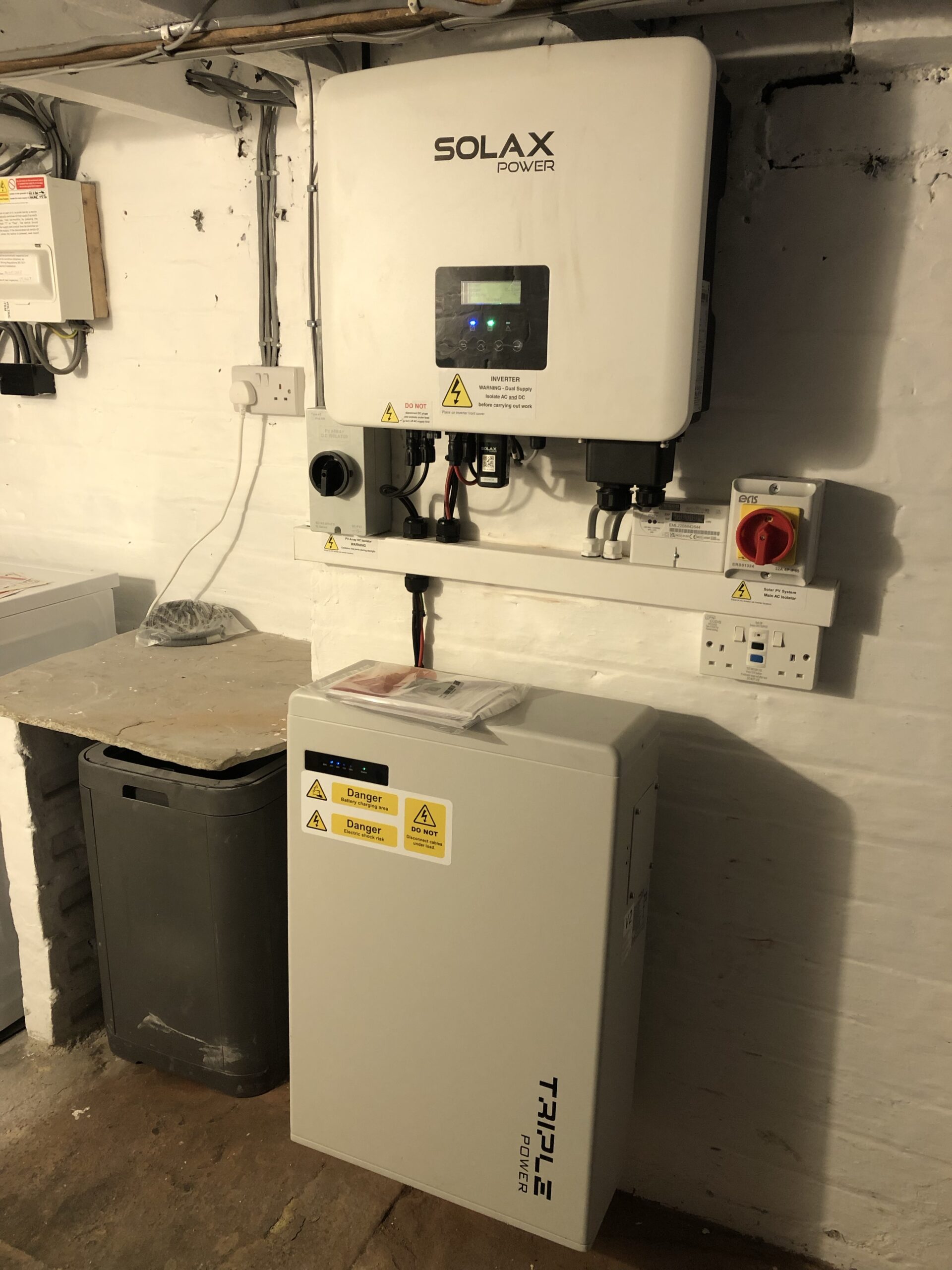
I would show you a photo of them, but that’s hard to do without also sharing a photo of our house, which I’m loathed to do publicly. Instead, here’s a photo of the interior kit – namely, the inverter and the battery.
The battery is an optional add-on to solar systems and is designed to offer additional off-grid power at the time when the solar panels aren’t working – i.e. dull days or at night. It can store up to 6 kWh of electricity, and there’s a pair of plug sockets that are attached to the battery, meaning that we have backup electricty in the event of a mains grid power cut.
Here are our reasons for having a solar panel installation:
Saving money
Energy prices have increased everywhere recently, but especially in the UK where many of our power stations work by burning natural gas. Gas prices were already on the rise when Russia declared war on the Ukraine, and pushed prices even higher as countries started to reduce their reliance on Russian gas. So, switching to a renewable source of power that doesn’t cost money to generate (once the panels are installed and paid for) seems like a good idea.
January is a bit of an odd time to have them installed, though. The days are short, and we only get about 6 hours of usable daylight for generating electricity as I write this – normally 9:30am until 3:30pm. Yes, it’s light from around 8am but the sun needs to have moved around sufficiently to be shining onto the panels to get more than just a few watts of power.
Last week was very, very cold but with clear, sunny afternoons. That was enough for the panels to generate around 2.5 kW – and normally, when I’m working at home without any appliances on (e.g. washing machine, dishwasher, cooker etc.) we only use about 250 W of power. So, that’s a lot of overflow to also charge the battery and there were several days where it was fully charged at sunset. That then gave us enough power for teatime and up until beyond bedtime, meaning that we weren’t paying for grid energy.
Right now, it’s saving us between £1 and £2 per day, depending on the weather and how much energy we’re using. Our savings will increase soon, once we have our Microgeneration Certification Scheme (MCS) certificate, which will allow us to be recompensed for the excess energy that we can sell back to the mains grid under the Smart Export Guarantee. Realistically it’ll be the end of next month before this is up and running, but it means that, once the battery is fully charged, we can make a bit of money back. Not much – at best, we can earn about 16p for kWh at present, which is less than half the 34 kWh we pay to use electricity – but we would already be a few pounds up by now if it had already been in place.
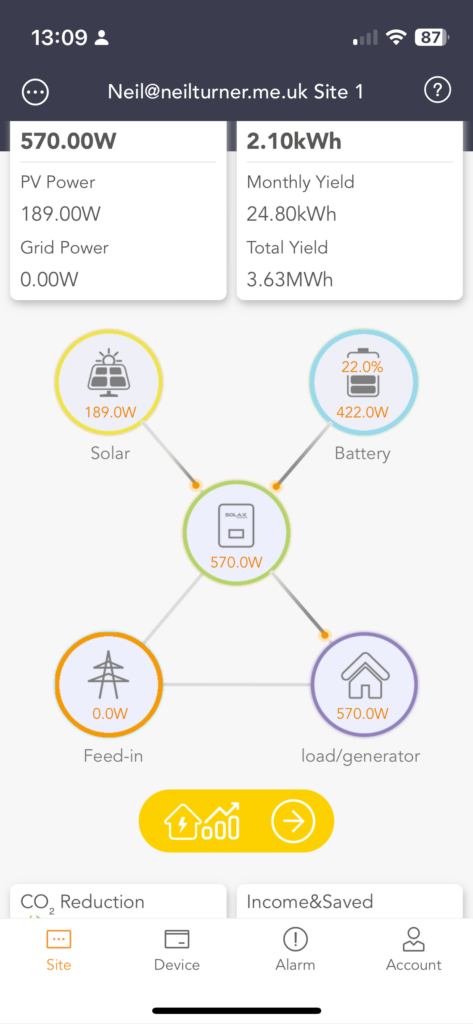
The app which links to the inverter can be configured to calculate your savings, so we have an idea of how much money we’re saving.
Doing our bit for the environment
You may choose to believe that climate change isn’t real, but I’m convinced, along with something like 99% of climate scientists that it is happening. So having solar panels means that we can actually do something tangible about it. Whilst renewable energy sources are forming an increasing proportion of Britain’s mains grid energy mix, burning natural gas is still the source of the majority of our electricity, and there are CO2 emissions involved. Also, gas supplies are finite, and so regardless of whether you believe in climate change, there will come a point when we run out of gas, or have to go to greater lengths to access it. Again, the inverter’s app approximates how much CO2 we’re saving, which is over 50kg in just over a week. I reckon that’ll be half a tonne by the end of the year, which seems like a staggering amount for just one household.
We are, of course, parents, and so by doing our bit, we can show our seven-year-old that we care about the planet that they’ll inherit.
International Geopolitics
I’ve mentioned Russia’s invasion of Ukraine, and I suppose this could be a small act of solidarity with the Ukrainian people. Whilst Britain only sources a small amount of its gas from Russia, if that could be reduced to zero then that’s a lot of money that Russia isn’t getting to fuel its war machine. I’d like to think we’re helping, even if it’s only a tiny contribution.
Resilience
I mentioned above that, attached to the battery, are a pair of plug sockets which draw power only from the battery. If there’s a power cut, then these sockets will still provide power, so long as there’s some charge left in the battery. Indeed, the inverter normally avoids depleting the battery completely – typically it’ll leave 10-20% charge behind.
Even it’s sunny and the panels are generating, should the mains grid go offline (i.e. we get a power cut), then unfortunately all the regular sockets and lights in our house will go off too. But this extra pair of sockets will keep going, and so we could, for example, run a long extension cable up from the cellar to the freezer, to keep that going. We’ve had a couple of short power cuts in recent months, but these have been no more than 10 minutes at a time thankfully.
What to consider if you want solar panels
Our system cost a low five figure sum to install, and was done by a local firm. We got three quotes and all were almost exactly the same, so this seemed to be the going rate. There’s a great guide on MoneySavingExpert about whether they’re worth it, and I suggest that you also read that, as well as my own experiences.
These are things you need to consider:
You need a pro-dominantly south-facing roof; ours faces south-west, which is okay but not perfect. If your roofs point east or west, then solar panels probably aren’t for you.
You will get more out of solar panels if you can use the energy whilst it’s sunny. So, you’ll need to use the delayed start on power hungry devices like tumble dryers and dishwashers, so that you’re using them when the panels are working. If you work at home, you may benefit more, and especially if you have an electric or plug-in hybrid car that you can charge at home during daylight hours.
Solar panels will help with electricity, but not with your gas bill. So, you’ll get less of a benefit if you have a gas oven, or if you don’t have an immersion heater in your hot water tank. Annoyingly, in hindsight, we ripped out our hot water tank in 2016 and replaced it with a combi gas boiler, although as part of our kitchen renovations, we bought new electric hobs and ovens. Conversely, if your heating and hot water is electrically-powered, perhaps using a heat pump rather than a gas boiler, you could benefit more from solar panels.
In a similar vein, to maximise your savings, you may consider boiling an electric kettle for hot water for washing up, or using an electric shower to fill a bath. Using a slow cooker during daylight hours may be more economical than a cooker in the evening.
The return on investment period for solar panels is about 11 years, so it’s probably best to install them in a house where you don’t plan to move any time soon.
It’s probably best not to borrow all of the money for solar panels. Whilst you can save hundreds of pounds per year, through less usage and selling back your excess to the grid, the interest payments on any borrowings will extend the return on investment period. We’re borrowing around £4000 to fund the panels, which I’m funding using a credit card balance transfer to keep the interest down, but the rest was savings and a parental gift.
You probably won’t need planning permission, unless your house is a listed building or you live in a conservation area.
I’ll aim to post again in the summer, once our Smart Export Guarantee is set up and we have some sunnier weather, to indicate how much we’re saving.