
V&A Cast Courts and Design Gallery

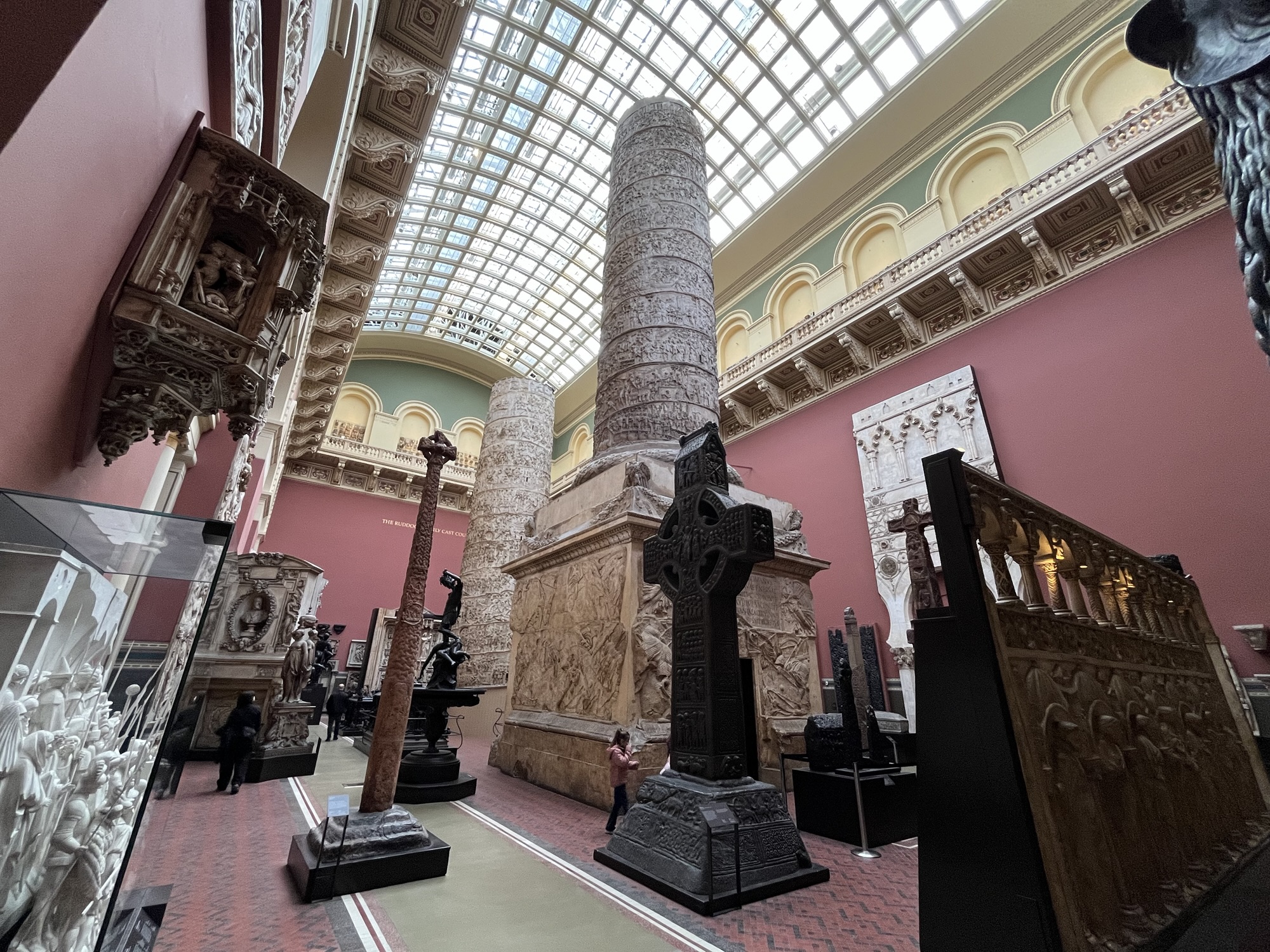
A photo of the Cast Court at the V&A

This is the fourth of my blog posts about last month’s trip to London. After visiting the Natural History Museum, we walked across the road to the V&A, where we visited the Cast Courts and the Design 1900-Now Gallery.

As I mentioned in my write-up of Banksy: Limitless, I’m not massively in to art, and so most of what the V&A offers isn’t of interest to me. Christine likes it though, and she has visited the V&A more often than I have. This time, she insisted on taking me to the Cast Courts on the ground floor.

Cast Courts

These three rooms are huge, extending to the full 25 metre height of the building. Their size is by necessity, as they contain some of the largest objects in the V&A’s collection.

As the name ‘cast’ suggests, these are plaster casts of various famous artefacts that exist elsewhere. There’s a cast of Michaelangelo’s David, for example, complete with a plaster fig leaf that was put over his manly bits when Queen Victoria visited. By far the biggest is a cast of Trajan’s Column, which is so big that it appears in two pieces. The cast courts were built as part of the original museum in the 1870s, and are now rather tightly packed with various pieces.

They’re impressive spaces, and it would be hard not to be wowed when walking in to them for the first time.

A photo of an Apple II computer and disk drive on display at the V&A

Design 1900-now

Whilst art may not be my thing, design and architecture are. So we went upstairs to the Design 1900-now gallery, which features 250 objects that show how design has changed over the past 126 years.

As well as furniture (including a standing lamp designed by Salvador Dali), there’s also technology here. There were two Apple computers on show; an Apple II, and a much newer MacBook that had been deliberately disassembled as it contained documents from Edward Snowden. There are also examples of objects that have been recently acquired, such as a Lababu.

The information included with each object is concise but thorough, but by virtue of being in central London, the limited space means that many objects are not on show here. Indeed, V&A has over a million objects in its collection, and has recently opened the V&A East Storehouse in Hackney Wick to allow visitors access to more of its objects. There’s also the Young V&A in Bethnal Green, which we visited in 2024.

Accessibility

Entry to the museum is free, but like most free museums, some special exhibitions require paid-for tickets. The main entrances are step-free, but not the entrance from the Museum tunnel that links to South Kensington tube station which is the nearest. Knightsbridge is the nearest step free tube station.

There is step-free access to all parts of the museum, but as it’s an old building that has been added to over time, step-free routes may take longer than some more direct ones. Disabled toilets are available, but for a Changing Places toilet, you’ll need to go across the road to the Science Museum.

Wildlife Photographer of the Year 2025

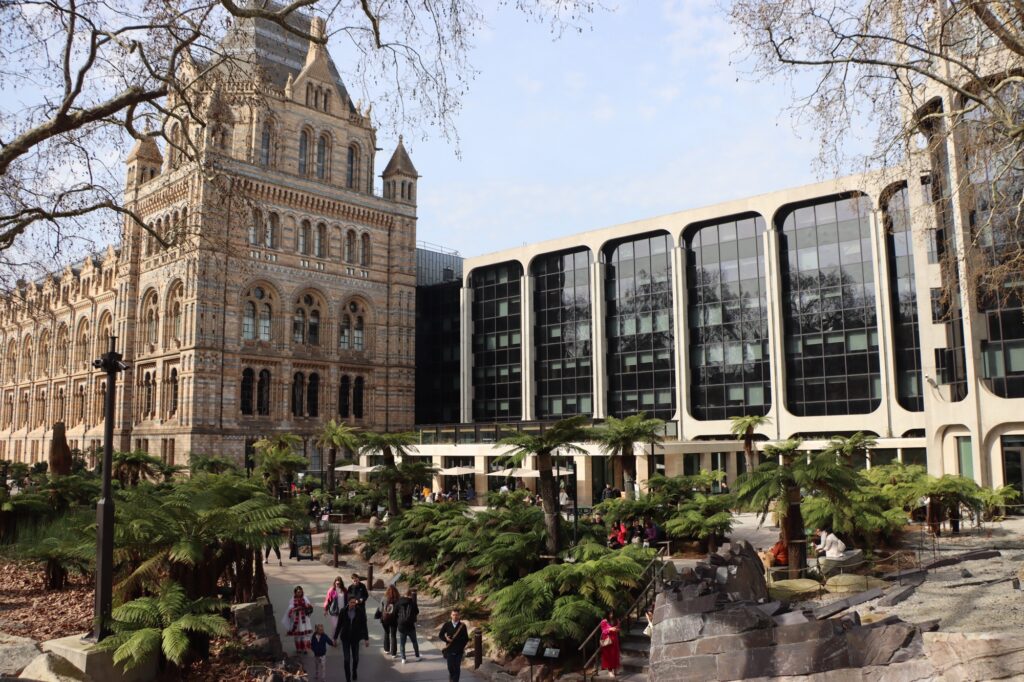
Outside the Natural History Museum which hosts the Wildlife Photographer of the Year award.

This is the third of my blog posts about last month’s trip to London. Following our visit to Banksy: Limitless in the morning, and a bit of lunch, we strolled around to the Natural History Museum for their Wildlife Photographer of the Year exhibition.

The exhibition displays the top 100 entries for the competition. The gallery is dimly lit, with all of the photographs displayed in lightboxes to make them really stand out. They’re split by category, and show the winning entry in each category alongside those highly commended by the judges. Each photograph also has a bit of blurb about where it was taken, and the lengths that the photographer took to get the shot. In some cases, these photographs took weeks or even months of planning. You also get to see which model of camera was used, the lenses and camera settings used to take the photograph.

The two winners of Wildlife Photographer of the Year 2025 were announced in October, a couple of days before the exhibition opened. There’s an overall winner, and a separate winner for under-18s. Both winning photographs are then displayed on bigger lightboxes at the end, and there are video interviews with the winners and the judging panel.

Whilst the Natural History Museum offers free entry, this exhibition is a paid add-on. Tickets start at £15.50 each for adults at off-peak times – we went on a Friday so paid this lower rate. Full-price tickets are £18 for adults, payable at weekends and weekdays during school holidays. You have until mid-July to see this year’s photos.

The Evolution Garden at the Natural History Museum

Evolution Garden

This was the first time we’d been to the Natural History Museum since 2022, and so it was the first time we’ve seen the new Evolution Garden. The museum used to be surrounded by grass lawns at the front, but one of these has been replaced with something rather more biodiverse. As you walk through the garden, you can see various fossils, showing (briefly) how life evolved over millions of years. The planting fits the theme, with ferns playing the role of ancient plants that would have been common the time of the dinosaurs.

It’s a good improvement to an under-utilised area. As well as being better for biodiversity, it supports the museum’s role in education, and is easily accessible even if you don’t want to go into the museum itself.

Pokemon Pop-up Shop

If you can make it to the museum before the 19th April, there’s a Pokemon Pop-up Shop. You need to book a timed ticket to go in, and these aren’t normally available to book online. We didn’t manage to get a ticket when we went, unfortunately.

Accessibility

All of the museum’s entrances are accessible, and wheelchair access to all parts of the museum should be achievable. Disabled toilets are available, but you’ll need to go next door to the Science Museum for a Changing Places toilet.

South Kensington is the nearest tube station, and there’s a tunnel link to the Evolution Garden from the ticket hall. Knightsbridge, on the Piccadilly Line, is the nearest step-free tube station.

Bansky: Limitless exhibition

A timeline at the start of the Banksy Limitless immersive experience

This is the second of my blog posts about last month’s trip to London. The first was about Kinky Boots, and this is about the Banksy: Limitless exhibition which was the other thing that we pre-booked before travelling.

You’ve probably heard of the pseudonymous street artist Banksy. This exhibition is an ‘immersive experience’ which has around 250 of his artworks on display. These are a mixture of prints and recreations of his works, and include those displayed at Dismaland, the Walled Off Hotel, Ukraine and his London animal trail.

I’m not massively into art, but I find Banksy interesting – not least because his true identity remains a mystery to most. All most people know about him is that he is male, white, and that he probably comes from Bristol where his earlier works appeared. He has been producing street art since at least 1999, if not earlier.

He’s probably best known for his stencilled street art. Stencils allow him to design his pieces in his studio; then, when he’s out in a public place, he can then quickly spray paint his works and move on before he gets in trouble. However, his art takes many forms and this exhibition covers lots of them.

Immersive experience

Banksy: Limitless is billed as an ‘immersive experience’, which made me think about that infamous Willy Wonka experience in Glasgow. Thankfully, it’s not a load of AI generated slop. Instead, whilst some parts are like a typical art gallery, others parts are laid out like a tube station, or a recreation of Dismaland. The web site says that you can expect to spend at least 80 minutes here; we spent well over two hours in the end. And, of course, you Exit Through the Gift Shop.

It’s important to note that Banksy himself hasn’t authorised this exhibition. Instead, it’s a collection of (mostly) privately owned pieces and prints that have been brought together. I really enjoyed it.

Accessibility

Banksy: Limitless is in Sussex Mansions on Old Brompton Road. It’s a short walk from South Kensington tube station on the Piccadilly, Circle and District Lines. The nearest step-free tube station is Knightsbridge, the previous stop on the Piccadilly line, which is a one mile walk.

The building is wheelchair accessible. The exhibition is across two floors, and there is a lift available. There are also toilets on site. The nearest Changing Places toilets are at the Science Museum, and the Royal Brompton Hospital, which are both a short distance away. Strobe lighting is used in the exhibition, and there is also an optional section towards the end that people with motion sickness are advised to avoid.

Ticket prices start at £20 each; Google’s AI summary offered me the discount code LONDONBY10 which gave me a 10% discount. Tickets are handled by Fever who we also used for The Art of the Brick, and you can earn points from your booking to use against future bookings (although this can’t be combined with discount codes).

Creative Commons License
Except where otherwise noted, the content on this site is licensed under a Creative Commons Attribution-ShareAlike 4.0 International License.