Pop Music Activism

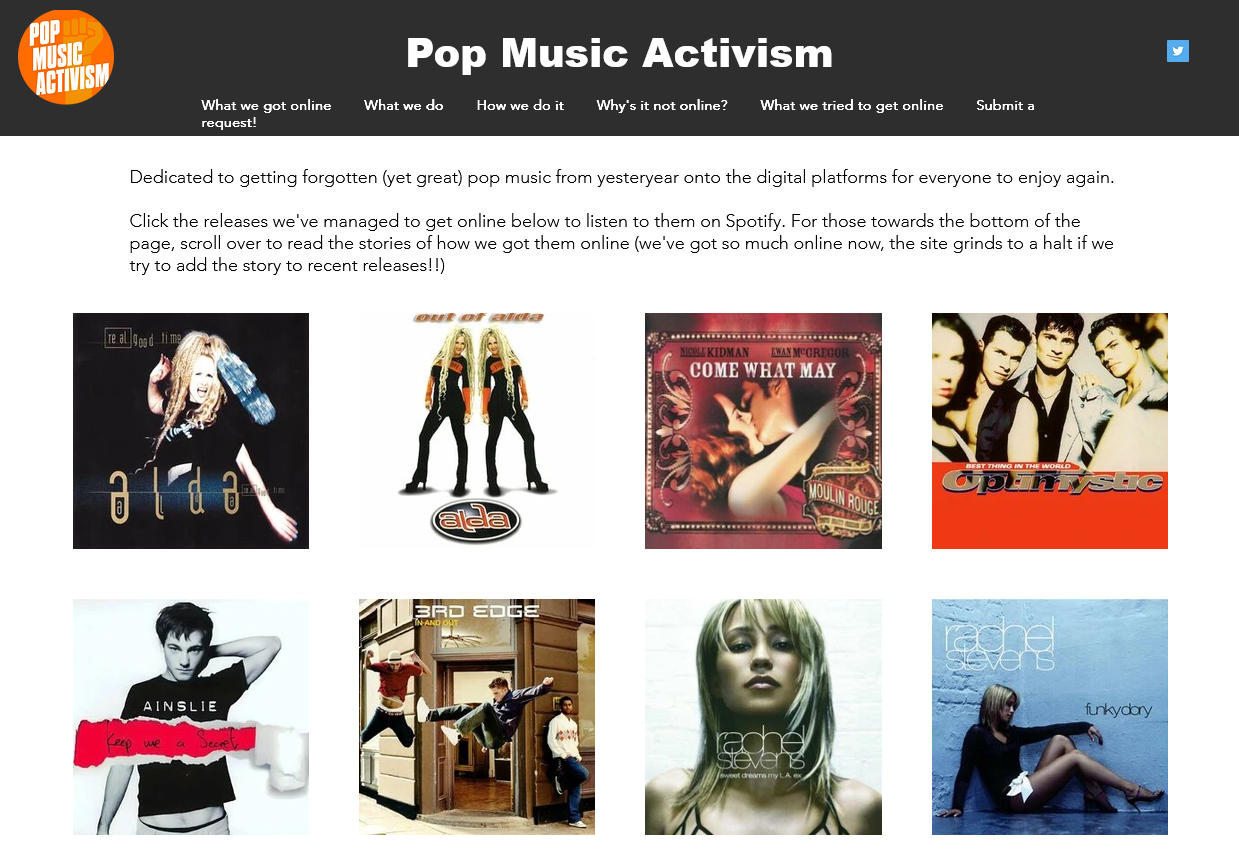
Screenshot of the Pop Music Activism web site

Have you ever been frustrated that some older music isn’t available on digital platforms like Spotify or iTunes? You’re not alone, and Pop Music Activism is trying to do something about it.

There are several reasons why music is missing from these platforms, and indeed there’s a list of the common ones. A lot of dance music from the 1990s and 2000s is missing, and this is often because songs were released by different labels in different countries. It wasn’t until the late 2000s that Spotify came along.

For some artists and bands, you may find their albums there, but not their singles. So remixes and b-sides are harder to come by. Or you may find that the song you want appears in a web search, but when you follow the link, it’s been geo-blocked.

This is where Pop Music Activism comes in. They track down who has the rights, and politely badger them to get the music online. And it works – the home page of the web site has hundreds of releases that are now available to legally stream and download. There have been some particular successes, such Things That Go Bump In The Night by *allStars, which after becoming available again appeared in lots of Hallowe’en playlists and has clocked up over 4 million streams on Spotify. Whilst Spotify pays a fraction of a penny per stream, it’s more than the nothing that these songs were earning before, due them not legally being available anywhere.

If you want to keep track of what ‘new’ old songs become available, you can follow them on Twitter/X. Usually, there’s something new each week on a Friday. It’s about the only reason I still occasionally log into Twitter nowadays. There’s also a monthly email list which I’m on, but can’t seem to find the subscribe link.

Disney Minus

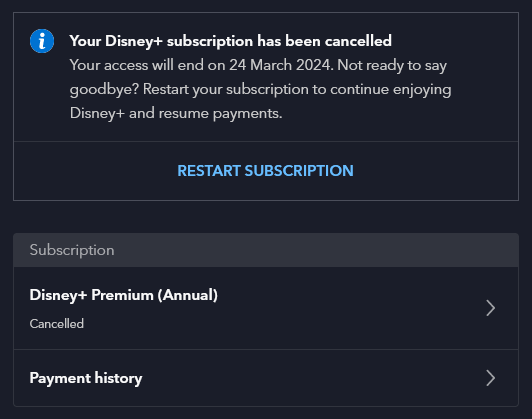
A screenshot of our Disney + account setting showing it cancelled.

Last week, we cancelled Disney+. Our annual subscription was due to renew, and at over £100 for the year, we could no longer justify it.

We’ve had a subscription ever since Disney+ launched in the UK, in the early days of lockdown in 2020. In fact, before then we had a subscription to DisneyLife, which was Disney’s UK-only streaming service for video and music, and used to cost £5 per month. Over time, Disney+ has got better, especially now that content from 20th Century Fox is on there.

But we just don’t watch enough of it. When we signed up to Disney+, there was only one price tier at £7.99 per month or £79 per year. Whilst that was more expensive than DisneyLife, there was more content available so it was worth it. Now there are three price tiers, and the most expensive is £10.99 per month, or £109 per year. That’s more than double what we were paying just five years ago. Whilst there is once again a £5 per month tier, it’s with adverts, and we don’t want those.

Like many kids, our eight-year-old seems to just want to watch YouTube Kids now. It’s something we’ve tried to resist for years, but apparently watching home-made videos and Minecraft walk-throughs is far more interesting than the professionally-produced content that we were paying for. We’ll keep paying for Netflix, as you can download content onto an iPad to watch offline. We tend to clip our eight-year-old’s iPad into a stand fixed to the back of the front passenger seat for long car journeys.

We’ve had Amazon Prime in the past, shared using Amazon Household with another family member, but we don’t have this now. Again, it’s getting more expensive, and we’d rather avoid the adverts. And whilst we’ve had free trials of Apple TV+ and Now TV, we’ve never paid for these beyond the trial period. We also don’t pay for a TV package, and just have Freeview and Freesat for live television.

I guess we’ll just re-subscribe to these from time-to-time when there’s something we actually want to watch.

I do find it odd comparing streaming video with streaming music. There’s a handful of music streaming services – Spotify, YouTube Music, Amazon Music, Deezer and so forth – and for the most part, they all have the same music. Yet with streaming video services, most shows are on one or two at best, and many or exclusive to one service.

Google Chromecast review

A photo of a Google Chromecast

There were only a couple of presents that I specifically asked for Christmas this year, and one of these was a Google Chromecast. At £30, it’s a cheap and easy way of getting internet content onto your TV.

Roku versus Chromecast

If you’ve read my blog for a while, you’ll know that I’ve had a Roku 2 XS since summer 2014. I wanted a Chromecast to complement it, and alleviate some of the Roku’s shortcomings.

The Roku is good little device, especially as it now supports almost all streaming media services in the UK with the recent additions of Rakuten’s Wuaki.tv and Amazon Prime Instant Video. And it’s easy to use, since it comes with a remote control – unlike the Chromecast. The main issues I’ve been having are:

  • Speed – apps such as BBC iPlayer are very slow. You can press pause, and the Roku will take several seconds before it actually responds in any way. I imagine newer Roku devices (the third and fourth series) are much faster; the Roku 2 series was on its way out when I bought it in 2014. That being said, it’s still receiving software updates which is good.
  • Stability – sometimes the Roku crashes, and has to reboot. I’ve had particular problems with the YouTube app causing this.
  • Netflix – the Netflix app on the Roku (second series at least) is poor. It doesn’t support multiple user profiles per account, so whatever you watch goes on the viewing history of the main profile. And parental controls don’t work, so you can’t watch any shows on the Roku which require a parental control PIN.
  • Spotify – Roku has a Spotify app, but you need to be a Premium subscriber to use it – that means paying £10 per month. I’m on Spotify’s £5 per month ‘Unlimited’ plan, which suits me but doesn’t work with the Roku.

Where the Chromecast excels

Setting up the Chromecast is quite easy – it took around 10 minutes which included installing a software update. And installation is as simple as plugging it into a spare HDMI socket, and then connecting the USB cable to a spare socket (a mains adaptor is included if required).

To ‘cast’ something, you just need to open an app on your Android or iOS mobile device, and look for the cast icon. Whatever you’re streaming will then appear on your TV, and you use your device to control it – playing, pausing etc. And, it only casts the content that you’re streaming, so your TV won’t flash up any notifications for example. This is a big advantage over simple Bluetooth speaker systems, for example, which simply broadcast all of the sounds that your device makes.

Compared with the Roku 2, the Chromecast is very fast. Tapping the cast icon in an app registers almost straightaway on the Chromecast and the only delays seem to be caused by buffering, rather than the device itself being slow.

Netflix works as well as it would do on a mobile device, so we can watch more adult things when our one-year-old isn’t about, but also ensure that their profile doesn’t show them. And Spotify streaming via Chromecast is available to all users – even those with free accounts.

There’s also a guest mode, which lets anyone who doesn’t have your Wifi password to cast to your Chromecast – provided that they have the PIN code displayed on the home screen. The PIN changes at least once a day.

…and some pitfalls

I’ve already mentioned the lack of a remote. But this problem is exacerbated, in my view, because you have to go into the app to access the controls to play and pause. On iOS, at least, the controls don’t appear on your device’s lock screen. You can lock your device and the content will still play, but pausing when the phone rings (for example) is a bit more involved. It’d be nice if there was an iOS widget that could pause whatever is playing, but I don’t know if that’s possible.

Not all apps support Chromecast. The big one that’s missing is Amazon Prime Instant Video, although there is a relatively easy workaround. The other app that I miss is UKTV Play, which is the only way that we can watch shows on Dave, like the new series of Red Dwarf. Living in a valley prevents us from receiving Dave via Freeview, we can’t get Virgin Media, it’s not on Freesat and we’re too cheap to pay for Sky.

I was also hoping that my favourite Podcast app, Overcast, would work, but apparently not. A tweet from the developer suggests that it would not be trivial to add this in future. And you’ll need to use an app such as AllCast if you want to view photos and videos from Dropbox on your Chromecast. I had mixed results with this in my testing.

Also, none of the built-in apps on iOS support Chromecast. This isn’t surprising – Apple sells a rival device, the Apple TV, and has a rival protocol called AirPlay. AirPlay is, in my view, more basic than the Chromecast protocol. With AirPlay, your mobile device acts as an intermediary – it receives the content stream, decodes it, and then sends it via AirPlay to your Apple TV. The Chromecast, instead, streams directly from the content provider – your device merely sends some instructions. The main benefit is that it won’t drain your device’s battery.

Sadly, I also had some stability issues when using the NextUp Comedy app with the Chromecast. Like with the Roku, these caused the Chromecast to lock up and restart. However, at least my device remembered where it was, so I could pick it up again easily after a restart.

Putting Chrome into Chromecast

There’s a reason for the Chromecast having such a name, and that’s because you can cast web pages from the Google Chrome web browser on the desktop. This is how you can get the aforementioned Amazon Prime and UKTV Play onto your Chromecast, but it does mean that you’ll have to play and pause playback using your computer. Which isn’t ideal when your computer is in a different room to your TV, like it is in our house.

Overall

The Chromecast isn’t perfect and has some key pitfalls as mentioned. But it’s great value for £30, and relatively simple for a moderately tech-minded person to use.

Roku 2 XS Streaming Player review

A photo of the box for the Roku 2 XS Streaming Player

Last week I purchased a Roku 2 XS Streaming Player from Amazon. Normally costing around £80, Amazon are now selling them for £55, making them just £6 more expensive than the slightly newer but more limited Roku Streaming Stick (sponsored link).

When I discussed streaming media boxes last month, the streaming stick was my original first choice, but this was before the drop in price of the Roku 2 XS. Compared with the Streaming Stick, the 2 XS adds a number of extra features:

  • A USB port, for plugging in external hard disks to watch video files from.
  • A Micro-SD card slot to expand its storage space from the 256 megabytes provided as standard.
  • An Ethernet port.
  • Analogue outputs for televisions that don’t support HDMI.
  • A motion-sensitive remote for playing games, with Angry Birds included.

The latter two don’t bother me too much, but extra capacity could be useful if I end up installing lots of extra channels.

I’m really impressed with it, actually. The box is tiny and can sit comfortably in the palm of your hand – in fact, the remote control is longer than the box itself. Speaking of which, the remote is simple and doesn’t have lots of seemingly useless buttons like most of our other remotes. It doesn’t come with HDMI cable as standard, instead shipping with an analogue cable, but you can get a reasonable HDMI cable from most pound shops these days.

Setting up the Roku

Device setup is quite easy – plug it into your TV and the mains, and then the device will try to connect to the internet. If you haven’t plugged an Ethernet cable in, you’ll get to select a Wifi network, and enter the passcode. Your device will now ask you to go to a computer and set up a Roku account, and then enter a code to link your device to your account. You do need to enter either a credit card number or PayPal email address to create an account, but you won’t be charged unless you purchase an app which costs money.

Roku will offer several channels to you, and then you’re ready to go. It’s easy to navigate around, although sometimes there’s a bit of a lag between you pressing a button on the remote and the box reacting. The newer and more powerful Roku 3 should have less lag but it’s quite a bit more expensive.

Setting up your Roku with your YouTube, Facebook and Flixster (for UltraViolet) accounts is done on your computer as before, but the Netflix app requires you to enter your username and password on the device itself. You can use an on-screen keyboard, or a mobile app for iOS or Android which turns your phone into a remote control, with keyboard entry. I found that the Netflix app would not accept a password with special characters so I had to change it first.

Using the Roku

Once set up, the device is really simple to use on a day to day basis. Firstly, you don’t need to turn it off, as it effectively runs on the same power as a Raspberry Pi and can be left plugged in and switched on without drawing too much electricity. This means it doesn’t take ages to boot up when you want to watch something. Apart from the slight interface lag as mentioned before, it’s quick to navigate through, and as most of the apps are official and authorised you get a consistent experience – the iPlayer app works in a similar way to the BBC’s web site, for example.

I’ve mentioned BBC iPlayer, but ITV Player, 4oD and Demand 5 are also available, covering all four main free-to-air broadcasters in the UK. Of the paid-for streaming services, Roku supports Netflix and Sky’s Now TV, but not Tesco’s BlinkBox or Rakuten’s Wuaki TV. US users can get the Amazon Prime Instant Video channel but it hasn’t launched in the UK yet.

If you want to watch content on your own computer, such as films that you have copied from DVDs, then you can install the Plex app on your Roku, and the Plex Media Server app on your computer. The Plex app on the Roku is free for 30 days and then there is a small charge to keep using it – I paid £1.49 but I think this was a special offer.

Another nifty feature allows you to beam content from the YouTube mobile app to your Roku, in a similar way to Google’s ChromeCast stick and Apple’s AirPlay. An icon appears on your screen, which will show the video on your TV, but you retain control on the mobile device. Right now, YouTube and Netflix are the only two apps which support this although I haven’t tried Netflix myself.

On the whole I’m really impressed with the Roku. At £55 it’s only just over half the price of the Apple TV, and can do just about everything its more expensive competitor can do, and more. The interface is simple and enjoyable to use, apart from the slight lag as mentioned earlier. I would definitely recommend it.

Purchasing a video streaming box

Raspberry Pi

I’m planning to purchase a video streaming box – i.e. a thing that you plug into your TV to watch streaming video services. Now that we have Netflix I’d like to be able to watch films and TV shows on our TV, without having to run them through my Mac (which is also connected to the TV).

Things I’ve already tried

Last year I bought a Raspberry Pi, and for a while I used that to watch BBC iPlayer, but it’s not a great experience. It’s a bit slow and as I had XBian on a different SD card to everything else I had to shut it down, swap the cards and reboot it. The BBC iPlayer interface in XBMC leaves a lot to be desired, plus I’d been using a smartphone app as a remote which is a bit clunky.

Our Freesat box and Blu-Ray players also technically support BBC iPlayer, and the latter also supports YouTube, but they’re so fiddly and slow that they’re not worth using. In particular the remote control for our Toshiba Blu-Ray player is awful – it’s often unresponsive and the buttons are confusing.

Comparing video streaming boxes

A couple of weeks’ ago Pocket Lint did a good review of several boxes available in the UK. They looked at the Apple TV, Roku, Roku Streaming Stick, Sky Now TV, Google Chromecast, WDTV Play, Amazon Fire TV (not currently available in the UK), plus a couple of less-known Android-based boxes.

As much as I like Apple, the Apple TV is out of the question. It’s one of the most expensive boxes on the market, at £99, and doesn’t support many UK streaming services – iPlayer and 4oD are missing, for example. Though Apple does add new channels from time to time, there’s no schedule and no way of adding custom apps without jailbreaking. Apple really needs to consider creating an app store for the Apple TV if it’s going to be more than a niche product.

I also think that the Google Chromecast is a bit too basic. It’s useless without a smartphone or tablet, but it is cheap. And the WDTV Play, as you’d expect from a company like Western Digital, is more about playing content that you already have on your own hard disks, although Netflix is supported.

Sky’s Now TV box is by far the cheapest at £10, and is basically a re-branded Roku box, but without the ability to (easily) add other apps. Indeed, there’s no Netflix because it competes with Now TV, but it does offer the main British streaming services like iPlayer and 4oD. And Amazon’s Fire TV box is US-only at present.

Rockin’ the Roku

So that basically leaves the Roku devices. They support the largest range of streaming services, including all the big British ones. The only notable omission is Amazon Instant Video, which we don’t subscribe to. And you can easily add extra services with custom apps if needed.

The Roku 3 offers more features, such as both ethernet and wifi (and not just the latter), as well as a remote control that can be used with headphones. But it’s larger and needs its own power supply. The Roku Streaming Stick, though less powerful, can run from a USB port and can be hidden away behind your TV. It’s also significantly cheaper at £50, versus £100 for the Roku 3.

So, it looks like I’ll be buying a Roku Streaming Stick soon. In my opinion it offers the best platform support and the best value for money.