My wife Christine recently introduced me to a new animé series on Netflix called Delicious in Dungeon. It’s based on a manga, of which we also recently picked up the first book.
If you like Dungeons & Dragons, and food, then you’ll probably like Delicious in Dungeon. It follows a small guild of explorers, who are trying to save their friend despite losing all their supplies. Hungry, they resort to eating the dungeon monsters they encounter. Early on, they meet a dwarf, who seems highly knowledgable about the best way to cook these monsters and end up eating delicious food of dubious origins.
The animé adaption of the manga is pretty good, with each dish presented like it would be on a cooking programme. In the manga books, the dishes even come with ingredients and nutritional information.
It took me a little while to get into the first episode, but I found it enjoyable and funny despite not being a big animé fan. The only animé I have watched more than a few episodes of is Pokémon, and that’s probably because I play Pokémon Go every day, and so am familiar with the species.
It’s a Netflix exclusive, and new episodes are being released weekly. There are currently 13 volumes of the manga, with a 14th due out this summer. We picked up our English translation from Travelling Man in Manchester.
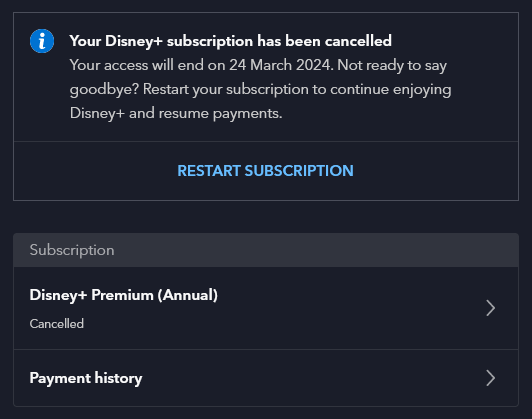
Last week, we cancelled Disney+. Our annual subscription was due to renew, and at over £100 for the year, we could no longer justify it.
We’ve had a subscription ever since Disney+ launched in the UK, in the early days of lockdown in 2020. In fact, before then we had a subscription to DisneyLife, which was Disney’s UK-only streaming service for video and music, and used to cost £5 per month. Over time, Disney+ has got better, especially now that content from 20th Century Fox is on there.
But we just don’t watch enough of it. When we signed up to Disney+, there was only one price tier at £7.99 per month or £79 per year. Whilst that was more expensive than DisneyLife, there was more content available so it was worth it. Now there are three price tiers, and the most expensive is £10.99 per month, or £109 per year. That’s more than double what we were paying just five years ago. Whilst there is once again a £5 per month tier, it’s with adverts, and we don’t want those.
Like many kids, our eight-year-old seems to just want to watch YouTube Kids now. It’s something we’ve tried to resist for years, but apparently watching home-made videos and Minecraft walk-throughs is far more interesting than the professionally-produced content that we were paying for. We’ll keep paying for Netflix, as you can download content onto an iPad to watch offline. We tend to clip our eight-year-old’s iPad into a stand fixed to the back of the front passenger seat for long car journeys.
We’ve had Amazon Prime in the past, shared using Amazon Household with another family member, but we don’t have this now. Again, it’s getting more expensive, and we’d rather avoid the adverts. And whilst we’ve had free trials of Apple TV+ and Now TV, we’ve never paid for these beyond the trial period. We also don’t pay for a TV package, and just have Freeview and Freesat for live television.
I guess we’ll just re-subscribe to these from time-to-time when there’s something we actually want to watch.
I do find it odd comparing streaming video with streaming music. There’s a handful of music streaming services – Spotify, YouTube Music, Amazon Music, Deezer and so forth – and for the most part, they all have the same music. Yet with streaming video services, most shows are on one or two at best, and many or exclusive to one service.
There’s only 32 hours of 2023 remaining in my timezone, so it’s time to review the things I’ve consumed this year and pick out my favourite content.
Note: all links below marked with a * are Amazon referral links, and so I receive a small amount of commission from any purchases. But please feel free to buy these from a local, independent tax-paying shop, or borrow them from your local library, as I did with several of these recommendations.
Favourite book of 2023
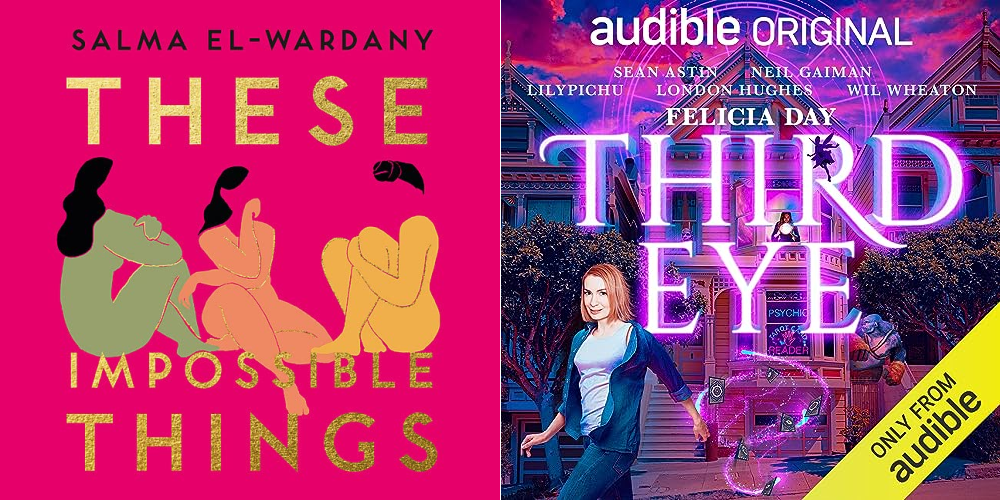
So far I’ve read 95 books this year, although to be fair, quite a few of these were bedtime stories for our eight-year-old. Those aside, my favourite book was ‘These Impossible Things’ by Salma El-Wardany*. It tells the story of three young British Asian women, who are navigating the divide between family and cultural expectations, and life as a young person in the UK in the 21st century. It’s very well-written, with very relatable characters. This is El-Wardany’s debut novel and so I’m interested to see what comes next.
Honourable mentions: There were a few books that I awarded five stars to on Goodreads this year:
What If? 2* is a sequel to Randall Munroe’s first book about absurd hypothetical questions – you’ll know him as the creator of xkcd. The first book* is good as well.
We haven’t been able to watch many films this year, and those that we have seen at the cinema have tended to be child-friendly films. We’re also behind on Marvel films and haven’t seen any in a couple of years. Of those that we have seen, probably my favourite was the Barbie movie, which was just hilarious all the way through. We saw it a few weeks after it came out and there were several of us laughing out loud in the cinema.
Honourable mentions:Dungeons and Dragons: Honour Amongst Thieves* was fun, and it was good to see Hugh Grant playing an antagonist for once. And it was nice to finally see a sequel to Chicken Run – I had the first film on VHS, which gives you an idea of how long ago since that came out, and meant I’ve had to explain to our eight-year-old what a ‘VHS’ is.
It’s also worth noting that we are planning to see Wonka tomorrow.
Favourite TV show of the year
Again, we’ve not had much time to watch TV this year. When you work full-time in a different city to where you live, and have a child who has school and homework and weekend activities, there’s not a lot of time to keep up with TV. Of the shows that I have seen bits of, The Repair Shop has filled that niche of being interesting, comforting and educational.
Favourite audio series of the year
Okay, so I basically created this category so that I could tell you about Felicia Day’s ‘Third Eye’*. It’s an Audible exclusive, and is more akin to a radio play rather than an audiobook. But, it has a narrator in the form of Neil Gaiman and is split into chapters. Felicia Day wrote the script for TV several years ago, and although no TV channels picked it up, it’s become a very good audio series with Day playing the lead character. London Hughes, Alan Tudyk and Wil Wheaton provide some of the other voices.
So – these are the things that I have watched, read and listened to in 2023. Next year, I’m hoping to catch up with the Marvel films we’ve missed (especially now that the pace of release has slowed down) and continue to read more things. Maybe I’ll manage 100 books across the year this time?
There were only a couple of presents that I specifically asked for Christmas this year, and one of these was a Google Chromecast. At £30, it’s a cheap and easy way of getting internet content onto your TV.
The Roku is good little device, especially as it now supports almost all streaming media services in the UK with the recent additions of Rakuten’s Wuaki.tv and Amazon Prime Instant Video. And it’s easy to use, since it comes with a remote control – unlike the Chromecast. The main issues I’ve been having are:
Speed – apps such as BBC iPlayer are very slow. You can press pause, and the Roku will take several seconds before it actually responds in any way. I imagine newer Roku devices (the third and fourth series) are much faster; the Roku 2 series was on its way out when I bought it in 2014. That being said, it’s still receiving software updates which is good.
Stability – sometimes the Roku crashes, and has to reboot. I’ve had particular problems with the YouTube app causing this.
Netflix – the Netflix app on the Roku (second series at least) is poor. It doesn’t support multiple user profiles per account, so whatever you watch goes on the viewing history of the main profile. And parental controls don’t work, so you can’t watch any shows on the Roku which require a parental control PIN.
Spotify – Roku has a Spotify app, but you need to be a Premium subscriber to use it – that means paying £10 per month. I’m on Spotify’s £5 per month ‘Unlimited’ plan, which suits me but doesn’t work with the Roku.
Where the Chromecast excels
Setting up the Chromecast is quite easy – it took around 10 minutes which included installing a software update. And installation is as simple as plugging it into a spare HDMI socket, and then connecting the USB cable to a spare socket (a mains adaptor is included if required).
To ‘cast’ something, you just need to open an app on your Android or iOS mobile device, and look for the cast icon. Whatever you’re streaming will then appear on your TV, and you use your device to control it – playing, pausing etc. And, it only casts the content that you’re streaming, so your TV won’t flash up any notifications for example. This is a big advantage over simple Bluetooth speaker systems, for example, which simply broadcast all of the sounds that your device makes.
Compared with the Roku 2, the Chromecast is very fast. Tapping the cast icon in an app registers almost straightaway on the Chromecast and the only delays seem to be caused by buffering, rather than the device itself being slow.
Netflix works as well as it would do on a mobile device, so we can watch more adult things when our one-year-old isn’t about, but also ensure that their profile doesn’t show them. And Spotify streaming via Chromecast is available to all users – even those with free accounts.
There’s also a guest mode, which lets anyone who doesn’t have your Wifi password to cast to your Chromecast – provided that they have the PIN code displayed on the home screen. The PIN changes at least once a day.
…and some pitfalls
I’ve already mentioned the lack of a remote. But this problem is exacerbated, in my view, because you have to go into the app to access the controls to play and pause. On iOS, at least, the controls don’t appear on your device’s lock screen. You can lock your device and the content will still play, but pausing when the phone rings (for example) is a bit more involved. It’d be nice if there was an iOS widget that could pause whatever is playing, but I don’t know if that’s possible.
Not all apps support Chromecast. The big one that’s missing is Amazon Prime Instant Video, although there is a relatively easy workaround. The other app that I miss is UKTV Play, which is the only way that we can watch shows on Dave, like the new series of Red Dwarf. Living in a valley prevents us from receiving Dave via Freeview, we can’t get Virgin Media, it’s not on Freesat and we’re too cheap to pay for Sky.
I was also hoping that my favourite Podcast app, Overcast, would work, but apparently not. A tweet from the developer suggests that it would not be trivial to add this in future. And you’ll need to use an app such as AllCast if you want to view photos and videos from Dropbox on your Chromecast. I had mixed results with this in my testing.
Also, none of the built-in apps on iOS support Chromecast. This isn’t surprising – Apple sells a rival device, the Apple TV, and has a rival protocol called AirPlay. AirPlay is, in my view, more basic than the Chromecast protocol. With AirPlay, your mobile device acts as an intermediary – it receives the content stream, decodes it, and then sends it via AirPlay to your Apple TV. The Chromecast, instead, streams directly from the content provider – your device merely sends some instructions. The main benefit is that it won’t drain your device’s battery.
Sadly, I also had some stability issues when using the NextUp Comedy app with the Chromecast. Like with the Roku, these caused the Chromecast to lock up and restart. However, at least my device remembered where it was, so I could pick it up again easily after a restart.
Putting Chrome into Chromecast
There’s a reason for the Chromecast having such a name, and that’s because you can cast web pages from the Google Chrome web browser on the desktop. This is how you can get the aforementioned Amazon Prime and UKTV Play onto your Chromecast, but it does mean that you’ll have to play and pause playback using your computer. Which isn’t ideal when your computer is in a different room to your TV, like it is in our house.
Overall
The Chromecast isn’t perfect and has some key pitfalls as mentioned. But it’s great value for £30, and relatively simple for a moderately tech-minded person to use.
Christine and I decided to sign up for Netflix last week. I’d been pondering it for a while but we decided that the price (£6 per month) was worth it considering the number of TV shows on offer. Unlike in the US, Netflix in Britain is online streaming only.
We’ve previously had a DVD rental by post subscription – originally with Amazon, which then got taken over by Lovefilm, and is now back in with Amazon again. That was £3 per month but we were barely using it. We were mainly renting films, and whilst we often have a spare half hour or so for a TV show it’s harder to find time on an evening for a film lasting two hours or more.
Amazon’s takeover of Lovefilm also meant that it was a lot easier to cancel. I almost cancelled Lovefilm a couple of years ago, but whilst on the phone I got talked into taking a cheaper package. Now Amazon just let you cancel in a rather nonchalant way online. I get the impression that Amazon see the DVD rental by post part of their business as a niche that it doesn’t have much of a future when compared to streaming.
Of course, Amazon has its own Instant Video service which does the same thing as Netflix, but we decided not to sign up; Netflix is available on more devices, and you can access everything on Netflix at no extra cost. Amazon, on the other hand, charge extra for some premium content.
What we’ve watched on Netflix
So far we’ve only watched a few things – in fact, Christine has watched more than me, mainly because I was out quite a bit last week whilst she was at home, on call. We’ve started watching Heroes together, as I never watched it when it was on, and Christine’s not seen all of the episodes. Considering it was shown in 2006, it already looks dated, with big CRT monitors in the background, non-smartphones and it being filmed in standard definition. Christine has also watched Grimm, and… Foster’s Home for Imaginary Friends. Yeah. We’ll get around the watching Orange is the New Black as well at some point, as I hear it’s very good – and a Netflix exclusive.
Netflix’s library extends into the few thousands, although there are some interesting omissions. For example, the second Iron Man film is there, but not the first or the third. Such is the weird world of entertainment rights I suppose. Still, you get a lot for £6 a month, and you can dip in and out of series as you please. And there’s no DVDs to return.
Last week we belatedly started watching the BBC One drama series Happy Valley. It stars Sarah Lancashire as Sergeant Catherine Cawood, a policewoman still coming to terms with the suicide of her daughter, when the boy she blames her death on is released from prison. A parallel story thread sees a businessman dabble with the criminal underworld to get enough money to send his daughter to a private school.
All six hour-long episodes of Happy Valley have now aired, but they are available on BBC iPlayer for a couple more days (and you can download the episodes to keep for 30 days). I also expect that it’ll be available on DVD and other digital download services before too long. Happy Valley has been a very well-received series and is tipped for a BAFTA, and there’s talk of a second series.
Happy Valley is shot, and indeed set, in the Calder Valley where Christine and I live. Indeed, the police station where the lead character is based is our local station in Sowerby Bridge, which I pass on the way to work every day. Earlier in the year there were frequently film crews outside, and the signs on the front had been changed from ‘West Yorkshire Police’ to simply ‘Yorkshire Police’, a fictional police force. Unlike its portrayal in the series, the police station is no longer open to the public – an issue that our local MP took up in parliament several years ago. Other scenes are filmed elsewhere in Sowerby Bridge, and also further up the valley in Hebden Bridge, Heptonstall, Todmorden and in the shadow of Stoodley Pike.
Despite the title of ‘Happy Valley’, the series is quite gritty and, though it’s fictional, focuses on some of the area’s social problems. As an example, whilst Hebden Bridge has a reputation for being a tourist-friendly hippie lesbian preservation area, it also has high rates of drug abuse and suicide. The steep sides of the valley, and gentrification, are frequently blamed for the area’s ills.
We’ve only watched episode one so far, so no spoilers please.
If you fancy an evening of entertainment, for free, then one great way of doing this is by being in the audience for a TV recording. Many TV shows are recorded in front of a live audience and in the vast majority of cases the tickets for the audience members were given away free. Christine and I have been to a couple of recordings ourselves, and I have some knowledge to impart on the subject.
1. Find out where to get tickets
There are a number of different companies and organisations that offer tickets. Sometimes this is the broadcaster or the production company itself, but more often that not a third-party company will provide the audience and there are a number of such companies that operate in the UK.
They will list the shows that they are currently offering tickets for; you may also find that you can join a waiting list for tickets for their more popular shows, even if they are not due to be recorded for some time (remember that some shows are recorded as much as 6 months in advance of transmission).
The main ones to look at are:
BBC Shows – for TV and radio programmes made by the BBC themselves
Applause Store – for big shows like X-Factor, Big Brother, but also shows like QI as well.
TV Recordings – some smaller shows like Russell Howard’s Good News and Not Going Out
SRO Audiences – generally used for Channel 4 shows like 8 Out Of 10 Cats and 10 O’Clock Live
Lost in TV – game shows like Superstar, Who Wants To Be A Millionaire
Many of these let you sign up to an email list, so that you are notified when tickets become available for new shows.
2. Most shows are recorded in London
London has more TV studios than the rest of the UK so the majority of recordings take place there. This is great if you live near London but a bit of a pain for us Northerners. You will find some in Birmingham, Manchester and Salford from time to time though.
3. The tickets are not for resale (so don’t buy or sell them)
Because the tickets are free, some people try and sell them on sites like eBay for a quick buck. Don’t do this – if the company offering the tickets finds out, you’ll find the tickets cancelled and you may be barred from future recordings. And, if you buy tickets this way, don’t be surprised to find yourself turned away if the tickets were cancelled, leaving you out of pocket.
4. You need to get there early
By early, I mean at least an hour or more before the doors open. This may seem extreme but empty seats in an audience looks bad, so the audience companies offer more tickets than there are seats, to compensate for no-shows. Unfortunately, should everybody turn up, if you’re at the back of the queue you may be turned away if all of the seats are already full.
For this reason, I’d advise against making special trips to places just to be in the audience. It’s happened to me before.
On the plus side, if you do turn up but the recording is already full, generally you will be put on a ‘priority list’ for a future recording.
If you do get in, then be prepared to wait around for some time before the recording starts – so bring something to read if you’re easily bored.
5. If you can’t go, let the audience company know
When you book tickets in advance, there’s always a chance that, nearer the time, something crops up which means you can’t make it. In this case, contact the company that issued the tickets, tell them that you can’t make it and ask them to re-allocate the tickets. Whilst I mentioned earlier that these companies do compensate for no-shows, by surrendering your unused ticket, you may give somebody else on a waiting list a chance to go instead. Plus, it keeps you in good standing with the audience company – if you don’t show up, then they may decide that you’re an unreliable guest and you will be less likely to get tickets in future – especially for the more popular shows.
6. If you attend regular shows, you may get priority tickets
If you build up a good reputation with a particular company, by showing up on time regularly (and surrendering unused tickets), you may be issued with ‘priority tickets’. This means you’ll be let into the studio first and will probably get the best seats, and often allows you to jump the queue. However, it’s still not a guaranteed seat, and generally you will have to turn up even earlier.
7. Don’t expect to be treated like a paying customer
When you pay to attend an event, you will have some expectations, such as comfortable seats and being treated nicely by staff. The opposite applies here – by attending on a free ticket, you are doing the programme makers a favour. You may find that you’re sat on an uncomfortable wooden set, and you will be expected to follow the instructions given to you by staff at the event. In particular, this includes turning off your mobile phone during the recording (in case there’s interference with radio microphones), keeping quiet when you’re told and also laughing or applauding when required. Hopefully the show will be enjoyable, but if you’re at a comedy recording your role is to laugh at the jokes regardless of how funny (or otherwise) they are.
8. To get tickets to the big shows, you may need to go to smaller ones
The bigger sites like Applause Store are contracted to find audiences both for the big, popular shows, and for new, less-exciting-sounding shows. To encourage people to go to these new shows, you may be offered a deal – go to relatively unknown show X, and get priority tickets to big show Y. Whilst this could mean sitting through a rubbish game show to be broadcast during the daytime on a little-watched digital channel, you will be doing the audience company a favour and so they will be more likely to offer you the chance to see the bigger shows.
9. Tickets for the big shows go quickly
And by quickly I mean within hours. A show like Have I Got News For You will fill up all of its audience seats for a whole series in less than a day, so join Hat Trick’s email list to find out what time the tickets go on sale, and then get them as soon as you can.
10. It takes longer to record a show than it does to broadcast
A half hour TV show may take nearly two hours to record – what you see on TV is the edited highlights. Before the recording starts, there is usually a warm-up act, and at the end of the recording, any bits that didn’t tape properly or were missed out will be re-recorded. Live recordings will fill the allotted time, of course, but bearing in mind that most recordings are done in the evening, it’s probably best not to plan to do anything afterwards. Also, make sure you eat something before, or whilst you are queueing, if you would otherwise miss a mealtime or you’re concerned at the prospect of not eating something for three-to-four hours.