My life in railcards

A photo of my current Disabled Persons Railcard, and an older Young Persons Railcard

Over the years, I’ve had five different types of railcard, to get discounted travel on Britain’s railways. I guess it’s one way of showing how my life has changed over the years.

Staff privileged travel card

Before he retired, my dad used to work for the railways, and this meant that he got free and discounted rail travel for himself and his dependents – i.e. myself and my mum. It was a pretty good deal: 20 days of free travel per year. Except each ‘day’ was actually 48 hours, so (for example) an outbound trip on a Saturday with a return on Sunday would only use one ‘slot’. These were recorded by writing the day on a credit-card sized piece of card, which was paired with another piece of card with my passport photo on.

Once the 20 free days were used up, or if I was saving them, I could get 2/3rd discount on any other tickets.

I was able to hold onto the card until my early 20s – basically, the point at which I was no longer a dependent of my parents and earning my own wage. I miss the days of being able to simply jump on a train to London from Bradford, to attend something like Open Tech, without having to pre-book tickets or worry about the cost. Oh, and did I mention that I was able to travel in first class too?

There were limitations. First class travel was for off-peak only, and there were no seat reservations. Indeed, I would have to give up my seat to a paying passenger if required. But considering how much long distance train fares cost even then, it gave me a lot of freedom in my early adult life. I have travelled first class since then – our return trip from St Andrews, and some London trips where we won upgrades using Seatfrog – but it’s not a frequent occurrence.

If you’ve read this and thought about a career in the railway industry, just be aware that staff travel privileges have almost certainly changed and may be nowhere near as generous as this nowadays.

Young Persons Railcard

Once I was self-sufficient – or at least, earning my own money through work – I had to get my own railcard. At the time, this was the ‘Young Persons Railcard’ but it’s now known as the 16-25 Railcard, which are the age ranges it’s open to. Like most railcards, it costs £30 per year, and gets you a 1/3rd off any train fares, with some exceptions. It does work at peak times, as long as the discounted ticket would cost £12 or more.

Despite the name, you can buy a 16-25 Railcard if you’re 26 or over, as long as you’re in full-time education. And, it doesn’t expire on your 26th birthday – indeed, you can buy one the day before your 26th birthday and it’ll still be valid for a year.

26-30 year-olds can now buy the 26-30 Railcard, but this wasn’t available when I was in that age range. It offers the same discount as the 16-25 Railcard, but it’s digital-only and not available as a physical card.

Two Together Railcard

I wrote about this one in 2014, when it was still a trial in the West Midlands. Thankfully, the Two Together Railcard trial was deemed enough of a success for it to be rolled out nationally, and so Christine and I have had a few of these. As the name suggests, it allows two named people travelling together to get a 1/3rd off rail fares, but can only be used off-peak.

As it’s £30 to buy the card, I remember someone (probably Martin Lewis) doing a stunt at Euston station one day, finding two random people travelling to the same destination, and have them purchase a Two Together Railcard. Even though they were complete strangers, the £30 cost was less than the 1/3rd saving on the two tickets.

Friends and Family Railcard

Children under 5 travel free on the railways, but they need their own ticket from age five onwards. So, the next railcard we had was a Friends and Family Railcard. With this, you save 1/3rd on adult fares and 60% on child fares, and it’s valid for 1-4 adults and 1-4 children travelling together. Ours is a digital railcard and so it lives in the Trainline app, and can be used by myself and/or Christine when we’re travelling with our eight-year-old (and potentially up to three of their friends). For most of the UK, it can be used at any time, but it’s not valid for journeys within London and the South East during peak times.

Disabled Persons Railcard

I fully expected to carry on using a Friends and Family Railcard until our eight-year-old turned 16 and would need their own railcard (see above), but then I found out I was deaf. The definition of ‘disabled’ is quite broad for the Disabled Persons Railcard, and includes anyone who uses a hearing aid – even if your hearing loss isn’t severe or profound. I suppose this is because Railcards are a commercial paid-for product offered by the rail industry; I’m not (yet) eligible for a free bus pass, for example, which would be paid for by my local authority.

As with other railcards, you get a 1/3rd discount, but with no time restrictions. As such, I can use it on my commute to work, and in the year that I’ve had it, it has paid for itself several times over. You can’t (yet) use it to buy season tickets, so I have to purchase a return fare every day that I’m in the office. If another adult is travelling with you, they also get a 1/3rd discount too – they can be a friend, family member, carer, or anyone else really.

You do need to demonstrate that you’re eligible for the card; in my case, I had to email a PDF form to my local authority who stamped and returned it for me, to vouch for my deafness.

We’ll still keep our Friends and Family Railcard, as this ensures discounts for our eight-year-old too, but we’ve no longer any need for a Two Together Railcard. And, unless there’s some way that my hearing can be restored in future, I probably won’t need a Senior Railcard when I reach 60 either. Assuming that railcards are still around in 20 years time.

Seatfrog – how to get a cheap first class upgrade

A screenshot of the Seatfrog app on iOS

Tomorrow, Christine, our three-year-old and I are off to London (actually for the second time this week, but that’s another story). We’re going by train, and, thanks to Seatfrog, we’ll be travelling in first class, at a relatively low additional cost, having already saved some money with railcards and advance booking.

Seat auction

In the UK, Seatfrog is available on LNER services on the East Coast Main Line. You buy your standard class tickets online, as normal, and then put your booking reference into Seatfrog. The day before departure, Seatfrog holds an auction; enter your bid, and if you win, your updated tickets appear in the app.

We bid £10 per ticket for our journey, and this won (the minimum bid was £5). However, there may be a higher reserve on some services – for our return, the reserve was £9. Upgrading to first class gets you a wider, reclining seat, the majority of which are leather upholstered on LNER services. Plus, free Wi-Fi, regular offers of tea and coffee, and, for journeys over an hour, a complementary meal. This is easily worth £10 a head and means we won’t need to buy extra food for our journey.

Of course, there’s no guarantee that you’ll win, and there’s no point bidding too high as you can buy an upgrade outright for £35 per ticket. At least if you’re outbid, no money is taken.

I suppose it’s a good way of filling vacant first class seats. I could also see this being useful for people travelling on business, who can only claim standard class travel on expenses. Seatfrog would allow you to trade up to first class from your own pocket if you’re happy to pay a bit extra yourself.

For now, Seatfrog is only available on LNER services, however, it’s run by an independent company and so it’s possible that other travel companies could adopt it – potentially airlines as well as train operators,

So, tomorrow we’ll be smugly sat in first class, knowing that we paid well under the odds for our tickets,

Combining travel discounts

57309 and 56312

Tomorrow we’re off to the Trafford Centre to buy a washing machine. You may wonder why we’re travelling all the way to the far side of Manchester for something that we could buy more easily locally. As it happens, we have loads of John Lewis gift vouchers left over from our wedding, plus some more from completing online surveys from Valued Opinions and Ipsos i-Say, so in all it’ll work out cheaper. And we’ll be making a day of it.

Because we don’t drive, we’ll be taking public transport – a train to Manchester, and then a bus, as the trams haven’t made it that far yet. In all, this would normally cost around £30 – £21 for return train tickets and around £8-10 for the bus tickets. But, by combining discounts, we got the lot for £12. Here’s how:

Two Together Railcard

Because Christine and I travel together by train a lot, we have a Two Together railcard, which means we get a third off almost all train fares provided we buy the tickets at the same time and travel together. It costs £30 a year, although there are plenty of discount codes bringing it down to £27, and you can exchange Tesco Clubcard vouchers for one as well.

It’s one of the newer railcards, having been launched last year, and we’re on our second card. We got our money’s worth on one journey alone, when we went to Nottingham, and use it regularly.

Advance purchase tickets

Northern Rail, who operate the trains between us and Manchester, have only recently introduced discounted advanced purchase tickets on some routes. If bought before 6pm the previous day, you can get a significant discount on the cost of tickets versus buying them on the day. By buying advanced purchase tickets with our railcard, we got the price of our train travel down from £21 to £8 – not bad.

Plusbus

Plusbus is a not particularly well-known add-on for train tickets, that allows you to purchase discounted bus travel at your destination. You buy it as part as of the same transaction as your train tickets, and it essentially gives you unlimited bus travel at your destination for one day, on participating routes and operators.

I’ll be honest – this weekend will be the first time we’ll be using it, and I’m still not 100% convinced that it will be accepted on the buses that run between Manchester city centre and the Trafford Centre. But, it only cost an additional £2 per ticket, thanks to a special offer that is only running this month, so if it doesn’t then we’re only out of pocket by £4.

Additional discounts

We bought the tickets online at First Transpennine Express, even though we won’t actually be travelling with them at all. I chose them for three reasons:

  1. They offer Nectar points at a rate of 2 points for every pound spent on train travel, so I earned 16 points for the £8 spent on the train tickets. I can then use these points for money off cinema tickets or shopping, for example.
  2. They offer cashback via Quidco (referral link) – it’s only 1%, but that effectively saves a further 12p off the cost.
  3. There are no additional booking, card or postage fees – you just pay for travel.

Disadvantages

The only downside to choosing an advanced purchase ticket is that it restricts us to travelling on certain trains. If we miss these trains, or want to vary our travel plans, then the tickets will no longer be valid and we’d need to buy new ones, probably at full price. Buying on the day costs more, but at least the tickets are fully flexible.

Normally one advantage of buying an advanced purchase ticket is that you also get a confirmed seat reservation as well. Northern Rail don’t offer seat reservations (despite running some long distance services) so the only real advantage of buying tickets in advance is the lower cost. Other operators do include seat reservations, so you could have two passengers: one who paid, say, £12 and got a guaranteed seat, and another who paid £80 on the day and who may have to stand.

And finally, before you ask – we’ll be having the washing machine delivered. I don’t think we’d get it home on public transport.

The Two Together Railcard

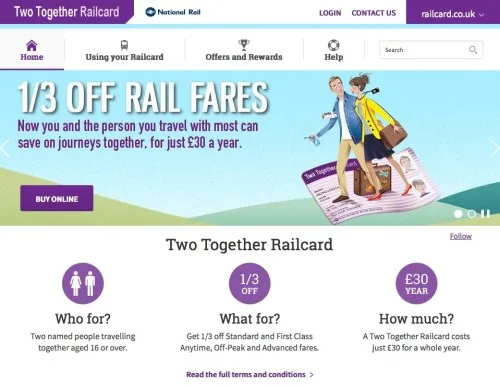
A screenshot of the Two Together Railcard web site

There’s a new addition to the railcard family – the Two Together Railcard. Launched some time ago as a pilot in the West Midlands, it’s now available nationally, as of yesterday.

Unlike most railcards, issued to a single person, this is issued to two named people who must travel together for it to be valid. You needn’t be related, so if you regularly travel with a particular friend or housemate then they can be on the card. Like most railcards, it costs £30 and is valid for one year, and gives you a third off almost all rail tickets. You can also get 10% from this link, so it costs £27 for the year. The card can be bought at staffed ticket offices at stations, or online.

As Christine and I do a lot of travel together, this card has the potential to save us a lot of money, so we’ve ordered one. The £30 cost will easily be recuperated as we regularly spend more than £90 per year on tickets where both of us travel. In fact, it may pay for itself after just one long return journey. Until now we’ve been making use of Northern Rail’s Duo tickets, which allow a second adult to go half price with a full-fare paying adult. But this is limited to only some of Northern’s trains and isn’t a national scheme.

Right now we don’t qualify for any of the four other existing national railcards. The 16-25 railcard is for those aged 16-25 (we’re too old) or older people in full-time education (we’re not). The Friends & Family railcard is for those with children aged 5-15, which won’t apply to us for some time – you need to be travelling with at least one child in that age range for it to be valid. We’re both thirty years too young for the Senior railcard, and neither of us are disabled, so the Disabled railcard is out.

So, if you’re like Christine and I – adults who work full time, are approaching middle age and are childless or don’t have any children over five years old – then the Two Together railcard is a welcome introduction.

Free audience tickets for TV recordings

Reef

If you fancy an evening of entertainment, for free, then one great way of doing this is by being in the audience for a TV recording. Many TV shows are recorded in front of a live audience and in the vast majority of cases the tickets for the audience members were given away free. Christine and I have been to a couple of recordings ourselves, and I have some knowledge to impart on the subject.

1. Find out where to get tickets

There are a number of different companies and organisations that offer tickets. Sometimes this is the broadcaster or the production company itself, but more often that not a third-party company will provide the audience and there are a number of such companies that operate in the UK.

They will list the shows that they are currently offering tickets for; you may also find that you can join a waiting list for tickets for their more popular shows, even if they are not due to be recorded for some time (remember that some shows are recorded as much as 6 months in advance of transmission).

The main ones to look at are:

  • BBC Shows – for TV and radio programmes made by the BBC themselves
  • Applause Store – for big shows like X-Factor, Big Brother, but also shows like QI as well.
  • TV Recordings – some smaller shows like Russell Howard’s Good News and Not Going Out
  • SRO Audiences – generally used for Channel 4 shows like 8 Out Of 10 Cats and 10 O’Clock Live
  • Lost in TV – game shows like Superstar, Who Wants To Be A Millionaire
  • Hat Trick Productions – Have I Got News For You, The Kumars and Room 101

Many of these let you sign up to an email list, so that you are notified when tickets become available for new shows.

2. Most shows are recorded in London

London has more TV studios than the rest of the UK so the majority of recordings take place there. This is great if you live near London but a bit of a pain for us Northerners. You will find some in Birmingham, Manchester and Salford from time to time though.

3. The tickets are not for resale (so don’t buy or sell them)

Because the tickets are free, some people try and sell them on sites like eBay for a quick buck. Don’t do this – if the company offering the tickets finds out, you’ll find the tickets cancelled and you may be barred from future recordings. And, if you buy tickets this way, don’t be surprised to find yourself turned away if the tickets were cancelled, leaving you out of pocket.

4. You need to get there early

By early, I mean at least an hour or more before the doors open. This may seem extreme but empty seats in an audience looks bad, so the audience companies offer more tickets than there are seats, to compensate for no-shows. Unfortunately, should everybody turn up, if you’re at the back of the queue you may be turned away if all of the seats are already full.

For this reason, I’d advise against making special trips to places just to be in the audience. It’s happened to me before.

On the plus side, if you do turn up but the recording is already full, generally you will be put on a ‘priority list’ for a future recording.

If you do get in, then be prepared to wait around for some time before the recording starts – so bring something to read if you’re easily bored.

5. If you can’t go, let the audience company know

When you book tickets in advance, there’s always a chance that, nearer the time, something crops up which means you can’t make it. In this case, contact the company that issued the tickets, tell them that you can’t make it and ask them to re-allocate the tickets. Whilst I mentioned earlier that these companies do compensate for no-shows, by surrendering your unused ticket, you may give somebody else on a waiting list a chance to go instead. Plus, it keeps you in good standing with the audience company – if you don’t show up, then they may decide that you’re an unreliable guest and you will be less likely to get tickets in future – especially for the more popular shows.

6. If you attend regular shows, you may get priority tickets

If you build up a good reputation with a particular company, by showing up on time regularly (and surrendering unused tickets), you may be issued with ‘priority tickets’. This means you’ll be let into the studio first and will probably get the best seats, and often allows you to jump the queue. However, it’s still not a guaranteed seat, and generally you will have to turn up even earlier.

7. Don’t expect to be treated like a paying customer

When you pay to attend an event, you will have some expectations, such as comfortable seats and being treated nicely by staff. The opposite applies here – by attending on a free ticket, you are doing the programme makers a favour. You may find that you’re sat on an uncomfortable wooden set, and you will be expected to follow the instructions given to you by staff at the event. In particular, this includes turning off your mobile phone during the recording (in case there’s interference with radio microphones), keeping quiet when you’re told and also laughing or applauding when required. Hopefully the show will be enjoyable, but if you’re at a comedy recording your role is to laugh at the jokes regardless of how funny (or otherwise) they are.

8. To get tickets to the big shows, you may need to go to smaller ones

The bigger sites like Applause Store are contracted to find audiences both for the big, popular shows, and for new, less-exciting-sounding shows. To encourage people to go to these new shows, you may be offered a deal – go to relatively unknown show X, and get priority tickets to big show Y. Whilst this could mean sitting through a rubbish game show to be broadcast during the daytime on a little-watched digital channel, you will be doing the audience company a favour and so they will be more likely to offer you the chance to see the bigger shows.

9. Tickets for the big shows go quickly

And by quickly I mean within hours. A show like Have I Got News For You will fill up all of its audience seats for a whole series in less than a day, so join Hat Trick’s email list to find out what time the tickets go on sale, and then get them as soon as you can.

10. It takes longer to record a show than it does to broadcast

A half hour TV show may take nearly two hours to record – what you see on TV is the edited highlights. Before the recording starts, there is usually a warm-up act, and at the end of the recording, any bits that didn’t tape properly or were missed out will be re-recorded. Live recordings will fill the allotted time, of course, but bearing in mind that most recordings are done in the evening, it’s probably best not to plan to do anything afterwards. Also, make sure you eat something before, or whilst you are queueing, if you would otherwise miss a mealtime or you’re concerned at the prospect of not eating something for three-to-four hours.

Buying rail tickets

Pendolino

Buying rail tickets for train travel in the UK is complicated. Despite some simplification introduced last year, it’s still possible to buy a range of rail tickets at different prices that will get you on the same seat on the same train.

The fantastic Money Saving Expert has a very thorough guide and it’s well worth a read, but here’s my summarised advice:

  • Buy your rail tickets in advance, and as early as possible – you can get them up to 3 months ahead.
  • Rail tickets bought on the day (so-called ‘walk on fares’) offer lots of flexibility but are also usually the most expensive – you can book as little as 48 hours in advance and save a lot of money.
  • Avoid thetrainline.com – it charges extra fees.
  • You can usually book any ticket from any train company, even if your journey doesn’t use their trains. So you could book with CrossCountry to travel on a First Transpennine Express (FTPE) train and get the same price as you would booking direct with FTPE.
  • Rail Easy displays fares in a different way which can make it easier to find cheaper tickets. I also found that they are more likely to send tickets by first class post for free, rather than charge £6 for next-day delivery. They do charge a booking fee though.
  • If you spend more than £76 per year (or £6 per month) on rail tickets, get a railcard. If you are between the ages of 16 and 25 you can get a 16-25 railcard. You can order a new one right up until the day before your 26th birthday too. Family railcards and senior railcards are also available. They give you 34% off the price of almost all train tickets, including those booked in advance.
  • Sometimes two single rail tickets are cheaper than a return – always check both. This is especially true if you book in advance.
  • Megatrain is worth a look as its fares start from £1 (plus 50p booking fee). Trains run from Sheffield, Derby and Portsmouth into London, but there are connecting coaches from cities like York and Bradford (I travelled from York to London for a total of £3.50 last year). There’s also additional discounts for NUS Extra card holders.

There are many more tips out there, which shows how confusing the system is. Ultimately, the best way to get the cheapest fare is to book as far in advance as possible, use a railcard and shop around a bit.