A couple of weeks ago, we went back to the Science & Industry Museum in Manchester, to see the newly re-opened Power Hall, and their latest exhibition, Horrible Science: Cosmic Chaos. I’ve written about their previous exhibitions here and here.
The Power Hall
The Power Hall has been closed for six of years for a refurbishment. This has included replacing the roof, and installing a more efficient heating system. Indeed, the new heating system is now an exhibit in itself – it’s based around water-source heat pumps which pump water from an aquifer 90 metres below the museum. The heating system also incorporates a recovery system for the steam generated by the various machines on display in the Power Hall. Overall, the new system should be cheaper to run and better for the environment, and explaining how it works is just what the museum should be doing. It’s quite the comparison to see this fancy new system alongside machinery that’s over a hundred years old.
Speaking of the other machines, these are not all on at the same time, but there is a schedule for when they are powered up. These include a talk by one of the museum’s explainer staff, about where the machine came from and what it was used for. We got to see the Buxton diesel generator in action, which used to work in mine research site in Buxton at a time when the site wasn’t connected to the Nation Grid.
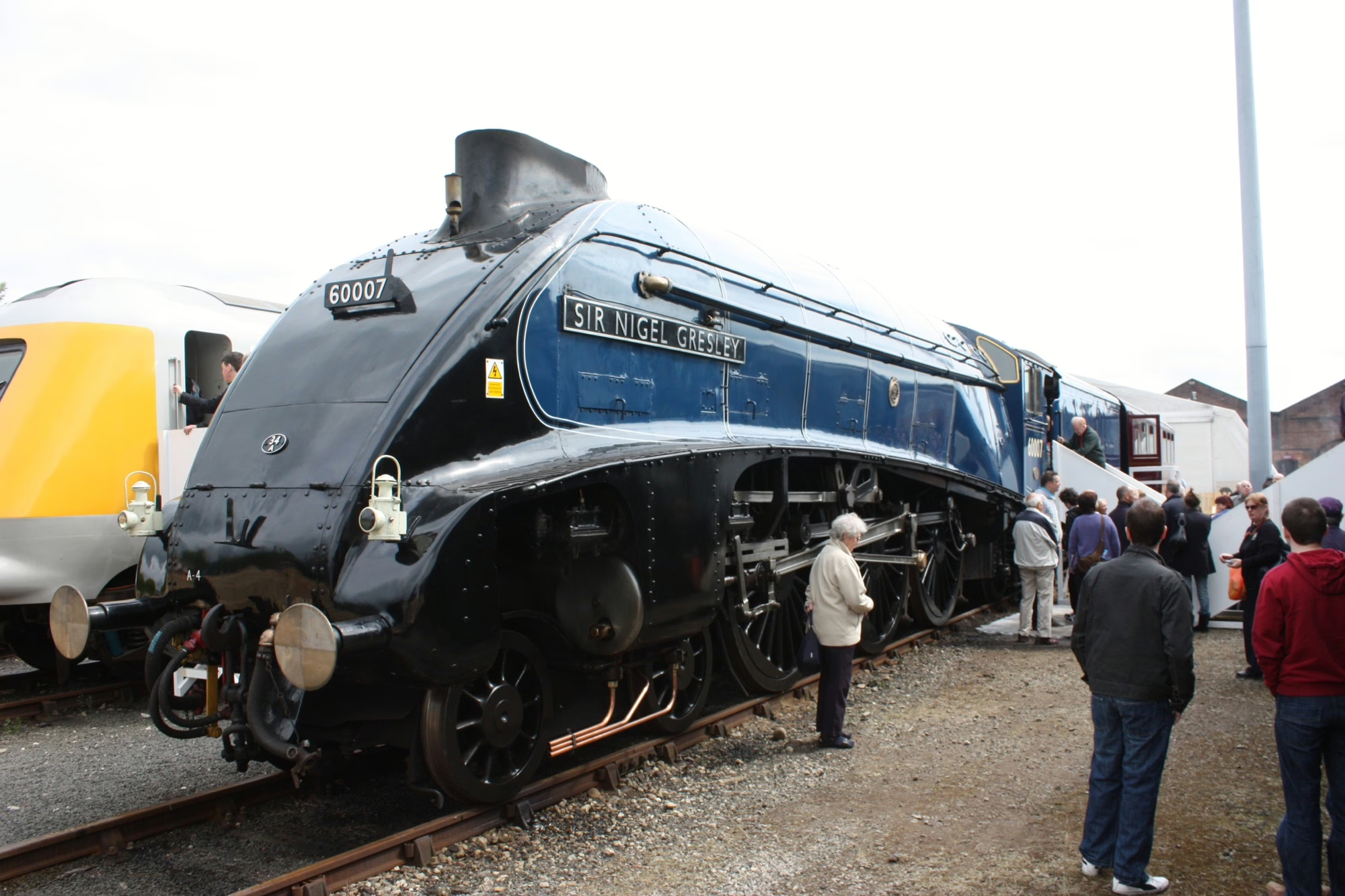
As well as static machines, the Power Hall is also home to some locomotives. There’s an enormous steam locomotive with two tenders, that was built in Manchester almost 100 years ago but worked in South Africa. A smaller locomotive, which was built for the Isle of Man, has been sectioned so that you can see inside it. There’s also Ariadne, a Class 77 electric locomotive that was built for services on the now-closed Woodhead Line between Sheffield and Manchester, and was later exported to the Netherlands. The Woodhead Line used a 1500 KV DC electrification system which isn’t used elsewhere in the UK (apart from on the Tyne & Wear Metro) but is common in the Netherlands.
The refurbishment of the Power Hall is good, and it’s nice to see some of the old exhibits again. It’s also nice for the museum to have more than one building open again; hopefully the rest of the site will be ready by 2030 for the 200th anniversary of the Manchester Liverpool Road station.
Entry to the Power Hall is free.
Horrible Science: Cosmic Chaos
The BBC is following up its hit Horrible Histories series with Horrible Science, and this exhibition is themed around its central character, Dr Big Brain. At the start of the exhibition is a short video where you are recruited as one of his henchpeople, and you are tasked with helping him conquer the solar system. On the way, you get to see what passes for a toilet on a Soyuz-Mir spacecraft, how astronauts live in space, and what each planet in our solar system is like. There’s a good balance of objects from the museum’s collection, with videos and interactive activities for kids.
The exhibition is primarily aimed at 8-14 year olds, as you would expect for a CBBC TV series, but I learned a few things whilst there. As with other special exhibitions, you need to pay extra for entry. Advance booking is recommended for busier times, like school holidays, but when we went on a Sunday it wasn’t too busy.
Accessibility
I’m going to skip over the accessibility section for this one as it’s basically the same as last time we visited.
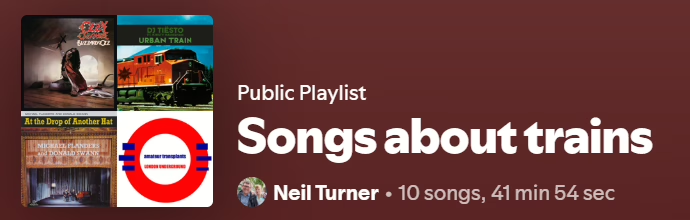
There’s no shortage of songs about trains – Wikipedia has a list of almost 800 – but what I did notice when compiling this is that many are minor key laments. There don’t seem to be many songs about liking trains, but instead they’re metaphors for life not going well. In other words, the subject of the song is taking the train because they don’t have a car and can’t afford to fly. I was also surprised at how many American songwriters have written songs about trains, considering that the American train network is nowhere near as extensive as it could be.
“Urban Train (Wippenberg Remix)” by Tiësto featuring Kirsty Hawkshaw. I chose this remix over the original as I think it’s superior, but also because it has a clickety-clack feel as if you’re on a train going over jointed track.
“London Underground” by Amateur Transplants. The Amateur Transplants were a musical comedy double act, consisting of two doctors: Dr Suman Biswas, now a consultant anaesthetist, and Adam Kay, who quit medicine and is now better known as the author of ‘This Is Going To Hurt’. This is a parody of ‘Going Underground’ by The Jam; released in 2005, it’s a complaint about Tube drivers going on strike. Notably, it complains about the drivers earning £30,000 per year – 20 years later and it’s closer to £80,000 per year. And this is why you should join a union.
“Don’t Stop Believin'” by Journey. “She took the midnight train going anywhere…” Fun fact – when originally released in the UK in 1981, it only reached number 62 in the singles charts. It wasn’t until 2009 that it broke into the top 20, but by 2014 it had sold a million copies in the UK.
“The Nightrain” by Kadoc. Not much to say about this, other than that I used to have it on audio cassette.
“The Train” by Macklemore and Ryan Lewis. Another downbeat song about getting the train. See what I mean?
“Train Kept a Rollin'” by Aerosmith. I’ll be honest, I hadn’t come across this song until compiling this list. I think it’s notable that there’s three classic rock songs in here.
“King’s Cross” by Pet Shop Boys. Yes, another rather downbeat song about the station and the area of London surrounding it. This was before the massive regeneration that has taken place in recent years.
Compared with the average young person in 1980s Yorkshire, I probably got more exposure to trains than other kids my age. This was because my dad worked for British Rail, in their civil engineering department. As such, we got employee travel benefits, meaning 20 days free travel per year and a steep discount on all other rail travel beyond that. As such, we travelled by train a lot; despite living in York, we would have regular day trips to London which was only a couple of hours away.
My parents still have their staff travel privileges, even though my dad retired from the railway over a decade ago. I unfortunately don’t, as I’m no longer dependent on them, but I was able to keep it through my time at university, which was nice.
I could see trains from my bedroom window
The window in my childhood bedroom overlooked mainly fields, but in the distance, I could also see trains on the East Coast Main Line. Our house overlooked one of the busier four-tracked sections, and so as well as London-Scotland Intercity trains, I could also see Transpennine and Crosscountry services, and a few freight trains. We were close enough to be able to make out train liveries and types, but not individual train numbers.
I have vague memories of seeing the engineering trains that were involved in the electrification of the line, which took place in the late 1980s, and experiencing the then new electric Intercity 225 trains that are now in their twilight years.
I grew up in York
York is an important junction on Britain’s railways, largely thanks to George Hudson (although he has a rather complicated legacy thanks to some dodgy financing). It has a much bigger station than many places of a similar size, and is where the East Coast Main Line meets branches from Harrogate and Scarborough to the north, and Hull and Leeds from the south. There are lots of places that you can get to from York without changing trains. So, the combination of easy journeys and free/discounted travel meant that I was able to go on lots of trips by train whilst growing up.
York is also home to the National Railway Museum, which I used to visit regularly as a child. As an adult, I haven’t been in a few years but we’ve taken our nine-year-old there at least a couple of times.
However, that meant that I spent the first 13 years of my adult life largely reliant on public transport. In 2010, I moved out of Bradford, where I was working, to Sowerby Bridge, and this meant that I spent subsequent years commuting to work by train. And even now, I tend to prefer commuting by train – it’s rare that I drive to work, even though I have the option.
Also, in 2009 and 2010, when Christine and I were dating but not living together, one of us would get the train across the Pennines to see each other almost every weekend.
I read magazines about trains
Ever since I could read confidently on my own, I’ve been reading Rail Magazine. Indeed, I’ve had a subscription and/or read it through Readly or Pressreader for many years now, not missing an issue. Which, as it’s published every fortnight, is a lot of content.
For a time, I also read Modern Railways every month, although I stopped when it was no longer included with Readly. I haven’t subscribed because, whilst I appreciated the analysis in it, I just don’t have the time to read that as well. Indeed, recently I was six issues behind with Rail Magazine and only really caught up due to being ill at the end of October.
Consequently, my knowledge of British rolling stock is pretty good. Give me a photo of a passenger unit or locomotive that has run within the past 20 years in Britain, and I’ll probably be able to tell you its class number, when it was introduced, which company built it and where. Granted, it’s not the most useful superpower, although it did come in useful when advising a friend with sensory issues about which trains would be nosiest on a long journey.
I’m also not a trainspotter – I don’t note down individual unit numbers and I don’t actively spend time hunting out particular types of trains. Not that there’s anything wrong with having a hobby like that, if that’s something you enjoy. It’s just not for me.
So, I think, in a nutshell, that’s why I’m interested in trains.
I think most Brits are award of Llanfairpwllgwyngyllgogerychwyrndrobwllllantysiliogogogoch station’s claim of being the station with the longest name on the British Rail network. However, it’s more commonly known as ‘Llanfairpwll station’ and this is what appears on train destination boards. Indeed, its unnecessarily long name was a contrivance thought up by the railway company that originally built it in the 19th Century as a way of encouraging people to visit it by train. It roughly translates into English as ‘The church of St. Mary of the pool of the white hazels near to the fierce whirlpool and the church of St. Tysilio of the red cave’.
Llanfairpwll station today
Llanfairpwll station (as I will call it for the rest of this post) isn’t much of a station. It survived the Beeching cuts in the 1960s, but nowadays it gets a rather infrequent service. Going back towards the mainland, there was a wait of over an hour for the next train whilst we were there. And it’s a ‘request stop’ – if you want to get on a train, you need to make a clear signal to the driver of the train, as otherwise services will pass through at low speed. Similarly, if you’re on a train and want to get off there, you need to tell the guard that you want to do so, so that he/she/they can tell the driver to stop.
There are two short platforms – indeed, some trains that do stop there need to use selective door opening as they’re longer than the platforms – and a footbridge. Only platform one, for trains back towards the mainland, is accessible from the car park as there are no ramps or lifts on the footbridge. There is a gate leading from platform two, for trains towards Holyhead, but it would be a very long walk/wheel back into the town.
As well as being a request stop, Llanfairpwll station is unstaffed. The old station master’s house has been restored, but isn’t in use as far as I can tell. There aren’t even any facilities to buy a ticket here. I think Transport for Wales is missing a trick here, as tickets purchased from here could be collectors items. A machine could be installed that even just sells ceremonial platform tickets.
Tourist trap
The reality is that most people who go to Llanfairpwll station arrive and depart by road. The station retains a large car park, and the fact that this car park has bays for coaches tells you a lot. Next to the station is a large shop, run by James Pringle Weavers (in reality a subsidiary of Edinburgh Woollen Mill) which sells a range of merchandise with Llanfairpwllgwyngyllgogerychwyrndrobwllllantysiliogogogoch branded on it, amongst other things. I’m sure most people grab a couple of photos on the station platforms before going to the shop, and then moving on, without setting foot on a train. And yes, that’s exactly what we did too.
It’s nice that quirks like this still exist in places in the UK, but I feel like the station itself could be more front and centre. Perhaps, with longer platforms, better access, a more frequent service and some ticket machines, more people might actually visit Llanfairpwll station by rail.
Yes, I’m writing about transport in London again, even though I live the best part of 200 miles away. This time, it’s about the ongoing efforts to get diesel trains out of the capital, and what progress is being made. I’m going to look at each of London’s rail termini in turn, and see what proportion of trains are running on electric power.
Background: London’s air quality problem
London, like many cities, has had an air quality problem for centuries. There was the Great Stink in 1858, the rise of pollution during the Industrial Revolution, and more recently, emissions from transport. Though I’ve never lived in London, I’ve made regular visits over the years, and still remember having black snot from the poor air quality.
The good news is that air quality in London is improving. Over the years, the Ultra-Low Emission Zone has expanded to cover just about all of London, and reduced the number of polluting vehicles on the road. Improving air quality has been a particular aim of mayor Sir Sadiq Khan, who has even written a book about it(sponsored link). It’s worth a read – it’s relatively short but gets the message across.
But the ULEZ is just about road transport. Today, I’m focussing on rail transport, and specifically looking at the twelve key London termini. Long-distance rail travel in Great Britain is generally focussed on London, and so if you get rid of diesel trains from London, you also get rid of them from other parts of the country too.
Cannon Street
Starting alphabetically, Cannon Street is the first terminus, and one that I personally have never been to. For many years, it was never open on Sundays, although it has operated seven days a week since 2015. All the trains to Cannon Street are operated by Southeastern, who only operate electric trains. So, Cannon Street is fully electrified – probably a good thing, as it’s an enclosed station with low ceilings.
Charing Cross
A little further west along the River Thames is Charing Cross. Like Cannon Street, it too has low ceilings due to over-site development, and is also only served by Southeastern. So, no dirty diesel trains here either.
Euston
Euston was controversially rebuilt in the 1960s as part of the then British Rail’s upgrade of the West Coast Main Line. This included electrification, and so nowadays almost all of the trains which operate from Euston are electric. Avanti West Coast operated a few diesel services to Chester and onwards to North Wales, but are being replaced with new Hitachi bi-mode trains that can operate on electric power as far as Crewe in Cheshire.
There may be some diesel visitors to Euston on occasion, as services that would normally call at Paddington are diverted to Euston during construction work at Old Oak Common. This includes the Night Riveria Sleeper, and some of GWR’s Hitachi bi-mode trains that may have to run on diesel power as they navigate through their diversionary routes.
Fenchurch Street
Fenchurch Street is the smallest of London’s rail termini, with just four platforms. It’s another one that I’ve never been to, as I’ve never needed to go to places like Tilbury or Southend. If I did, I would be able to catch an electric train there courtesy of c2c, whose entire fleet is electric. Indeed, the lines out of Fenchurch Street were some of the first to be electrified using overhead cables in the late 1950s.
King’s Cross
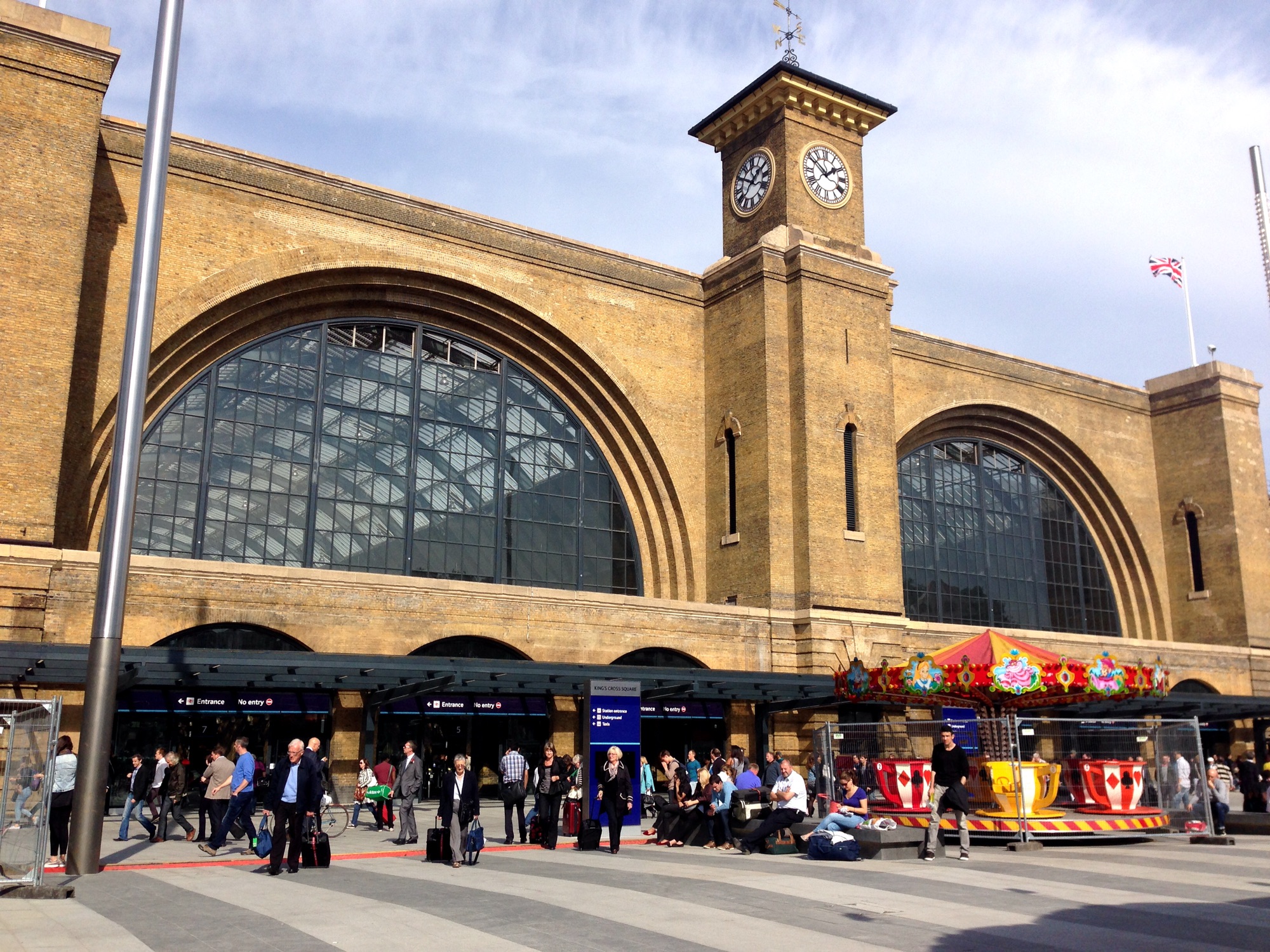
Being from Yorkshire, King’s Cross is the London terminal I’m most familiar with. Most (but not all) of my rail journeys to and from London include King’s Cross.
Though overhead electric wires were strung up for commuter services in the 1970s, the wires didn’t go north of Peterborough until the 1990s. Even then, British Rail still operated a mixture of electric and diesel trains (the venerable High Speed Train) and this persisted until very recently. Their replacement came in the form of more of Hitachi’s bi-mode trains, introduced by LNER. Such trains are also operated by open access operators Hull Trains and Lumo (although Lumo’s trains are all electric).
The outlier is another open access operator, Grand Central. Whilst they operate a small fraction of the services from King’s Cross, at present, they’re all still diesel-powered. That’s due to change, once again thanks to Hitachi who are building some tri-mode trains that can run on electric wires, batteries and diesel. The order for these was only announced a few weeks ago, so it’ll be 2-4 years before we see the back of the last purely diesel trains from King’s Cross, but there’s good progress being made.
Liverpool Street
I’ve only ever been to Liverpool Street mainline station once, which was to use the Stansted Express back in 2009. That was, and still is, an electric train, and indeed all the trains that operate from Liverpool Street are electric. Well, almost: Greater Anglia has a small fleet of bi-mode trains, which for once are not made by Hitachi but by Stadler. Occasionally these run to Liverpool Street, although their main stomping grounds are across Norfolk and Suffolk running regional services. In any case, they should run on electric power when available, so we can tick off Liverpool Street as being electric.
London Bridge
London Bridge underwent a stunning rebuild in the 2010s. I used the old station a bit pre-rebuild and it was awful – the new station is much better.
In the 1930s, the then Southern Railway invested in extensive electrification of its lines, using the third rail principle. Instead of overhead wires, a third metal rail is added to the outside of the two running rails and trains pick up power that way. As such, almost all of the railways in the south-east of England are electrified. Indeed, many have never routinely hosted diesel trains, having gone straight from steam to electric.
However, a handful of lines didn’t get electrified, including services to Uckfield along the Oxted Line. Therefore, there’s a small fleet of diesel trains that serve London Bridge.
Marylebone
Oh dear.
We were doing so well, weren’t we? Seven stations in, and all were either completely electrified, getting there, or had just a handful of diesel services. And then Marylebone has to ruin everything for us.
Okay, so Marylebone is quite a nice London terminus. Whilst not as small as Fenchurch Street, it’s still quite dinky and less overwhelming than some others. It survived closure in the 1980s, and Chiltern Railways has been one of rail privatisation’s few success stories, with new services, new stations and improvements to infrastructure. Indeed, if you want to get a train between London and Birmingham, and don’t mind it being a bit slower, it’s much nicer going from Marylebone to Birmingham Moor Street.
But Marylebone isn’t electrified – at all. Every service that terminates there is a diesel train. And it shows – the last time I was there, there were advertising boards proudly telling us that they had air purification technology built into them. But this wouldn’t be necessary, if the trains that were calling there didn’t spout diesel fumes.
There have been some lacklustre efforts to improve the situation – one of Chiltern Railways’ trains was modified to be a diesel-battery hybrid, and it could use its battery at low speed and in stations. Alas, this was never rolled out to other trains in the fleet. Also, the oldest of Chilterns’ trains are now around 30 years old and need replacing, so putting up electric wires would be timely to prevent a new order of diesel trains.
One issue is that trains from Marylebone to Aylesbury share track with London Underground’s Metropolitan Line services (a relic from when the Metropolitan Line went all the way to Aylesbury). These lines are owned by Transport for London, and electrified using a unique four-rail system. Any electrification scheme would need to take this into account, especially as TfL probably won’t want overhead wires stringing up over their infrastructure. Dual-voltage trains, which can run on both overhead and third-rail electrified lines, are a thing and are used daily on Thameslink services, for example, but this would need careful planning to work out.
Moorgate
Moorgate is a London terminus, albeit of just one line nowadays – the Northern City Line. Historically, this line was considered part of London Underground and was grouped with the Northern Line, and so it’s electrified.
Until the 2010s, some Thameslink services terminated here too, but these were axed to allow platform extensions at Farringdon station. They too were electric though.
Paddington
Paddington was a latecomer to the electrification party (which sounds like a round from I’m Sorry I Haven’t A Clue). The first electric trains started in the late 1990s, and even then, it was just the new Heathrow Express service. However, the announcement of the Great Western Main Line Electrification project allowed it to catch up, with electric wires extended all the way from Airport Junction in West London across the Welsh border into Cardiff. However, that project also went massively over budget, and as such, lines to Bristol and Oxford never received their wires.
Whilst some electric trains run from Paddington, the majority are those Hitachi bi-modes again, which can run on electric power where available and switch to diesel if needed. This has meant that Paddington has moved from having only a handful of electric trains in the 2000s, to being almost entirely electric now. There’s just a handful of commuter trains at peak times that use diesel Networker Turbo units, and the Night Riveria Sleeper train, which uses diesel locomotives. Perhaps, in future, the Night Riveria will be hauled by bi-mode locomotives, such as the new Class 93 and Class 99 locomotives under construction.
See Marylebone? It can be done.
St Pancras
The rebuild of St Pancras for High Speed One services was excellent. I have vague memories of the tired old station, and now it’s much better.
However, there are still a few diesel trains plying their trade at St Pancras. These are the trains which take the Midland Main Line up to Sheffield and Nottingham. This line should have been electrified in its entirety by now; instead, it’s being done on a piecemeal basis and currently the wires are projected to stop just south of Leicester.
The good news is that new trains are on order – and yes, they’re yet more bi-mode trains from Hitachi, although they’ll be slightly different than the units used by other operators. And East Midlands Railway has introduced electric trains from Corby into St Pancras – impressive as Corby station only re-opened in 2009.
Victoria
Victoria is big and confusing. I’ve used it a few times and can’t say I’m a fan. But all the trains that run from Victoria are electric, so that’s good.
Waterloo
Until the Elizabeth Line came along, Waterloo, with its 24 platforms, was the busiest station in the UK. Now it’s third, but still very busy.
It’s also a bit like London Bridge, in that the vast majority of trains are electric, but a handful of diesel services limp on to serve places beyond the reach of the third rail network. Doing something about these services is more pressing than those from London Bridge to Uckfield, as the trains are older and due for replacement. Various ideas have been floated around, but it seems probable that we’ll see existing electric trains getting batteries bolted onto them, and some discontinuous electrification to charge them up. That could be some of the new Class 701s, which have had one of the most protracted entries into service of any new train, or some Class 350s which are about to go off-lease from London Northwestern.
Conclusion
Overall, the majority of train services into London are already electric, including all services to seven of the twelve stations. Of the remaining five, diesel trains make up a small number of services at three of them, and we’ll likely see the back of the last remaining diesel trains at King’s Cross and St Pancras by the end of the decade. The lack of any sort of electrification at Marylebone is a bigger problem to tackle, but then Paddington has gone from being all diesel to almost all electric within 30 years; indeed much of that progress has been within the last 10-15 years. It’s also clear that bi-mode trains have a future until further electrification outside the capital takes place.
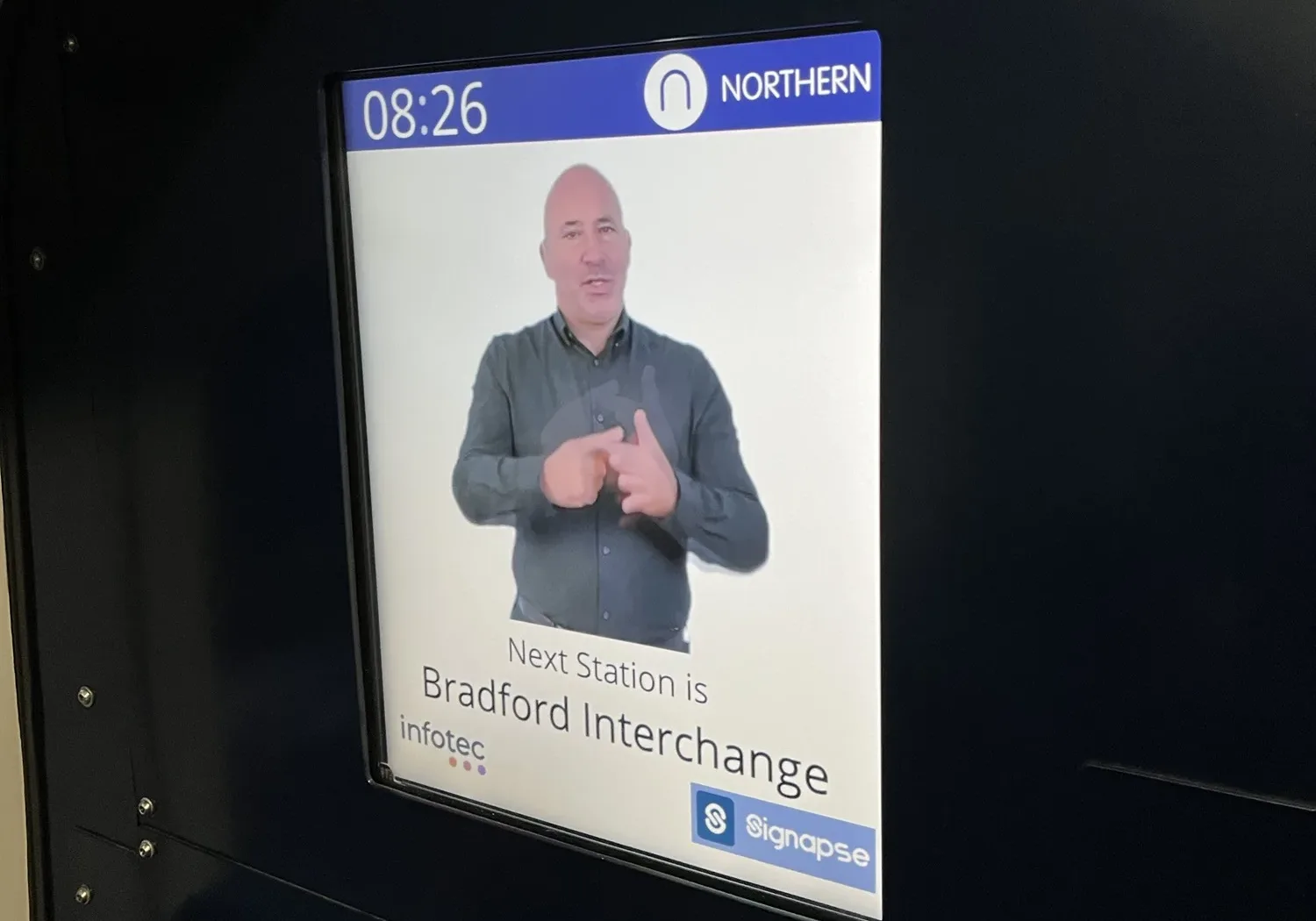
This is in addition to the existing text-based and audio announcements, and is designed to increase the accessibility of the railways for people with disabilities. Elsewhere in the north, Transpennine Express is rolling out BSL screens at stations.
When I shared this photo on Facebook, it got the usual likes and hearts from friends. But, predictably, there were some comments on the lines of ‘can’t they just read?’. And, recently, over at X/Twitter, its overly impulsive edgelord owner recently asked the same question in a tweet.
I too would have probably asked the same question until recently. However, over Christmas, I read Samantha Baines’ brilliant book ‘Living with Hearing Loss and Deafness’(sponsored link). Baines’ book helpfully explains that British Sign Language is, well, a language – and it’s distinct from English. Furthermore, some deaf people who have always been deaf will have BSL as their first language and English as their second. If you ever go abroad, to France for example, and have to constantly translate signs into English, it can get tiring after a while. Now imagine that your first language is sign language, and you have to translate written English into the signs that you have learned, all the time.
As someone who wears hearing aids, learning British Sign Language is something that I plan to do in time. This is because my hearing could continue to deteriorate to the point where hearing aids can’t compensate. Being able to understand BSL may still allow me to communicate with some people should that happen. So whilst these BSL announcements won’t necessarily help me, they will hopefully make trains more accessible for BSL users.
Tomorrow, Christine, our three-year-old and I are off to London (actually for the second time this week, but that’s another story). We’re going by train, and, thanks to Seatfrog, we’ll be travelling in first class, at a relatively low additional cost, having already saved some money with railcards and advance booking.
Seat auction
In the UK, Seatfrog is available on LNER services on the East Coast Main Line. You buy your standard class tickets online, as normal, and then put your booking reference into Seatfrog. The day before departure, Seatfrog holds an auction; enter your bid, and if you win, your updated tickets appear in the app.
We bid £10 per ticket for our journey, and this won (the minimum bid was £5). However, there may be a higher reserve on some services – for our return, the reserve was £9. Upgrading to first class gets you a wider, reclining seat, the majority of which are leather upholstered on LNER services. Plus, free Wi-Fi, regular offers of tea and coffee, and, for journeys over an hour, a complementary meal. This is easily worth £10 a head and means we won’t need to buy extra food for our journey.
Of course, there’s no guarantee that you’ll win, and there’s no point bidding too high as you can buy an upgrade outright for £35 per ticket. At least if you’re outbid, no money is taken.
I suppose it’s a good way of filling vacant first class seats. I could also see this being useful for people travelling on business, who can only claim standard class travel on expenses. Seatfrog would allow you to trade up to first class from your own pocket if you’re happy to pay a bit extra yourself.
For now, Seatfrog is only available on LNER services, however, it’s run by an independent company and so it’s possible that other travel companies could adopt it – potentially airlines as well as train operators,
So, tomorrow we’ll be smugly sat in first class, knowing that we paid well under the odds for our tickets,
Tomorrow we’re off to the Trafford Centre to buy a washing machine. You may wonder why we’re travelling all the way to the far side of Manchester for something that we could buy more easily locally. As it happens, we have loads of John Lewis gift vouchers left over from our wedding, plus some more from completing online surveys from Valued Opinions and Ipsos i-Say, so in all it’ll work out cheaper. And we’ll be making a day of it.
Because we don’t drive, we’ll be taking public transport – a train to Manchester, and then a bus, as the trams haven’t made it that far yet. In all, this would normally cost around £30 – £21 for return train tickets and around £8-10 for the bus tickets. But, by combining discounts, we got the lot for £12. Here’s how:
Two Together Railcard
Because Christine and I travel together by train a lot, we have a Two Together railcard, which means we get a third off almost all train fares provided we buy the tickets at the same time and travel together. It costs £30 a year, although there are plenty of discount codes bringing it down to £27, and you can exchange Tesco Clubcard vouchers for one as well.
It’s one of the newer railcards, having been launched last year, and we’re on our second card. We got our money’s worth on one journey alone, when we went to Nottingham, and use it regularly.
Advance purchase tickets
Northern Rail, who operate the trains between us and Manchester, have only recently introduced discounted advanced purchase tickets on some routes. If bought before 6pm the previous day, you can get a significant discount on the cost of tickets versus buying them on the day. By buying advanced purchase tickets with our railcard, we got the price of our train travel down from £21 to £8 – not bad.
Plusbus
Plusbus is a not particularly well-known add-on for train tickets, that allows you to purchase discounted bus travel at your destination. You buy it as part as of the same transaction as your train tickets, and it essentially gives you unlimited bus travel at your destination for one day, on participating routes and operators.
I’ll be honest – this weekend will be the first time we’ll be using it, and I’m still not 100% convinced that it will be accepted on the buses that run between Manchester city centre and the Trafford Centre. But, it only cost an additional £2 per ticket, thanks to a special offer that is only running this month, so if it doesn’t then we’re only out of pocket by £4.
Additional discounts
We bought the tickets online at First Transpennine Express, even though we won’t actually be travelling with them at all. I chose them for three reasons:
They offer Nectar points at a rate of 2 points for every pound spent on train travel, so I earned 16 points for the £8 spent on the train tickets. I can then use these points for money off cinema tickets or shopping, for example.
They offer cashback via Quidco (referral link) – it’s only 1%, but that effectively saves a further 12p off the cost.
There are no additional booking, card or postage fees – you just pay for travel.
Disadvantages
The only downside to choosing an advanced purchase ticket is that it restricts us to travelling on certain trains. If we miss these trains, or want to vary our travel plans, then the tickets will no longer be valid and we’d need to buy new ones, probably at full price. Buying on the day costs more, but at least the tickets are fully flexible.
Normally one advantage of buying an advanced purchase ticket is that you also get a confirmed seat reservation as well. Northern Rail don’t offer seat reservations (despite running some long distance services) so the only real advantage of buying tickets in advance is the lower cost. Other operators do include seat reservations, so you could have two passengers: one who paid, say, £12 and got a guaranteed seat, and another who paid £80 on the day and who may have to stand.
And finally, before you ask – we’ll be having the washing machine delivered. I don’t think we’d get it home on public transport.
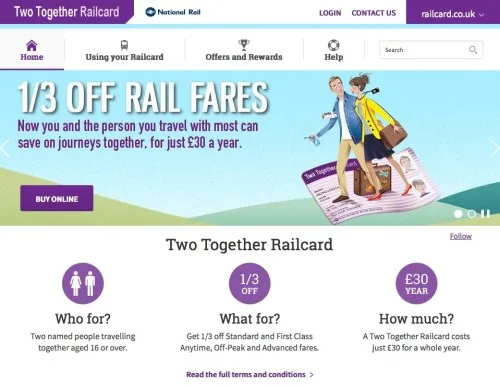
There’s a new addition to the railcard family – the Two Together Railcard. Launched some time ago as a pilot in the West Midlands, it’s now available nationally, as of yesterday.
Unlike most railcards, issued to a single person, this is issued to two named people who must travel together for it to be valid. You needn’t be related, so if you regularly travel with a particular friend or housemate then they can be on the card. Like most railcards, it costs £30 and is valid for one year, and gives you a third off almost all rail tickets. You can also get 10% from this link, so it costs £27 for the year. The card can be bought at staffed ticket offices at stations, or online.
As Christine and I do a lot of travel together, this card has the potential to save us a lot of money, so we’ve ordered one. The £30 cost will easily be recuperated as we regularly spend more than £90 per year on tickets where both of us travel. In fact, it may pay for itself after just one long return journey. Until now we’ve been making use of Northern Rail’s Duo tickets, which allow a second adult to go half price with a full-fare paying adult. But this is limited to only some of Northern’s trains and isn’t a national scheme.
Right now we don’t qualify for any of the four other existing national railcards. The 16-25 railcard is for those aged 16-25 (we’re too old) or older people in full-time education (we’re not). The Friends & Family railcard is for those with children aged 5-15, which won’t apply to us for some time – you need to be travelling with at least one child in that age range for it to be valid. We’re both thirty years too young for the Senior railcard, and neither of us are disabled, so the Disabled railcard is out.
So, if you’re like Christine and I – adults who work full time, are approaching middle age and are childless or don’t have any children over five years old – then the Two Together railcard is a welcome introduction.
On Saturday myself and a group of friends went to do the Transpennine Real Ale Trail. Many of the stations on the railway line between Leeds and Manchester via Huddersfield have pubs serving real ale either on the station or nearby, and eight of these form part of an official trail.
Though it’s been done for years, the trail grew in popularity following the broadcast of Oz and James Drink to Britain, a BBC TV show with Oz Clarke and Top Gear’s James May which was broadcast in 2009. The number of people attempting the real ale trail increased significantly, although sadly many weren’t in it for the real ale. Go back a to any Saturday afternoon earlier this year and you would expect to see large groups of people – mostly men – frequently in fancy dress, drinking lager and engaging in anti-social behaviour.
A particular problem point was the small and usually quiet village of Marsden. Though Marsden has a pub right by the railway station, conveniently called The Railway, many prefer to go into the village to the Riverhead Brewery Tap and others. This BBC News video gives you an idea of how bad it was last year.
Since then, many of the pubs on the route have stopped serving lager and spirits on Saturdays, and will refuse service to those in fancy dress. In other words, patrons have to drink real ale or soft drinks. And, based on our experiences, it seems to be working – whilst a Saturday in late October is bound to be less busy than in mid-summer, the route was much quieter and the people there were better behaved. At Slaithwaite (pronounced ‘slowwwit’) station, Northern Rail had provided a couple of marshals to manage the numbers of people on the small platforms. And at Huddersfield there were a number of British Transport Police officers around, but that may be more to do with the local football team playing local rivals Leeds United at home that day.
On our visit, we went to six of the eight ‘main’ pubs on the trail. Starting at Stalybridge, we then called at Greenfield, Marsden and Slaithwaite, before then skipping straight to Dewsbury and then back to Mirfield. By this point it was getting late, so we didn’t go to Huddersfield or Batley this time around.
I’ve done Huddersfield many times before though, and the station actually plays host to two pubs. They’re both on platform 1 – The Kings Head and The Head of Steam – although the introduction of ticket barriers means that you need to exist the station to access them now. The Head of Steam is my favourite and has the largest overall drinks selection (including a good cider menu) but real ale drinkers tend to prefer The Kings Head as its ale selection is stronger.
It’s a good way to spend an afternoon with friends and I’m pleased that the solution to the problems with rowdy drinkers seems to have worked. Other ale trails are available around the country and this month’s CAMRA magazine has a special feature on pubs at stations, which seem to be enjoying something of a renaissance of late. CAMRA also published a book last year; it’s out of stock on Amazon unfortunately but is available in CAMRA’s own shop, and members get £2 off.