So, in the start of the month round-up, I mentioned that Sci-Fi Weekender had been cancelled with only a few weeks notice. This meant that we had three nights of childcare arranged, with no plans. So, as this post goes live, Christine and I will be on our way down to London.
It’ll be my first trip to London in two years, although Christine has been more recently for some conferences related to her work. Normally we go once a year, so a two year gap is unusual for me. We’re travelling down by train, as per usual; I drove to London and back once, and vowed never to do so again.
It’s also the first time since 2021 that we’ve had a child-free weekend in London. We, of course, love our ten-year-old to bits, and there’s no shortage of things to do in London as a family. But when it’s just two of us, we can just be a little more agile and spontaneous, and can be a bit more daring when it comes to food. Plus, some of the places we’re planning to visit are things that our ten-year-old would either dislike or find boring. Instead, they’re staying with my cousins, and then with my parents in York.
That being said, as I write this, we haven’t firmly decided what we plan to visit. So far, we’ve got the train and the hotel booked, and may go and see a West End show one night. The trips to London we’ve enjoyed the most have had a mixture of planned and spontaneous activities, so we deliberately don’t plan the trip too much before we arrive.
I’ve got a few pre-written blog posts to go live over the next few days, and then I’ll write about where we went. See you soon.
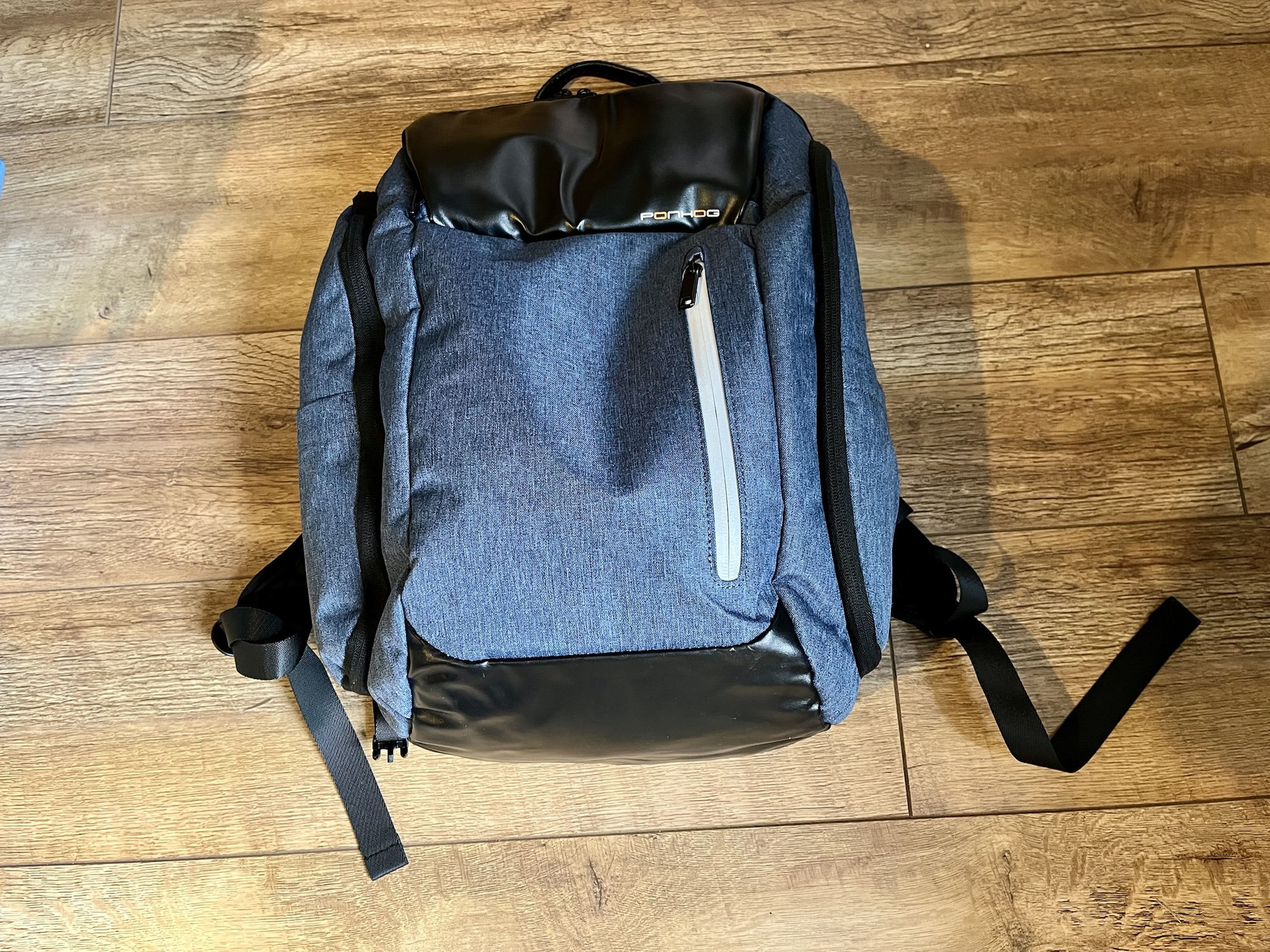
I was in need of a new backpack that can carry a laptop, and so I bought this Ponhog laptop backpack(sponsored link) a few weeks ago. Here’s my review of it, but firstly a bit of background.
I’m a hybrid worker, and when I go into the office I tend to commute by train. In the near future, I’m likely to need to transport my work laptop around more often than I do now. At present, I have a lightweight backpack designed for hiking and cycling, which can hold my iPad, my lunch bag, and not a lot else, so I have a separate laptop bag.
I’d rather not have two bags – I don’t want to be that guy who has to grovel to our IT department because I left the laptop on the train. So, I needed a backpack which could also safely transport a laptop, and this Ponhog laptop backpack seemed to fit the bill.
Overlooking the name ‘ponhog’
Firstly, I’d like to address the elephant, or rather, ‘hog’ in the room: frankly, I think ‘ponhog’ is a terrible name for a luggage brand. Whilst the word ‘ponhog’ itself isn’t in Urban Dictionary (a baseline test for any brand – looking at you, Nonce Finance), ‘pon’ just means ‘on’ and ‘hog’ means ‘pig’.
I don’t have any better suggestions myself, but I’m sure there are many potential brand names that are better than ‘Ponhog’.
The outside of the backpack
There are a number of different styles and colours available. I went with blue, which I mainly chose because I liked the colour, but it also appears to be cheaper than some of the others. The fabric feels like a plastic-y denim, which gives it some water resistance. It certainly hasn’t let in any of the rain that we’ve had in recent weeks whilst I’ve been using it, so that’s good.
There are five zipped compartments accessible from outside. There’s the big main one (more on this later), a smaller one which is behind some black shiny fabric, a small flat one on the front with reflective material, and two tall side compartments. I particularly like the side compartments, as I can pop a water bottle in one, and a reusable coffee cup in the other, and they can be completely enclosed inside. There are also two thin side pockets that don’t zip up, one on each side.
Inside the backpack
It’s possible to open the backpack so both the top and bottom of the main compartment are completely flat. Apparently this is so that you can have it open for inspection at airport security. There are Velcro flaps on each side that you can close if you don’t want to open it fully.
The main compartment is pretty big – it claims to have a 30 litre capacity. At the back are two padded pockets – a larger one for a laptop, and a smaller one for a tablet. A Velcro strap helps to anchor the devices in these pockets in place, although it doesn’t fit snugly around the device like some dedicated laptop bags do. As such, it’ll protect your devices somewhat, but not as much as one with a tighter strap. Also, whilst I could fit my iPad Air into the tablet pocket, I could only do so without a case on. But there’s plenty of room in the laptop pocket for a really chunky laptop and a larger tablet.
The front compartment with the black shiny fabric has four little sub-pockets. I like these – it means that I can sort the various gubbins I carry around with me into each pocket. This includes spare headphones, charger cable and plug, hearing aid batteries, a pen, some hand cream and a power bank. It makes finding things a lot easier, and it’s handy that it’s separate from the main compartment.
What it’s like to wear the backpack
All this would be for nothing if this backpack wasn’t comfortable to wear, so thankfully it is relatively pleasant to have on your back. Overall, it is heavier than my old backpack, which was made of much lighter material, but it also seems more waterproof. The back panel is made of a breathable mesh, and as well as the shoulder straps, there’s a cross brace so that you can transfer some of the weight to your ribcage.
The dimensions mean that it is (just) small enough to be classed as a ‘small under seat bag’ on airlines such as Jet2 and Ryanair, so you could have this in addition to your hand luggage that goes in the overhead locker. Indeed, there’s a strap on the bag that allows you to hook it on top of a rolling case, which is handy. I actually wish I’d taken this to Athens rather than a small tote bag, as it would have made packing to go home much easier.
Whilst I’m primarily using this bag for daily commuting, I can see it being very useful for international travel, should I need to fly somewhere again. I’ve had it for about six weeks as I write this, and have taken it to and from work a few times. Overall, I’m pretty happy with it; it’s the first time that I’ve bought a backpack online rather than in a shop where I can try it on first. So, I’m pleased that it’s been a worthwhile purchase.
For the third year running, I’m summarising all those end of year reviews that apps like Spotify and Goodreads offer you. You can take a look at 2024 and 2023 if you want.
Countries and counties visited
Unlike last year, I did manage to leave England a couple of times – Athens in June, and Wales in July. I also spent some time at Amsterdam Schipol Airport in the Netherlands, but as I was airside the whole time, I’m not really counting it.
Over the course of the year, I have spent at least some time in the following English counties:
West Yorkshire
North Yorkshire
South Yorkshire
East Yorkshire
Lincolnshire
Greater Manchester
Lancashire
Cheshire
Norfolk
County Durham
Merseyside
West Midlands
Oxfordshire
Northamptonshire
Staffordshire
Tyne & Wear
That’s a few more than last year – East Yorkshire, Oxfordshire, Northamptonshire, Staffordshire and Tyne & Wear weren’t on last year’s list.
My trip to Athens was something of an outlier, but we also went further west than last year. Not so far north this time, though.
Methods of transport used
For the first time since doing this, I can include planes in this (Athens again). There was also a lot of driving, in our old and new cars, and I continued to mostly take the train to work. No trips to London last year, but I did travel by train to and from Manchester Airport, when heading to Athens, and to Leeds. Apart from those Manchester trips, which included time on Transpennine Express, all my journeys were with Northern. Speaking of which, I had 8 successful Delay Repay claims, totalling £6.25 (78p on average).
I’ve been on a few buses and trams as well. No ferries last year, but I did spend some time on a boat in Oxfordshire.
Music listened to
Over the year, I scrobbled 15,063 tracks on last.fm, which is more than the past few years. That’s a little over 41 songs per day, so on average I listened to six additional songs per day in 2025 compared to 2024. Assuming an average song is around three minutes, I listened to slightly over two hours of music every day on average. My ‘listening age’ was 42 – only out by a year, which is nice.
Whilst I don’t exclusively listen to music on Spotify, on there, trance was my top genre this year (it was pop last year), according to my Spotify Wrapped. My most-listened to song was Lady Gaga’s Abracadabra – look, a song that was released in 2025 – as it’s one of our (now) ten-year-old’s favourites. Similarly zeitgeisty was my top album – the soundtrack to K-Pop Demon Hunters.
My top artist was Alex Christensen, which is a weird outlier; he released several albums of classical cover versions of dance music which I marathon-listened to one day. Last year’s top, Armin van Buuren, was second.
Books read and listened to
According to My Goodreads Year in Books for 2025, I read 76 books this year, which is one less than last year (and 17 fewer than 2023). Unfortunately, I set my 2025 reading challenge at 80 books, so didn’t achieve it. Also, books ‘read’ include those that I have listened to as audiobooks.
The shortest book I read, at 64 pages long, was ‘Our Super Japanese Adventure‘ by Sarah Graley and Stef Purenins (not available on Amazon), who we met at Thought Bubble. Meanwhile, the longest book was ‘Rule of Cool‘ (sponsored link) by Matthew Siege at 479 pages, although I listened to the audiobook which was narrated by Felicia Day over 12 and a half hours. The longest audiobook was ‘Neurotribes‘ (sponsored link) by Steve Silberman, which was over 20 hours and probably the longest audiobook I’ve ever listened to, although the print edition is 477 pages (two less than the Rule of Cool)
Overall, the average length of book that I read was 270 pages, which is 39 more than 2024. ‘A Brief History of Time‘ by Prof Stephen Hawking (sponsored link) was the most popular book that I read last year. Although, I found it a struggle in parts and, unsurprisingly, some of the science has changed in the 37 years since it was first published.
Beers and ciders consumed
I log the beers and ciders that I drink using Untappd, and these stats are from my year in beer. Like last year, I drank less than one per month (11 in total) and my main style was ‘non-alcoholic’.
Steps taken
My total steps taken was very similar to 2024 and 2023. Overall I took 3,455,761 steps, which is only slightly less than 2024. My average is 9,468 per day; January was my most sedentary month and July was my most active, but not by much.
Time spent learning French
I started Duolingo’s French course on the 1st January 2022 (so I have a four year streak now), and in 2025, I spent 3,560 minutes learning – that’s 59 hours in total. Compared to 2024, that’s 11 hours less, but we didn’t go to France again this year.
My Duolingo Score for French is 118, which means that I’m in the medium B2 level (‘vantage’) of the CEFR for French. Currently Duolingo’s maximum score for French is 130, which is high B2 level and should be sufficient to study a university course taught in French. I was expecting to have reached 130 by now, but clearly not.
Still, not much further to go. I’m probably going to switch to German next – I got an A* in GCSE German in 2000, but a quarter of a century has passed since then and I’ve forgotten most of it.
A new stat that I tracked in 2024 was an estimate of photos taken, although it will also include some screenshots as well. In 2025, I took 1536 photos, so less than 2024 but more than 2023.
So, that’s 2025 quantified, and a useful summary of the statistics from various web services that seem to spend their December telling me data they hold about me but in a nice way.
This is the fifth and final blog post about my trip to Athens – bearing in mind that my trip was only for three and a half days. This is where I want to write about everything else that happened whilst not in Athens – i.e. the journey there and back. Here are the links to part one, part two, part three and part four.
Ibis Budget hotel at Manchester Airport
As I mentioned last Monday, my flight was a 6:30am departure from Manchester on a Sunday morning. With this in mind, I booked myself a room in the Ibis Budget hotel at the airport, and then got a train over on the Saturday night.
Now, if you’re staying in a hotel with the word ‘budget’ in its name, you need to manage your expectations. The rooms are small – there’s space for a double bed, but no bedside tables. There’s a small and narrow desk, a blind instead of curtains, and quite a thin mattress. But as I only needed the room for about seven hours, it was fine. There was free Wi-Fi, and most importantly it was in very easy walking distance of Terminal 2, where I needed to be for my flight. I didn’t want to stay somewhere that required a shuttle bus transfer which may or may not turn up at stupid o’clock in the morning. And the room was significantly cheaper than almost all other hotels at the airport.
Manchester Airport at 5am on a Sunday
Speaking of an early start, you would not know that it was only 5am on a Sunday once you were through security and in to the duty free bit before the gates. It was like the Trafford Centre on a Saturday afternoon – all the shops were open, all the lights were on, and it was heaving. There was a lack of seating, although Terminal 2 is being renovated at present which may explain the lack of capacity.
Judging by the airlines and destinations, it was mostly package holiday flights taking advantage of off-peak slots.
Flying with Jet2
Indeed, my flight to Athens was with Jet2. Jet2’s selling point is that they’re a budget airline, but they’re not as stingy as some of their rivals *cough*Ryanair*cough*. You’re allowed one standard cabin bag, and one small bag as standard, although you can pay extra to ‘guarantee’ space for your cabin bag in the overhead locker. My carry-on case was quite a bit smaller than the maximum permitted size and so I didn’t bother, and indeed had no issues with space. As with my trip to Dublin, I only took carry-on luggage with me.
If you want a meal on the flight, you have to pre-order it when checking in online. It is, of course, extortionately expensive for what it is, but the food was fine and rather welcome considering my early start. If you don’t pre-order food, the cabin crew may be able to offer any food that is left over after the pre-orders have been given out.
On more than one occasion, staff wished me a good holiday. I didn’t have the heart to tell them I was travelling for work.
Flying with KLM
My flights back were with KLM, the Dutch flag carrier, and so this meant a connection at Amsterdam. I honestly expected more from KLM – after all, Jet2 is a budget airline and so I didn’t expect any niceties like in-flight entertainment or Wi-Fi. But I didn’t have those with KLM either, and both planes were also a bit shabbier and care-warn than Jet2’s plane. They were all variants of Boeing 737 planes, if you’re interested.
KLM did include a ‘snack’ on each flight though. From Athens to Amsterdam, we were all offered a Beemster cheese sandwich with a honey and mustard dressing, which was actually quite nice, and a small piece of cake. Drinks were also offered. Meanwhile, for the much shorter flight from Amsterdam to Manchester, we just got a packet of Mini Cheddars and a more limited range of drinks.
My flight back to Manchester also appeared to be a late aircraft swap. When I checked in at the gate, I was given a new boarding pass with a different seat number, having been moved from row 29 to row 22. Indeed, there was no row 29 on this plane. Amsterdam Schiphol Airport is KLM’s hub, and so they must’ve decided to swap the planes as the flight was under-booked.
Amsterdam Schiphol Airport
After Dubai, Schiphol is the second busiest airport that I’ve been to. My brief layover there on Tuesday is, to date, the only time I have been in the Netherlands, and I don’t think it really counts as I spent my entire time ‘airside’. Unlike other big airports, Schiphol has just one massive terminal, arranged in a horseshoe shape. Thankfully, my arrival and departure gates were relatively close to each other and so I didn’t have to walk too far. Like in Athens, there were lots of food and shopping brands familiar to Brits. Although, unlike 5am in Manchester, by the time I got to Amsterdam at close to 9pm local time, many of the places to eat were closed. I ended up spending €10 on a WHSmith meal deal for some sustenance.
Getting home
I think some colleagues at the summit were a little concerned that my journey home to Sowerby Bridge consisted of two flights and then three trains. As it was, both flights were only delayed very slightly, and all my trains were on time – a relief as I had to change at both Manchester Oxford Road and Victoria, and the connections were both around five minutes. Not only that, but my train from Victoria to Sowerby Bridge was the last train of the night, so I was very relieved to make that connection.
Whilst this wasn’t my first visit to Greece – I went to the Greek island of Crete when I was three, but don’t remember much about it – this was my first time in the Greek capital. As per previous trips to Paris and Dublin, here are some assorted notes about my time in Athens.
Athens Airport
My flights were to and from Athens International Airport “Eleftherios Venizelos”, which was opened in 2001 in readiness for Athens to host the 2004 Olympic and Paralympic Games. As such, it’s relatively modern, but it’s clear that passenger numbers have grown since it was opened. We were bussed between the plane and terminal both times, as there’s not enough airbridges to allow direct boarding. On arrival, we had to sit on the tarmac for a while to get a parking space and again to wait for the buses to arrive – the pilot commented that it was like they weren’t expecting us.
Inside the terminal, I was a little surprised at just how many British/global brands were there – the shops were all WHSmith, and there was a Burger King and Pret a Manger. It turns out they’re all operated by SSP, a British multinational which runs many franchised outlets in airports and railway stations. There were plenty of Greek options though too. Oh, and lots of adverts, in English, for Lidl, advising people that they can still use the Lidl Plus app in Greece.
Whilst our departure was from the main terminal, when I first arrived we were bussed to the satellite terminal. There followed a ten minute underground walk to the main terminal. According to Wikipedia, the airport was built with room to expand, and it looks like it needs it. It has two runways, either side of the A6 motorway, and on the return flight the plane taxied over the motorway to take off. Hopefully they will open another satellite terminal soon, and consider some kind of people mover to get people around more quickly.
The city of Athens
We arrived in Athens on a Sunday, and then Monday was Whit Monday, which in Greece is celebrated as the ‘Day of the Holy Spirit’ and is therefore a public holiday. As such, the city seemed rather closed up and deserted until Tuesday, which for me was just a half day. However, lots of shops seemed to be open late on Monday night, presumably because it’s cooler.
Athens also has a graffiti problem – much more so than Paris which I thought was bad. There were also more buildings in a state of disrepair, with some older buildings looking like they’d had scaffolding around them for years. However, this certainly wasn’t the majority and not reflective of the whole city.
Transport
In terms of transport, Athens has a variety of modes on offer. There’s an underground metro, trams, and trolleybuses, as well as the usual buses – some of which are zero-emission battery electric buses. As befits an ancient city, lots of the streets are quite narrow and there are one-way systems in lieu of dual carriageways in places. Coming from Bradford, which was the last UK city to get rid of its trolleybuses in 1972, it was good to see them still in use in Greece. After all, Greece is not short of sunlight for solar power, and I saw plenty of solar panels whilst there.
I was provided taxi transport to and from the airport, which took around half an hour, but the metro and suburban rail services also connect to the airport, using overhead electrified lines. That being said, I only saw a couple of trains in each direction – the railway is in the central reservation of the motorway links to the airport. Had I needed to take the metro, I would have been able to get very close to my hotel without any changes.
Speaking of motorways, these seemed relatively new and were tolled. Our driver had a toll tag, similar to the one we use when in France. Some of the motorways were quite twisty, with sharper bends that I would expect to see in the UK, but I suspect that this is due to the terrain – we also went through several tunnels.
Almost all signage that I saw was in both Greek and English.
My hotel
I stayed at the NYX Esperia Palace Hotel, which is part of the Leonardo Hotels group. It’s quite new, and way outside my normal budget for a hotel. There are two swimming pools – one in the basement, and a smaller one on the roof. The restaurant is also up on the roof, with a view of the Acropolis – I really enjoyed being able to sit outside at breakfast time with a stunning view across the city.
As a smart home geek, I was particularly drawn to the controls in the rooms. There were several human presence sensors to turn on the lights automatically, and several touchscreen panels to control the lights, air conditioning and even open and close the curtains. For coffee making, there was a Nespresso machine in the room – indeed, it appears that pod coffee machines are really popular in Greece based on my experience.
The hotel was also just on the next block over from LanguageCert’s headquarters. The Wi-Fi was free and worked well.
Mobile phones
I bought a 1 GB eSIM before setting off for £4 on Airalo, rather than relying on roaming. Greece has three main networks:
Vodafone, which Brits will be familiar with. Indeed, at Athens airport, there was a vending machine selling Vodafone SIM cards which was clearly aimed at Brits.
Cosmote, which is the state operator but is majority owned by Deutsche Telekom. As such, there’s a lot of T-Mobile co-branding. Brits may be surprised to see T-Mobile still in existence as in the UK it merged with Orange, became EE and was then bought by BT.
Nova, which is what both my UK SIM on 3 connected to, and the network used by my Meraki Mobile eSIM from Airalo.
Across Athens, 5G internet was widely available. Indeed, it may be that Nova has already turned off its 3G network (as all but O2 in the UK have already done) as when I couldn’t get a 5G or 4G signal, it dropped down to EDGE.
I realised after reviewing this that it sounds like I’m surprised that Greece has similar level of connectivity to the UK, as if my perception is that Greece is somehow less developed than the UK. This was not my intention – I think as someone who would feel very isolated without internet access, I was reassuring myself that I would have good access to services whilst travelling.
Food
The food we had during our stay was nothing short of excellent. Christine and I are both foodies and we cook a lot of Persian food at home, of which Greek food has some similarities. The organisers of the summit took us to a couple of excellent Greek restaurants for our evening meals – again, both with a view of the Acropolis. I ate very well whilst I was away.
If you play Pokemon Go, then there’s a Pokemon to catch which is exclusive to Greece and Egypt (and parts of Albania bordering Greece): Sigilyph. They’re not very common – it took me until the morning of my departure on Tuesday to track one down – but they often appeared on my radar. I later caught another at the airport whilst waiting for my flight.
I have one more blog post to follow, which will be another miscellaneous blog post about everything else that happened whilst I was away.
Something that seemed popular on Bluesky last week was Sophie Stone’s UK Travel Visualiser. There’s a map of the UK (plus the Isle of Man) showing each county, and you can select each one to mark whether you’ve lived there, stayed over, visited, stopped or passed through. I’ve uploaded an excerpt of mine above, and included the full image below (converted from SVG to PNG because I can’t be bothered amending the WordPress config file to enable SVG uploads).
Here’s a text based breakdown for the counties I have visited:
Counties I have lived in
Just two: North Yorkshire and West Yorkshire. I was born in York, in North Yorkshire, and then moved to Bradford in West Yorkshire when I was 18. Then, when Christine and I decided to move in together in 2010, we moved to Sowerby Bridge, also in West Yorkshire, where we still live now. Christine meanwhile has also lived in Lancashire and Derbyshire.
Counties I have stayed in
I’ve interpreted this as ‘counties where I have stayed overnight for at least one night’. There are a lot more of these:
Berkshire – last visited in 2021 when we stayed in Slough, ahead of a trip to Legoland Windsor.
Bristol – I last visited for work in 2014, which involved a couple of overnight stays.
Cheshire – an overnight stay in Chester in 2012 with Christine, marking a year since we got engaged.
Cumbria – lots of hiking trips to the Lake District, but I think our most recent stay was with a friend from university who has now settled in Kirkby Lonsdale.
Derbyshire – another hiking trip, this time to Dovedale in 2009.
Durham – we stayed overnight to attend a wedding in 2016.
East Riding of Yorkshire – my grandparents lived in the East Riding and so stayed over many times in the past.
East Sussex – on holiday in 2021.
Greater London – I last stayed over last year, however Christine has been more recently.
Greater Manchester – before I could drive, we used to stay over in Manchester after various music gigs. The last time was in 2014, when we saw Delain and Within Temptation at the O2 Apollo. Also spent a couple of nights there for a stag do in 2015.
Hampshire – we’ve stayed over at the Travelodge by Portsmouth Ferry Terminal a few times on the way back from France, most recently in 2023. Also that year, we spent an afternoon in Southsea.
Herefordshire – way back in the late 1990s, I went on a week-long PGL holiday near Ross-on-Wye.
Hertfordshire – another overnight stay for a wedding, this time in 2013, in Stevenage.
Kent – though we visited Kent in 2021, we stayed in East Sussex. The last time I stayed overnight in Kent was in 2000, on a short break ahead of a few days in the Pas-de-Calais region of France.
Lancashire – Christine lived here when I met her, and so I stayed overnight a few times during 2009 and 2010 before we moved in together.
Leicestershire – another overnight stay for a wedding, this time in 2018. The wedding was at the National Space Centre in Leicester, incidentally.
Lincolnshire – I had a few days in Lincoln with my parents in 2001.
Tyne and Wear – our most recent trip away was last weekend, when we stayed overnight in Gateshead to visit Beamish. Even though Beamish itself is in County Durham.
Fife – one of my mum’s university friends lives in Fife and so I’ve been a few times. Our most recent visit was in 2015, and, in what is becoming a theme, it was for a wedding.
Perth and Kinross – very early in our relationship, Christine and I joined two other couples on a long weekend near Callander in Perthshire, in early 2010.
Counties I have visited
This is a much smaller list of places where I have intentionally gone to on a day trip:
Cambridgeshire – I’ve been to Cambridge once, for a meetup with other editors at the Open Directory Project, back in 2003.
Shropshire and Powys – as mentioned, I have family in Staffordshire and so I’ve been to Shropshire and Powys before on day trips – just not very recently.
Lanarkshire – I’ve also only made it to Glasgow once, in November 2009. I met up with several people in my World of Warcraft guild, including Hari – we had split up earlier that year and this was the first time we’d seen each other since. I’d first met Christine a few weeks before.
Counties I have stopped off in
Essex – literally just at Birchanger Green services on the M11.
East Sussex – part of Gatwick Airport is in East Sussex and so I would have been there very briefly in 1999.
Counties I have passed through
Devon, Somerset and Dorset – in the 1990s, when on holiday with my parents, we came back via Poole and Plymouth on occasion and so will have passed through these counties. But I haven’t visited them properly.
Gwent – on the way to Cardiff in 2004.
Rutland, Northamptonshire, Bedfordshire, Buckinghamshire – these are places I have driven through, but never visited. Christine has recently reconnected with some of her family in Milton Keynes, so Buckinghamshire may rise up the list in future.
Berwickshire, West Lothian, Midlothian, East Lothian. These are all counties that we passed through on our way to Fife in 2015.
Dumfries, Dumbartonshire, Stirling & Falkirk. Similarly, we passed through these in 2010 on the way to Callander.
Counties I’ve never been to
I’m not going to list them all, but this includes large parts of Scotland, mid Wales, and the whole of Northern Ireland. We’d like to go to Cornwall at some point, but it’s a very long way from where we are in Northern England. There’s a reason why there’s still a sleeper train from London to Penzance. Our nine-year-old has also expressed an interest in seeing the Giant’s Causeway in Northern Ireland at some point.
How many points?
The UK Travel Visualiser also awards points – the longer you’ve spent in a county, the more points you get. I managed 184 points – not bad, but it would have been higher if I had lived in more places. Diamond Geezer managed 241, by virtue of having lived in more places, and being 19 years my senior.
I did this last year, and found it interesting to look back at the various statistics of things that I have done over the year. So, here it is again for 2024. It helps that loads of web sites now offer their own version of Spotify Wrapped.
Countries and counties visited
In 2024, I didn’t visit any countries besides England where I live.
Over the course of the year, I have spent at least some time in the following English counties:
West Yorkshire
North Yorkshire
South Yorkshire
Lincolnshire
Greater Manchester
Lancashire
Cheshire
Norfolk
Northumberland
County Durham
Merseyside
Greater London
West Midlands
This doesn’t include any counties that I have passed through without stopping. Compared to last year, I didn’t go to Leicestershire, Northamptonshire, Hertfordshire, Surrey or Hampshire, but I did go to Northumberland, County Durham, Merseyside, Greater London and the West Midlands which were all counties that I didn’t go to in 2023.
For context, I went as far east as 2023, but further north and (slightly) further west. However, as we didn’t go to France this year, I went significantly less far south.
Methods of transport used
Because we didn’t take our car to France, I didn’t drive as much this year – about 8000 miles, or 20% less than last year.
However, I have done more train travel. As well as my commute to work, we took the train to London in March. I have driven once in London and vowed never again; not least because our car is a diesel and therefore subject to additional charges inside the ULEZ. I also took our nine-year-old to Leeds last week on the train.
We’ve also been on trams a couple of times in Manchester – we tend to drive to Hollinwood tram stop and use Metrolink as a park and ride service. And whilst we didn’t cross the channel by ferry this year, we did cross the Mersey by ferry instead. Once again, no aeroplane flights in 2024.
Music listened to
Over the year, I scrobbled 12,671 tracks on last.fm, so slightly down on the 13,194 from 2023 (and 13,447 from 2022). That’s almost 35 songs per day, again down by about one a day from 2023. Assuming an average song is around three minutes, I listen to almost two hours of music every day on average. Spotify reckons that I listened to 436 minutes, or just over 7 hours of music on the 25 October.
Whilst I don’t exclusively listen to music on Spotify, on there, pop was my top genre, following by trance, rock, pop dance and Europop this year, according to my Spotify Wrapped. My most-listened to song was ‘React’ by Switch Disco featuring Ella Henderson and Robert Miles, which I listened to 14 times. Which is unsurprising as it’s one of our nine-year-old’s favourite songs, and samples Robert Miles’ ‘Children’.
My top artist was Armin van Buuren, which surprised me but there’s almost always one of his songs in my weekly Release Radar playlist. The rest of my top five were Patty Gurdy (blog post), Madam Misfit (blog post), David Guetta and Dua Lipa. I listened to 4,235 different bands and artists over the course of the year.
Books read and listened to
According to My Goodreads Year in Books for 2024, I read 77 books this year – 16 fewer than 2023. This amounts to 17,845 pages (although many of these were listened to as audiobooks).
The shortest book I read, at 32 pages long, was ‘The Giraffe, The Pelly and Me’ by Roald Dahl(sponsored link) – clearly, one of the books that I read to our nine-year-old this year. Meanwhile, I listened to 15 and a half hours of Nicola Coughlan reading ‘The Shadow Cabinet’ by Juno Dawson(sponsored link), which translates to 528 pages and the longest book. That’s longer in terms of pages than my longest book last year (‘What Just Happened?!’ by Marina Hyde(sponsored link) – 472 pages) but shorter in terms of listening time (17 hours).
Overall, the average length of book that I read was 231 pages, which is 11 more than 2023. Matt Haig’s ‘The Midnight Library’(sponsored link) was the most popular book that I read last year.
Beers and ciders consumed
I log the beers and ciders that I drink using Untappd, and these stats are from my year in beer. However, I only logged 11 such drinks this year (compared to 58 in 2022). I just haven’t been particularly interested in drinking beer and cider this year, and it’s notable that my favourite style was ‘non-alcoholic’.
Steps taken
My total steps taken was very similar to 2023. Overall I took 3,526,369 steps, which is 5% less than 2023 and means that, on average, I walked just under 10,000 steps per day. Overall that’s almost 2,600 kilometres (again down by around 100 compared to 2023). These are all tracked using my Fitbit Versa 3.
Time spent learning French
I started Duolingo’s French course on the 1st January 2022 (so I have a three year streak now), and in 2024, I spent 4,228 minutes learning – that’s 70 hours or an average of 12 minutes per day. Again, slightly down on 2023, but then we didn’t go to France this year. I also managed to remain in the Diamond League for the entire year, and successfully completed every friends quest and monthly challenge.
My Duolingo Score for French is 100, which means that I’m in the low B2 level (‘vantage’) of the CEFR for French. Currently Duolingo’s maximum score for French is 130, which is high B2 level and should be sufficient to study a university course taught in French. I’m hoping to achieve that by the end of 2025, although there’s a possibility of us going on holiday somewhere else which may see me switch languages for a bit.
Podcasts listened to
I listen to the majority of my podcasts through Overcast (with the remainder in BBC Sounds). My most listened to podcast was RHLSTP (RHLSTP!) with 78 hours over the year. The Guilty Feminist, The Comedian’s Comedian, The Bugle and The Infinite Monkey Cage make up the rest of my top 5. ‘Reasons Revisited’ is the now defunct podcast which was hosted by Ed Milliband and Geoff Lloyd; now that Ed is a government minister again, there are no more new episodes.
Tracking my podcast listening is a relatively new feature in Overcast and so this is a new statistic that I didn’t track in 2023.
Photos taken
Another new statistic that I didn’t track in 2023 was number of photos taken. It’s an estimate – basically it’s the total number of images backed up from my phone to Dropbox over the year. That could also include screenshots, memes and a few videos. Overall, it was 1,813 in 2024, compared to 1,417 in 2023. So whilst I may have been less active, listened to less music and not been abroad, I did take around 28% more photos in 2024.
So, that’s 2024 quantified, and a useful summary of the statistics from various web services that seem to spend their December telling me data they hold about me but in a nice way. I suppose I need to get a bit active in 2025 then.
Over the years, I’ve had five different types of railcard, to get discounted travel on Britain’s railways. I guess it’s one way of showing how my life has changed over the years.
Staff privileged travel card
Before he retired, my dad used to work for the railways, and this meant that he got free and discounted rail travel for himself and his dependents – i.e. myself and my mum. It was a pretty good deal: 20 days of free travel per year. Except each ‘day’ was actually 48 hours, so (for example) an outbound trip on a Saturday with a return on Sunday would only use one ‘slot’. These were recorded by writing the day on a credit-card sized piece of card, which was paired with another piece of card with my passport photo on.
Once the 20 free days were used up, or if I was saving them, I could get 2/3rd discount on any other tickets.
I was able to hold onto the card until my early 20s – basically, the point at which I was no longer a dependent of my parents and earning my own wage. I miss the days of being able to simply jump on a train to London from Bradford, to attend something like Open Tech, without having to pre-book tickets or worry about the cost. Oh, and did I mention that I was able to travel in first class too?
There were limitations. First class travel was for off-peak only, and there were no seat reservations. Indeed, I would have to give up my seat to a paying passenger if required. But considering how much long distance train fares cost even then, it gave me a lot of freedom in my early adult life. I have travelled first class since then – our return trip from St Andrews, and some London trips where we won upgrades using Seatfrog – but it’s not a frequent occurrence.
If you’ve read this and thought about a career in the railway industry, just be aware that staff travel privileges have almost certainly changed and may be nowhere near as generous as this nowadays.
Young Persons Railcard
Once I was self-sufficient – or at least, earning my own money through work – I had to get my own railcard. At the time, this was the ‘Young Persons Railcard’ but it’s now known as the 16-25 Railcard, which are the age ranges it’s open to. Like most railcards, it costs £30 per year, and gets you a 1/3rd off any train fares, with some exceptions. It does work at peak times, as long as the discounted ticket would cost £12 or more.
Despite the name, you can buy a 16-25 Railcard if you’re 26 or over, as long as you’re in full-time education. And, it doesn’t expire on your 26th birthday – indeed, you can buy one the day before your 26th birthday and it’ll still be valid for a year.
26-30 year-olds can now buy the 26-30 Railcard, but this wasn’t available when I was in that age range. It offers the same discount as the 16-25 Railcard, but it’s digital-only and not available as a physical card.
Two Together Railcard
I wrote about this one in 2014, when it was still a trial in the West Midlands. Thankfully, the Two Together Railcard trial was deemed enough of a success for it to be rolled out nationally, and so Christine and I have had a few of these. As the name suggests, it allows two named people travelling together to get a 1/3rd off rail fares, but can only be used off-peak.
As it’s £30 to buy the card, I remember someone (probably Martin Lewis) doing a stunt at Euston station one day, finding two random people travelling to the same destination, and have them purchase a Two Together Railcard. Even though they were complete strangers, the £30 cost was less than the 1/3rd saving on the two tickets.
Friends and Family Railcard
Children under 5 travel free on the railways, but they need their own ticket from age five onwards. So, the next railcard we had was a Friends and Family Railcard. With this, you save 1/3rd on adult fares and 60% on child fares, and it’s valid for 1-4 adults and 1-4 children travelling together. Ours is a digital railcard and so it lives in the Trainline app, and can be used by myself and/or Christine when we’re travelling with our eight-year-old (and potentially up to three of their friends). For most of the UK, it can be used at any time, but it’s not valid for journeys within London and the South East during peak times.
Disabled Persons Railcard
I fully expected to carry on using a Friends and Family Railcard until our eight-year-old turned 16 and would need their own railcard (see above), but then I found out I was deaf. The definition of ‘disabled’ is quite broad for the Disabled Persons Railcard, and includes anyone who uses a hearing aid – even if your hearing loss isn’t severe or profound. I suppose this is because Railcards are a commercial paid-for product offered by the rail industry; I’m not (yet) eligible for a free bus pass, for example, which would be paid for by my local authority.
As with other railcards, you get a 1/3rd discount, but with no time restrictions. As such, I can use it on my commute to work, and in the year that I’ve had it, it has paid for itself several times over. You can’t (yet) use it to buy season tickets, so I have to purchase a return fare every day that I’m in the office. If another adult is travelling with you, they also get a 1/3rd discount too – they can be a friend, family member, carer, or anyone else really.
You do need to demonstrate that you’re eligible for the card; in my case, I had to email a PDF form to my local authority who stamped and returned it for me, to vouch for my deafness.
We’ll still keep our Friends and Family Railcard, as this ensures discounts for our eight-year-old too, but we’ve no longer any need for a Two Together Railcard. And, unless there’s some way that my hearing can be restored in future, I probably won’t need a Senior Railcard when I reach 60 either. Assuming that railcards are still around in 20 years time.
A common question that comes up in various social media memes is about how far north, south, east and west you have been in your life. Over the years, I’ve travelled a fair amount, although I’ve always lived in one of two neighbouring counties in Yorkshire. That means that the compass points below are all relative to Yorkshire.
I’ve tried to include different modes of transport as well.
Furthest north
Being in northern England, I’m already at a comparatively high latitude and so the furthest north I’ve been is St Andrews in Scotland. My mum has a friend from university that lives nearby, and so we’ve been a few times. The last time was in 2015 for a friends’ wedding, when Christine was pregnant. We went by train, as I had only just passed my driving test.
Again, being at a high latitude means there’s a lot of south. So far, I haven’t ventured beyond the equator. The furthest south I have been is St Lawrence Gap, on the south coast of Barbados. I went there with my parents on holiday in 2000; it was the year I turned 16, and also their 25th wedding anniversary.
Sticking to land transport, I have travelled by train from Agde on the south coast of France, all the way back up to York in a day before. It took 9 1/2 hours, although this was in the days before High Speed 1 had opened and so the same journey would probably be closer to 8 hours now. This was in 2003, again on holiday with my parents. The journey down was by car, but I had opted to join the holiday late as was after my first year at university. My parents were booked onto Motorail to travel back from the south of France to Calais, where you put the car on the train overnight and travel in sleeper carriages. Alas, it wasn’t possible for me to be added to the Motorail booking so I made my own way home.
As well as going north, I also went very far east in 2015. This was travel for work, and so far it’s the one and only time I’ve been abroad for work. The trip took me to Jordan and Oman, with layovers in Dubai and Bahrain. Specifically, the furthest east was in Muscat, the capital of Oman.
When it comes to driving, the furthest east I have been is probably Great Yarmouth, for Sci-Fi Weekender. Looking at a map, Great Yarmouth is slightly further east than some of the places I’ve driven to on holiday in France. And though I have caught a train into Italy before, this was a flying holiday in 2001.
Furthest west
Our trip to Barbados is the one time I’ve crossed the Atlantic Ocean, and so it’s also the furthest west that I’ve been. We stayed in a self-catering apartment in Holetown on the western coast.
If we zoom in on Europe, then Dublin was the most westerly place, but we flew there. We haven’t been back to Ireland yet but it’s somewhere that I’d like to see again.
Driving-wise, the furthest west I’ve gone is the peninsula of Quiberon in Brittany, France, where we went in 2022. As for by train, this would probably have been Gloucester, where I went on a PGL canoeing holiday in 1998.
All in all, I’m lucky to have been able to travel so far. I definitely want to go further, and I’m sure a list of places that I haven’t been to yet would make a good future blog post.
So, in the second of my two blog posts about things we’ve done to make our holidays a little easier, I’m going to talk about eSIMs, and how you can use them to get cheaper data when travelling. The first post was on using a tag to pay for motorway tolls in Europe from Monday.
An eSIM is an ’embedded SIM’. So, unlike a SIM card that you put into your phone, an eSIM is built in. However, newer phones make this eSIM re-programmable, and so you can download a profile to change your eSIM to a different network. Normally, this is in addition to whichever physical SIM card is in your phone.
What this means is that you can have your regular SIM for making calls and sending/receiving SMS messages, and then a different eSIM for data. This can be a local eSIM, so you don’t have to pay roaming charges. And, because your regular SIM is still there, you’re still reachable on your regular phone number.
Buying an eSIM from Airalo
Whilst in France, I bought my eSIM from Airalo. You install their app, purchase your eSIM, and then install it so that your phone can use it. It’s straightforward, and the eSIMs are not expensive. I paid $10 for a 3 GB eSIM that was valid for 30 days, which was sufficient. By contrast, I would have spent £2 per day to roam with Three, which would have added up to £20. $10 is roughly £8, so it saved a little money. Airalo also offers ‘Airmoney’ which is essentially cashback on each purchase, that can be accumulated towards buying more credit.
When you have both a regular SIM and an eSIM active, your phone should show the signal for both. In my case, I was connected to Bouygues for voice and SMS, and Orange for data.
If you use an iPhone, then you’ll need an iPhone XR, XS or XS Max or later. These were the models announced in September 2018, so unless you have a very old iPhone, you should be able to use an eSIM. Obviously support for Android phones will vary by manufacturer; my wife has a Samsung Galaxy phone of a similar age and this didn’t support an eSIM.
Whilst there are other eSIM retailers besides Airalo, this is the one I have experience with. If you want to try them yourself, then if you use the code ‘NEIL6715’ when signing up, you’ll get $3 credit.