We managed a couple of trips on the new Elizabeth Line; it was partially open on our last trip to London in 2022 but we didn’t need to use it then. The stations are impressive and I appreciated the greater accessibility, but I couldn’t help but feel that the trains themselves already look a little tired. It may be the use of grey interior panels; they felt a little dark and not as bright internally as other new trains elsewhere. It’s good to see it being well-used despite being opened for less than two years.
We normally manage one trip to London each year – we missed 2020 for obvious reasons, but also didn’t manage to go last year either. We may have a shorter visit later this year, but with journeys taking 3 hours each way and the costs, it’s not something that we can do on a whim.
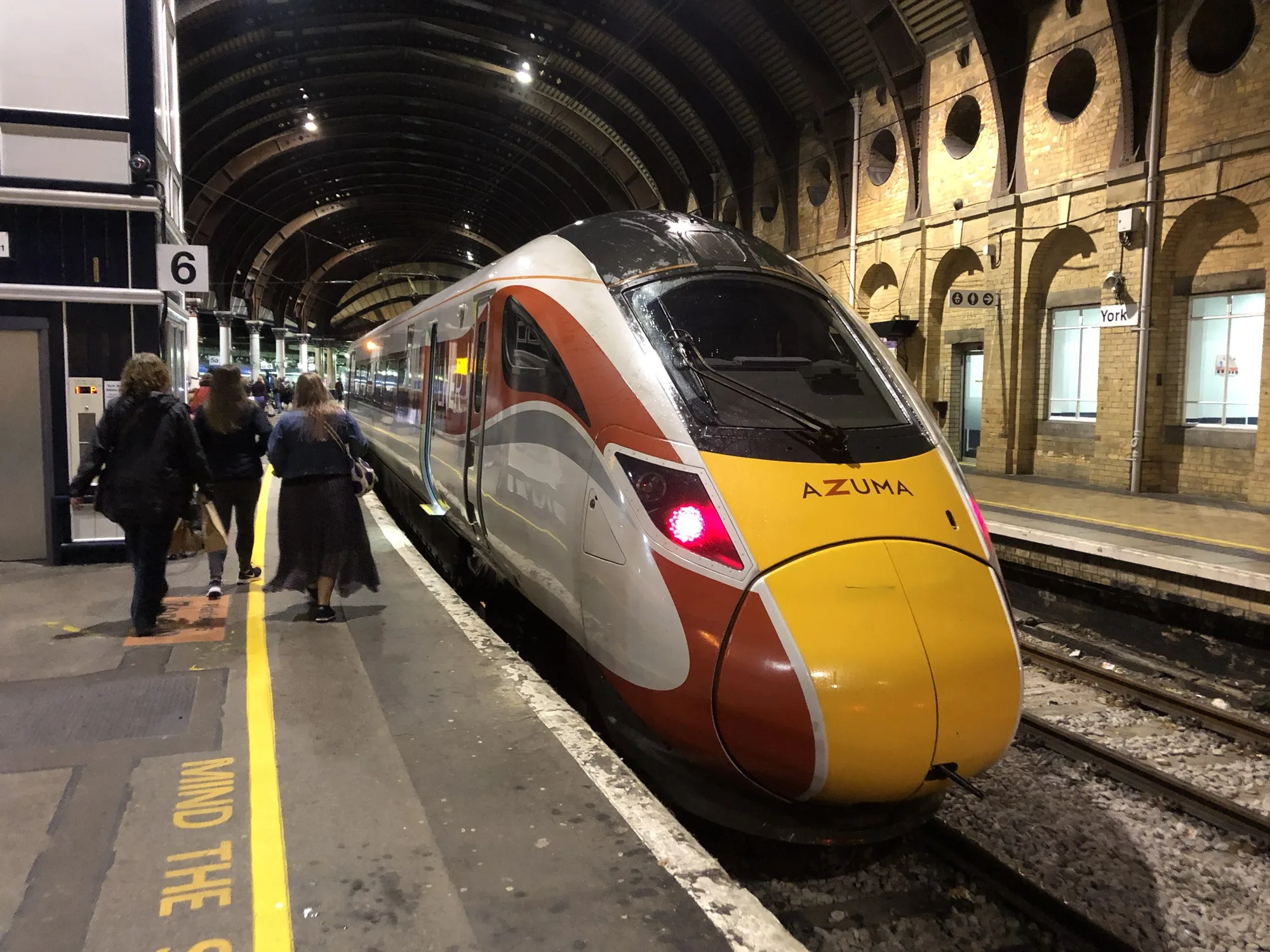
Tomorrow, Christine, our three-year-old and I are off to London (actually for the second time this week, but that’s another story). We’re going by train, and, thanks to Seatfrog, we’ll be travelling in first class, at a relatively low additional cost, having already saved some money with railcards and advance booking.
Seat auction
In the UK, Seatfrog is available on LNER services on the East Coast Main Line. You buy your standard class tickets online, as normal, and then put your booking reference into Seatfrog. The day before departure, Seatfrog holds an auction; enter your bid, and if you win, your updated tickets appear in the app.
We bid £10 per ticket for our journey, and this won (the minimum bid was £5). However, there may be a higher reserve on some services – for our return, the reserve was £9. Upgrading to first class gets you a wider, reclining seat, the majority of which are leather upholstered on LNER services. Plus, free Wi-Fi, regular offers of tea and coffee, and, for journeys over an hour, a complementary meal. This is easily worth £10 a head and means we won’t need to buy extra food for our journey.
Of course, there’s no guarantee that you’ll win, and there’s no point bidding too high as you can buy an upgrade outright for £35 per ticket. At least if you’re outbid, no money is taken.
I suppose it’s a good way of filling vacant first class seats. I could also see this being useful for people travelling on business, who can only claim standard class travel on expenses. Seatfrog would allow you to trade up to first class from your own pocket if you’re happy to pay a bit extra yourself.
For now, Seatfrog is only available on LNER services, however, it’s run by an independent company and so it’s possible that other travel companies could adopt it – potentially airlines as well as train operators,
So, tomorrow we’ll be smugly sat in first class, knowing that we paid well under the odds for our tickets,
I’m really worried about the on-off-on-off travel ban that’s the subject of ongoing legal action in America. To summarise: President Trump (urgh) enacted an Executive Order stopping anyone arriving from Iraq, Syria, Iran, Libya, Somalia, Sudan, and Yemen from entering the US for 90 days, and suspending the US’s refugee programme. Right now, the ban has been temporarily lifted by the courts, but I expect this to go back an forth for some time.
I’m not from any of those countries, nor am I related to anyone from that region or have been to any of those countries. But I have been to the middle-east region for work, including to Amman in Jordan, which is around an hour from the border with Syria. My passport, valid for several more years, carries visas for Oman and Jordan.
And I’ve heard stories where those arriving at US airports are being asked to show their social media profiles, or asked about their opinions about the new US president. My opinions are hardly favourable. I think Trump is a disaster for America and the world, and have shared a number of anti-Trump statuses on Facebook and Twitter.
I’ve never been to America but have always wanted to go. Christine has family out there, and her uncle recently gained American citizenship. Whilst he has met our one-year-old on a recent visit to Britain, the rest of Christine’s relatives haven’t yet had the chance.
Of course, the main factor stopping us from getting to America is money – getting across the Atlantic is going to be expensive, and we have a lot of other things that we also need to spend money on. But I don’t want to be in a situation where we’ve spent hundreds of pounds on flights, to then be turned away at the border, or lose several hours whilst being interrogated by immigration officials. Nor do I want to be forced to keep quiet on social media about issues I feel strongly about.
Next week, Christine, our baby and I are off to London for a few days. It’ll be our first trip as a family of three there; I last went in January on my own when our baby was only a few weeks’ old. It’ll also be the first time I’ve ever driven to London, as we’ve always taken the train or coach in the past.
I’m driving because we’re also visiting family on the way, but also because of the amount of luggage we’ll need. Babies may be small, but they also need several days worth of food and nappies, a pram, travel cot, high chair and other things. So whilst Christine and I could do several days in London with a rucksack each, with a baby, we’ll need the car.
We’re staying in a hotel in north London that’s easily reached by car and has parking, but is also close to a tube station. Once we’re there, I have no intention of driving in central London – congestion charge aside, I’m not keen on driving in city centres. And whilst London Underground is not great for prams or wheelchairs, our baby thankfully tolerates being carried in a sling.
Part of the reason for our visit is so that I can go to the HE Show at Olympia – if you’re going as well, drop me a line. We’re also planning to go to the Tower of London, as it’s been many years since I visited, and Christine has never been. It’s expensive, unless you have lots of spare Tesco Clubcard tokens like we do.
I always look forward to trips to London, partly because we always make a point of seeing friends who live there when we go, but also because there is so much to do. It makes a change from a few years ago when I developed a general dislike of the place. Back then, I also had access to free train travel and so could visit London (or, indeed any British city) whenever I wanted to. Perhaps I like London more nowadays because I only get to go there once or twice each year, and it usually requires weeks of forward planning – I can’t just decide to go there on a whim like I used to.
For the last blog post on my Middle East trip, I thought I’d spend a bit of time writing about Dubai, or specifically its airport. As I flew with Emirates, I passed through Dubai airport both on the way out and coming back.
The travel agents we use at work offered Emirates as one of three airlines to fly with. The others were Etihad, via Abu Dhabi, and British Airways via London Heathrow. Having asked for advice on Facebook and Twitter, British Airways was discounted pretty quickly. Eventually I chose Emirates for the more convenient flight times – the late finishes and early starts that I had on my trip would have been even worse if I’d flown with Etihad.
One of the world’s biggest
Dubai airport is big. It’s the world’s busiest airport when ranked by international passenger numbers, and third overall when you count all passengers (domestic and international). Last year, over 70 million passengers passed through Dubai airport – more than the entire population on the UK, and 35 times more than Dubai’s total population.
Despite being busier than London Heathrow (ranked second globally for international passenger traffic), Dubai has three terminals compared to Heathrow’s five. Terminal three is the biggest of these and is split into two halves, connected by an automated people mover. It’s basically an underground metro train, but it’s driverless and runs on pneumatic tyres, rather than steel wheels on rails, and only runs between the two halves of the terminal.
Coming back, my flight from Muscat arrived into terminal three, but my onward flight to Manchester departed from terminal one. The concourse of terminal one is connected to terminal three, but I still had to use the people mover and then had a long walk. At least it was all indoors, and all ‘airside’ so no need to go through immigration. Terminal two is completely separate though, and a shuttle bus can take 20 minutes.
Altogether, terminal 3 is the second largest building in the world by floor space. It’s big, and is almost exclusively for flights with Emirates, with just a few Qantas services calling there.
Shopping
Modern airports aren’t just designed to help you get on and off planes, and in parts Dubai airport feels more like a shopping mall than an airport. Most shops exist in multiple locations in each terminal, because of the size, and are generally run by the airport operator with just a few branded concessions like Starbucks and Boots. In all, Dubai Duty Free makes over £1billion a year from sales. Outbound, I didn’t buy much, apart from a couple of drinks (which were far cheaper than in the UK). But coming back, I picked up a couple of things, having forgotten to buy any souvenirs whilst in Jordan or Oman.
As with most airports free Wi-Fi was available, but only for one hour. Thankfully I had a phone and two iPads (one work, one personal) to stretch this out.
Dubai
I didn’t leave the confines of the airport but it’s worth talking about Dubai itself. Dubai is an ’emirate’ – essentially a city-state within the larger nation state of the United Arab Emirates (UAE). Abu Dhabi is another emirate, and there are several others that are less well-known. Originally a series of sheikhdoms under British control, independence was granted in 1971. The majority of sheikhdoms joined together to form the UAE, but two – Qatar and Bahrain – split off to become independent nations. Dubai residents are known as Emiratis, along with those from other emirates.
The UAE is an Islamic country and so there are restrictions on alcohol – in the airport, there were just a handful of Heineken-branded bars where drinking was permitted. There are also dress codes; these primarily relate to women and oblige them to dress modestly. Not doing so is a criminal offence.
Qatar has been in the news for the deaths of hundreds of migrant workers who have been building venues for the 2022 Fifa Football World Cup. Migrant workers in the UAE also suffer from a lack of rights and are forbidden from unionising, despite the huge amount of ongoing construction.
Flying back
My outbound flight from Manchester to Dubai was on a Boeing 777, but on the return I got to travel on one of Emirates’ Airbus A380s. These are the largest passenger planes in use today, with the cabin spanning two levels. Dubai airport has specially-adapted air-bridges that connect to both levels, with those travelling in Economy using the lower level and first class passengers going upstairs. In-flight Wi-Fi is available, and it starts at just $1 USD for up to a gigabyte of data, which is far cheaper than many hotels. The downside is that it’s so slow to be almost unusable, but better than nothing I suppose. And you have the opportunity to post a boastful tweet that you have internet access whilst in the air, which, for people like me who grew up with dial-up internet, is pretty amazing.
My return journey from Salalah back to my flat in Sowerby Bridge took the best part of 24 hours, in all. I woke up at about 10pm UK time on the Thursday, and was home at a similar time on the Friday. In all, it involved a minibus, three flights, a people mover, a train, a taxi, and a fair bit of walking.
I haven’t been asked to do any more overseas events for work as yet, and with a baby on the way I’m not sure if I would agree to any if offered. But it was a good experience in all, and one that I’d consider doing again in a few years time perhaps. With less overnight travel, hopefully.
The third of the three cities I visited on my trip was Salalah, Oman’s second city. Located in the south of the country, I reached it via an internal flight from Muscat, as otherwise it would be a 10 hour journey by road. Not that it’s very, very far from Muscat, but the roads in Oman are of variable quality, especially outside built-up areas. I heard that a new motorway was being built, and that will bring the journey time down to closer to seven hours. And eventually the Gulf Railway will reach Salalah – this will be Oman’s first railway and will head north all of the way to Kuwait when completed.
Salalah is much smaller than Muscat. It’s a port, but is also beginning to establish itself as a tourist resort. I stayed at the Hilton Resort there (this was where the event that I was part of took place) and it seemed quite popular with German tourists. Indeed, German seemed to be the unofficial third language in Oman after English.
Salalah used to be the capital of Oman, and there’s still a large palace there which the Sultan visits every few years. Sultan Qaboos was born in Salalah, but when he came to power in the 1970s he moved the capital to Muscat. Its climate is a little wetter than Muscat which means that plants grow naturally without the need for massive amounts of irrigation. Fruits like bananas and coconuts grow there and are available from various market stalls. There’s also a souk, which we spent around an hour in. Many of the stalls specialised in frankincense, but there were also plenty of clothes stalls and shops which sell the traditional hats that Omani men wear.
I didn’t buy anything, because by this point I realised that I’d lost all of my local currency, and, more worryingly, my passport. Fortunately the tour operators were able to make some phone calls and re-unite me with both later in the day, but I was dreading having to make the ten hour road journey back to Muscat to get to the British consulate.
As part of our visit we went to the local university, Dhofar University. Ranked second in the country after Sultan Qaboos University (albeit from a list of 5), it was only completed in 2010. If you have 15 minutes spare, watch its corporate video which is rather different from the videos that British universities produce.
Our visit to Salalah wasn’t as heavily-loaded as previous days and so we had a bit of free time. Consequently I have more photos of Salalah than I do of the other cities that I visited, and I was able to actually use my Canon SLR camera. Most other photos were taken on my iPhone as that’s all I had to hand.
Whereas most people I encountered in Muscat spoke English quite well, this was less the case in Salalah. With it being a more isolated city away from international travel, I suppose there’s less need for the locals to speak English. A slight issue for me as I didn’t (and still don’t) speak any Arabic.
The Omani government have plans to develop the area south of Salalah as a container port. The photo above shows the view from my hotel room and you may just be able to see the existing port on the right hand side of the horizon. This would tie into the Gulf Railway, and an expanded airport – like in Muscat, a new terminal was under construction. Salalah Airport, as it stands, is just one very small terminal with only three or four gates, but there are international flights from there across the region and out as far as India.
Salalah has its eyes on the tourism market, but right now only really caters for those wanting to stay at a premium all-inclusive resort, or those after something a bit off the beaten track. I imagine that, as the port develops, it will welcome a wider variety of visitor.
I arrived into Muscat at a ridiculously early time on a Monday morning from my flight in from Bahrain. Thankfully, Muscat airport isn’t too far out of the city centre and so it wasn’t long before I was in my hotel bed – for all of about an hour before a 6am start.
Muscat is the capital city of Oman, a coastal kingdom in the Arab Gulf which has seen massive change since the 1970s. Oman’s ruler is Sultan Qaboos bin Said al Said, who rose to power by ousting his father in a coup, and then set about redistributing the country’s wealth to its citizens. Consequently a lot of the country’s infrastructure is very new, and the Sultan is generally revered by the Omanis for the investments that he has made. This was made very apparent during my visit, as on the Monday evening the Sultan returned to Oman after a 9 month absence in Germany for cancer treatment. There were many street celebrations that evening and the Tuesday was declared a public holiday.
Oman History and Culture
The aim of my trip was to recruit students for the university that I work for, and so the history of education in Oman was of particular interest to me. In 1970, Oman had just three schools and no universities. That’s now changed, with a large number of schools, including a number of international schools that teach the British and American systems or the IB, and several universities. We visited Sultan Qaboos University, which was the first to open in 1986 and is still the only public university in the country. By British standards, it would rank as an upper-medium sized university with just under 18,000 students.
Oman isn’t the only gulf country to see massive development in recent years. Indeed, the United Arab Emirates and Qatar, amongst others, have changed massively. But what sets Oman apart is that it is trying to retain a link with its heritage through its architecture. There are no high-rise buildings in Muscat, and all new buildings maintain an Arabian influence in their design. Similarly a majority of Omani men choose to wear traditional, rather than western clothing. This included the border staff at the airport who could only really be identified as such by their lanyards. By maintaining its links with tradition, Oman sets itself apart from its other developed neighbours.
Compared to Jordan, telephony isn’t as good. There are just two communications companies, one of which is state owned, although 4G internet access is slowly becoming available in major cities, like Muscat. That being said, Oman was one country where my mobile phone operator, 3, did not have a data roaming agreement, so I had no choice but to use Wi-Fi where it was available.
Muscat
Oman is mostly a desert country. Despite this, Muscat is very green with most major roads lined with trees, lawns and decorative plants – and a lot of irrigation. They were well-tended-to, with plenty of gardeners working on them all through the day.
Muscat airport, as it stands, is quite small, but a completely new terminal is in the final stages of construction, closer to the main runway. Indeed it currently takes ages for planes to taxi between the current terminal and runway, and even then there are no air-bridges. It’s home to the national flag carrier, Oman Air, which operates more than half of the flights, including a number of internal flights.
Compared with Jordan and Bahrain, Oman is a much more peaceful country. There were some protests in 2011 as part of the Arab Spring, but these were quickly quelled and some positive change has happened since. There is a democratically-elected government, but Oman is an absolute monarchy and so the Sultan can overrule his government. Women’s rights are better than in some countries, but women have only been able to vote since 1997. There are a number of allegations about human rights violations.
Arabic is the main language used in Oman but most signage is also in English. Most Omanis that I encountered in Muscat had at least a basic grasp of English, although as I was recruiting students wanting to study in England, and stayed in a Western hotel chain, this is hardly surprising.
As with my visit to Amman, I didn’t get to see a lot of Muscat whilst there – my itinerary was jam-packed. It’s certainly an attractive city, thanks to the commitment to traditional architecture and I’d maybe consider visiting again in future.
As my Middle East trip had a rather complicated itinerary, involving multiple events each day and various hotel and flight bookings, I decided to sign up to TripIt.
TripIt is an online itinerary builder. You put all of your bookings into it, and it provides a complete overview of your trip that you can print out, or import into your calendar app. There are also mobile apps for iOS and Android.
Its most useful feature is that it can automatically parse booking confirmation emails. So, all you need to do is forward these messages to TripIt, and it will build out an itinerary for you, complete with seat numbers and contact details. If it recognises an address, then you’ll get a map as well. Of course, manual editing is possible as well, but the automatic parsing saves a lot of time. TripIt can even be configured to automatically scan your Gmail or Outlook.com email account for booking emails, upon which it will magically create itineraries for you.
The parsing technology isn’t perfect. I forwarded a confirmation email for a recent train booking from Halifax, and it thought that was Halifax, Nova Scotia in Canada and not Halifax, West Yorkshire. But errors like these are easily corrected. TripIt also automatically detects the correct time zone.
TripIt also has a social aspect. You can add friends how also use the service and see where they’re travelling to (trips can be made private if you don’t want to share them all). If a contact is nearby, you can then make arrangements to meet up.
TripIt Pro
Like many sites these days, TripIt operates on a ‘freemium’ model. All of the above features are available for free, but for $49 per year you can upgrade to TripIt Pro. This will let you add your airline frequent flyer accounts, and hotel loyalty accounts, and offer advice about how to make the most of them. You’ll also get instant updates about flight delays by email, SMS or a push notification in the mobile app, assuming you have internet access where you are. As an extension of this, TripIt Pro will try to help you re-book flights in case of cancellation, and also let you know if you are due a refund. TripIt Pro is available free for the first month, and if you use this link you can get it for $39 in the first year, a saving of $10.
I now send any hotel and travel bookings to TripIt as a matter of course. Partly because it saves me having to wade through emails to find important information. But TripIt also lets the two other people I know who use it, know where I’m going, in case our paths cross at any point. TripIt synchronises with my Sunrise calendar as well, so my trips show up alongside any other plans.
TripIt was great in the Middle East, as it made a really complex itinerary much more manageable, but I’d also recommend it even for much simpler trips. Having all of your important travel information in one place is great, and I’m happy to endorse the free service to even the most occasional travellers. The premium service is probably only of interest to regular flyers, but at less than £3 per month it’s not expensive.
Gulf Air’s history is actually quite interesting, as various Arabian Gulf countries owned parts of it in the past. Nowadays, it is wholly owned by the government on Bahrain, and based out of Bahrain international airport. The flights I took were on its smaller Airbus A320 aircraft, and neither flight was particularly well-loaded. I think I was one of of only 20 passengers on the second leg from Bahrain to Muscat.
Despite being a hub airport, Bahrain International isn’t all that big. It sits on an island off the cost of mainland Bahrain (itself an island), and has just one terminal. Naturally, Gulf Air operate the vast majority of flights. But, there are a number of other operators, including British Airways who fly from Heathrow.
As I was travelling overnight after two long days, I didn’t really take much time to explore the terminal. Instead, I went straight to the gate for my flight and made use of the free Wi-Fi for an hour or so. The time difference meant that Christine was still awake at home, despite it being the small hours of the morning where I was. The previous flight from my gate was a busy flight to Mumbai in India, which departed late as a large group of elderly passengers turned up to the gate well after the scheduled departure time. Even though I fly rarely, I’d like to think that I’m a considerate traveller, and so I aim to be at the gate well in advance of the departure.
The flight departed from a small extension to the terminal, right at the far end. It was barely more than a shed, with a small coffee shop and duty-free stand. Naturally, the coffee shop was a Costa Coffee – it and Starbucks were available throughout the Middle East. Both offered pretty much exactly the same experience as at home. Whereas the gates in the main terminal had air-bridges, we were loaded onto those super wide buses with minimal seats that you only see at airports, for the short drive to the plane.
The first stop on my trip was to Amman, the capital city of Jordan. My time there was brief – less than 48 hours in total, as I arrived in the early hours of Saturday morning local time and departed on Sunday evening.
Rather than obtain a visa ahead of time, I acquired a visa on arrival. As well as an ink stamp in my passport, I also got two 20 dinar Jordanian postage stamps, which reflected the cost of the visa. A nice addition to my previously blank passport.
The security situation in Jordan is worth mentioning. Jordan has a land border with Syria, which is in the midst of a civil war between the government, Islamic State and other rebel groups. Amman is around 80 kilometres, or an hour’s drive from the Syrian border.
Consequently, on leaving the airport (which is around 25 minutes’ drive south of Amman) we had to pass through a military checkpoint, and to enter the hotel we had to go through a metal detector and have all of our bags x-rayed. Part of my visit involved going to schools, to recruit students, and these were all within secure compounds with gates and security guards. I was also advised to keep my passport on me at all times for identification.
Whilst we did travel around Amman and its environs, visiting 5 schools, unfortunately I didn’t have much spare time to actually explore the city. The hotel I stayed in, the Crowne Plaza, was some way out of the centre of the city – and it’s a big city. Around 4 million people call it home, making it not much smaller than London.
What I did see of Amman seemed rather run-down – a bit like Burnley, I suppose, but much bigger and with better weather. I gather that Amman has some really nice parts though, and if I’d had the opportunity to fly out earlier and spend a day exploring then I’d have been able to see more. Sadly work commitments made this impossible.
I did notice a lack of traffic lights. Most road junctions are roundabouts, or grade-separated junctions with slip-roads (on-ramps to Americans). I don’t think I saw a single set of traffic lights, which means that drivers tend to use up any bit of available road space when waiting in stationary traffic. And seemingly everyone drives – there were very few pedestrian crossings and I wouldn’t like to try my luck with them.
Immigration in Jordan is something of an issue. Recent years have seen a lot of conflict in the Middle East region and Jordan’s open border policy has seen around 5 million people seek refuge from countries like Iraq and Syria. As Jordan’s population wasn’t that large to start with, it’s resulted in a massive, fast growth in the number of people living there, and, from what I saw on my brief visit, is struggling to adapt somewhat.
The internet connection in the hotel was very good though – they advertised that they had a 150 Mbps line which suggests that the telephony infrastructure in Amman is generally good. This came in useful when needing to do a Skype call with someone.
I’d maybe like to go back to Jordan in future to actually see the nice bits of Amman, and visit the Dead Sea which isn’t far away. But I’d prefer to wait until the situation in Syria dies down first.