
This is the fourth of my blog posts about last month’s trip to London. After visiting the Natural History Museum, we walked across the road to the V&A, where we visited the Cast Courts and the Design 1900-Now Gallery.
As I mentioned in my write-up of Banksy: Limitless, I’m not massively in to art, and so most of what the V&A offers isn’t of interest to me. Christine likes it though, and she has visited the V&A more often than I have. This time, she insisted on taking me to the Cast Courts on the ground floor.
Cast Courts
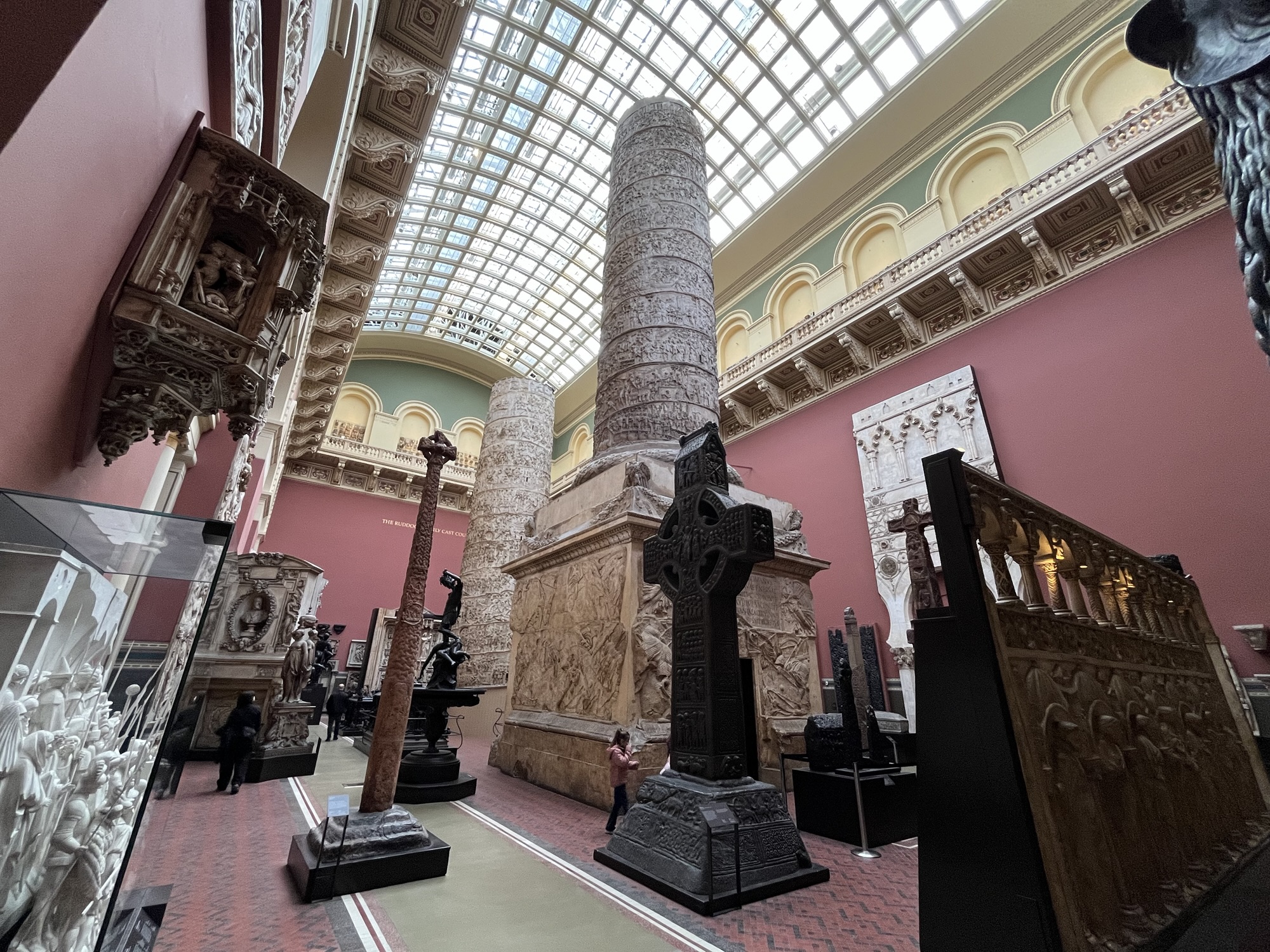
These three rooms are huge, extending to the full 25 metre height of the building. Their size is by necessity, as they contain some of the largest objects in the V&A’s collection.
As the name ‘cast’ suggests, these are plaster casts of various famous artefacts that exist elsewhere. There’s a cast of Michaelangelo’s David, for example, complete with a plaster fig leaf that was put over his manly bits when Queen Victoria visited. By far the biggest is a cast of Trajan’s Column, which is so big that it appears in two pieces. The cast courts were built as part of the original museum in the 1870s, and are now rather tightly packed with various pieces.
They’re impressive spaces, and it would be hard not to be wowed when walking in to them for the first time.

Design 1900-now
Whilst art may not be my thing, design and architecture are. So we went upstairs to the Design 1900-now gallery, which features 250 objects that show how design has changed over the past 126 years.
As well as furniture (including a standing lamp designed by Salvador Dali), there’s also technology here. There were two Apple computers on show; an Apple II, and a much newer MacBook that had been deliberately disassembled as it contained documents from Edward Snowden. There are also examples of objects that have been recently acquired, such as a Lababu.
The information included with each object is concise but thorough, but by virtue of being in central London, the limited space means that many objects are not on show here. Indeed, V&A has over a million objects in its collection, and has recently opened the V&A East Storehouse in Hackney Wick to allow visitors access to more of its objects. There’s also the Young V&A in Bethnal Green, which we visited in 2024.
Accessibility
Entry to the museum is free, but like most free museums, some special exhibitions require paid-for tickets. The main entrances are step-free, but not the entrance from the Museum tunnel that links to South Kensington tube station which is the nearest. Knightsbridge is the nearest step free tube station.
There is step-free access to all parts of the museum, but as it’s an old building that has been added to over time, step-free routes may take longer than some more direct ones. Disabled toilets are available, but for a Changing Places toilet, you’ll need to go across the road to the Science Museum.
