
The 7 election candidates in Halifax

A screenshot of the map of the Halifax parliamentary constituency

So, there’s a General Election coming up on the 4th July. Although I live in Sowerby Bridge, our local constituency is Halifax, as we’re lumped with the larger town just up the road.

Since the last general election at the end of 2019, there’s a couple of changes.

New constituency boundaries

The first change is the constituency boundary. Whilst there will still be 650 constituencies across the United Kingdom, the boundaries have changed to ensure that there’s a more even balance of population in each. In our case, the Halifax constituency has grown slightly, and now includes part of the Ryburn ward which used to be in the neighbouring Calder Valley constituency. This adds the villages of Sowerby and Triangle.

A new MP

Our previous Labour MP, Holly Lynch, decided not to run again. She is currently pregnant with her second child, and trying to run a re-election campaign whilst expecting doesn’t sound like my idea of fun. She’s been our MP since the 2015 general election, and was re-elected in 2017 and 2019.

So, using the list from WhoCanIVoteFor, here’s who I’ll be able to consider voting for next month:

Labour: Kate Dearden

Kate is the Labour candidate, and most likely to win; Halifax has elected a Labour MP at every election since 1987. Indeed, since 1964, the Tories have only held the seat for the four years prior to 1987. As I’m a member of the Labour party, I’ll be voting for Kate.

Though not born in Halifax, she grew up not too far away in Bingley, and has worked in trade union roles prior to becoming a political candidate.

Reform UK: James Griffith-Jones

Reform is Nigel Farage’s latest political vehicle, and is fielding candidates in just about every constituency in England, Wales and Scotland this time. Previously known as the Brexit Party, James previously stood for UKIP in a local council election in 2016, but there’s a lack of information about him on Reform’s web site. Reform may be popular with some of the more rural areas of the Halifax constituency but I can’t see him winning here. The Brexit Party previously came third in 2019, beating the Liberal Democrats, but only winning 6% of the vote.

This post was edited on Wednesday 26th June in response to a comment from James Griffith-Jones who states that he is not a ‘far-right’ candidate.

Green Party: Martin Hey

Martin is already active in local politics, having been elected a local councillor in the Shelf and Northowram ward a couple of years ago. Judging by his profile, he’s a bit of a NIMBY and concerned with the amount of housebuilding proposed for the area. In the last general election in 2019, the Greens came last with just 2% of the vote.

Independent: Perveen Hussain

In addition to the six parties fielding candidates, there’s one candidate standing as an independent, who is Perveen Hussain. According to her candidate statement, she’s a local businessperson and a campaigner, especially around Palestine. The Park ward in Halifax has a large Muslim community and she may see some support here.

Liberal Democrats: Samuel Jackson

We don’t know what Samuel Jackson’s middle name is, so I’ll leave the Nick Fury comparisons out for now. He’s a local lad, born in the constituency, who works in one of the local textile factories. As mentioned, the LibDems polled fourth in 2019 with a little under 5% of the vote.

Workers Party of Britain: Shakir Saghir

Now this is an interesting one. The Workers Party GB is George Galloway’s latest vehicle, and Shakir recently outed Labour in the Park ward in the recent local council elections. I happened to drive through the ward on election day last month, and his posters were everywhere, alongside photos of Galloway and lots of messaging around Palestine. Policy on Palestine has been one of Labour’s weak points this year.

WhoCanIVoteFor reveals that Shakir was previously a Tory, having stood several times for the Conservatives in local council elections. His switch to the Workers Party seems to have helped him get elected in Park ward, but I would be surprised if he can repeat that success across the wider Halifax constituency. Also, as someone who used to work in Bradford West during Galloway’s last stint as an MP between 2012 and 2015, he comes across as an absolute grifter.

Conservatives: Hazel Sharp

Hazel Sharp has her own, rather basic web site. She’s originally from Scotland, but now works as a physiotherapist for the NHS. Which, considering the current Tory government’s record when it comes to the NHS, is surprising. Having looked at her Facebook page, her campaign seems to be focussed on a handful of more rural areas, with nothing from the suburbs of Halifax itself.

The Tories have come second in every election since losing the seat in 1987, and only lost by 400 votes (1%) in 2015. However, with their frankly disastrous campaign and falling poll ratings, I would be very surprised if Hazel is elected as Halifax’s next MP.

FWIW, I realise that Diamond Geezer has done the same for his constituency in London, but I had planned to write this for some time. Anyway, if you live in Halifax, vote for Kate Dearden on the 4th July.
Election day

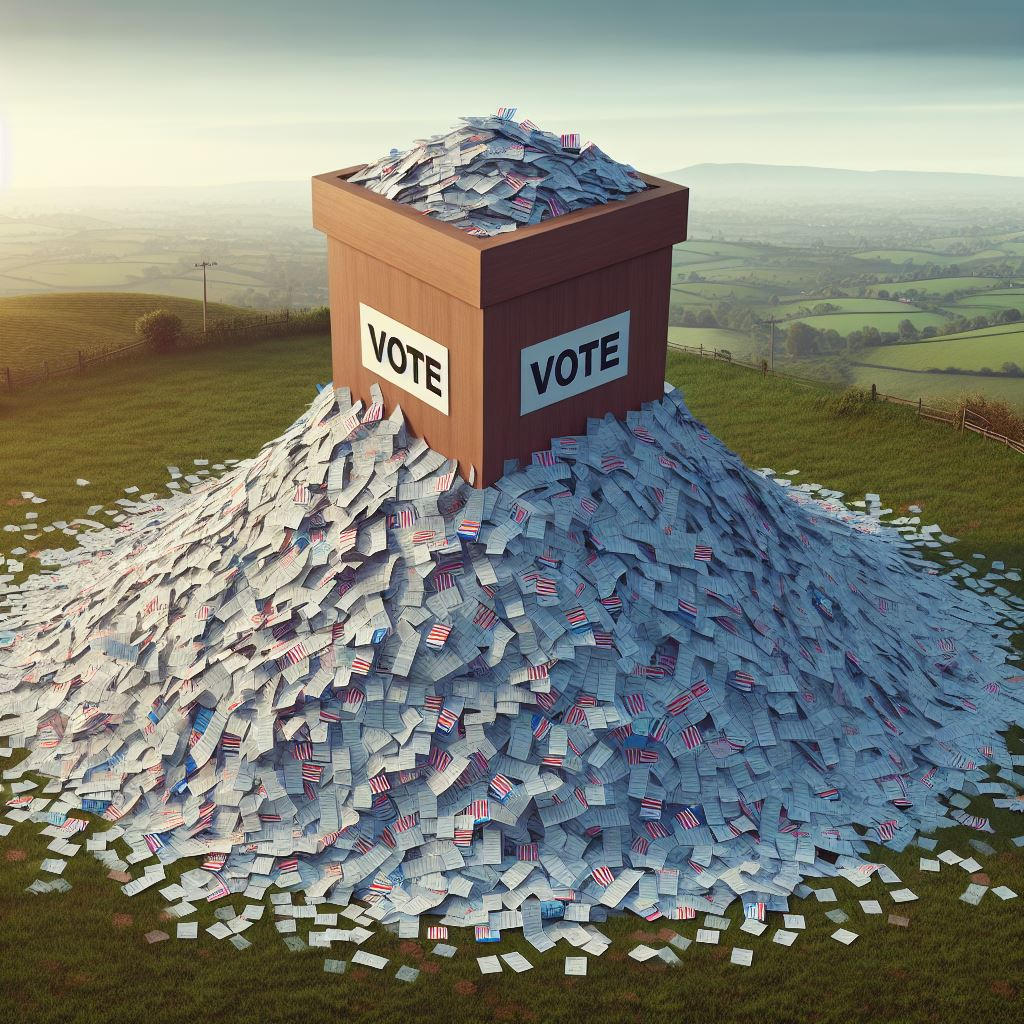
An AI generated image of a ballot box overflowing with election ballots in the countryside

Today is election day for much of the UK. It’s not a general election, as much as I would like it to be; that will be sometime between mid-June and mid-January. But here in Sowerby Bridge, we have two elections taking place:

As I am a card-carrying member of the Labour Party, I’ll be voting for them in both elections. It’s likely that Labour will win both too. Our local authority, Calderdale Council, is already a Labour-controlled council, as are the four other local authorities that make up West Yorkshire. And Tracy Brabin, the incumbent mayor, will almost certainly be re-elected. Although very little local polling has taken place, Labour are polling significantly ahead of all other parties nationally.

If you are voting today, remember that you need to take some photo ID with you. This will be my second election where photo ID has been required, but may be your first. Even though the actual rate of electoral fraud was almost completely insignificant before voter ID rules were introduced.

New mayoralties

Over in York, my parents will be able to vote for an elected mayor of York and North Yorkshire for the first time. This will be a more interesting contest, as York tends to lean towards Labour and the Liberal Democrats, whereas the wider (and more rural) county of North Yorkshire leans Conservative. If David Skaith wins the mayoralty for Labour, it will mean that the Conservatives really are in trouble when they finally call a General Election.

There will also be mayoral elections for the first time in the North East and East Midlands, and the Conservative mayors of Tees Valley and the West Midlands will be hoping to be re-elected. Again, should these mayoralties fall to Labour, it’s a sign that the Conservative party are a spent electoral force.

London mayoral election

And there’s the London mayoral election, where Sadiq Khan will be looking to become the first modern mayor to be elected for a third time. The ULEZ seems to be the key issue here; it was a key part of Khan’s manifesto and most of his rivals want to scrap or curtail it. The exception seems to be Count Binface, who instead wants to expand free parking to electric vehicle users between Vine Street and the Strand. Except for those who drive a Tesla.

We’ll get most of the local council elections tomorrow, with the mayoral election results coming in over the weekend. It certainly promises to be an interesting few days in British politics.

Why I’ve voted Yes

Shark Statue

Today I sent off my postal vote, with a ‘Yes’ vote for the referendum on the voting system which takes place on the 5th May. I’d like to take a little bit of your time to explain why I voted yes, and why I hope you will do too.

Before I go into my own personal reasons, have a look at the Why Vote Yes? pages on the Yes to Fairer Votes campaign, and in particular the AV myths page.

I’ve had personal experience with the AV system whilst studying as a student, as we have used the system effectively for the student union elections for some years now. In particular, I’ve been involved with the counting of votes, and it really isn’t a difficult system. If you’ve watched the ‘No’ campaign’s referendum broadcast, they would have you think that it’s really complicated – trust me, it isn’t. It’s the No campaign telling you that you’re not intelligent enough to do simple maths, which is rather insulting. Jessica Hynes, the actress who appeared in that advert, should be ashamed of herself.

I also feel that the AV system is better than the First Past The Post (FPTP) system we have right now. At present, a candidate can be elected with less than half of the votes cast; in other words, a majority of the electorate did not support them but they were still elected. AV will mean that candidates will have to gain wider support in order to be elected.

It’ll also mean the end of tactical voting. Under FPTP, if you support a party that is likely to come third, you may wish to vote for a different party that you don’t really agree with (but has more support), to prevent a third party from being elected that you don’t want. This is because FPTP does not allow you to select second or third preferences; AV does, so you could put your favoured candidate first and then another candidate second if you wish, in case your first choice is eliminated.

It will hopefully spell the end for extremist parties like the BNP. Despite the ‘No’ campaign saying that AV will help the BNP (without really explaining how…), the BNP are actively campaigning for a ‘no’ vote themselves. Under FPTP, a candidate can win if a significant minority support them (which is true of the BNP), but under AV, a candidate needs to be able to appeal to a majority of voters. Most people find the BNP abhorrent, so under AV, their chances of being elected are further diminished.

And my final reason is because of the negativity and outright lies of the No campaign. There is a very good takedown of their leaflet here, for example their claim that AV will cost £250 million – it won’t. Part of that is the cost of the referendum which is happening anyway and will be spent regardless of the result, some of it is for electronic voting machines, which aren’t planned to be used, and at least £3 million of that isn’t even substantiated. Pure scaremongering and lies.

I care about this country and want our political leaders to put this country and its people – all of them – first. First Past The Post is not allowing enough people sufficient say in who gets elected to run our country and our local authorities. It may have suited us fine when we only had 2 major political parties – we have 3 now and parties like the Green Party, with its first MP, and UKIP are also on the rise. Our voting system therefore needs to change, so that more people can get more say in how our country is run.

Please vote ‘Yes’ to AV on May 5th.