Miscellaneous notes on North Wales

This is the one final holiday post before I get on with writing about the other things we’ve done on this holiday. It’s a few assorted notes and observations from our time away.

North Wales is popular with dog owners

If you want to bring your dog on holiday, then North Wales seems to a popular choice. The cottage we rented was dog-friendly, with hard floors in most of the rooms, and in Llandudno we saw at least one hotel specifically marketing itself as dog-friendly. In fact, there was even a dog toileting area to the side. Alas, I didn’t catch the name of it, and can’t find it on Google Street View, but I think it was on Church Street.

We certainly saw plenty of people out and about with their dogs.

Charging our electric car wasn’t much of an issue

Getting a new electric car less than a week before we went on holiday was an interesting decision in retrospect, but we coped well. Whilst there are literally no public chargers in Conwy, and we weren’t permitted to charge it at the cottage we rented, there were a couple of rapid chargers a few minutes away in Llandudno Junction. These kept us going when we couldn’t charge on days out, however, several of the places that we visited did offer public charging. We only had to go out of way once to charge up; the rest of the time, we fitted our charges around the activities that we’d planned.

Signage is in Welsh first, then English

North Wales has a higher concentration of people who speak Welsh as their first language, than other parts of Wales. So, Welsh tends to appear first on road signs with English beneath. This isn’t universal, and elsewhere in Wales it’s English first. And whereas in Ireland, where the Irish text on road signs is in italics, both the English and Welsh are in the same font, same colour and not italicised. I don’t speak Welsh – I tried it on Duolingo for a couple of weeks before going back to French – and so reading signs took a little longer as I had to look where the Welsh stopped and the English started.

Christine, meanwhile, is still learning Welsh on Duolingo.

It’s also notable that all the Welsh signs instantly disappear as soon as you cross the border back into England.

The Welsh NHS is separate to the English NHS

I forgot to pack any spare hearing aid batteries, and so needed to find somewhere that sold them. Being English, I went to the nhs.uk web site to find somewhere that would sell them, but it turns out that, despite ending in ‘.uk’, nhs.uk is just the web site for NHS England. So when I searched for nearby pharmacies, for example, all the results were in Cheshire and Merseyside.

Healthcare is a ‘devolved’ matter in the UK, and so the regional governments in Wales, Scotland and Northern Ireland have their own branches of the NHS. (Technically, it’s not the NHS in Northern Ireland but HSC instead).

NHS Wales confusingly has two web sites. The main NHS Wales web site, at nhs.wales, is more of a corporate web site – if you want health advice, or to find services, you need NHS 111 Wales, which is at 111.wales.nhs.uk.

I know NHS England is being abolished but you would expect a web site called ‘nhs.uk’ to apply to the whole of the UK, and not just England.

For completeness, health advice in Scotland comes from NHS Inform, at nhsinform.scot, and in Northern Ireland, it’s part of NIDirect.

Our 2025 holiday: RSPB Conwy

A photo of some birds at RSPB Conwy

I’m almost done with our holiday posts – this is the penultimate one, and is about the RSPB Nature Reserve at Conwy. It’s relatively new, having opened in 1995, and exists because of the building of the A55 North Wales Expressway.

Tunnel spoil

When the A55 Conwy tunnel was built, the spoil created from the excavation needed to go somewhere. Major tunnelling projects often result in the spoil being used to create nature reserves: Samphire Hoe was created from the Channel Tunnel, RSPB Wallasea Island from the Elizabeth Line, and when HS2 is finished, it’ll result in new chalk grassland in the Chilterns. For the A55, the spoil was placed along the side of the Conwy Estuary, to create a new wetland habitat during the late 1980s and early 1990s.

Many birds have now made this wetland their home, and we saw plenty of white egrets, lapwings and whimbrels that you wouldn’t often see elsewhere. The site consists of two large lagoons, with paths and bird hides around them, although the smaller of the two lagoons was completely dry when we visited, as a result of the exceptionally dry summer that we’ve had this year.

A photo of a six-spot burnet at RSPB Conwy

Visitor centre

There’s a large visitor centre at the site, home to the shop as well as information about what you can expect to see. Obviously, the birds there are wild, and so nothing is guaranteed, but we saw a good variety. You can also pick up maps for the trials around the lagoons – we didn’t do the longest path, as we were just visiting for the afternoon. There’s also a café, plenty of places to eat a picnic, and a small playground.

One of the hides that we visited also had an extensive history of the building of the road tunnel, and how that led to the establishment of the nature reserve.

We had a nice, relatively peaceful afternoon at RSPB Conwy. There is the background noise of traffic on the A55, but it was nice to go somewhere with a slower pace.

Accessibility

The site is mostly flat, although the paths are mainly gravel, or wooden boards across the wetter areas. There are various colour-coded trails that you can follow, and the maps provide information about gradients.

Access to the site is from Junction 18 of the A55 – it’s directly connected to the roundabout here. Work was ongoing to improve cycle access when we visited, and it’s a about a half mile walk from Llandudno Junction railway station. RSPB members get free entry.

Our 2025 holiday: Bodnant Garden

A photo of Bodnant Garden.

The next place we went to on our 2025 holiday to North Wales was Bodnant Garden. It’s another National Trust property, and consists of the formal gardens attached to the larger Bodnant Estate.

Bodnant Garden is located to the south of where we were staying, in the Conwy Valley. The garden itself began to be developed in 1874 (so just over 150 years ago), when the Pochin family bought the estate at auction. Over time, the garden was extended multiple times, and is now home to a number of prize-winning trees. It came into the National Trust’s care in 1949, but the rest of the Bodnant Estate remains family-owned.

If you look at the prices for Bodnant Garden, you’ll see that they’re towards the higher end of the scale compared to some National Trust properties. That’s no accident – Bodnant Garden is huge, and we ended up spending all day here. Being as it was the summer holidays, there was a Wallace and Gromit Augmented Reality Trail running, although today was its last day, sorry. Our nine-year-old really enjoyed doing the trail, which included some hands-on activities too.

A photo of Bodnant Garden.

The Wallace and Gromit trail took us to the far end of the site, and then we made our way steadily back along the stream that flows through it. There’s lots to see – even if you’re not a big horticulturalist, it’s still very pretty.

In all, we probably saw about two thirds of what was there – we missed some of the fringes as it is just so big. Indeed, there is more than one café there; one at the entrance, and another near the Old Mill towards the middle of the site. It’s definitely somewhere I’d consider going to again, and taking a different route around.

Accessibility

You enter the site at the top, and then there are slopes down to the stream – some more gentle than others. The map shows a couple of step-free routes that encompass most of the site, but there are some steep slopes. Most of the paths are gravel.

There are two electric car charging sockets in the car park. On the plus side, they’re both completely free to use, however, one is a medium-speed 7 kW Type-2 charger, and one is just a 3-pin plug. We ended up having to use the latter with our granny charger, but then we were there all day, and it was free after all. It managed to charge our Nissan Leaf up from 31% to 59% over around five hours.

The nearest railway station is Tal-y-Cafn on the Conwy Valley Line, however, it’s a 40 minute walk, it’s a request stop, and there are only 6 trains per day (4 on Sundays). If arriving by public transport, a better bet is the number 25 bus, which runs from Llandudno and calls at Llandudno Junction station. That being said, there’s still only one bus every two hours.

Nearby attractions

The Bodnant Estate also runs an adjacent garden centre, and Bodnant Welsh Food is a short drive away. We nipped into the shop there, although it was rather expensive and didn’t have a great range.

On the other side of the valley, and about a ten minute drive away, are the Conwy Water Gardens. We didn’t go as the TripAdvisor reviews aren’t great; it seems like somewhere that used to be better than it is now.

Playlist of the month: Welsh pop music

Screenshot of the Welsh Pop Music playlist

It’s almost the end of the month, and so it’s time for this month’s Playlist of the month. As I’ve been busy writing about our holiday in Wales (and I’m not quite finished), I thought I’d focus on pop bands and artists from Wales this time. As per usual, you can listen to the playlist on Spotify.

  • “Road Rage” by Catatonia. This song came out when I was 14, and at the time I had a huge crush on a girl who was really into Catatonia. Nowadays, lead singer Cerys Matthews is probably best known for her weekly show on BBC 6 Music.
  • “Juxtaposed with U” by Super Furry Animals. Super Furry Animals originally only sang in Welsh, but found success when they started singing in English too. I like this song.
  • “If You Tolerate This, Then Your Children Will Be Next” by Manic Street Preachers. The Manics have been going for (checked Wikipedia) 39 years, and yet this was only one of two number one singles for them. The music video was also quite memorable.
  • “Dakota” by Stereophonics. I was surprised to find that Stereophonics have released 13 studio albums, since I could probably only name four. I wasn’t a big fan of their JEEP (Just Enough Education to Perform) era but “Dakota” is better.
  • “Mercy” by Duffy. Duffy was pretty big in the late 2000s, this being her debut single.
  • “Sexbomb” by Tom Jones. You can’t have a list of Welsh singers without Tom Jones, who is still performing well into his 80s. This 1990s remix of Sexbomb with Mousse T is probably my favourite of his, but with 41 (!) studio albums under his belt it’s tough to choose just one.
  • “Get The Party Started” by Shirley Bassey. And you can’t have a list of Welsh singers without the great Shirley Bassey either. Three years older than Tom Jones, I’ve included her excellent cover of P!nk’s “Get The Party Started” as it’s exactly what you would expect a Shirley Bassey cover to sound like, in the best possible way.
  • “Monster” by The Automatic. I want to like The Automatic more, as this and “Steve McQueen” are amongst my all-time favourite songs. Anyway, here’s what’s coming over the hill.
  • “Crazy Chick” by Charlotte Church. Church found fame as a child soprano, singing classical music. As a young adult, she pivoted to pop music in 2005 for an album entitled “Tissues and Issues”. There’s some good songs on there, and Church remains someone who proudly still lives in Wales.
  • “Just The Way I’m Feeling” by Feeder. “Just A Day” is my favourite Feeder song, but I’ve already used it in a playlist and so this is my second favourite of their songs. It was from their fourth album, “Comfort in Sound”, which is a bittersweet album recorded following the death of the band’s drummer.

Our 2025 holiday: Llanfair­pwllgwyngyll­gogery­chwyrn­drobwll­llan­tysilio­gogo­goch station

The old station house at Llanfair­pwllgwyngyll­gogery­chwyrn­drobwll­llan­tysilio­gogo­goch station

I wonder how many RSS readers I’ve broken with the title of this blog post? Anyway, our last stop on our day out to Anglesey was Llanfair­pwllgwyngyll­gogery­chwyrn­drobwll­llan­tysilio­gogo­goch railway station.

I think most Brits are award of Llanfair­pwllgwyngyll­gogery­chwyrn­drobwll­llan­tysilio­gogo­goch station’s claim of being the station with the longest name on the British Rail network. However, it’s more commonly known as ‘Llanfairpwll station’ and this is what appears on train destination boards. Indeed, its unnecessarily long name was a contrivance thought up by the railway company that originally built it in the 19th Century as a way of encouraging people to visit it by train. It roughly translates into English as ‘The church of St. Mary of the pool of the white hazels near to the fierce whirlpool and the church of St. Tysilio of the red cave’.

The platforms at Llanfair­pwllgwyngyll­gogery­chwyrn­drobwll­llan­tysilio­gogo­goch station

Llanfairpwll station today

Llanfairpwll station (as I will call it for the rest of this post) isn’t much of a station. It survived the Beeching cuts in the 1960s, but nowadays it gets a rather infrequent service. Going back towards the mainland, there was a wait of over an hour for the next train whilst we were there. And it’s a ‘request stop’ – if you want to get on a train, you need to make a clear signal to the driver of the train, as otherwise services will pass through at low speed. Similarly, if you’re on a train and want to get off there, you need to tell the guard that you want to do so, so that he/she/they can tell the driver to stop.

There are two short platforms – indeed, some trains that do stop there need to use selective door opening as they’re longer than the platforms – and a footbridge. Only platform one, for trains back towards the mainland, is accessible from the car park as there are no ramps or lifts on the footbridge. There is a gate leading from platform two, for trains towards Holyhead, but it would be a very long walk/wheel back into the town.

As well as being a request stop, Llanfairpwll station is unstaffed. The old station master’s house has been restored, but isn’t in use as far as I can tell. There aren’t even any facilities to buy a ticket here. I think Transport for Wales is missing a trick here, as tickets purchased from here could be collectors items. A machine could be installed that even just sells ceremonial platform tickets.

A photo of the outside of James Pringle Weavers at Llanfair­pwllgwyngyll­gogery­chwyrn­drobwll­llan­tysilio­gogo­goch station

Tourist trap

The reality is that most people who go to Llanfairpwll station arrive and depart by road. The station retains a large car park, and the fact that this car park has bays for coaches tells you a lot. Next to the station is a large shop, run by James Pringle Weavers (in reality a subsidiary of Edinburgh Woollen Mill) which sells a range of merchandise with Llanfair­pwllgwyngyll­gogery­chwyrn­drobwll­llan­tysilio­gogo­goch branded on it, amongst other things. I’m sure most people grab a couple of photos on the station platforms before going to the shop, and then moving on, without setting foot on a train. And yes, that’s exactly what we did too.

It’s nice that quirks like this still exist in places in the UK, but I feel like the station itself could be more front and centre. Perhaps, with longer platforms, better access, a more frequent service and some ticket machines, more people might actually visit Llanfairpwll station by rail.

Our 2025 holiday: Anglesey Sea Zoo

A photo of a boat at Anglesey Sea Zoo

After Beaumaris Castle and Plas Newydd, our third stop on our Anglesey day out was at Anglesey Sea Zoo. This is towards the southern tip of the island.

Anglesey Sea Zoo is an aquarium, with a focus on the sea creatures that you would encounter in the seas around Wales and the rest of Britain. As such, you won’t see many tropical fish, or massive sharks, but you will get to see the Lobster Hatchery of Wales – a conservation project to boost the numbers of wild European lobsters. Anglesey Sea Zoo was also the few aquariums in the world to successfully breed the native British species of seahorse, and you can see some of the seahorses on show there. There are also plenty of anemones, starfish, crabs, prawns, and various different species of fish.

Anglesey Sea Zoo is quite small, especially compared to Sea Life Centres or The Deep in Hull, and we got around it in about an hour. But it was interesting, and is certainly something to bear in mind for a wet day as it’s almost all indoors.

Accessibility

Anglesey Sea Zoo is mostly on one level and so those who struggle with steps should be able to see almost everything. There’s a modest car park, and (at time of writing) there were two free of charge medium-speed 7 kW electric car chargers available for visitors to use. The same bus that serves Plas Newydd gets within about a mile of the aquarium.

Nearby attractions

Next door to Anglesey Sea Zoo is the Halen Mon Sea Salt Factory – there’s a shop, and you can book on factory tours which run twice a day.

There’s also Foel Farm Park nearby, which is an open farm with play areas. We didn’t have the time to visit either of these when we went.

Our 2025 holiday: Plas Newydd

A photo of Plas Newydd, looking up from the sea wall along the Menai Strait

After visiting Beaumaris Castle in the morning, the second place we visited on Anglesey was Plas Newydd (Welsh for ‘New House’). It’s a large country house overlooking the Menai Strait, originally started in the 15th Century but substantially rebuilt in the 18th Century. Nowadays, it’s in the care of the National Trust, who look after both the house and its gardens. The house is presented largely as it would have been in the 1950s.

We went around the house first. Not all of the rooms are open to view; though the National Trust have cared for it since 1976, until around 10 years ago people still lived in the property. The dining room is home to a huge painting by Rex Whistler, which was the largest ever canvas painting in the UK when it was unveiled in the 1930s. A previous owner of Plas Newydd, Henry William Paget, fought in the Battle of Waterloo where he lost a leg – the house has an exhibition about him including one of his prosthetic legs. He was awarded the title of ‘Marquess of Anglesey’ for his bravery.

The 5th Marquess of Anglesey, Henry Cyril Paget, was a rather flamboyant character who inherited Plas Newydd in 1898. He converted the chapel into a theatre, where he performed in what we would now most likely describe as drag. Whilst he was born into great wealth, ultimately he ended up bankrupt six years later in 1904, and died the following year. Many of his costumes were subsequently sold in the ‘Great Anglesey Sale’. However, some photographs survive, and visitors are invited to dance in one of the rooms, as the 5th Marquess would have done.

The gardens at Plas Newydd

Gardens

There are some formal gardens at Plas Newydd, on the slope down to the Menai Strait, and there are great views across the Strait towards Caernarfon. There’s also plenty of parkland, including an arboretum. Anglesey is also one of the few remaining places in Britain with wild populations of native red squirrels, and there’s a feeding station in the arboretum. We didn’t get a chance to visit this, unfortunately, and we didn’t see any red squirrels during our time in Anglesey.

As it’s the summer holidays, there were plenty of activities for kids as part of the Summer of Play event that runs until the end of this month.

Accessibility

For the house, only the ground floor is accessible to those who can’t use stairs. There is a step-free route from the car park to the house, but not all routes across the parkland are step-free and it is on a slope.

When we visited, five electric car chargers were being installed in the car park – these appear to be operational now, offering 7 kW medium-speed charging on the RAW Power network. Bus services pass the site on Mondays-Saturdays, or it’s a roughly 2 mile walk from Llanfair­pwllgwyngyll­gogery­chwyrn­drobwll­llan­tysilio­gogo­goch station, if you want to catch the train.

Our 2025 holiday: Beaumaris Castle

A photo of the outside of Beaumaris Castle on Anglesey including its moat

We spent a day of our holiday on the island of Anglesey, starting at the north east corner with Beaumaris Castle. You could be forgiven for thinking that Beaumaris Castle is now a ruin, but in reality it was never actually finished.

It was commissioned by Edward I of England in the late 13th Century, along with Conwy Castle, Caernarfon and Harlech, and was supposed to be the biggest and grandest of them all. However, the money ran out, and construction basically stopped in the 1320s. The towers were never as tall as planned, but what remains today is still a large castle with multiple fortified walls. Nowadays, as with Conwy, it’s in the care of Cadw. Despite being built by an English king in Wales, ‘Beaumaris’ is derived from the French ‘beaux marais’, or ‘fair marsh’.

Visitors can climb up onto the walls, and up some of the towers, to get a view across the Menai Strait and towards mainland Wales. There’s also a video history of the castle, and the chapel has been restored with new stained glass windows. The outer walls are enclosed by a proper water-filled moat, and whilst it was never completed, it’s still a formidable castle. It’s worth a 1-2 hour visit.

Accessibility

As you would expect from something built over 800 years ago, accessibility isn’t the best. Access to the walls and towers is by staircases only, but there’s flat access to many other parts of the castle, albeit mostly on grass or gravel surfaces.

The castle is in the centre of the town of Beaumaris, which doesn’t have a railway station (and indeed never has) but is served by regular bus services. There’s an official castle car park just to the north, but we parked in a pay and display car park at a nearby leisure centre, that was a similar distance walk away. The leisure centre car park has two medium-speed (7 kW AC) electric car chargers on the PodPoint network.

Nearby

We didn’t spend much time in the town of Beaumaris, but it looked quite nice for a bit of pottering around. There’s a pier, and a large sightseeing Ferris wheel was there when we visited.

Our 2025 holiday: Portmeirion

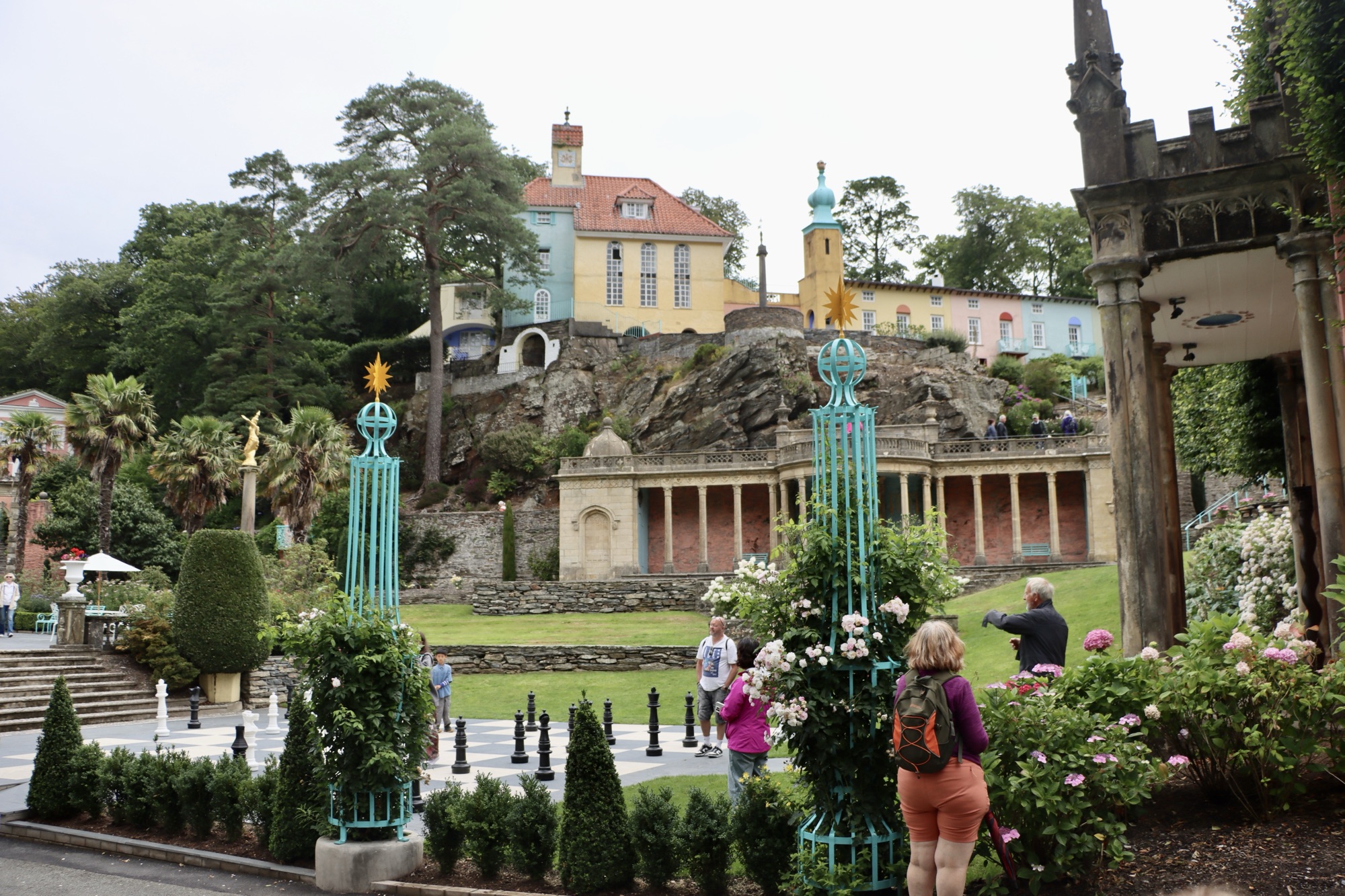
A photo of the village of Portmeirion in North Wales

Our next day trip on holiday was to the village of Portmeirion. This was a little further away; though still in North Wales, it’s not along the north coast but instead further south, near Portmadog. The village was built gradually over 50 years between 1925 and 1975, and is designed to look like a Mediterrean port village, but on a small scale. So, unlike most of the local architecture, the buildings are brightly coloured, with lots of tropical planting.

It has always been designed to be a tourist attraction, and many of the buildings are available as holiday cottages. There’s also a range of gift shops and cafés, and some formal gardens and woodland.

Another view of the village of Portmeirion

All of us had been before, including our nine-year-old, although they were only two on their previous visit. I think they liked the smaller scale of it, and that there’s lots of little nooks and crannies to explore. Over the years, it’s been a popular filming location, and many of the buildings are now listed as heritage assets. The pottery brand Portmeirion takes its name from the village, and yes, there’s a pottery factory shop in the village.

Even though the weather was quite dull when we visited, I still took plenty of photos as it’s so picturesque.

Accessibility

Portmeirion is quite expensive, at £20 for an adult day ticket (at the time of writing). However, you can easily spend the whole day here – especially if you head off on the various walks. Being located on a hill side, with the car parks at the top, means it may be hard work for those with mobility issues. Whilst there are steps in places, there are usually alternative ramped routes available.

There is a large car park at the top, with 10 electric car charging points offering medium-speed 7kW AC output (Type 2), on the Monta network. At the time of our visit, we paid 60p per kWh to charge. Some of the charge points were out of order, however.

The nearest railway station is Minffordd, which is on the Cambrian Coast Line with trains from Birmingham, and the narrow-gauge Ffestiniog Steam Railway. This is also where the nearest bus stop is. There’s then a 1 1/2 mile walk to Portmeirion.

A narrow gauge steam locomotive called Linda at Portmadog Harbour station on the Ffestiniog Railway

Also nearby

After visiting Portmeirion, we went to Porthmadog, which is the terminus for both the Ffestiniog and Welsh Highland narrow gauge steam railways. We didn’t have time for a journey – a return trip on the Welsh Highland Railway to Caernarfon and back takes most of the day – but we did watch a couple of trains departing and visited the shop.

How we handled poor phone reception

A photo taken atop the Great Orme in Wales

Our holiday in Wales was good, but we didn’t always have good phone reception whilst we were there. Now, it’s a holiday, and you can argue that we probably should have had a break from phones, social media and the like. But we also need our phones for certain things – I use Google Maps for navigation, for example, and we needed apps to find out where to charge our electric car.

In North Wales, most of the population is concentrated in a relatively narrow strip of land between the hills and the north coast. Providing a mobile service is therefore more difficult and expensive – each mast is likely to cover a smaller and more sparsely populated area than in a big city. For the most part, there were few places where we had no signal whatsoever. But even when showing full bars, we couldn’t make calls or use the internet in some places.

Here’s how we handled it:

Downloading things on Wi-Fi beforehand

It’s a bit hidden, but Google Maps lets you download offline maps on a Wi-Fi connection. We had good internet where we were staying – the Conwy area has been upgraded to full fibre broadband – so we could download a map of the area. This meant that we could still use Google Maps to navigate without a mobile data connection.

Note that Google’s guide, linked above, is a little out of date. At the time of writing, you need to:

  1. Search for a place
  2. Swipe right on the lower panel where it says ‘Directions’ and ‘Start’, until you see a button that says ‘More’
  3. Tap ‘More’ and then ‘Download Offline Map’
  4. You can then pinch and zoom to select the area – a larger area will take up more storage space

There are limitations – you won’t get live traffic data if you’re using an offline map without a phone signal. However, once Google Maps is able to reconnect, it’ll update your route if needed. If you use Gmail and sign in to Google Maps with the same account, you may get push notifications ahead of upcoming trips to prompt you to download offline maps. I’d recommend it, especially if it’s somewhere you’ve not been before, or somewhere particularly remote.

The same applies for content that you want to consume whilst outside of mobile data range. If you use Spotify Premium, you can download playlists ahead of time. I make sure that I download, rather than stream, any shows on BBC Sounds that I want to listen to.

Hotspotting where possible

If there’s free Wi-Fi available somewhere that you’re visiting, use it. Most National Trust properties have free Wi-Fi in their cafés, for example.

If you have another device on a different phone network, then you could try hotspotting off that too. My phone is on 3, but my iPad has a mobile data SIM on a virtual operator which uses EE. Whilst it was a bit of a pain to have to carry my iPad around as well, it meant I could use the iPad as a Personal Hotspot for my phone and get online. You may be able to do this with a newer car, if you have a data plan on it, or a portable Wi-Fi hotspot device.

Get an eSIM on a different network

When I’ve travelled abroad, I’ve used eSIMs from Airalo rather than roaming on my existing SIM, as it’s cheaper. But you can buy UK eSIMs too. If your primary SIM has poor signal, then you could buy an eSIM on a different network that may work better. My iPhone (and I assume most new-ish Android phones) can switch between multiple SIMs on the fly, if one loses signal. If you decide to buy from Airalo, use the code NEIL6715 for some extra initial credit.

If you want to go further, try Honest Mobile’s Smart SIM. This can connect to all four UK networks (3, Vodafone, O2 and EE, although 3 and Vodafone may merge their networks soon), and costs £45 per year. However, whilst there are no data limits, it is limited to set pre-approved apps. These are mainly navigation apps like Google Maps, messaging, news, weather, banking and apps for electric car parking. There’s about 400 in total, but it excludes any social media apps, or any that involve streaming audio or video. I signed up to Honest Mobile after coming back from Wales, and I’m giving it a try for a year to see how I get on. Here’s my referral link if you want your first month free.

Honest Mobile’s Smart SIM has been heavily advertised on my Facebook feed, and so I read this post by Martin Brophy before committing.

Ultimately, what works for you will depend on how often you’re without a mobile signal, and how much you rely on your phone. I normally get a good signal on 3 in most places, but I’ll see how I get on with Honest Mobile.