Our 2026 holiday: Llechwedd Slate Caverns

A photo of the inside of the Llechwedd Slate Caverns

Although we arrived in Wales on the Saturday, we had a slow day on the Sunday with just a little stroll around Conwy (which I wrote about last year). The first big thing we did was head to Zip World in Llechwedd, home to the Llechwedd Slate Caverns.

A brief history of the Llechwedd Slate Caverns

In the 19th century, a deep mine was dug at the Llechwedd slate quarry, to access slate deep underground. The mine expanded significantly over the years, and eventually reached 25 miles of tunnels with caverns hundreds of metres below the surface. By the 1970s, demand for Welsh slate was falling, and so it was converted into a tourist attraction.

To improve access to the deep mine, now known as the Llechwedd Slate Caverns, a cable-hauled narrow-gauge railway was built, on a 30ยบ incline.

I last visited with my parents in 1999, when we stayed for a week in the area. Back then, the slate caverns were the only attraction at the Llechwedd site, but in recent years it has expanded. There are now two zip lines – one below ground, one above ground – the ‘Bounce Below’ which is an underground trampoline park, and an underground mini-golf course. We just went for the slate cavern tour; Christine had also been before but it was our ten-year-old’s first time.

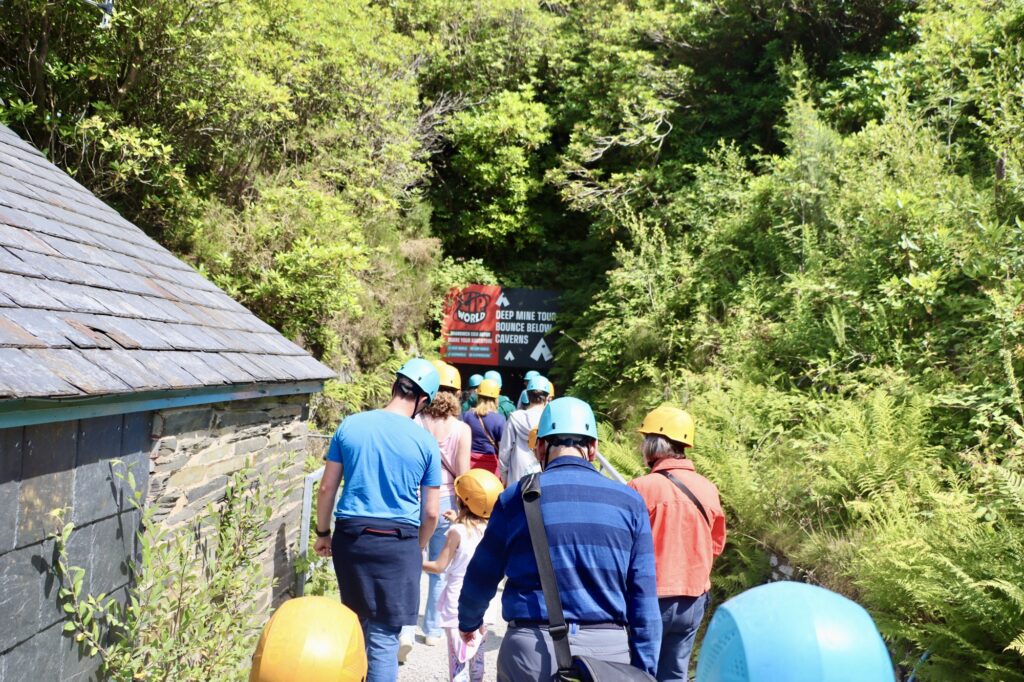
The entrance to the Llechwedd Slate Caverns

Down the mine

Some tours include a train ride up and down (and this is also how you access the mini-golf course); on our tour, we walked down and got the train back up at the end. Which, considering it’s a 150 metre (500 feet) climb back up, is very welcome. Your tour guide talks you through the history of the site, how slate was mined, and how the pieces of slate were broken up and shaped into roof tiles to be sold on. There are some audio-visual bits, and a demonstration of what it might have looked like when gunpowder was detonated to break the rocks apart.

A highlight is a cavern with an underwater lake, which is illuminated and looks amazing. It’s quite a different tour from what I remember from when I was 15, and is a good balance of history, education and entertainment. Whilst our guide wasn’t a miner himself, his ancestors worked in the mine, and he was able to tell us some of the stories.

The mine is located near Blaenau Ffestiniog, home to the northern terminus of the Ffestiniog Railway. This was partly built to transport the finished slate products to Porthmadog, for onward distribution by boat.

Accessibility

As you would expect from a 19th century mine, accessibility is restricted to people able to walk and handle low ceilings. And even on a warm July day like when we visited, the mine is cold so bring warm clothing. When you book, you’ll be asked to sign a waiver, and it highlights any medical conditions that would preclude you from entering, or that you need to make staff aware of. Some of the walking surfaces can be slippery and there are uneven steps in places.

There are disabled toilets, but no Changing Places toilet. In fact, the nearest Changing Places toilet is in Caernafon which is over 17 miles away. I suppose if you require a Changing Places toilet, then you’re not going to get much out of the activities at Zip World, but I was surprised that there wasn’t anywhere closer.

Car parking is available on site, at a cost of ยฃ3 per car – if you book in advance, you can pre-pay, or use the RingGo app on arrival. There aren’t any electric car chargers in the Zip World car parks, but there is an InstaVolt Rapid charger nearby with two CCS2 and one CHAdeMO plugs, just on the way in.

It’s a two mile uphill walk from Blaenau Ffestiniog railway station, which has trains every two hours from Llandudno Junction, or narrow-gauge heritage trains from Porthmadog. You can also get to Blaenau Ffestiniog on the T22 Transcymru bus service, but you’ll have the same two mile uphill walk.

Booking online is cheaper, and as it’s underground, it’s good for a rainy day. I was also able to get an additional 10% discount through one of my employee benefit schemes at work. There is a cafรฉ which sells the sort of food you would expect from an outdoor activities centre. Above ground, music is played at a moderate volume across the site; I didn’t mind this as it was mostly 1990s and 2000s music which I listen to anyway, but my probably-but-undiagnosed autistic mother found it a bit much. There’s free Wi-Fi available across the site – handy if you need to pay for parking.

Unblogged July

Time for another round-up of things that I’ve been up to this month that I didn’t blog about. As with June’s update, it’s back to being a little longer than May as I’ve been able to do more things as I gradually recover.

Back from Wales

Our holiday in Wales was once again just a week, and so we got back last Saturday – all of this week’s blog posts were written before we left. Blog posts about what we did whilst we were away will start appearing next week, once I’ve had chance to write them.

We’ve decided collectively (our household plus my parents) that we won’t be making it a third year in Wales, having been there last year as well. So there will probably be a ‘what we didn’t do in Wales’ post, like 2024’s Northumberland post, coming later next month.

Returning to the office

Me standing in City Park in Bradford

Another update on my recovery is that I’m back to working full-time hours, and back to hybrid working. This means I’ve successfully managed the commute by train to Bradford and back a few times now, and made it through a work day in the office.

I realise that I’ve touched on this in my review of my OneLife ID wristband but it’s been nice to get out of the house and see my colleagues again. Working all the time at home was okay when we were all doing it (because we had to during lockdown), but when only some of us are at home, it can be a bit isolating.

At present, I’m (mostly) just working two days a week in the office, but this will go up to three days a week from September, as part of a wider policy change at work. To be fair, I’ve often gone into the office on extra days before, so it’s not a huge change for me, and I’m glad that we get to retain our hybrid working privileges.

This week also marked the first time I’ve taken my backpack into work. Since the fall, I’d previously not been able to get the straps onto both shoulders, and so I’ve just had a smaller shoulder bag in the meantime. However, my mobility has improved so that I can finally wear my backpack properly, albeit by putting it on in a rather inelegant way. Still, it’s progress.

Octopus Electroverse Plunge Pricing

On the way back from Wales, we got to take advantage of Octopus Electroverse Plunge Pricing for the first time. When electricity supply is exceeding demand, then public car charging providers who partner with Octopus Electroverse offer a discount when you charge your electric car (or plug-in hybrid). For us, this was 30% – we saved ยฃ2 on a quick 15 minute top-up – but can be anything from 20% to as high as 50%.

Generally this happens when it’s particularly sunny and/or windy, and so the electricity being generated by solar panels and wind turbines is higher than the demand. Whilst wind turbines are usually commercially owned and can be turned off (despite this being a massive waste of green energy), energy companies will still pay out for exported electricity from domestic solar installations (like ours). So, offering lower prices for electric vehicle charging gives electric car owners an incentive to charge their cars at a time when supply needs taking out of the grid.

It’s still not as cheap as charging at home, but being able to save a little money is always welcome.

New glasses

I’ll blog about them in more detail when they arrive, but earlier this week I had a routine eye test and found my prescription has changed slightly, again, so I’ll be getting new glasses next month. I’ve been wearing glasses for five years now, and these will be my third pair. My current (second) pair will then become my backup glasses, and I’ll be donating my first pair (current backup pair) to charity.

We’re in Wales

A photo of Mostyn Street in Llandudno in Wales, looking towards the Great Orme

As mentioned at the start of the month, we’re off to Wales again for our summer holiday, and by the time you read this, we should have been there a couple of days. We’re staying near Conwy again, in a rented holiday cottage, as a group of five – me, Christine, our ten-year-old and my parents.

We were unsure whether this holiday would happen; I’ve had my injuries to recover from, and my Dad was unwell earlier in the year too. And there was a major wildfire not far from where we’re staying. But my Dad and I have recovered sufficiently, and the fire seems to be under control and has not spread to the cottage we’re renting for the week.

Weather-wise, it looks like quite a nice week, but cooler than it has been recently. Which I’m appreciating.

There will still be regular blog posts going live whilst I’m away, as I’ve written plenty in advance. Having spent most of the month working part-time, as part of a phased return to work, has meant I’ve had more time for writing new blog posts. So, I’ve made the most of it and ensured that there’s content for the rest of this week and next.

Once I’m back, I’ll start writing about the places we visited and what we got up to. See you then.

Jumping into July

A photo of Conwy castle taken through the gap in the town wall.

Here we are, into the latter half of the year. I’m continuing to recover, and this month sees us go on our annual summer holiday.

Recovery update

I’m slowly regaining mobility in my arms, following my fall, and I’m generally in less pain now. I’m still not fully back to normal, but may be closer to normal mobility by the end of the month. At least I’ve been able to help out with more of the housework; Christine and I normally split tasks relatively evenly, so a lot has fallen on her.

This month should also see me returning to work in the office on occasional days – until now, all my work has been at home.

I have a bone density (Dexa) scan coming up this month, as for someone to break both arms in the way I did at my age is unusual. I expect it won’t show anything concerning but my GP wants me to have one anyway.

Summer holiday

In the latter half of the month, once the schools have broken up, we’re off for a week’s holiday in North Wales. We’re actually staying in the exact same place as last year – it was nice, convenient, and there are plenty of things that we didn’t get to do last time. In fact, my potential to-do list has enough for a potential third holiday next year, although I doubt we’ll make it three years in a row.

Weather permitting, we’d like to go up Yr Wyddfa (Snowdon), although we’ll probably be taking the train to do so. We also plan to go down some kind of mine one day, and visit the Welsh Mountain Zoo.

As I’m not currently permitted to drive, Christine will be doing all of the driving this time. Which part of me feels bad about; however, I did all of the driving on our 2018, 2019, 2021, 2022, 2023 and 2024 holidays, so maybe this will help balance things.

New tech

I mentioned at the start of the year that we’d be looking at getting a replacement laptop for home use. Christine bought one earlier this year, and now I have one on the way too so that we each have our own device. I’ll blog about it once it has arrived and I’ve had a chance to play with it.

Miscellaneous notes on North Wales

This is the one final holiday post before I get on with writing about the other things we’ve done on this holiday. It’s a few assorted notes and observations from our time away.

North Wales is popular with dog owners

If you want to bring your dog on holiday, then North Wales seems to a popular choice. The cottage we rented was dog-friendly, with hard floors in most of the rooms, and in Llandudno we saw at least one hotel specifically marketing itself as dog-friendly. In fact, there was even a dog toileting area to the side. Alas, I didn’t catch the name of it, and can’t find it on Google Street View, but I think it was on Church Street.

We certainly saw plenty of people out and about with their dogs.

Charging our electric car wasn’t much of an issue

Getting a new electric car less than a week before we went on holiday was an interesting decision in retrospect, but we coped well. Whilst there are literally no public chargers in Conwy, and we weren’t permitted to charge it at the cottage we rented, there were a couple of rapid chargers a few minutes away in Llandudno Junction. These kept us going when we couldn’t charge on days out, however, several of the places that we visited did offer public charging. We only had to go out of way once to charge up; the rest of the time, we fitted our charges around the activities that we’d planned.

Signage is in Welsh first, then English

North Wales has a higher concentration of people who speak Welsh as their first language, than other parts of Wales. So, Welsh tends to appear first on road signs with English beneath. This isn’t universal, and elsewhere in Wales it’s English first. And whereas in Ireland, where the Irish text on road signs is in italics, both the English and Welsh are in the same font, same colour and not italicised. I don’t speak Welsh – I tried it on Duolingo for a couple of weeks before going back to French – and so reading signs took a little longer as I had to look where the Welsh stopped and the English started.

Christine, meanwhile, is still learning Welsh on Duolingo.

It’s also notable that all the Welsh signs instantly disappear as soon as you cross the border back into England.

The Welsh NHS is separate to the English NHS

I forgot to pack any spare hearing aid batteries, and so needed to find somewhere that sold them. Being English, I went to the nhs.uk web site to find somewhere that would sell them, but it turns out that, despite ending in ‘.uk’, nhs.uk is just the web site for NHS England. So when I searched for nearby pharmacies, for example, all the results were in Cheshire and Merseyside.

Healthcare is a ‘devolved’ matter in the UK, and so the regional governments in Wales, Scotland and Northern Ireland have their own branches of the NHS. (Technically, it’s not the NHS in Northern Ireland but HSC instead).

NHS Wales confusingly has two web sites. The main NHS Wales web site, at nhs.wales, is more of a corporate web site – if you want health advice, or to find services, you need NHS 111 Wales, which is at 111.wales.nhs.uk.

I know NHS England is being abolished but you would expect a web site called ‘nhs.uk’ to apply to the whole of the UK, and not just England.

For completeness, health advice in Scotland comes from NHS Inform, at nhsinform.scot, and in Northern Ireland, it’s part of NIDirect.

Our 2025 holiday: RSPB Conwy

A photo of some birds at RSPB Conwy

I’m almost done with our holiday posts – this is the penultimate one, and is about the RSPB Nature Reserve at Conwy. It’s relatively new, having opened in 1995, and exists because of the building of the A55 North Wales Expressway.

Tunnel spoil

When the A55 Conwy tunnel was built, the spoil created from the excavation needed to go somewhere. Major tunnelling projects often result in the spoil being used to create nature reserves: Samphire Hoe was created from the Channel Tunnel, RSPB Wallasea Island from the Elizabeth Line, and when HS2 is finished, it’ll result in new chalk grassland in the Chilterns. For the A55, the spoil was placed along the side of the Conwy Estuary, to create a new wetland habitat during the late 1980s and early 1990s.

Many birds have now made this wetland their home, and we saw plenty of white egrets, lapwings and whimbrels that you wouldn’t often see elsewhere. The site consists of two large lagoons, with paths and bird hides around them, although the smaller of the two lagoons was completely dry when we visited, as a result of the exceptionally dry summer that we’ve had this year.

A photo of a six-spot burnet at RSPB Conwy

Visitor centre

There’s a large visitor centre at the site, home to the shop as well as information about what you can expect to see. Obviously, the birds there are wild, and so nothing is guaranteed, but we saw a good variety. You can also pick up maps for the trials around the lagoons – we didn’t do the longest path, as we were just visiting for the afternoon. There’s also a cafรฉ, plenty of places to eat a picnic, and a small playground.

One of the hides that we visited also had an extensive history of the building of the road tunnel, and how that led to the establishment of the nature reserve.

We had a nice, relatively peaceful afternoon at RSPB Conwy. There is the background noise of traffic on the A55, but it was nice to go somewhere with a slower pace.

Accessibility

The site is mostly flat, although the paths are mainly gravel, or wooden boards across the wetter areas. There are various colour-coded trails that you can follow, and the maps provide information about gradients.

Access to the site is from Junction 18 of the A55 – it’s directly connected to the roundabout here. Work was ongoing to improve cycle access when we visited, and it’s a about a half mile walk from Llandudno Junction railway station. RSPB members get free entry.

Our 2025 holiday: Bodnant Garden

A photo of Bodnant Garden.

The next place we went to on our 2025 holiday to North Wales was Bodnant Garden. It’s another National Trust property, and consists of the formal gardens attached to the larger Bodnant Estate.

Bodnant Garden is located to the south of where we were staying, in the Conwy Valley. The garden itself began to be developed in 1874 (so just over 150 years ago), when the Pochin family bought the estate at auction. Over time, the garden was extended multiple times, and is now home to a number of prize-winning trees. It came into the National Trust’s care in 1949, but the rest of the Bodnant Estate remains family-owned.

If you look at the prices for Bodnant Garden, you’ll see that they’re towards the higher end of the scale compared to some National Trust properties. That’s no accident – Bodnant Garden is huge, and we ended up spending all day here. Being as it was the summer holidays, there was a Wallace and Gromit Augmented Reality Trail running, although today was its last day, sorry. Our nine-year-old really enjoyed doing the trail, which included some hands-on activities too.

A photo of Bodnant Garden.

The Wallace and Gromit trail took us to the far end of the site, and then we made our way steadily back along the stream that flows through it. There’s lots to see – even if you’re not a big horticulturalist, it’s still very pretty.

In all, we probably saw about two thirds of what was there – we missed some of the fringes as it is just so big. Indeed, there is more than one cafรฉ there; one at the entrance, and another near the Old Mill towards the middle of the site. It’s definitely somewhere I’d consider going to again, and taking a different route around.

Accessibility

You enter the site at the top, and then there are slopes down to the stream – some more gentle than others. The map shows a couple of step-free routes that encompass most of the site, but there are some steep slopes. Most of the paths are gravel.

There are two electric car charging sockets in the car park. On the plus side, they’re both completely free to use, however, one is a medium-speed 7 kW Type-2 charger, and one is just a 3-pin plug. We ended up having to use the latter with our granny charger, but then we were there all day, and it was free after all. It managed to charge our Nissan Leaf up from 31% to 59% over around five hours.

The nearest railway station is Tal-y-Cafn on the Conwy Valley Line, however, it’s a 40 minute walk, it’s a request stop, and there are only 6 trains per day (4 on Sundays). If arriving by public transport, a better bet is the number 25 bus, which runs from Llandudno and calls at Llandudno Junction station. That being said, there’s still only one bus every two hours.

Nearby attractions

The Bodnant Estate also runs an adjacent garden centre, and Bodnant Welsh Food is a short drive away. We nipped into the shop there, although it was rather expensive and didn’t have a great range.

On the other side of the valley, and about a ten minute drive away, are the Conwy Water Gardens. We didn’t go as the TripAdvisor reviews aren’t great; it seems like somewhere that used to be better than it is now.

Playlist of the month: Welsh pop music

Screenshot of the Welsh Pop Music playlist

It’s almost the end of the month, and so it’s time for this month’s Playlist of the month. As I’ve been busy writing about our holiday in Wales (and I’m not quite finished), I thought I’d focus on pop bands and artists from Wales this time. As per usual, you can listen to the playlist on Spotify.

  • “Road Rage” by Catatonia. This song came out when I was 14, and at the time I had a huge crush on a girl who was really into Catatonia. Nowadays, lead singer Cerys Matthews is probably best known for her weekly show on BBC 6 Music.
  • “Juxtaposed with U” by Super Furry Animals. Super Furry Animals originally only sang in Welsh, but found success when they started singing in English too. I like this song.
  • “If You Tolerate This, Then Your Children Will Be Next” by Manic Street Preachers. The Manics have been going for (checked Wikipedia) 39 years, and yet this was only one of two number one singles for them. The music video was also quite memorable.
  • “Dakota” by Stereophonics. I was surprised to find that Stereophonics have released 13 studio albums, since I could probably only name four. I wasn’t a big fan of their JEEP (Just Enough Education to Perform) era but “Dakota” is better.
  • “Mercy” by Duffy. Duffy was pretty big in the late 2000s, this being her debut single.
  • “Sexbomb” by Tom Jones. You can’t have a list of Welsh singers without Tom Jones, who is still performing well into his 80s. This 1990s remix of Sexbomb with Mousse T is probably my favourite of his, but with 41 (!) studio albums under his belt it’s tough to choose just one.
  • “Get The Party Started” by Shirley Bassey. And you can’t have a list of Welsh singers without the great Shirley Bassey either. Three years older than Tom Jones, I’ve included her excellent cover of P!nk’s “Get The Party Started” as it’s exactly what you would expect a Shirley Bassey cover to sound like, in the best possible way.
  • “Monster” by The Automatic. I want to like The Automatic more, as this and “Steve McQueen” are amongst my all-time favourite songs. Anyway, here’s what’s coming over the hill.
  • “Crazy Chick” by Charlotte Church. Church found fame as a child soprano, singing classical music. As a young adult, she pivoted to pop music in 2005 for an album entitled “Tissues and Issues”. There’s some good songs on there, and Church remains someone who proudly still lives in Wales.
  • “Just The Way I’m Feeling” by Feeder. “Just A Day” is my favourite Feeder song, but I’ve already used it in a playlist and so this is my second favourite of their songs. It was from their fourth album, “Comfort in Sound”, which is a bittersweet album recorded following the death of the band’s drummer.

Our 2025 holiday: Llanfairยญpwllgwyngyllยญgogeryยญchwyrnยญdrobwllยญllanยญtysilioยญgogoยญgoch station

The old station house at Llanfairยญpwllgwyngyllยญgogeryยญchwyrnยญdrobwllยญllanยญtysilioยญgogoยญgoch station

I wonder how many RSS readers I’ve broken with the title of this blog post? Anyway, our last stop on our day out to Anglesey was Llanfairยญpwllgwyngyllยญgogeryยญchwyrnยญdrobwllยญllanยญtysilioยญgogoยญgoch railway station.

I think most Brits are award of Llanfairยญpwllgwyngyllยญgogeryยญchwyrnยญdrobwllยญllanยญtysilioยญgogoยญgoch station’s claim of being the station with the longest name on the British Rail network. However, it’s more commonly known as ‘Llanfairpwll station’ and this is what appears on train destination boards. Indeed, its unnecessarily long name was a contrivance thought up by the railway company that originally built it in the 19th Century as a way of encouraging people to visit it by train. It roughly translates into English as ‘The church of St. Mary of the pool of the white hazels near to the fierce whirlpool and the church of St. Tysilio of the red cave’.

The platforms at Llanfairยญpwllgwyngyllยญgogeryยญchwyrnยญdrobwllยญllanยญtysilioยญgogoยญgoch station

Llanfairpwll station today

Llanfairpwll station (as I will call it for the rest of this post) isn’t much of a station. It survived the Beeching cuts in the 1960s, but nowadays it gets a rather infrequent service. Going back towards the mainland, there was a wait of over an hour for the next train whilst we were there. And it’s a ‘request stop’ – if you want to get on a train, you need to make a clear signal to the driver of the train, as otherwise services will pass through at low speed. Similarly, if you’re on a train and want to get off there, you need to tell the guard that you want to do so, so that he/she/they can tell the driver to stop.

There are two short platforms – indeed, some trains that do stop there need to use selective door opening as they’re longer than the platforms – and a footbridge. Only platform one, for trains back towards the mainland, is accessible from the car park as there are no ramps or lifts on the footbridge. There is a gate leading from platform two, for trains towards Holyhead, but it would be a very long walk/wheel back into the town.

As well as being a request stop, Llanfairpwll station is unstaffed. The old station master’s house has been restored, but isn’t in use as far as I can tell. There aren’t even any facilities to buy a ticket here. I think Transport for Wales is missing a trick here, as tickets purchased from here could be collectors items. A machine could be installed that even just sells ceremonial platform tickets.

A photo of the outside of James Pringle Weavers at Llanfairยญpwllgwyngyllยญgogeryยญchwyrnยญdrobwllยญllanยญtysilioยญgogoยญgoch station

Tourist trap

The reality is that most people who go to Llanfairpwll station arrive and depart by road. The station retains a large car park, and the fact that this car park has bays for coaches tells you a lot. Next to the station is a large shop, run by James Pringle Weavers (in reality a subsidiary of Edinburgh Woollen Mill) which sells a range of merchandise with Llanfairยญpwllgwyngyllยญgogeryยญchwyrnยญdrobwllยญllanยญtysilioยญgogoยญgoch branded on it, amongst other things. I’m sure most people grab a couple of photos on the station platforms before going to the shop, and then moving on, without setting foot on a train. And yes, that’s exactly what we did too.

It’s nice that quirks like this still exist in places in the UK, but I feel like the station itself could be more front and centre. Perhaps, with longer platforms, better access, a more frequent service and some ticket machines, more people might actually visit Llanfairpwll station by rail.

Our 2025 holiday: Anglesey Sea Zoo

A photo of a boat at Anglesey Sea Zoo

After Beaumaris Castle and Plas Newydd, our third stop on our Anglesey day out was at Anglesey Sea Zoo. This is towards the southern tip of the island.

Anglesey Sea Zoo is an aquarium, with a focus on the sea creatures that you would encounter in the seas around Wales and the rest of Britain. As such, you won’t see many tropical fish, or massive sharks, but you will get to see the Lobster Hatchery of Wales – a conservation project to boost the numbers of wild European lobsters. Anglesey Sea Zoo was also the few aquariums in the world to successfully breed the native British species of seahorse, and you can see some of the seahorses on show there. There are also plenty of anemones, starfish, crabs, prawns, and various different species of fish.

Anglesey Sea Zoo is quite small, especially compared to Sea Life Centres or The Deep in Hull, and we got around it in about an hour. But it was interesting, and is certainly something to bear in mind for a wet day as it’s almost all indoors.

Accessibility

Anglesey Sea Zoo is mostly on one level and so those who struggle with steps should be able to see almost everything. There’s a modest car park, and (at time of writing) there were two free of charge medium-speed 7 kW electric car chargers available for visitors to use. The same bus that serves Plas Newydd gets within about a mile of the aquarium.

Nearby attractions

Next door to Anglesey Sea Zoo is the Halen Mon Sea Salt Factory – there’s a shop, and you can book on factory tours which run twice a day.

There’s also Foel Farm Park nearby, which is an open farm with play areas. We didn’t have the time to visit either of these when we went.

Creative Commons License
Except where otherwise noted, the content on this site is licensed under a Creative Commons Attribution-ShareAlike 4.0 International License.