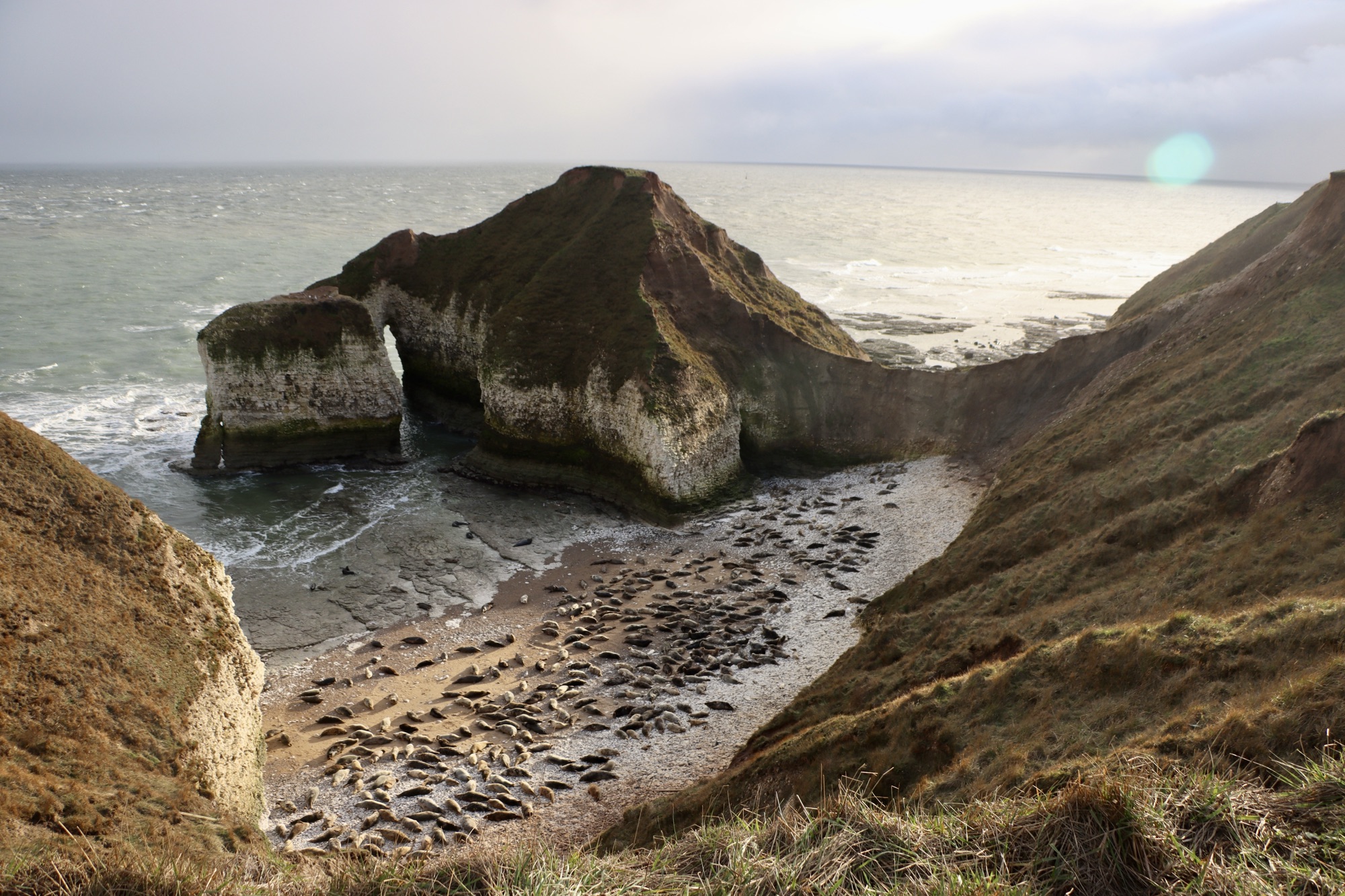
Every autumn, for the past few years, a large group of Atlantic grey seals make a temporary home on one of the beaches at Flamborough Head for breeding. And over the Christmas break, we popped along to see them.
The seals haven’t always gravitated to Flamborough. It’s only been in the past few years that they have appeared there. I used to go to Flamborough quite a bit when I was younger, as my paternal grandparents lived nearby and my Dad was brought up in nearby Bridlington. It may be a sign of a stronger seal population.
The best time to visit is really in October and November. This is the core breeding season, and so you are more likely to see seal cubs at this time. By the time we visited in late December, most of the cubs were mostly or fully grown. Still, there were probably 50-60 seals there – more than we saw on the Farne Islands in 2024.
Access down to the cove, where most of the seals congregate, is restricted. The population is being monitored by the Yorkshire Wildlife Trust, and we saw signage from the University of Hull’s marine biology unit who are involved in research there. However, you get a good view of them from a safe distance from the headlands.
Accessibility
We parked at the Flamborough Head and Lighthouse car park, which is the nearest car park. It’s pay and display, or you can pay on the MiPermit app. Electric vehicle charging isn’t currently available in the car park – we used a rapid charger at the Co-op supermarket in the nearby village of Sewerby.
From the car park, there are unpaved footpaths down to the cliff edge. These are uneven and a little steep in places, and probably not suitable for wheelchairs. Also be aware that the cliff edge doesn’t have any railings or barriers, so bear this in mind if you have young children or dogs with you.
Bridlington is the nearest town with a railway station; from there, you’ll need to catch the number 14 ‘Coaster’ service which runs hourly and can drop you in Flamborough village. From there, it’s about a 10 minute walk.
Other things to see
Flamborough Head in itself is interesting from a geology perspective, as it’s a relatively hard chunk of chalk in an area where most of the nearby coastline is eroding away. You can tell that I studied this for A-level Geography, can’t you?
There is a café at the car park – we stopped there for lunch on our visit. I bet they’re glad that the seals are providing extra custom in the winter.
Flamborough actually has two lighthouses. The one that is currently in use dates from the early 19th century, although it’s now completely automated. It used to be open for tours, but it’s not open at present. The second is slightly further inland and known as the Chalk Tower – it’s the oldest surviving complete lighthouse in England and is now grade II* listed.
Nearby is Sewerby Hall, which is a manor house, gardens, and small zoo, and to the north is RSPB Bempton Cliffs. Plus, there are all the attractions in the seaside town of Bridlington, further along the coast.
Last Sunday, we spent an afternoon at Fairburn Ings, an RSPB nature reserve that straddles the border between North and West Yorkshire.
Fairburn Ings was previously used for coal mining and industry, until the 1950s. It’s been left to return to nature, and is now a series of ponds, lakes and bogs, with the River Aire flowing past. These wetlands have attracted many birds, and it’s now run by the RSPB who have a series of hides across the site, and a visitor centre.
The visitor centre sits in the middle of the site. On our most recent visit, we walked around the western side of the site, in the hope of seeing some spoonbills. Alas, we didn’t, but we saw plenty of swans and cormorants, along with a black-necked grebe which isn’t native to Britain. We also saw a white egret.
There are a number of marked footpaths around the site, but many areas are kept out of bounds to give safe spaces to the wildlife. The visitor centre has binoculars for sale and to hire, and you can also hire a pond dipping kit for kids.
About 10 minutes drive away is another RSPB reserve at St Aidans – indeed, the two are jointly managed, and you could combine both as a single day out. We actually planned to go to St Aidans, but couldn’t get parked; it seemed that with the recent lovely weather, lots of other people had the same idea.
Accessibility
Fairburn Ings is near the village of Fairburn, which until 20 years ago was bisected by the A1 but is now a relatively quiet backwater. You probably want to drive there, as there aren’t any buses that get particularly near Fairburn Ings, and the nearest railway station is three miles away in Castleford.
There are two car parks at Fairburn Ings; the central one is run by the RSPB and is close to the visitor centre. There’s a separate one run by Leeds City Council at the western end. Both are pay and display, but otherwise entrance to Fairburn Ings is free.
Whilst there are few steps on the site, the ground is often uneven and there are some steep slopes. The visitor centre has a disabled toilet, but if you need a Changing Places toilet, you’ll need to go to the Junction 32 Outlet or Ferrybridge Motorway Services which are both a short drive away.
York, the city I was born in, now has yet another tourist attraction – the Askham Bryan Wildlife and Conservation Park. Located on the edge of the city by the ring road, it’s on the site of Askham Bryan College, one of the largest agricultural colleges in the UK. It’s been open just over a week, and I visited with Christine and Lizzie yesterday.
Fish and reptiles
The visit starts inside the visitor centre, with a look at fish and reptiles. Sadly the fish tank had broken already, and so was empty. To make up for it, visitors were allowed behind the scenes to one of the back rooms. Here, there were many more small aquatic and amphibious animals that were not normally on show to the public. Plus, students from the college were on-hand to answer questions.
It’s worth noting here that the wildlife park isn’t just a tourist attraction, but is part of Askham Bryan College itself. Many of the keepers are also students of the college, who are doing courses in animal management. The courses range right from basic level 1 qualifications in land-based studies all the way through to degrees. The wildlife park therefore gives the students practical experience as an integrated part of their course, without the need to go elsewhere.
After the reptiles, there’s a nocturnal animals section with dimmed lights. The animals here included a civet, a sugar glider, an armadillo and several chinchillas. All apart from the chinchillas were active when we first arrived in the morning, but were nowhere to be seen in the afternoon. The chinchillas seemed to be asleep the whole time.
The visitor centre also includes an ‘Education Pod’, and we went to two handling sessions during the day. One focused on reptiles, with the opportunity to stroke a snake, a bearded dragon and a tortoise, and the other on bugs – stick insects and cockroaches.
Meerkats and farm animals
Outside, there’s a meerkat and mongoose enclosure, with two gangs of meerkats in separate areas. The Yorkshire Wildlife Park, a few miles south near Doncaster, also mixes its meerkats and mongooses (not ‘mongeese’) and this is because the two species often share burrows in the wild. There were a couple of talks about the meerkats during the day, and we stayed for the second talk in the afternoon.
Next is a farm enclosure, home to seven goats, spanning three species, and three alpacas. Again, there was a ‘Meet a goat’ talk, where kids got chance to pet a large goat called Steve.
Arboretum
The rest of the site is in what used to be Askham Bryan College’s arboretum. There’s a wide variety of trees and plants, with the same information boards as the animals. Some of the trees, like the animals, are endangered, and so it was interesting to read about them.
The next set of enclosures housed lemurs, raccoons and skunks. The lemurs were quite active but we didn’t get to see a raccoon until the afternoon, and even then it was asleep. American readers may wonder why an animal that is considered a pest is in a zoo in Britain, but they’re not native here. Interestingly though, it will shortly become illegal in the EU to breed raccoons, as they’re classed as an invasive species.
As for the skunks, we only got to see them at feeding time in the afternoon. They’re nocturnal, so this isn’t so surprising.
Wallabies and birds
There are six wallabies at Askham Bryan, one of which is a joey. The joey is a few months old, but it doesn’t yet have a name as it’s still in its mother’s pouch. Next to that were two monkey enclosures, home to some marmosets and tamarins – the latter had only been at the zoo for a few weeks.
Further on is an aviary with a variety of parrots. Unfortunately, issues with avian flu meant that the aviary was closed, although you could hear the birds. Finally, visitors can access York Falconry at the far end of the site, for a small additional fee – £2 for adults, cash only. York Falconry is home to several birds of prey – owls, hawks, and some ferrets. When we went, there was an opportunity to hold a Little Owl. Despite the small extra cost, this end of the zoo was very quiet and we saw several groups turn back when they realised there was an additional charge, which is a shame.
Work in progress
The wildlife park is, of course, brand new, and so there were some areas that weren’t ready. There’s a wetland area with a pond that was open, but with nothing to see. And an enclosure for some Scottish wildcats was being finished, ready to open soon.
Without attending the talks, we could have done the park in less than two hours, as it’s not very big and certainly on a much smaller scale than many other zoos in the UK. The talks were good, although some of the students delivering the talks seemed a bit unsure of what they were saying. The cafe in the visitor centre was rather underwhelming, and just offered drinks, pre-packed sandwiches and cakes. The sole member of staff was clearly overworked with patrons, and it wasn’t even lunchtime. So there’s room to improve.
I also think it would be good to see more of the behind the scenes areas. We were lucky to be able to see one of them, but this won’t normally be open, which is a shame – it was good to see how the park was run, and could be a good recruitment tool for the college’s courses.
Opening times
Unlike most zoos, which are open almost every day of the year, Askham Bryan’s wildlife park is normally only open on weekends. Exceptions are school holidays, when it’s open throughout the week, and bank holidays. At £7 for adults and £5 for children, it is considerably cheaper than most other zoos. And, whilst there isn’t a lot to see right now, what they do have so far is good. It’s also worth mentioning that, at present, you have to pre-book your tickets online and print them out. You’ll also need to bring cash if you want to see the falconry. I hope that, in future, there’ll be an option to include the falconry in the entry tariff on the door, or at least a way of buying a voucher with a credit card.
Askham Bryan is very close to where my parents live, and I imagine that when Lizzie stays with them she’ll be a regular visitor. Certainly, had this existed 30 years ago, I think my parents would have taken me there regularly. And whilst York isn’t short of tourist attractions, it’s an interesting and unique addition.
Having visited last Valentines Day, we made a return visit to the Yorkshire Wildlife Park near Doncaster at the weekend. We really enjoyed it last time, but our visit was cut short when the weather turned. Saturday was a cold but dry day, so we headed over for another visit.
Getting there was a little easier this time, thanks to the opening of the Great Yorkshire Way. This links the M18 – the motorway that bypasses Doncaster to the south – with the A638, the road that feeds the wildlife park and nearby Robin Hood Airport. A second phase, due to start construction shortly, will see the road make it all of the way to the airport. But even the first phase cut our travelling time by at least 10 minutes each way.
The main attraction that we missed last time was the lions, so we went there first. The lions were rescued from a run-down zoo in Romania, and flown to the UK on a specially-adapted Jet2 plane. Their new enclosure is as big as the whole of the zoo that they called their home previously. Indeed, one thing I like about the Yorkshire Wildlife Park is that the enclosures are big, and designed so that visitors can see in over the fencing in many cases. On both visits, my Canon EOS 600D DSLR camera has seemed almost amateur compared to some of the specialist photography kit that other visitors have brought, and it’s easy to see why.
We also got to see one of the leopards; last time, none of them fancied making an appearance. And we saw a stoat – not one of the zoo’s animals, but it was on an area of rough ground near the polar bears that has yet to be developed.
Yesterday, Christine and I took our little cherub to the Yorkshire Wildlife Park, near Doncaster. It’s one of Britain’s newest zoos, having opened as recently as 2009. It’s been on our ‘to-do’ list of regional attractions for some time, but it’s not the easiest place to reach by public transport – from Sowerby Bridge, we’d need to get a train to Leeds, another train to Doncaster and then a bus, and then the same going back. Now that we have a car, it’s only a little over an hour’s drive away, and gave us something to do out of the house on Valentines Day.
Despite the name, the Yorkshire Wildlife Park is more like a zoo than a safari park, so you park your car and head in on foot. The park covers a large area, and unlike some zoos, has a narrower range of animals but larger enclosures with bigger groups of animals. Whilst one zoo might have one or two tigers, the wildlife park has six spread across two big enclosures. And there are some animals, like polar bears and an armadillo, that I haven’t seen in other zoos. No red pandas though.
Some of the enclosures allow you to walk through, but those that don’t usually have dedicated viewing platforms without metal railings in the way. Consequently it’s popular with photographers with some very large camera lenses and tripods around. As with most attractions, photography for personal use is fine, but commercial use requires a license.
My personal highlights were the tigers and the polar bears, although I also enjoyed the talk about the lemurs. Again, like most zoos, there are talks throughout the day, every half hour. Although we got there quite early, we didn’t get chance to see everything as what started as a very sunny (but cold) day turned to snow by the mid-afternoon. But I’m sure we’ll be back, especially as our little cherub gets a bit older and is able to appreciate it more. As it was, they were asleep in the pram most of the time.
Another thing that sets the wildlife park apart from its rivals is its range of food outlets; each one has a different focus and it’s good quality. We went to the Safari Cafe by the entrance and were impressed with the food and drink on offer, much of which is from local suppliers. Entrance to the wildlife park is, like many zoos, a bit pricey – we pre-booked online which cost £13.50 each for adults, but children over 2 will be charged £11.50. Tickets booked online are a pound cheaper, but make sure you check the weather first as almost all of the park is outdoors. And there are annual passes available for those who visit regularly – I expect we’ll be back quite a bit in a year or two as it’s our nearest outdoor zoo. We really enjoyed our day out and I strongly recommend it.