I quite like doing these round-ups of previously unblogged minor things at the end of each month. You can read what I wrote in October, and now here’s November:
Peter Pan-to time (oh no it isn’t)
We’re off to see Peter Pan at the Bradford Playhouse this weekend. It’s the annual pantomime from one of the local amateur dramatics societies, The Bradford Players. It also marks ten years since I helped backstage with Sleeping Beauty, a previous pantomime production. We don’t see a panto every year, but we know some of the cast and so we want to support them. Some tickets still available for the performances taking place today and tomorrow, but be quick.
The Bradford Playhouse is hosting another panto next month – Cinderella. By contrast, this is a professional production – several showings have already sold out but others have good availability. It’s cheaper than many mainstream theatres, and by booking to see it, you’re supporting smaller independent theatres.
I suck at soldering
In last month’s unblogged update, I mentioned how I was playing with a ESP development board to add Wi-Fi control to an existing non-smart device. In the end, I gave up, as my soldering skills just weren’t sufficient to keep the wires soldered to the contact points on the circuit board. If you’re interested, the device I was modifying was an Ikea Uppåtvind air purifier, and I was using this guide. To be fair, even if it had worked, I was using a much larger board than the D1 Mini recommended and so there’s no guarantee that I would have been able to re-assemble it anyway.
York Christmas Market
Whilst we were in York last weekend, alongside visiting York’s Chocolate Story, we also had a browse of York’s Christmas Market in Parliament Street. Even on a Sunday morning, it was very busy, and overall the city was the busiest I’ve seen it (remember, I grew up in York). Indeed, people have been complaining about how busy it is.
Christmas markets can be a bit hit-and-miss – I remember going to the Manchester Christmas market several years ago to find it was basically the same four stalls repeated across the whole city. York’s market is mostly local businesses, and it’s a good mix of food, drink and gifty things. We always buy a litre bottle of barbecue sauce from The Chilli Jam Man when we go.
Black Friday
I literally only bought two things on Black Friday this year, both from Amazon:
A 3 way plug with USB-A and USB-C(sponsored link). Christine has had one of these for a while and uses it daily; I’ve bought a second one because I want a charger for the bedroom that doesn’t have any LEDs on it.
The Actually Delicious One Pot Cookbook(sponsored link). This is the latest cookbook from Poppy O’Toole, aka Poppy Cooks, and it’s reduced to £10 (from £22) in their Black Friday sale. We already have her Potato Book and Slow Cooker books and use them both frequently.
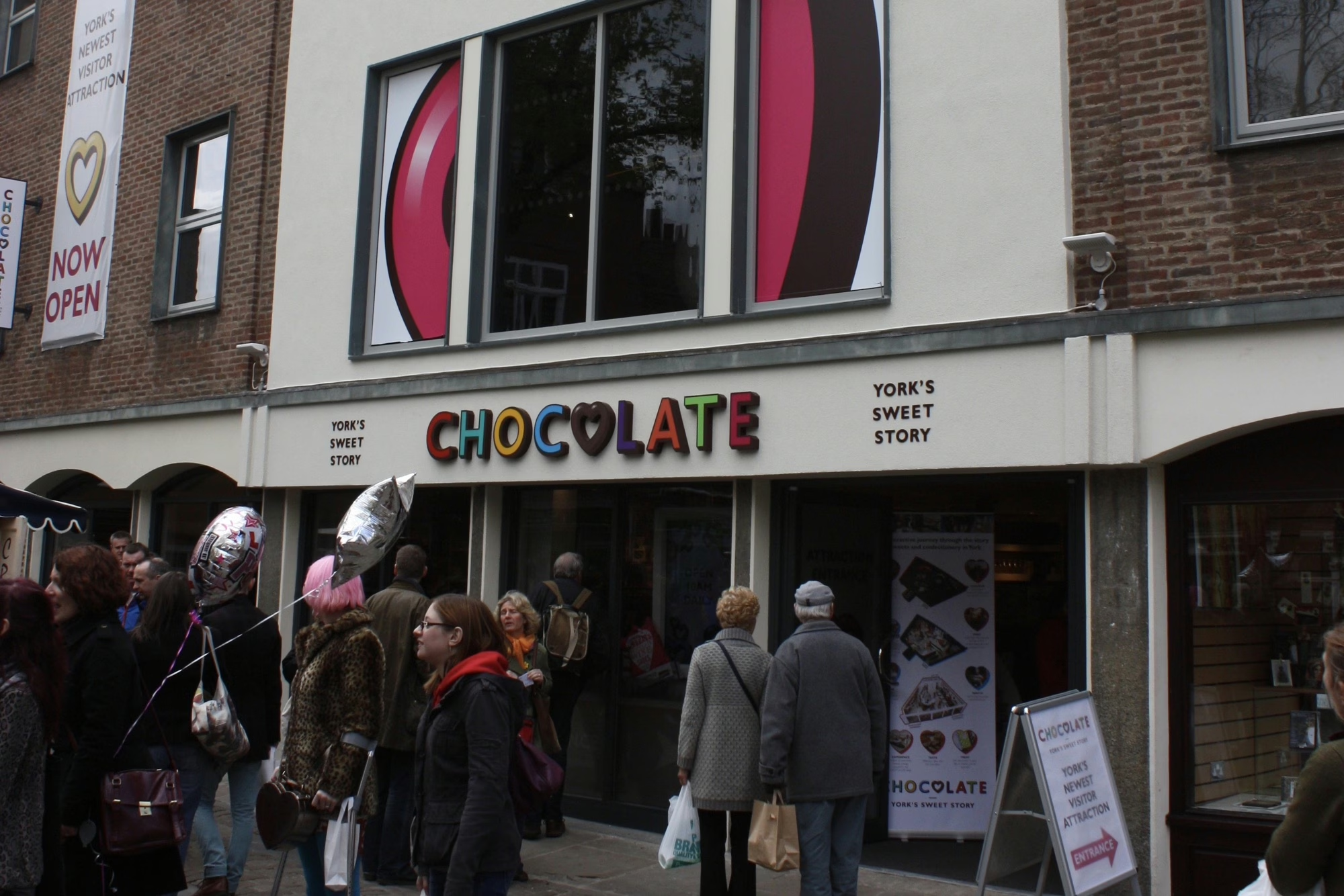
York, my city of birth, is known for a lot of historical things – the Romans, the Vikings, the medieval city walls and others. But it’s also known for chocolate, and was once home to three large confectionary companies: Rowntree’s, Terry’s and Cravens. And the story of York’s chocolate industry is the focus of one of its newer museums: York’s Chocolate Story.
Christine and I visited shortly after it opened, back before we got married, in 2012. Then, it was known as Chocolate: York’s Sweet Story, but its name has changed since. I hadn’t been back since – Christine had her hen do there – but last weekend I took our nine-year-old along.
Having visited Cadbury World earlier in the summer, it was good to compare the two. Cadbury World is a Merlin attraction, and so it’s more of an indoor theme park with some history. Meanwhile, York’s Chocolate Story, is primarily a museum, although both offer you chocolate samples to eat on your way around.
Inside York’s Chocolate Story
Guests follow a guided tour around the museum, although there are videos to watch as well. Whilst we waited for the rest of the group to come up in the lift, our knowledgeable guide asked everyone what their favourite chocolate bar was, and he was able to quickly look up when they first went on sale. It turns out that many chocolate bars have been around longer than we might expect.
The first room is about the ancient history of chocolate, and how Spanish colonialists ‘discovered’ it when they reached Mexico. At this point, you get to try a sample of the bitter chocolate drink that people would have drunk back then.
Next, we’re introduced to the aforementioned three confectionary businesses, and the people behind them. Of these, Rowntree’s still has a factory in York, but is now part of the massive Nestlé conglomerate. Terry’s are still making chocolate, but the York factory (close to where I went to secondary school) is now flats, with production shifted to Strasbourg. Whilst I’m old enough to remember Craven’s sweets, the company is no longer around.
Making chocolate
We then head downstairs, to find out more about how chocolate bars are made. This included a chance to make our own white chocolate lollipop, with a choice of flavours. They use white chocolate as it sets more quickly. We could also watch a demonstration where filled chocolate truffles were made, and of course we got samples to taste. The same room has a history of KitKats, and you can watch various classic KitKat TV adverts too.
All in all, it takes about an hour to get around. Of course, there’s a shop at the end which also does a range of hot chocolate.
Accessibility
Being a newer museum, accessibility is good – there’s a lift taking you to all floors. It’s in York city centre, around the corner from The Shambles, so within walking distance of the station. Whilst you can try to park your car in York city centre, please don’t – we saw loads of people queueing to get into car parks and blocking the roads whilst doing so, and besides, you’ll pay a small fortune. Instead, take one of the six Park and Ride services.
It’s best to book in advance – if you turn up on the day, all the tour slots may have gone or you may have to hang around for a while. Plus, there’s a 20% discount for booking in advance, and York residents get a 30% discount for visits on Sundays.
Compared with the average young person in 1980s Yorkshire, I probably got more exposure to trains than other kids my age. This was because my dad worked for British Rail, in their civil engineering department. As such, we got employee travel benefits, meaning 20 days free travel per year and a steep discount on all other rail travel beyond that. As such, we travelled by train a lot; despite living in York, we would have regular day trips to London which was only a couple of hours away.
My parents still have their staff travel privileges, even though my dad retired from the railway over a decade ago. I unfortunately don’t, as I’m no longer dependent on them, but I was able to keep it through my time at university, which was nice.
I could see trains from my bedroom window
The window in my childhood bedroom overlooked mainly fields, but in the distance, I could also see trains on the East Coast Main Line. Our house overlooked one of the busier four-tracked sections, and so as well as London-Scotland Intercity trains, I could also see Transpennine and Crosscountry services, and a few freight trains. We were close enough to be able to make out train liveries and types, but not individual train numbers.
I have vague memories of seeing the engineering trains that were involved in the electrification of the line, which took place in the late 1980s, and experiencing the then new electric Intercity 225 trains that are now in their twilight years.
I grew up in York
York is an important junction on Britain’s railways, largely thanks to George Hudson (although he has a rather complicated legacy thanks to some dodgy financing). It has a much bigger station than many places of a similar size, and is where the East Coast Main Line meets branches from Harrogate and Scarborough to the north, and Hull and Leeds from the south. There are lots of places that you can get to from York without changing trains. So, the combination of easy journeys and free/discounted travel meant that I was able to go on lots of trips by train whilst growing up.
York is also home to the National Railway Museum, which I used to visit regularly as a child. As an adult, I haven’t been in a few years but we’ve taken our nine-year-old there at least a couple of times.
However, that meant that I spent the first 13 years of my adult life largely reliant on public transport. In 2010, I moved out of Bradford, where I was working, to Sowerby Bridge, and this meant that I spent subsequent years commuting to work by train. And even now, I tend to prefer commuting by train – it’s rare that I drive to work, even though I have the option.
Also, in 2009 and 2010, when Christine and I were dating but not living together, one of us would get the train across the Pennines to see each other almost every weekend.
I read magazines about trains
Ever since I could read confidently on my own, I’ve been reading Rail Magazine. Indeed, I’ve had a subscription and/or read it through Readly or Pressreader for many years now, not missing an issue. Which, as it’s published every fortnight, is a lot of content.
For a time, I also read Modern Railways every month, although I stopped when it was no longer included with Readly. I haven’t subscribed because, whilst I appreciated the analysis in it, I just don’t have the time to read that as well. Indeed, recently I was six issues behind with Rail Magazine and only really caught up due to being ill at the end of October.
Consequently, my knowledge of British rolling stock is pretty good. Give me a photo of a passenger unit or locomotive that has run within the past 20 years in Britain, and I’ll probably be able to tell you its class number, when it was introduced, which company built it and where. Granted, it’s not the most useful superpower, although it did come in useful when advising a friend with sensory issues about which trains would be nosiest on a long journey.
I’m also not a trainspotter – I don’t note down individual unit numbers and I don’t actively spend time hunting out particular types of trains. Not that there’s anything wrong with having a hobby like that, if that’s something you enjoy. It’s just not for me.
So, I think, in a nutshell, that’s why I’m interested in trains.
The last time we went was, I believe, 2017, when our nine-year-old was only 2. I remember it not being a particularly enjoyable experience for them so we hadn’t been back since. But they seemed keen to go this year, and enjoyed it. The last time I blogged about it was in 2016, so maybe read that first.
Compared with previous years, I noted that most layouts now use Digital Command Control for operating the model trains. This allows modellers to control individual trains directly, rather than by selectively powering the tracks. It also allows the trains to have sound effects that react to their current operation (so sounds get faster as the train speeds up). Indeed, one layout seemed to be operated by tablet computers, rather than traditional handsets.
I also felt like there was more variety this year too. Certainly, there were more layouts set in modern times – it wasn’t steam engines all the way down. But it was also nice to see some non-British settings, including an interesting Chinese layout. China, apparently, was still using steam engines in revenue service as recently as the early 2000s, which seems hard to believe when you consider it’s now a world leader in high speed electric train services.
The other thing I noticed was the impact of 3D printing. Indeed, there was at least one 3D printing demonstration there. Being able to 3D print your own parts, model buildings and even model locomotives must be a big step forward.
The York Model Railway Show takes place every Easter at York Racecourse. Seeing as our nine-year-old enjoyed it this time, we may well be back next year.
Last week, we took our nine-year-old for their first visit to the Jorvik Viking Centre in York. Now I grew up in York, and so have been many times over the years, but the last time Christine and I went was in 2012.
Jorvik is undoubtedly one of York’s best known tourist attractions, having opened celebrated its 40th anniversary last year. However, I’m writing about it now because, until the 23rd February, Jorvik is dressed up for winter.
Recreation of Jorvik ride
The main part of Jorvik sees visitors sitting in carriages that move around a recreation of York, or ‘Jorvik’ as it was known in the time of the Vikings. The carriages seat six, and feature a commentary in multiple languages. This part takes around 15 minutes, and the carriages rotate to highlight different parts of the recreated city. The buildings are laid out roughly as they were found when the site was excavated in the 1970s.
Before you go on the ride, there’s a glass floor to walk over which has a recreation of that 1970s archaeological dig. Previously, the site had been a factory for Cravens Confectionery, a now defunct sweet and chocolate manufacturer (alongside Rowntrees, now part of Nestlé, and Terry’s, now part of Mondelez). Local planning rules in York mean that an archaeological dig must take place whenever foundations are to be dug, and this large site resulted in a five year excavation that unveiled many artefacts of York’s past. Indeed, once the ride has finished, you can view some of the finds that were excavated, and find out more about how the Vikings settled in York.
As mentioned, Jorvik has been dressed up for winter, so at present there’s snow on all the recreated buildings and on the ground. If you’ve been to Jorvik recently, maybe give it another visit as it looks very different at present. I didn’t take any photos on my visit this time unfortunately.
Accessibility
Jorvik is accessed down some stairs, although there is a lift. If you’re a wheelchair user, you’ll need to book in advance by phone (not online), as only one of the carriages has been adapted for a wheelchair and the staff will need to give you a specific timeslot. However, all the carriages offer a hearing loop for hearing aid users, and subtitles for the commentary. Famously, Jorvik recreates the smells of Viking York and this is worth being prepared for if you’re sensitive to unusual scents. There’s an extensive accessibility page on Jorvik’s web site, detailing what you can expect and how they can help you.
The days of there being massive queues for Jorvik snaking around the Coppergate Shopping Centre are mostly gone, as you now need to pre-book. You should do this online if you can; you can book on your phone on arrival, but be prepared to have to come back later. We turned up without pre-booking and had to return after 45 minutes. However, the following day, there were signs up saying that all time slots were booked up and no more bookings were being taken that day.
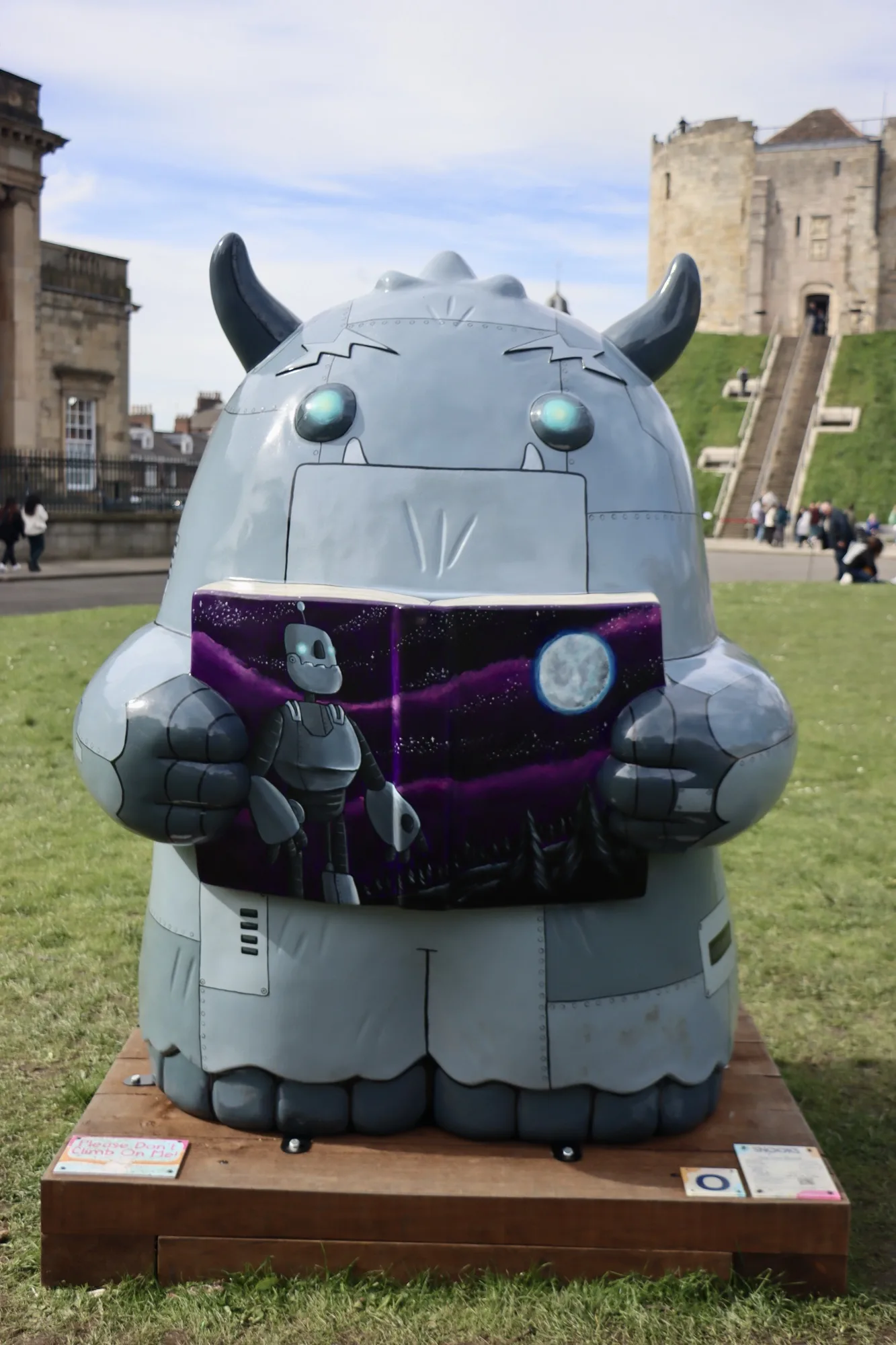
If you go to York (my home town) between now and the 25th April, you may encounter several large painted fibreglass monsters reading books dotted around. They’re the Snooks, and they’re part of the The Snooks Trail around the city.
There are 21 snooks in total, mostly in the city centre but a couple located further out. We spent part of our Easter Sunday hunting the snooks, and managed to see 12 of them. Our eight-year-old thought that ‘Frankie the Fostering Snook‘ was the best one – it’s outside York Central Library and sponsored by the York Fostering Service. Whilst the full list is on the web site, we also saw a few two-dimensional Snooks in the windows of buildings that we passed that presumably aren’t part of the official trail.
Each of the snooks has a letter attached, and if you put the letters in order, you can find a secret web address. Unfortunately, we didn’t have time to visit all of the snooks and didn’t get the full code.
Easter Monday, despite being a bank holiday, was quite a nice day. So, we went to Beningbrough Hall, near York, with my parents in tow.
I’ve been before, as it’s not far from my parents’ house, and it’s a National Trust property. My parents have been National Trust members for years, and I also joined some time ago. Unfortunately, there aren’t many properties near us in West Yorkshire. East Riddlesden Hall is the nearest to where we live, and so I don’t get many chances to use my membership. So it was nice to be able to get some return on my membership fees. Plus, Christine has never been.
We didn’t go inside the hall itself, although I later found out that there’s a children’s playroom inside – dammit! Beningbrough Hall is a northern outpost of the National Portrait Gallery, and so there are many paintings inside.
Instead, we strolled around the gardens. They’re not the biggest, but they’re pretty and well-kept. Being Easter, there was the usual Cadbury’s Egg Hunt taking place. Our one-year-old was a bit young for this, but I think they’ll enjoy it next year.
There’s also a good outdoor playground. Again, it’s better for bigger kids, but our one-year-old enjoyed the swings. During school holidays, there are opportunities to build dens in the wood, and various other activities to keep children entertained.
York, the city I was born in, now has yet another tourist attraction – the Askham Bryan Wildlife and Conservation Park. Located on the edge of the city by the ring road, it’s on the site of Askham Bryan College, one of the largest agricultural colleges in the UK. It’s been open just over a week, and I visited with Christine and Lizzie yesterday.
Fish and reptiles
The visit starts inside the visitor centre, with a look at fish and reptiles. Sadly the fish tank had broken already, and so was empty. To make up for it, visitors were allowed behind the scenes to one of the back rooms. Here, there were many more small aquatic and amphibious animals that were not normally on show to the public. Plus, students from the college were on-hand to answer questions.
It’s worth noting here that the wildlife park isn’t just a tourist attraction, but is part of Askham Bryan College itself. Many of the keepers are also students of the college, who are doing courses in animal management. The courses range right from basic level 1 qualifications in land-based studies all the way through to degrees. The wildlife park therefore gives the students practical experience as an integrated part of their course, without the need to go elsewhere.
After the reptiles, there’s a nocturnal animals section with dimmed lights. The animals here included a civet, a sugar glider, an armadillo and several chinchillas. All apart from the chinchillas were active when we first arrived in the morning, but were nowhere to be seen in the afternoon. The chinchillas seemed to be asleep the whole time.
The visitor centre also includes an ‘Education Pod’, and we went to two handling sessions during the day. One focused on reptiles, with the opportunity to stroke a snake, a bearded dragon and a tortoise, and the other on bugs – stick insects and cockroaches.
Meerkats and farm animals
Outside, there’s a meerkat and mongoose enclosure, with two gangs of meerkats in separate areas. The Yorkshire Wildlife Park, a few miles south near Doncaster, also mixes its meerkats and mongooses (not ‘mongeese’) and this is because the two species often share burrows in the wild. There were a couple of talks about the meerkats during the day, and we stayed for the second talk in the afternoon.
Next is a farm enclosure, home to seven goats, spanning three species, and three alpacas. Again, there was a ‘Meet a goat’ talk, where kids got chance to pet a large goat called Steve.
Arboretum
The rest of the site is in what used to be Askham Bryan College’s arboretum. There’s a wide variety of trees and plants, with the same information boards as the animals. Some of the trees, like the animals, are endangered, and so it was interesting to read about them.
The next set of enclosures housed lemurs, raccoons and skunks. The lemurs were quite active but we didn’t get to see a raccoon until the afternoon, and even then it was asleep. American readers may wonder why an animal that is considered a pest is in a zoo in Britain, but they’re not native here. Interestingly though, it will shortly become illegal in the EU to breed raccoons, as they’re classed as an invasive species.
As for the skunks, we only got to see them at feeding time in the afternoon. They’re nocturnal, so this isn’t so surprising.
Wallabies and birds
There are six wallabies at Askham Bryan, one of which is a joey. The joey is a few months old, but it doesn’t yet have a name as it’s still in its mother’s pouch. Next to that were two monkey enclosures, home to some marmosets and tamarins – the latter had only been at the zoo for a few weeks.
Further on is an aviary with a variety of parrots. Unfortunately, issues with avian flu meant that the aviary was closed, although you could hear the birds. Finally, visitors can access York Falconry at the far end of the site, for a small additional fee – £2 for adults, cash only. York Falconry is home to several birds of prey – owls, hawks, and some ferrets. When we went, there was an opportunity to hold a Little Owl. Despite the small extra cost, this end of the zoo was very quiet and we saw several groups turn back when they realised there was an additional charge, which is a shame.
Work in progress
The wildlife park is, of course, brand new, and so there were some areas that weren’t ready. There’s a wetland area with a pond that was open, but with nothing to see. And an enclosure for some Scottish wildcats was being finished, ready to open soon.
Without attending the talks, we could have done the park in less than two hours, as it’s not very big and certainly on a much smaller scale than many other zoos in the UK. The talks were good, although some of the students delivering the talks seemed a bit unsure of what they were saying. The cafe in the visitor centre was rather underwhelming, and just offered drinks, pre-packed sandwiches and cakes. The sole member of staff was clearly overworked with patrons, and it wasn’t even lunchtime. So there’s room to improve.
I also think it would be good to see more of the behind the scenes areas. We were lucky to be able to see one of them, but this won’t normally be open, which is a shame – it was good to see how the park was run, and could be a good recruitment tool for the college’s courses.
Opening times
Unlike most zoos, which are open almost every day of the year, Askham Bryan’s wildlife park is normally only open on weekends. Exceptions are school holidays, when it’s open throughout the week, and bank holidays. At £7 for adults and £5 for children, it is considerably cheaper than most other zoos. And, whilst there isn’t a lot to see right now, what they do have so far is good. It’s also worth mentioning that, at present, you have to pre-book your tickets online and print them out. You’ll also need to bring cash if you want to see the falconry. I hope that, in future, there’ll be an option to include the falconry in the entry tariff on the door, or at least a way of buying a voucher with a credit card.
Askham Bryan is very close to where my parents live, and I imagine that when Lizzie stays with them she’ll be a regular visitor. Certainly, had this existed 30 years ago, I think my parents would have taken me there regularly. And whilst York isn’t short of tourist attractions, it’s an interesting and unique addition.
It’s an event I’ve been going to from a very young age – both my Dad and I have an interest in railway modelling and there’s a large train set at my parents’ house in York. Although it’s gathering dust and hasn’t been used much over the last 10-15 years – I imagine that Dad planned to work on it in retirement but he’s been too busy doing other things.
So, the model railway show. It takes place over the Easter weekend and has run every year (I think) since the 1960s. Whilst I used to go every year, this was my first visit since 2013. There are a mixture of layouts, built by individuals and societies, as well as many trade stands.
The layouts vary greatly in size. Some are huge, requiring multiple people to operate, whereas others will easily fit in the back of someone’s car. The smallest was in a flight case, which used the diminutive ‘T gauge‘. Whilst many layouts used ‘OO’ gauge, which is the most widely available to those with trainsets at home, there were many others with bigger and smaller trains.
As you can imagine, model railways attract a predominantly older, male audience, but it’s popular with kids as well – footstools are available for hire for those otherwise unable to see the layouts. We didn’t take our baby this time as they’re a bit young, and it can be rather crowded – not ideal conditions for a pram. Maybe next year, when they can take an interest in what’s going on.
York is one of the larger exhibitions, both in terms of the number of layouts on show and also in length, as it runs over three days. Opening yesterday, it runs until tomorrow.
I went to RailFest 2012 at the National Railway Museum yesterday. As it’s still on until Sunday, I’ve decided to write about it now, just in case you have time to go and visit.
Firstly, if you’re not normally interested in trains, then, to be frank, RailFest probably isn’t for you. In essence, you have several items of the NRM’s own collection, mixed in with some visiting trains, both old and new. This is great for train geeks like me, but not so great for those without a passion for rail travel, like Christine, who did not accompany me on this occasion.
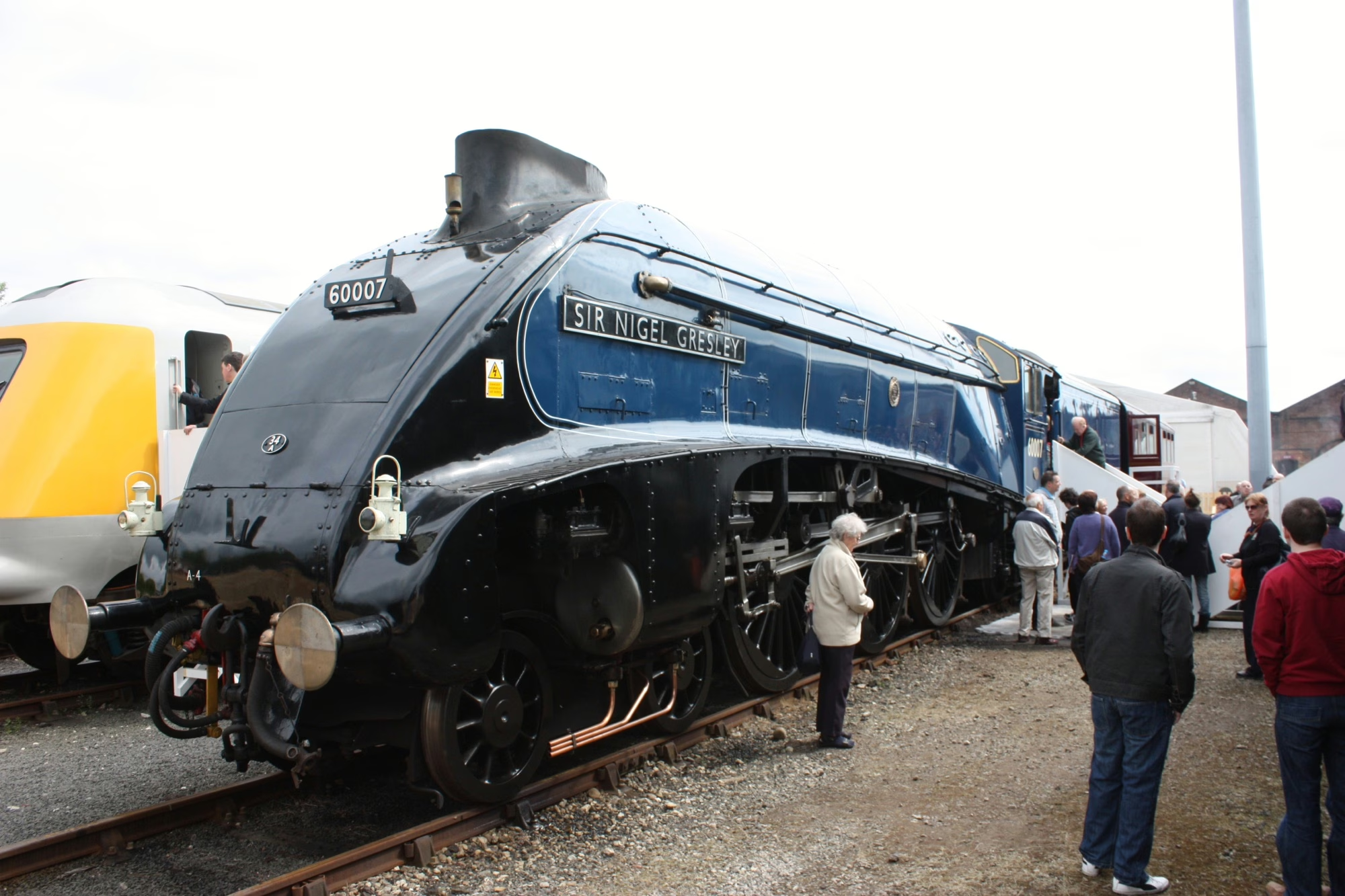
You can go onto the footplate, or into the drivers cab of many of the trains on show, and there are plenty of volunteers around to talk with you about the train. Plus, every train on show has an information board, with many answering the question ‘Why is this here?’ as some locomotives are notable. There’s Sarah Siddons, a Metropolitan Railway locomotive preserved by London Underground which is now Britain’s oldest working electric locomotive. Or a class 43 High Speed Train locomotive called 43159, which was part of a pair of locomotives that set the official world speed record for a diesel locomotive, and which is still in regular revenue service with First Great Western. And next to it is 41001, the sole remaining prototype locomotive for the High Speed Train which has just commenced restoration. And then there are the more well-known locomotives – both Mallard and Sir Nigel Gresley were available for footplate talks, as was Tornado, a steam locomotive built in 2008 to original LNER designs.
But in a way it was nice to be able to get up close to some of the trains that we see every day, or look behind the scenes in places where passengers don’t normally go, like the drivers cab. It was particularly interesting comparing the cab of 41001, which dates from 1972, with the cab of one of the Class 395 Hitachi trains which operate on High Speed 1 for Southeastern’s domestic high speed services (and the Javelin services for the upcoming Olympics) which were introduced 37 years later in 2009. Both seem to have a similar number of buttons and controls but the latter could do so much more.
There were also a number of train rides available on standard, narrow and miniature gauge trains, although I didn’t take this up even though they were included with the entry price – £13 for all day if bought in advance online. The site was quite busy, especially in the afternoon, and, unsurprisingly, most visitors were older men with cameras and excitable young boys. The museum itself is open as usual, and remains free to those who aren’t interested in RailFest.
If you are going, allow at least 3 hours for RailFest alone, on top of any time you want to spend in the rest of the museum. I’d also advise bringing your own food as the catering on the RailFest site is extortionate (best part of £10 for a cheeseburger, chips and a bottle of cola). And also think of lots of questions to ask, as the volunteers are more than happy to answer them. It’s well worth the visit.