Park and Ride for Northern English Cities

A photo of Temple Green Park and Ride in Leeds

I like a good Park and Ride system. You park your car somewhere on the edge of a city, usually for free, and then switch to a more sustainable mode of transport to get to the city centre.

I grew up in York, whose Park and Ride system has been around since the late 1980s. NestlĂ© Rowntree were an early sponsor, and I remember as a kid getting a box of Smarties when boarding. Back then, it was operated in the car park of the (then) York College of Art and Design on Saturdays, using hired in coaches. Later, it moved to a purpose built site on the other side of the A1036 Tadcaster Road and eventually got its own dedicated fleet of buses. Nowadays, York’s system operates from six sites and is the largest one in the UK, as befits such an ancient city.

Most other cities in the north of England have some kind of Park and Ride scheme, and this is my attempt at summarising them. I’m including every settlement in the North East, North West and Yorkshire that has official city status.

Bradford

In a way, it’s a shame to start with Bradford, as there isn’t an official Park and Ride scheme there yet. Bradford definitely needs one – I think part of the reason why Bradford has such a reputation for bad driving is that congestion is a major issue, and you almost have to drive aggressively to be able to get anywhere because otherwise no-one will let you in. One was proposed for south Bradford, near the northern end of the M606, but it seems that a majority of respondents to a consultation opposed it, and nothing has come of it since.

There is also Low Moor railway station, which opened in 2017 and is located a short drive from the M62. If you time it right, you can park there and commute by train to Bradford. However, there’s only a couple of trains per hour, so it’s not a ‘turn up and go’ service, and only around 100 car parking spaces.

Carlisle

I’ve only been into Carlisle once, in 2012, and I apparently didn’t see fit to write much about it. We were there just for an afternoon and, it being January, it was pouring with rain.

From what I can tell, Carlisle does not have a formal Park and Ride scheme.

Chester

Chester, however, does have a formal Park and Ride scheme. At present, there are three services, located in the north, south and east of the city. A fourth site, to the west, is closed at the time of writing. These are all bus-based services, and the northern site is next to Chester Zoo.

Back in 2011, Christine and I used the Park and Ride service in reverse, to get from Chester city centre, where we were staying, to the zoo. At the time, the Park and Ride called at Chester railway station and so we actually had ‘train’ tickets to use the bus. However, none of the current Park and Ride services call at Chester station and so zoo visitors are instead advised to catch the Chester-Liverpool X1 service; this also drops you at the zoo entrance, rather than the Park and Ride site which is a 5-10 minute walk.

Doncaster

Yes, Doncaster is a city, as of 2022, thanks to Queen Elizabeth II’s Platty Jubes. Travel South Yorkshire list 10 (!) Park and Ride sites for Doncaster, although some of these are ‘railway stations with car parks’ and not all of them have a turn-up-and-go service. Still, it’s good that they’re being promoted in this way.

Durham

Durham is a bit like York, but with additional altitude, and so it has three Park and Ride sites. These are all bus services.

Kingston upon Hull

Hull just has the one Park and Ride service, and unlike most others, it looks like it’s purely a commercial service operated by Stagecoach. It’s for traffic approaching from the west, which is where most of the traffic to Hull comes from to be fair, with it being on the East Coast. It’s located at Priory Park, which is the next junction on the A63 after the Humber Bridge as you head east.

Lancaster

Like Hull, Lancaster has one site, located by junction 34 of the M6 to the north of the city. It’s a bus service.

Leeds

Leeds has three Park and Ride sites: one at Elland Road, the Leeds United Stadium, serving the west of the city, one at Stourton, to the south, and a third at Temple Green, serving the east. There isn’t currently a northern site. We use the Elland Road service quite frequently, as it’s cheaper than parking in Leeds city centre and has recently started running on Saturdays again. It’s a bus service, with buses every 10-15 minutes. We’ve used the Temple Green service once, which is the header image for this post.

If the West Yorkshire Rapid Transit System goes ahead, then you may also be able to catch a tram from the White Rose Centre into Leeds in a decade’s time.

Liverpool

There’s no formal Park and Ride service in Liverpool, but Merseyrail has information about car parking at its stations. Of these, Headbolt Lane, Liverpool South Parkway, Maghull, Southport, Bidston, Birkenhead North, Hooton and Leasowe all have 200 or more car parking spaces. Generally, trains on Merseyrail run every 15 minutes.

Manchester and Salford

Salford is a city in its own right, but I’ve grouped it with its larger neighbour as it shares a transport authority. The Bee Network lists a staggering 41 Park and Ride sites, using a combination of rail, bus and tram. Not all of them have lots of spaces, but many have 200+. For some, you may have to pay for parking as well as your travel. Helpfully, the Bee Network page also lists those that have electric car charging facilities.

We tend to use Hollinwood Metrolink, which is just off the eastern side of the M60, and has a modest multi-storey car park with 178 spaces. You can tell that it’s well-used but we’ve also always managed to find a space when we’ve used it. Metrolink services are normally every 12 minutes.

Newcastle upon Tyne and Sunderland

I’m also grouping these two local rivals for the same reason as Manchester and Sunderland. Nexus list the stations on the Tyne and Wear Metro with parking, rather than offering a formal park and ride scheme. Again, you may need to pay to park at some of these stations. Trains are typically every 12-15 minutes.

Preston

There are two Park and Ride sites in Preston; one at Walton-le-Dale, to the south-east of the city near the M6, and a second at Portway, to the west. Whilst the Walton-le-Dale site is run by the county council, the Portway site is a commercial one, run by a local operator.

There’s been a long-standing proposal for a privately-funded tram line running to Preston city centre from a potential park and ride site at Junction 31A of the M6, but nothing seems to have come of it.

Ripon

I’m including Ripon on this list as it is officially a city, despite its small size. There have long been proposals for a park and ride scheme, but there isn’t one at present. Elsewhere in North Yorkshire, the towns of Whitby and Scarborough have Park and Ride schemes, but neither is a city.

Sheffield

As with Doncaster, Travel South Yorkshire offer a list for Sheffield. Unlike Doncaster, the majority of these are tram services, and each has a decent number of car parking spaces. Trams typically operate every 12 minutes.

Wakefield

No formal scheme here either. You could park at Outwood, or Sandal & Agbrigg railway stations, I suppose.

York

And we’re back to York. York wasn’t the first city in the UK to adopt a Park and Ride – services in Oxford date back to the 1960s. But it’s one of the biggest and has a dedicated fleet of all-electric buses. As it’s a dedicated service, the buses are limited-stop services that skip stops in the suburbs.

It makes sense that York was an early adopter of Park and Ride services, being an ancient city with roads that weren’t designed for cars and therefore limited capacity for car parking.

Difference between level 1, 2 and 3 chargers

A photo of my Nissan Leaf, with the car charging port open and a Type 2 cable plugged in.

This is one of those blog posts where I’d wondered something, looked it up, and am now sharing what I’ve found out. When it comes to charging your electric car, you may hear the terms ‘level 2’ or ‘level 3’ charger being used. They’re not common terms in the UK, but you may encounter them in other countries – especially the US.

Level 1 chargers

A level 1 charger is, essentially, just a standard 3 pin plug like you have at home. Your electric car will probably come with an adaptor cable, with a 3 pin plug on one end, and a Type 2 plug on the other end. There’s usually a chonky box on the cable, known as an EVSE (Electric Vehicle Supply Equipment), that regulates the power flow. Colloquially, these are known as granny chargers.

In the UK, our standard power supply is 240 volts and 13 amps. Going back to GCSE Science, we know that power is the product of voltage and current (amps), so the maximum output is 3.1 kW. An electrician may be able to fit a waterproof external plug socket for you which is rated at 16 amps, upping the maximum power output to 3.8 kW. One of our neighbours had this done for charging their plug-in hybrid as it was cheaper than a dedicated car charger (level 2, as we’ll encounter in a bit).

In the US, the voltage is lower (typically 120 volts) but the current can be as high as 20 amps, depending on how it’s been wired. However, even a 20 amp socket in the US can only output a maximum of 2.4 kW due to the lower voltage.

A level 1 charger is therefore going to charge your car quite slowly – especially if you have a big battery. I have also seen photos of plug sockets that have melted due to continual use for charging electric cars. And it’s (probably) the least efficient; some tests suggest that 25% of the electricity doesn’t make it into your car’s battery and is lost as heat.

Level 2 chargers

Level 2 chargers are the dedicated electric car chargers that you can get fitted at home. In our case, we have a Rolec EVO unit, and this will be fitted to the outside of your house. In the UK, it’ll have a Type 2 connector, and will be capable of much higher current – up to 32 amps. That equates to (almost) 7.7 kW, which is the maximum that you can get on a single-phase electrical supply that is standard in UK homes.

My Rolec charger lets me vary the current, so I can set it below 10 amps if I’m not in a hurry and want to make the most of my solar panels. Level 2 chargers also incorporate EVSE inside them, so the cables just tend to have a standard type 2 plug on each end.

Many public chargers are also level 2 – especially older ones. Some may be connected to a three-phase electrical supply, which triples the power output to 22 kW. You’ll generally find these at places where you can park your car all day.

I personally describe level 2 chargers as ‘medium’ speed, but a full charge at 7 kW will take a long time for larger vehicles. For our Nissan Leaf, a full charge (from 0 to 100%) would take 6 hours and 30 minutes, although that’s partly because it can only accept 6.6 kW from level 1 or 2 chargers.

Level 3 chargers

Level 3 chargers are the rapid and ultra-rapid chargers that can output 40 kW or more – some can do up to 150 kW. Unlike level 1 and 2, these chargers use DC (Direct Current) rather than the standard AC (Alternating Current) that you would get from a standard 3-pin plug. They also use different plugs – CCS2 is the most common, but some cars, like our Nissan Leaf, use a competing standard called CHAdeMO. You’ll also find that these are almost always ‘tethered’ chargers that include their own cable, so you won’t need to plug your own cable in.

I doubt you would be able to get a level 3 charger installed at home, as they’re expensive and would probably need planning permission and authorisation from the electricity distribution network operator (DNO). But increasing numbers of these rapid chargers are available when out and about, and especially at places like motorway service stations where you need to charge quickly whilst en-route somewhere.

How fast your car will charge will again depend on its maximum charging speed. Our Nissan Leaf, when using CHAdeMO, can only accept up to 46 kW. Still, that means a full charge in less than an hour.

DC chargers are also more efficient, in that you’re less likely to lose power as heat than AC chargers. As these chargers are generally the ones you pay a premium for, that’s a good thing as almost all the electricity you pay for will make it into your car’s battery. However, regular use of rapid chargers can degrade the battery more quickly.

Playlist of the month: Rain

Screemshot of the rain playlist on Spotify

This month’s playlist is coming a little earlier than usual. As I write this, Storm Amy is delivering lots of wind and rain, and I’ve had a complete change of clothes having got completely drenched merely by being outside for ten minutes. So, this month’s theme is rain, seeing as I did Halloween last year.

As usual, you can listen along on Spotify.

  • “Rain on Me” by Lady Gaga and Ariana Grande. A collaboration between two of America’s biggest music stars was bound to be the first song that came up when I searched Spotify for ‘rain’.
  • “Raindrops (Encore Une Fois) by Sash! featuring Stunt. This was a 2008 remix of the 1996 Sash! original, featuring additional vocals by Stunt. One half of Stunt, Molly Smitten-Downes, represented the UK at the 2014 Eurovision Song Contest.
  • “It’s Raining Men” by The Weather Girls. By far the most recognisable song on this list and a staple at every wedding disco. This original is better than Geri Halliwell’s cover version.
  • “It’s All About Me (Rain)” by Amaranthe. I mentioned Amaranthe in last month’s symphonic metal playlist, and this is another single from the same album.
  • “Let It Rain” by Eliza Doolittle. Christine and I saw Eliza Doolittle play at Bingley Music Live in 2011 and she did a really good performance with a full live band. This is from her second album and is quite lovely.
  • “Kiss The Rain” by Billie Myers. This is top tier 1990s guitar pop. Billie Myers was something of a one-hit wonder; whilst she released several albums, this single is by far her biggest hit.
  • “The Day It Rained Forever” by Aurora. Aurora were a trance act which changed to pop. This was their fourth song, and is a great driving song.
  • “Sunshine After The Rain” by Berri. Berri is also from York, like me, and this was a big hit in 1995 thanks to this remix. Berri has recently started releasing new music.
  • “Nice Weather For Ducks” by Lemon Jelly. This is quite a delightful song that came out about the same time I started university.
  • “The Rain” by The Menagerie featuring Professor Elemental. Oh look, another Professor Elemental song has snuck into a playlist. He gets everywhere, doesn’t he?

Windows 10 Extended Security Updates

Screenshot which says 'You're eligible to enrol in Extended Security Updates at no extra cost'

Microsoft is ending support for Windows 10 in just two days time. What this means is, if you’re using Windows 10 and don’t take action, you’ll no longer get security updates for your computer. And that would be bad – your computer is therefore at greater risk of viruses and malware.

Previously, when Microsoft ended support for Windows, if you were a home user then you were on your own. This time, Microsoft is offering the Extended Security Updates programme, and making it available to home users for the first time. I suppose this is because Windows 11 installs only exceeded Windows 10 as recently as June this year, and around 45% of Windows users still use Windows 10 despite it being 10 years old now. This includes us.

Upgrade or replace

Ideally, Microsoft wants you to upgrade to Windows 11. Many Windows 10 computers can be upgraded, but not all. If not, then, as far as Microsoft is concerned, you should be considering purchasing a new computer.

At home, we have a Lenovo Ideapad 320S which is approaching its eighth birthday. That’s pretty old for a laptop, and it’s been used heavily as it was my main work computer during lockdown. Theoretically, it might run Windows 11, if I backed everything up, wiped its SSD and did a fresh install. But Microsoft’s PC Health Check app won’t allow an in-place upgrade, as its processor (an Intel Core i3 in the 7000 series) doesn’t meet its minimum hardware requirements.

We will, eventually, replace this with a new laptop running Windows 11 – probably some time next year. But for now, this little survivor meets our needs – especially as, back in 2021, I upgraded its RAM from 4 gigabytes to 16 gigabytes.

Enrolling for Extended Security Updates

If you open Windows Update on a Windows 10 machine, you should see the option to enrol for Extended Security Updates. This gives you an additional year of security updates, to allow you time to either upgrade or buy a new computer. As mentioned, this is a new offering for home users; previously, only enterprise users ever had this option.

Enrolling for extended security updates may cost you, depending on your system settings. If, at the time you sign up, you’re already synchronising your PC settings, then you may be offered the extended security updates at no charge. This is what happened to us, as per the screenshot at the top of this blog post. Which was nice.

Alternatively, if you live in the European Economic Area (EEA), then you should also get the updates for free. Thanks to Brexit, us Brits unfortunately no longer live in the EEA.

If you’re not eligible for free updates, then Microsoft will charge you. If you use Microsoft Rewards, then you can redeem 1000 reward points instead of paying money. Alternatively, there’s a $30 charge, which works out at about ÂŁ24 for the year.

What about Linux?

If you don’t want to buy a new PC, aren’t eligible for free updates and don’t want to pay, then I suppose the other option is to consider running some flavour of Linux on your existing PC. I wouldn’t necessarily recommend this, but if you’re really stuck for money and have the time to learn how to use a new operating system, then sure, I guess it’s an option to consider.

Haden 4-in-1 Air Fryer Microwave review

A photo of the Haden Air Fryer Microwave

It may surprise you to hear that we haven’t owned an air fryer until recently. They’re really popular, especially as, when compared with a regular convection oven, they can cook food faster and more cheaply. The cost of living crisis, and huge increase in energy bills, led many people towards buying these and I know lots of people who swear by them.

Anyway, we do now own an air fryer, in the form of this Haden 4-in-1 Air Fryer Microwave (sponsored link). It’s a microwave that can also act as an air fryer, a grill, and a convection oven. You can buy one from Amazon for ÂŁ150, but we picked up ours from the middle aisle of our local Lidl for ÂŁ120 a few weeks ago.

So why haven’t we owned an air fryer until now?

There are two key reasons why it’s taken us this long to buy an air fryer. The first is a lack of space; when we had our kitchen renovated in 2022, we ended up with less work surface space (but more usable space overall). There wasn’t really any room to keep a large air fryer out on the work surface, but nor did we want to be lifting a big air fryer out of a cupboard every time we wanted to use it. We also didn’t want to buy a small air fryer that wouldn’t serve our needs.

The second is that Christine wasn’t convinced by them. For her, Jay Rayner’s 2022 article criticising them was proof that they weren’t worth it. Also, in the kitchen renovation we had two full-size convection ovens installed, so there wasn’t much need.

This air fryer microwave gets around the space issue, by replacing one of the appliances that was already taking up space on our kitchen work surface. Our previous microwave pre-dates our relationship (which is 16 years as of tomorrow), and was only a cheap own-brand model from Tesco. It had a bit of metal missing, and as a 800 watt model, wasn’t as fast as newer microwaves on the market. Replacing it with an air fryer microwave would give us a more useful appliance, in the same space.

What it’s like to use

The controls are relatively straightforward – more so than our previous microwave. It defaults to microwave mode, but you can press the ‘grill’, ‘air fryer’ or ‘micro+conv’ buttons first to change the mode. In air fryer and oven mode, you select the temperature in degrees Celsius, and then the cooking time, before pressing the big start button. There are shortcut buttons to quickly add 30 seconds, a minute or five minutes. There are also presets for pizza, chicken and popcorn.

It is quite noisy, and the fan sometimes stays on after cooking – especially in air fryer mode.

As a microwave, it works well; the extra hundred watts of power reducing cooking time compared to our old microwave. Meanwhile, to use it as an air fryer, you pop a metal stand on top of the glass microwave plate with your food on. That means the food still rotates on the stand in air fryer mode, like it would in a regular microwave. In this mode, it can use up to 1500 watts of power, which is equivalent to dedicated stand-alone models.

We’ve yet to use the grill and convection oven modes, so I can’t comment on those.

Compromises

Any multi-function device is going to have some compromises, when compared with dedicated appliances. Taking our Instant Pot for example: it can slow cook, but you have to set the cooking temperature higher. This Haden air fryer microwave works well as a microwave, as mentioned above, but as an air fryer it isn’t as good as a dedicated appliance would be. The cooking times are longer; indeed, generally it needs to cook food for about the same time as in an oven. It does save a bit of time, as there’s no need to pre-heat it like you would with a regular oven, and it’s heating a smaller space and so should use less energy. But it’s not significantly faster than an oven in the way that a dedicated air fryer would be.

The other compromise is when you want to use multiple functions sequentially. For example, we air fried some sausages, and then wanted to use the microwave function to steam some broccoli to serve as part of the same meal. Unfortunately, the glass microwave plate was still really hot, and so not suitable for using with the plastic microwave steamer basket. As our old microwave wasn’t fit to pass on to a charity shop, we salvaged its glass plate before taking it to be recycled; thankfully this fits the new microwave and so we can swap the plates around if one gets too warm.

Verdict

So, should you consider a combination air fryer and microwave? If you’re pushed for space, then sure – you get what would normally be several separate appliances combined into one neat package. And at ÂŁ150, it may be cheaper than buying the appliances individually, if you’re starting from scratch.

However, if you have the space for a microwave and an air fryer, and the money to spare, you’ll probably get better results from a dedicated air fryer than this combination model – especially if you plan to use it regularly. That being said, this Haden model is very much at the budget end, and others are available which may offer better results. There’s a Toshiba model (sponsored link) which includes a steamer basket and currently sells for ÂŁ170 (normally ÂŁ250). Panasonic’s microwaves tend to be highly rated, so you could consider their 4-in-1 model (sponsored link), but it’s currently ÂŁ360. That’s three times as much as what we paid for our Haden model.

When you should (and shouldn’t) charge your electric car to 100%

Something to bear in mind about electric cars is that their batteries will degrade slightly over time. As the batteries age, the maximum range obtainable from the batteries on a full charge will go down. How quickly this happens will depend on how you use and how you charge your car, and in this blog post, I’m going to talk about the impact of charging to 100% on your battery’s health.

In our previous diesel car, we would usually let the fuel tank run down until it was in the red zone (about 1/8 full) and then fill it up. The exceptions would be when we’re about to go on a long journey, and so we would fill up before departing to save having to stop off on the way.

With our electric car, we follow the advice of generally keeping the charge level between 20% and 80%. A quick web search finds several different articles backing this up. But we do also charge to 100% sometimes:

When you should charge to 100%

If you’re about to go on a journey where you need the range, then charging up to 100% makes sense. This is especially so if you’re charging at home, as this will be much cheaper than paying to do so at a public charger. There’s no point in only charging to 80%, if this would mean that you have to stop and charge on your journey, when a 100% charge would allow you to complete your journey without a break.

Occasional charges to 100% are probably not going to contribute significantly to your battery’s degradation.

When you shouldn’t charge to 100%

The batteries in your car tend to work best at between 20% and 80% charge. Going outside this range can stress the battery, and doing so regularly may result in them degrading faster. This is also why rapid public chargers slow down the rate of charge after your battery reaches 80%.

Therefore, if you’re not planning a long journey, then it’s best to stop charging your car at around 80%. It’s also worth noting that some cars will limit the effects of regenerative braking above 80% charge, so your driving will be less efficient until your battery drops below 80% charge. Route planning apps should estimate how much charge you will need for your journey, and whether it’s worth charging to 100%.

Also, if you’re using a public charger and don’t need a full charge, then it’s courteous to stop charging at 80% and move your car to a non-charging bay, so that someone else can use it.

Is battery degradation a big problem?

Battery degradation is something that owners of electric cars should be somewhat aware of, but I also think that it’s less of an issue than some make it out to be. We didn’t buy our Nissan Leaf new – it was three and a half years old, and with around 33,000 miles on the clock. Its battery capacity isn’t quite as much as it would have been fresh from the factory, but we’re talking about a reduction of maybe four miles, which is less than 2%. If you extrapolate that, then by the time the car is around 10 years old, the battery degradation may reach 5-6%. But that still means that the battery can hold almost as much charge as new.

Obviously, we’ll do what we can to try and preserve the battery’s capacity for as long as possible, although there will be the occasional 100% charge when necessary.

Converting a Tasmota smart plug to ESPHome

A photo of a Coosa smart plug, originally running Tuya firmware, and a USB to UART converter. This now runs ESPHome firmware.

Back in June, I flashed some old Tuya Wi-Fi smart plugs with Tasmota firmware. I’ve now re-flashed one of them with ESPHome, an alternative firmware by the Open Home Foundation who are the same people as Home Assistant. In this blog post, I’m going to outline:

  • Why the change from Tasmota to ESPHome
  • How to build a YAML file for ESPHome
  • The flashing process

This is a longer blog post, so if you want to skip the explanations for each section of the YAML file and just want to go ahead and do this yourself, you can download my pre-made YAML file from GitHub, and then follow these instructions.

Why the change from Tasmota to ESPHome

If you’re starting out with custom firmware for your existing devices, then I would still recommend Tasmota. It’s much easier to set up, as you install it first, and then configure it. There’s also a much more extensive repository of supported devices, so you shouldn’t need to do much manual tinkering once Tasmota is installed.

ESPHome, by contrast, requires you to configure it first, and then install it. Furthermore, rather than offering a web interface for configuring your devices, instead you have to do this in a YAML file. And then you have to compile the firmware specifically for your device and upload it.

That being said, ESPHome is much more powerful. You can build automations into it that run on the device itself, rather than through, say, Home Assistant. And as each firmware binary is compiled for each device, it’s much smaller, which allows for easier updates. On some Tasmota devices, you have to install a ‘minimal’ version of the firmware before you can upgrade. By contrast, with ESPHome, your device should be able to update directly to new firmware versions.

As you would expect, ESPHome integrates better with Home Assistant. Indeed, one reason for me changing to ESPHome is that the Tasmota integration takes a while to start up and is one of those slowing Home Assistant down. Firmware updates are also offered through Home Assistant, so you don’t need something like TasmoAdmin to manage firmware updates for multiple Tasmota devices.

Building the YAML file

I’m going to go through each section of the YAML file, to explain what it does, and why it’s necessary. Some of these are specific to the plugs that I’m using, and may not transfer to other devices.

Firstly, with Tasmota still running, open the Configuration screen and choose Template. This will give you a list of the GPIO pins, and what they currently do in Tasmota. You’ll need to note these, so that you can tell ESPHome what pins to use. On mine, these were the ones in use:

  • GPIO4 – LED
  • GPIO5 – Relay
  • GPIO13 – Button

The LED is the light on the smart plug, the relay is what controls whether the power is on or not, and the button is the physical button on the smart plug that controls the relay. Whilst the relay is the most important, to preserve the device’s full functionality, we need to tell ESPHome about all of them.

The ESPHome section

Here’s the first bit of the YAML file:

esphome:
  name: $name
  friendly_name: $friendly_name

esp8266:
  board: esp01_1m

If you use the wizard in the ESPHome Device Builder, then these will have been created for you and filled out with whatever name you’ve chosen. The second block tells ESPHome that the device has an ESP8266 chip, and it’s a generic board. This was the default selection and seemed to work fine for me.

Logging, API, OTA, Wi-Fi

Next, we have the following:

# Enable logging
logger:

# Enable Home Assistant API
api:
  encryption:
    key: $key

ota:
  - platform: esphome
    password: $password

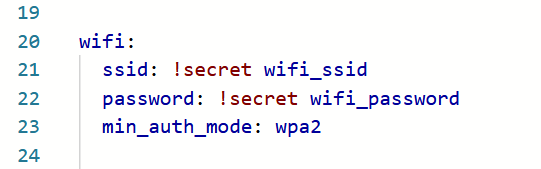
wifi:
  ssid: !secret wifi_ssid
  password: !secret wifi_password

  # Enable fallback hotspot (captive portal) in case wifi connection fails
  ap:
    ssid: "esphome-smartplug"
    password: $fallbackpassword

captive_portal:

The logger means that the device will keep logs. It’s up to you whether you keep this in, but as I was coming up with this myself, I decided it would be best to help debugging.

Because I’ll be using this smart plug with Home Assistant, we need to include the ‘api:‘ section. Again, the ESPHome device builder should have filled out an API key here.

The ‘ota:‘ section allows for ‘over the air’ updates. This means that your device can update to new versions of ESPHome without needing to be plugged in to a device, either over USB or a UART connection.

In the ‘wifi:‘ section, this includes references to the ESPHome Device Builder’s secrets file which should have your Wi-Fi network SSID and password. If the smart plug can’t connect using these details, then, as a fallback, it’ll create its own access point. This is where we also need the ‘captive_portal:‘ section, which allows the user to select a Wi-fi network if the one we’ve pre-programmed can’t be found.

Web server

Next, we have this section:

web_server:
  port: 80

This is optional, but it creates a Tasmota-like web app that you can connect to. This will allow you to press the button on the smart plug, view the logs, and upload firmware. We don’t need it, but it partially replicates the functionality of the previous Tasmota firmware, and helps with debugging.

Binary sensor

This is the section that enables the hardware button on the smart plug to work:

binary_sensor:
  - platform: gpio
    pin:
      number: GPIO13
      mode: INPUT_PULLUP
      inverted: True
    use_interrupt: True
    name: "Power Button"
    id: "smartplug_button"
    on_press:
      - switch.toggle: "smartplug_relay"
    disabled_by_default: True

We’re telling ESPHome that the button is attached to GPIO pin 13, and, when the button is pressed, to toggle the relay on or off. I’ve also added the ‘disabled_by_default: True‘ line so that it doesn’t show in Home Assistant.

Switch

Now, we need to configure the relay, and make it available to Home Assistant:

switch:
  - platform: gpio
    name: "Switch"
    id: "smartplug_relay"
    pin: GPIO5
    on_turn_on:
      - output.turn_on: led
    on_turn_off:
      - output.turn_off: led
    restore_mode: RESTORE_DEFAULT_ON

So, we’re telling Home Assistant that the relay is connected to GPIO pin 5. We’re also telling it to turn on the LED when the relay is turned on, and off again when it’s turned off. The ‘restore_mode: RESTORE_DEFAULT_ON‘ tells ESPHome what to do when the device boots up, perhaps after a power cut. I’ve set it to try to restore the status that it had before, but if it can’t, to turn the relay on.

LED

Here’s our final block, to tell ESPHome that there’s an LED

output:
  - platform: gpio
    pin: GPIO4
    inverted: true
    id: led

Again, we tell ESPHome that it’s connected to GPIO pin 4. The YAML code in the Switch section tells ESPHome when to turn the LED on or off.

So, now we have a YAML configuration file. This should be added as a new device in the ESPHome Device Builder.

The flashing process

The good news is that switching from Tasmota to ESPHome is easier than from the original Tuya firmware. You probably won’t have to get out a UART converter and cables, unless you accidentally brick your device. Instead, you just need to follow these instructions, which involve manually downloading the firmware binary, and then uploading it to Tasmota. When the device restarts, it’ll be running ESPHome instead.

Regenerative braking in electric cars

My Nissan Leaf dashboard showing that it has regenerated enough energy through regenerative braking to add three miles to the range

One of the benefits of most electric cars (and many hybrid cars) is regenerative braking – recovering the energy created from braking to charge the battery. It’s something that most petrol and diesel cars can’t do, and it allows electric cars to extend their range slightly.

Regenerative braking is something that electric trains have done for many years (indeed most electric passenger trains in the UK have regenerative braking), but it’s something that is probably new to car owners.

The first law of thermodynamics

If you’ve studied physics, you may be familiar with the first law of thermodynamics. This law dictates that energy can’t be destroyed and it can only be changed from one form to another. When you press the brake pedal to slow your car down, the energy from the brake force has to go somewhere.

On a internal combustion engine (ICE) car powered by petrol or diesel, your car will slow down by the friction created when your brake pads are pressed against your brake discs. The energy is therefore wasted as heat, and braking gradually wears your brake pads down over time.

Electric cars brake slightly differently. They still have brake discs and brake pads, but when you want to brake, the electric motor can work in reverse. The resultant kinetic energy can then be converted into electrical energy that is fed back into the battery, rather than being wasted as heat. From what I understand, this is done using magnets; if you think back to GCSE Science, you’ll remember that a magnet, combined with motion, produces electricity.

Additional range

That additional energy flowing back into the battery can therefore extend the range that your car can achieve on a full charge. We’ve actually noticed the charge level go up whilst driving downhill. An example is when we’re heading home from Manchester; to reach Sowerby Bridge, we exit the M62 at its summit point which is 372 metres above sea level, and descend around 300 metres. Typically, the charge goes up around 2% over the 8 miles from the M62 to Sowerby Bridge.

One thing to note is that your battery needs some capacity to accept the extra charge from regenerative braking. Therefore, if your car is 100% charged, there won’t be any regenerative charge. On our car, regenerative braking is limited above 80% charge.

Overall, depending on the types of roads, regenerative braking tends to add between 5 and 10% more range, which equates to between 7 and 14 miles. As well as allowing you to drive further on a full charge, it also saves a bit of money.

Reduced brake wear

Because you’re using the car’s electric motor to slow down, you should also find that your car’s brake pads and brake discs suffer less wear and tear. Again, this will save you money, as the discs and pads won’t need replacing as often as they would in an ICE car. It also reduces your car’s emissions; not only do electric cars not have any tailpipe emissions, but the particulate emissions from your brakes is also reduced compared to an equivalent ICE car.

How much regenerative braking your car will do, will depend on its mode. On our Nissan Leaf, in standard and eco driving modes, it will do a moderate amount of regenerative braking. But if we pop it into e-pedal mode, which is its one-pedal driving feature, the motor brakes more aggressively to regenerate more energy. We tend to keep it in e-pedal mode almost all of the time, although it’s of less use on motorways, for example.

Regenerative braking is a nice bonus feature of electric cars, and helps them be more efficient. It also adds to their lower maintenance costs, through lower brake wear. It’s certainly something to consider when weighing up whether to buy an electric or hybrid car.

Bowland Wild Boar and Animal Park

A photo of some wild boar at the Bowland Wild Boar Park

We’re finally at the end of the list of the things we did over the summer. And yes, I’m aware that it is now October and the weather is distinctly un-summery. On the August Bank Holiday Monday, we went to the Bowland Wild Boar and Animal Park, which is in the Forest of Bowland Natural Landscape in North Lancashire.

The Bowland Wild Boar Park is an open farm, and one of many across the UK that doubles as a visitor attraction. However, as the name suggests, it’s also home to a herd of wild boar, who have a large paddock to roam around in. Indeed, the photo at the top of this post was about the best shot as I could manage on the day. Besides the wild boar, there are also emus, goats, llamas, alpacas, peacocks, geese, hens, owls, deer, pigs, donkeys, ducks, and the ubiquitous meerkats.

It’s quite a large site, with the animals having plenty of space. You can also buy bags of animal feed, to give to (some of) the animals, and there’s a playground, cafĂ© and ice cream shop. If you’re able to stay for a whole day, then there are walks around the site that you can go on, but we mainly stayed around where the animals were. On the day we visited, there was an excellent food truck visiting, so I can’t comment on the food at the cafĂ©.

Geese and goats at the Bowland Wild Boar Park

Accessibility

If this all sounds great, just be aware that the park has limited opening outside of the summer peak, so don’t head off there this weekend. It’s open throughout the forthcoming October half term, with Halloween themed activities (Saturday 25th October to Sunday 2nd November), but not until then. After that, you’ll need to check the web site as it’s often only open at weekends or for special events. I gather that the site doesn’t have mains electricity, and so it’s reliant on a couple of massive free-standing solar panel arrays and generators.

The site is on a slope, and there’s a lot of uneven ground. However, you can rent a rugged mobility scooter in advance if needed.

We drove there, taking a rather scenic route across the top of the Calder Valley avoiding Todmorden, and then through some of the more well-to-do villages near Clitheroe. If you don’t have a car, then there are hourly buses from Clitheroe (which is the nearest railway station with trains from Manchester and Bolton) that take you to the village of Chipping, where it is then a 3-4 mile walk. Maybe bring a bike.

Unblogged September

A depiction of the Cheshire cat on the roof of Trinity Leeds

Considering that I still haven’t written about everything we did in July and August (there’s one more blog post to follow on Thursday), then surely there’s lots more to come from what we did in September. Right?

Well, we did do quite a few things this month, but not all of them merited blogging about on their own. Diamond Geezer normally writes a summary of unblogged things each month (here’s his from August) and whilst I won’t be writing a day-by-day summary, here are some of the things we did:

Trips to Manchester

I went to Manchester twice this month. The first was for a birthday meal for Christine, and also a shopping trip. We naturally went to Afflecks, which is an indoor market focussed on alternative lifestyles and has many small businesses selling clothes, jewellery and music. It’s in an old department store which closed in the 1970s after being taken over by Debenhams (who already had a larger store nearby). It’s operated in its current format since 1982, and is a very quirky place.

My second trip was for work, attending a training session about international qualifications delivered by UK ENIC. That was held at the University of Manchester.

Trip to Leeds

We also had a shopping trip to Leeds, which also doubled up as a second birthday meal for Christine, this time with my parents. This was at Bibi’s Italianissimo, which is a huge art deco restaurant near the station. Bibi’s has been in Leeds for years and retains a reasonably good reputation for food and hospitality – especially for families.

We also went into the Corn Exchange, which is similar in some respects to Afflecks in Manchester as it’s also home to many smaller shops – a couple of which are also in Afflecks. Architecturally, the Corn Exchange is far more interesting, being as it is circular with a huge glass domed roof over the central atrium inside. It’s unsurprisingly Grade I listed.

Back to school

Our nine-year-old is back at school, and started year five – their penultimate year at primary school. Next year, we’ll need to start looking at secondary schools.

Getting cold

This time of year is when we see how long we can hold out before turning the heating on. Which turned out to be Tuesday 16th September, after a run of cold days. It warmed up again afterwards, and so the thermostat didn’t come on until it turned cold again last weekend. Normally, the heating stays on until early May.

Speaking of heating, I’ve had major issues with my Nest thermostat recently with it refusing to work with either the Google Home app or Home Assistant. Ultimately, I had to completely remove it from both, and then re-add it, to get it working again. Which is a faff because the Nest integration in Home Assistant is one of the most difficult to set up, and it’s actually gotten worse since last time as you now have to create a Pub/Sub topic too. I’m pleased that it’s working again, but you can tell Google are phasing out their Nest thermostats in Europe. It will certainly get replaced with a different system, as and when we’re ready to replace our gas boiler with a heat pump.